A gas sedan won’t crank in an Anaheim lot off Katella. You pull up in a Tesla and reach for jumper cables. That favor can flatten the 12-volt your Tesla already leans on. Then both of you sit there.
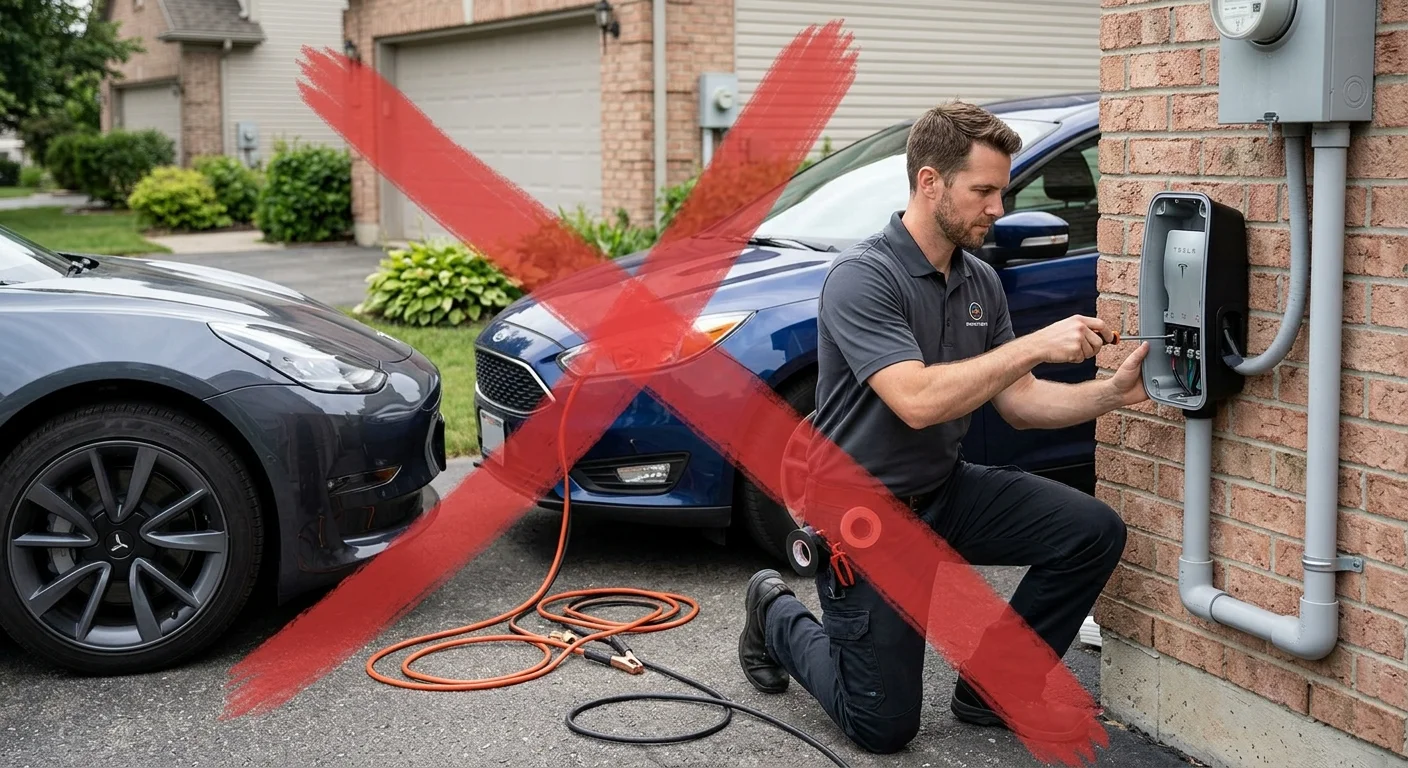
Orange County lots already work that 12-volt hard
Teslas are common here, not rare. The California Energy Commission counted 138,121 Teslas on Orange County roads as of December 31, 2025. That’s 65.51% of the county’s 210,842 battery-electric cars. California’s Tesla share of BEVs is 61.34%. This county sits 6.4 points more Tesla-heavy than the state. Orange County holds 12.02% of California’s battery-electric vehicles. It’s only 8.33% of the state’s light-duty fleet.
Gasoline cars still fill the same lots. The same CEC file lists 1,996,523 gasoline light-duty vehicles in Orange County. Battery-electric cars are 8.54% of Orange County’s light-duty fleet. ZEVs as a group are 10.56%. A dead sedan next to a Model Y is a normal afternoon. You’re still surrounded by gasoline cars that want a jump.
Those Teslas sit with accessories drawing. Climate while you shop. Sentry while the car waits. Phones on the pad. The high-voltage pack is asleep. The small 12-volt is the one doing the work. Anaheim parking near the Lincoln and Katella Superchargers sees that sit all week. Tustin lots around the Franklin Avenue Supercharger see it too. So does Huntington Beach parking near Warner Avenue.
A 12-volt that’s already sagging is a poor donor. Clip it to a gasoline starter. You can take your own car down with it.
That battery was never a jump pack
Every Tesla still carries a low-voltage battery. It wakes screens, locks, lights, and the contactors that connect the big pack. It isn’t a spare cranking battery with extra amps sitting unused.
A gasoline starter pulls a short, heavy spike. The gas car’s 12-volt and alternator are built for that spike. A Tesla keeps its 12-volt topped by a DC-to-DC converter. That converter draws from the high-voltage pack. It’s sized to run Tesla electronics. It isn’t sized to spin someone else’s engine.
You can often receive a jump when your own 12-volt is dead. Tesla documents that recovery path by model. Giving a jump is the reverse job. Hardware built to take a boost isn’t built to source a cranking spike. The receive-side steps live in Tesla won’t crank: jump-start steps for Model 3, Y, S, and X. The give side is how two cars end up dark.
How a courtesy jump strands both of you
Clamp on, and the dead gas battery looks like a hungry load. Current leaves your Tesla’s 12-volt first. If that pack was already low from a long sit, voltage can drop. Your contactors can open. Now the Tesla won’t wake. The gas car still won’t crank.
Parts can fail on that path. A fuse can open. The converter can trip or quit. Modules on that bus can glitch. No verified repair price turned up in the county files we used. We won’t invent one. The lot outcome is plain enough. You may need a 12-volt jump of your own before anyone leaves.
That’s the core of the risks of using a Tesla to jump start a gas car. You’re pulling from a battery that already kept the car alive through a long park. Mixed lots are the rule in this county.
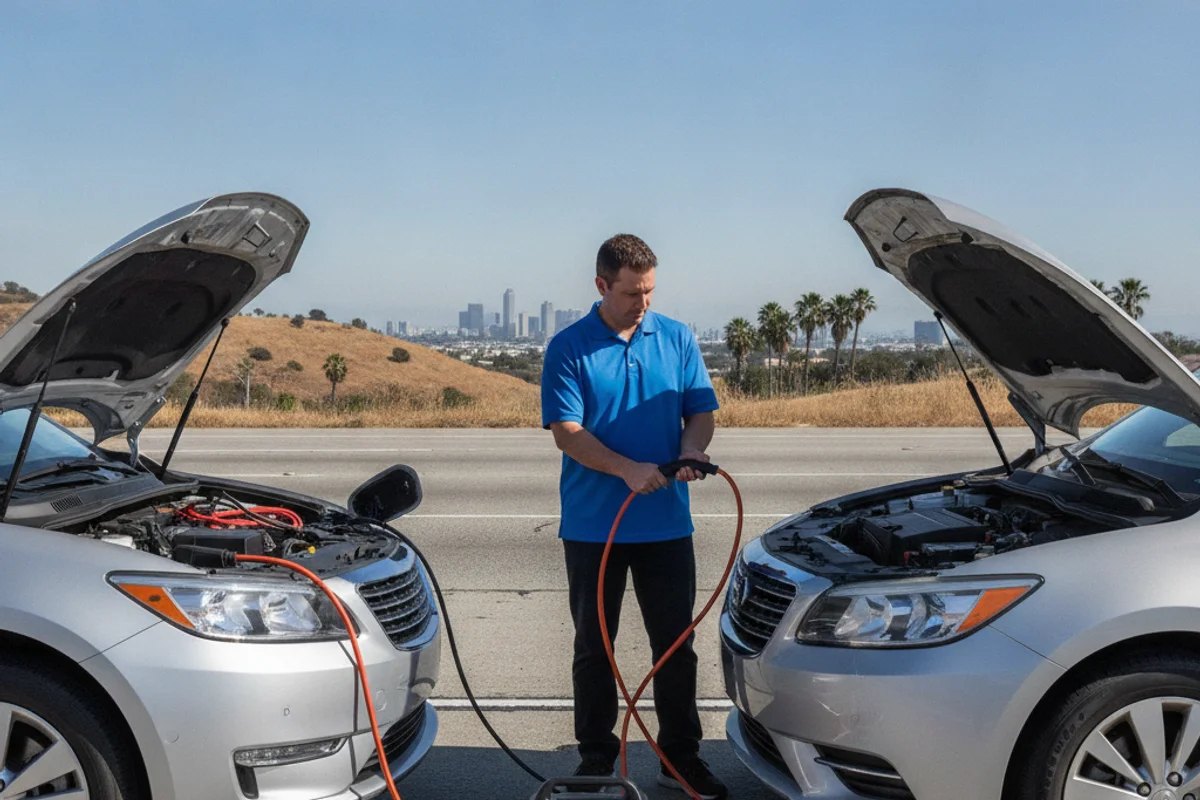
Tesla tells you how to take a jump, not how to give one
Tesla publishes 12-volt jump procedures for when the Tesla is the dead car. Those steps exist because a flat 12-volt can lock you out. That can happen with range still on the pack. Tesla doesn’t publish a donor procedure for a gasoline engine. If your manual is silent on giving a jump, treat that silence as the limit.
The Model Y owner’s manual also notes a related 12-volt fact. Once the high-voltage pack is exhausted, the low-voltage battery can lose support. It then needs an external supply before the pack can charge. Jumping a gas car doesn’t add range. It only stresses the small battery.
For warranty language after a failed donor jump, read the booklet that came with your car. We can’t confirm a denial or a payout. We don’t have those Tesla claim documents on file here. Start with your model’s manual. Then ask Tesla Service if a part actually failed.
Help the gas car without using your Tesla
A portable lithium jump pack is built to crank a gas engine. It never touches your Tesla’s 12-volt. If you regularly park next to friends in gasoline cars, keep one in the frunk.
If another gas car is in the lot, that’s the usual donor. Positive to positive. Then the negative on the dead car to a clean ground. That’s their sequence to get right.
Their insurer or club plan can send a pack for a gasoline no-start. You don’t have to be the power source.
If the dead car is the Tesla, that’s a different job. A 12-volt that won’t wake after a long sit is a common Orange County stranding. Independent operators we connect you with can jump or replace that 12-volt on site. They quote before they start. They bill you directly. Details are in Tesla 12V battery failure: when it strands you, and what follows and our Tesla 12V battery jump page.
A Supercharger won’t crank a gas car, or a dead 12-volt
Orange County has 48 Tesla Supercharger sites and 861 DC fast ports. That’s from U.S. Department of Energy Alternative Fuels Data Center records. The filter is public Tesla DC fast sites inside the county boundary. Irvine’s 1920 Main Street site lists 40 stalls. San Clemente’s 101 W Avenida Vista Hermosa site lists 49. Garden Grove’s Harbor Boulevard site lists 32. Anaheim has Superchargers on Lincoln, Katella, Euclid, Imperial Highway, and Santa Ana Canyon Road. Those stalls feed the high-voltage pack.
They won’t spin a gasoline starter. They also won’t wake a Tesla whose 12-volt has collapsed. Dark screens and sticky doors are a low-voltage problem. Driving toward EV charging in Anaheim is the wrong first move if the car won’t power up. Get the 12-volt back first.
Costa Mesa adds Superchargers on Bristol Street, Coast Drive, and Hyland Avenue. Buena Park has stalls on Beach Boulevard and Knott Avenue. Santa Ana has them on 17th Street and 5th Street. Fullerton has Superchargers on Harbor Boulevard and Orangethorpe Avenue. Plenty of places to add range once the car can actually drive. None of them replace a jump pack for a gasoline starter.
For the longer explainer on EVs as donors, see Can an EV jump-start a gas car? The honest answer and Can a Tesla jump-start another car? Why that usually fails.
If you already clipped the cables
Stay with the cars. Hazards on if you’re in a travel lane. Stop clamping and unclamping. If your Tesla now shows a low-voltage warning, treat it as a 12-volt failure. Same if it won’t power up. That sequence is in When the 12-volt dies, why the EV looks completely dead.
Charge Pro OC is a referral line for Orange County. We don’t own trucks, and we don’t do the work. We match stranded EV drivers with independent mobile operators. The operators we connect you with are licensed and insured. Those operators can jump or replace a dead 12-volt. They handle Tesla and other major EV brands. If the pack is empty, they bring a 240-volt Level 2 source. That typically adds 10 to 20 miles of range. The charging window is 15 to 30 minutes. That’s charging time, never an arrival time. The operator quotes you before starting and bills you directly. Call (949) 444-0151 when you need that match.
Why can a Tesla jump leave both cars stuck?
The gas starter pulls a heavy spike from your Tesla’s small 12-volt. If that battery was already tired from a long Orange County sit, voltage can sag. Your own car can drop offline. The gas car may still be dead. That’s two strandings from one set of cables.
Does Tesla’s manual say I can jump a gas car?
The manuals we can point to explain how to receive a 12-volt jump. They don’t lay out a donor procedure for a gasoline engine. Read the booklet for your model and year. Silence on giving a jump is the practical no.
What should I use instead of my Tesla?
Use a portable jump pack, another gas car, or the other driver’s roadside plan. Keep your Tesla out of the circuit. If your Tesla’s 12-volt is the one that’s dead, ask for an EV 12-volt jump. Don’t borrow from a friend in a gasoline car.