A dead gas car on an Orange County shoulder still tempts EV drivers to help. Drivers still type can an EV jump start a gas car after that stall. On an Orange County shoulder, the honest answer is no. An EV isn’t a safe donor for that start. The traction pack never feeds those clamps. Only the small 12-volt battery does. It isn’t built to crank a starter.
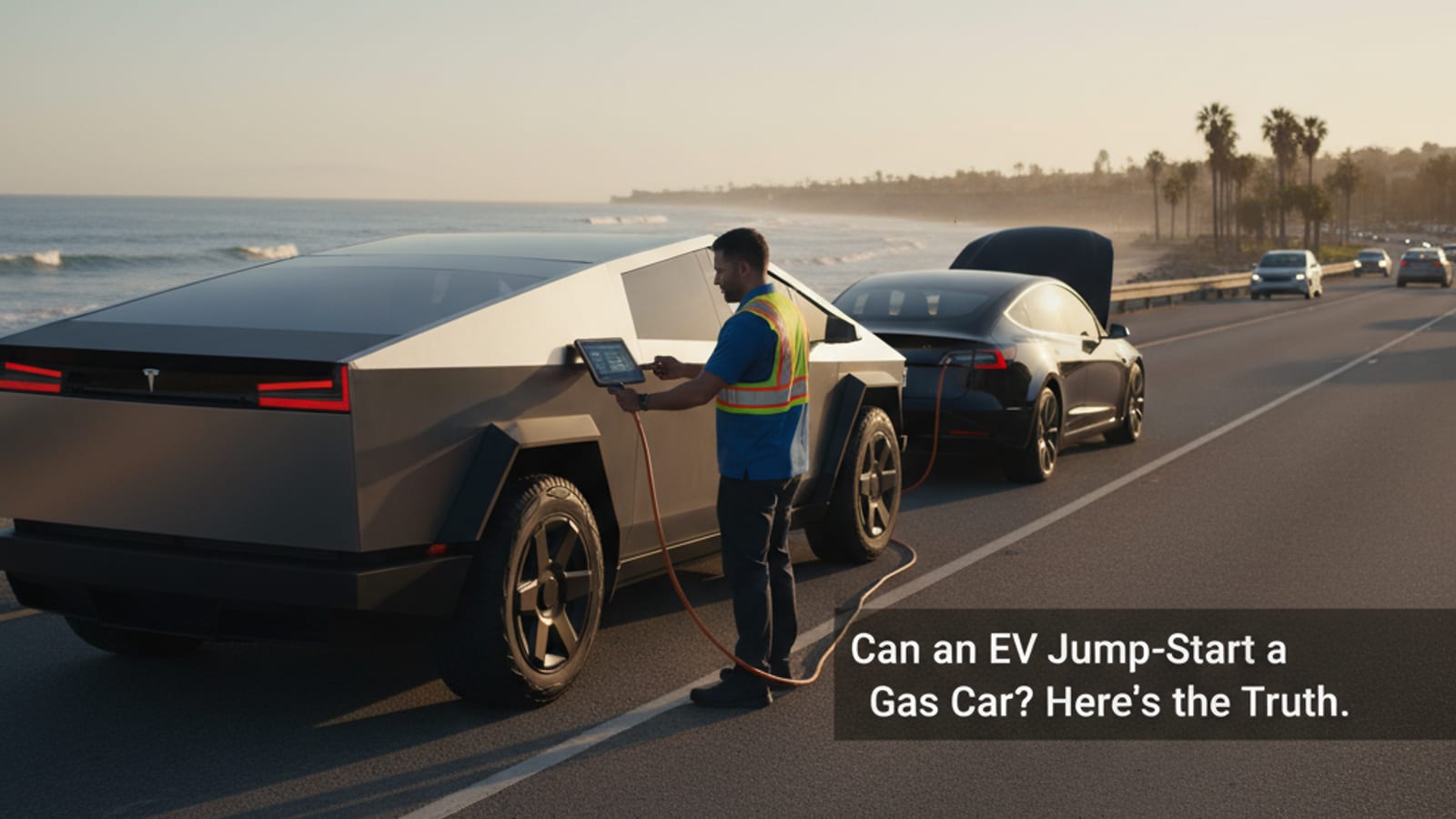
The battery that moves you isn’t in the jump
Every EV still has two electrical systems. The high-voltage pack turns the motor. A separate 12-volt battery wakes computers, lights, locks, and contactors. If that small battery is down, the car looks fully dead. The pack can still hold plenty of range. A gasoline car uses its 12-volt battery to spin a starter. Then the alternator takes over and keeps that battery charged. An EV has no starter, so that 12-volt battery only boots the car. A DC-DC converter later recharges it from the main pack. Orange County’s roads mix both powertrains every hour. The California Energy Commission counted Orange County’s BEVs as of December 31, 2025. The total was 210,842 battery-electric vehicles. Teslas were 138,121 of those BEVs. That’s 65.51 percent of the county’s electric fleet. The same file still listed 1,996,523 gasoline light-duty vehicles. A Model Y beside a dead Camry on the 91 is ordinary county traffic.
What a jump actually takes from the donor
A jump doesn’t power the gas engine. It briefly feeds the dead 12-volt battery so the starter can turn. That pulse is a hard drain on the donor. Cables make a direct path between two 12-volt systems. Positive goes to positive, and that’s the easy part. The negative clamp should land on a clean ground on the dead car. Keep it away from that car’s battery. A reversed clamp can spark and damage modules. The National Highway Traffic Safety Administration publishes jump-start safety steps. Confirm the current procedure on nhtsa.gov before anyone clips on. None of that path touches the EV’s high-voltage pack. The clamps, if they connect at all, only see the accessory 12-volt battery. That’s the mismatch most people miss on the shoulder.
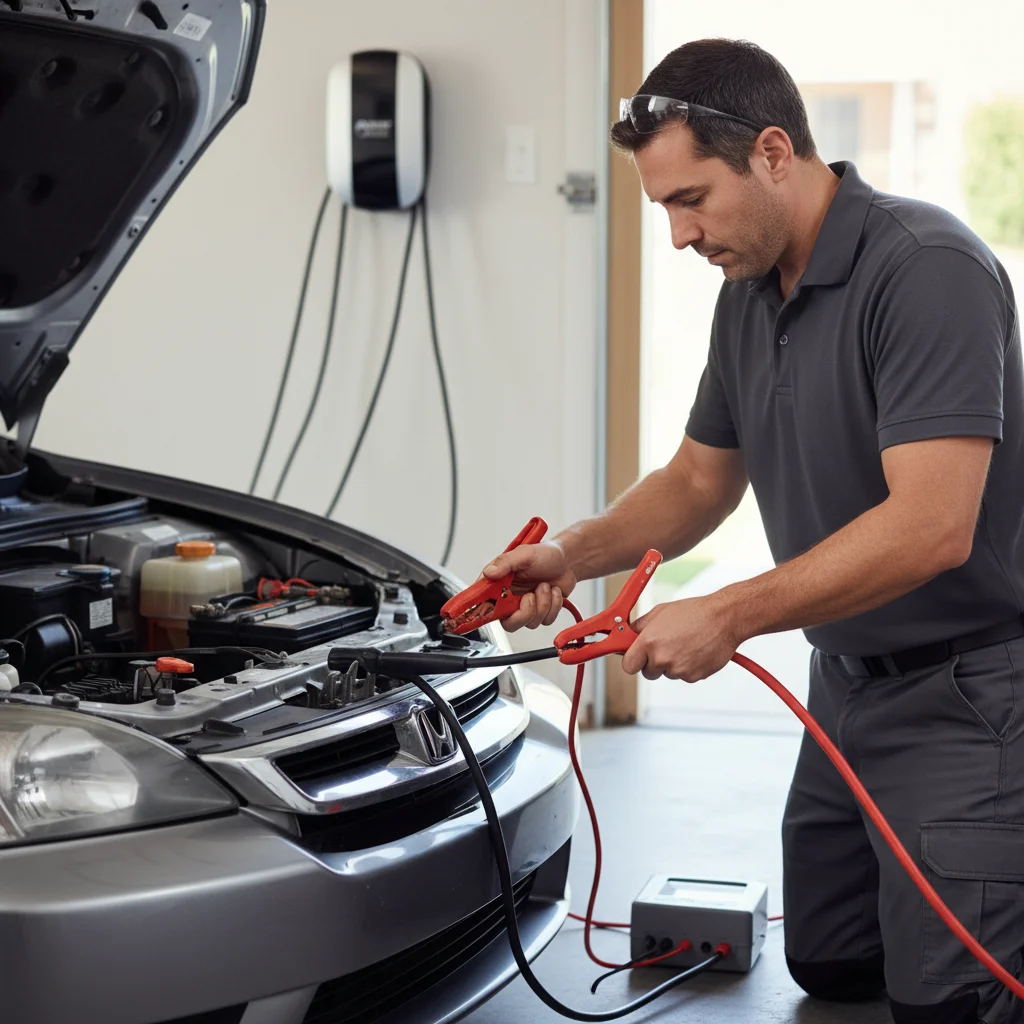
Why an OC shoulder is a bad place to try it
An EV 12-volt battery is sized for accessories and control gear. It isn’t sized for a starter. Some newer Teslas use a lithium 12-volt battery instead of lead-acid. Lithium packs can last longer and weigh less. They also open protection circuits when the current looks like a crank. Lead-acid in an EV can flatten or cook internally under the same load. Either way, you can damage the EV you meant to help with. A spike can upset the DC-DC converter. A drained 12-volt can leave your own car unable to start. Then two vehicles sit on the same shoulder. Traffic on I-405 or SR-22 doesn’t wait. Tesla’s published donor-jump rule wasn’t confirmed on tesla.com for this page. Open Tesla Support and your model’s owner’s manual before you assume it’s allowed. The usual outcome is still a no. Can a Tesla jump-start another car walks through that Tesla-specific case. Why you shouldn’t jump a gas car with a Tesla covers that same risk. If you’re already on a freeway shoulder, stay in the vehicle with hazards on. Don’t stand between bumpers in a live lane to attach cables.
Help the other driver without becoming the power source
The gas car needs a jump pack or a conventional roadside truck. Those tools are built for starter current, and your EV isn’t. You can wait with a friend, but you shouldn’t clip on. If it’s your EV that won’t start, reverse the diagnosis. A dead 12-volt on an EV looks like a brick. That’s true even when the pack still has range. That’s the EV-as-patient case, not the EV-as-donor case. How to jump start an electric car on site is the right sequence. When the 12-volt dies on the road explains why the whole car goes dark. Charge Pro OC is a referral line. It matches stranded EV drivers with independent local mobile rescue operators. The brand owns no trucks and performs no work. Operators can jump a Tesla 12-volt battery on site. They also handle every major EV brand. They quote before they start and bill you directly. They don’t use an EV to jump a gasoline car. If your own pack is low, use a public stall instead. CEC’s charger file, dated December 31, 2025, counted 7,095 public ports in Orange County. That total includes 1,475 public DC fast ports. Tesla Superchargers sit in Anaheim, Irvine, Costa Mesa, Tustin, and San Clemente. Confirm a live stall in your app. That network still doesn’t make your EV a donor.
Stay put, then call the right help
Put the hazards on and stay out of the travel lane. On I-5, I-405, the 91, or SR-22, stay in the car. If you call CHP, say you have an EV and a dead gas car. That stops a two-car jump from being the default plan. Don’t clip cables from the EV. Let the gas car get its own jump. If your EV also won’t start, treat it as a 12-volt or empty-pack problem. Roadside help can jump an EV’s 12-volt. It can’t jump the high-voltage pack. For an empty pack, operators bring a 240-volt Level 2 source to the car. Native NACS for Tesla, CCS or J1772 adapters for other brands. Operators typically add 10 to 20 miles of range. That takes 15 to 30 minutes of charging, not travel. That’s charging time, never an arrival time. Call (949) 444-0151 to match an Orange County EV with a local operator. Ask what they’ll do before they roll. The operator sets the quote, and Charge Pro OC doesn’t.