A Tesla can sit for days in an airport long-term lot. You walk back with the bags and the car stays dark. Handles don’t pop, the screen never wakes, and the phone key does nothing. That’s tesla 12v battery failure, not a ruined drive pack. The high-voltage battery can still hold plenty of range. The 12-volt pack that runs the computers went flat while it sat.
Why this stranding shows up after OC airport parking
Orange County has a lot of Teslas parked between trips. The California Energy Commission counted 210,842 battery-electric cars here on December 31, 2025. Teslas were 138,121 of those BEVs, or 65.51%. Statewide, Tesla was 61.34% of BEVs. Orange County is 6.4 points more Tesla-heavy than California as a whole. A dead 12-volt pack is a normal Tesla fault. In this county it’s also a common lot problem.
Airport parking around Costa Mesa, Tustin, and MacArthur Boulevard is a long sit. The car is off and it should sleep. A tired 12-volt pack still slowly drains. Older Model S and Model X cars use a lead-acid 12-volt battery. Those packs dislike sitting unused between flights. Newer Model 3 and Model Y cars often use a lithium 12-volt pack. Lithium rests better, but it’s not magic. If the car stayed awake in the lot, that small pack can still empty.
Tesla service sits in Costa Mesa, Buena Park, Santa Ana, Irvine, Anaheim, and Aliso Viejo. Costa Mesa sits in the same corridor as those airport lots.
What the 12-volt pack does in a Tesla
A gas car uses 12 volts to crank a starter. A Tesla has no starter. The 12-volt circuit still runs the first things you touch.
It powers door-handle motors, including Model S pop-out handles. It powers the trunk and frunk latches. It powers the display and the car’s network modules. It also powers the battery-management relay. That relay lets the high-voltage pack feed the motors.
If the 12-volt pack is flat, the relay stays open. The drive pack can still be sitting on a long trip’s charge. The car still won’t unlock, light up, or roll. That’s why tesla 12v battery failure looks like a total loss. It usually isn’t.
Tesla’s Model Y owner’s manual describes a related trap. Once driving range is gone, the low-voltage battery can lose support. The car then needs an outside 12-volt source before the high-voltage pack will charge. A dark airport car can be a flat 12-volt pack or an empty drive pack. See how to tell a dead pack from a dead 12-volt.
How the failure usually presents
Sometimes you get a warning in time. The Tesla app can ping “12V battery low.” The car may still drive home, then fail after another long sit. Tesla hasn’t published a public hour-by-hour countdown we could confirm. Get the pack tested or replaced before the next airport trip.
Sometimes you catch nothing. You return to a brick. Model S handles stay flush. The app shows the car offline. A knock on the glass does nothing. People assume the drive pack failed. A 12-volt jump at Tesla’s jump port is the check that sorts it.
What to do in the lot before you call a tow
Stay with the car if you can. Confirm whether it’s fully dark, or awake with a range number. A tow from a long-term structure is a last move on an EV. You want the car to wake first.
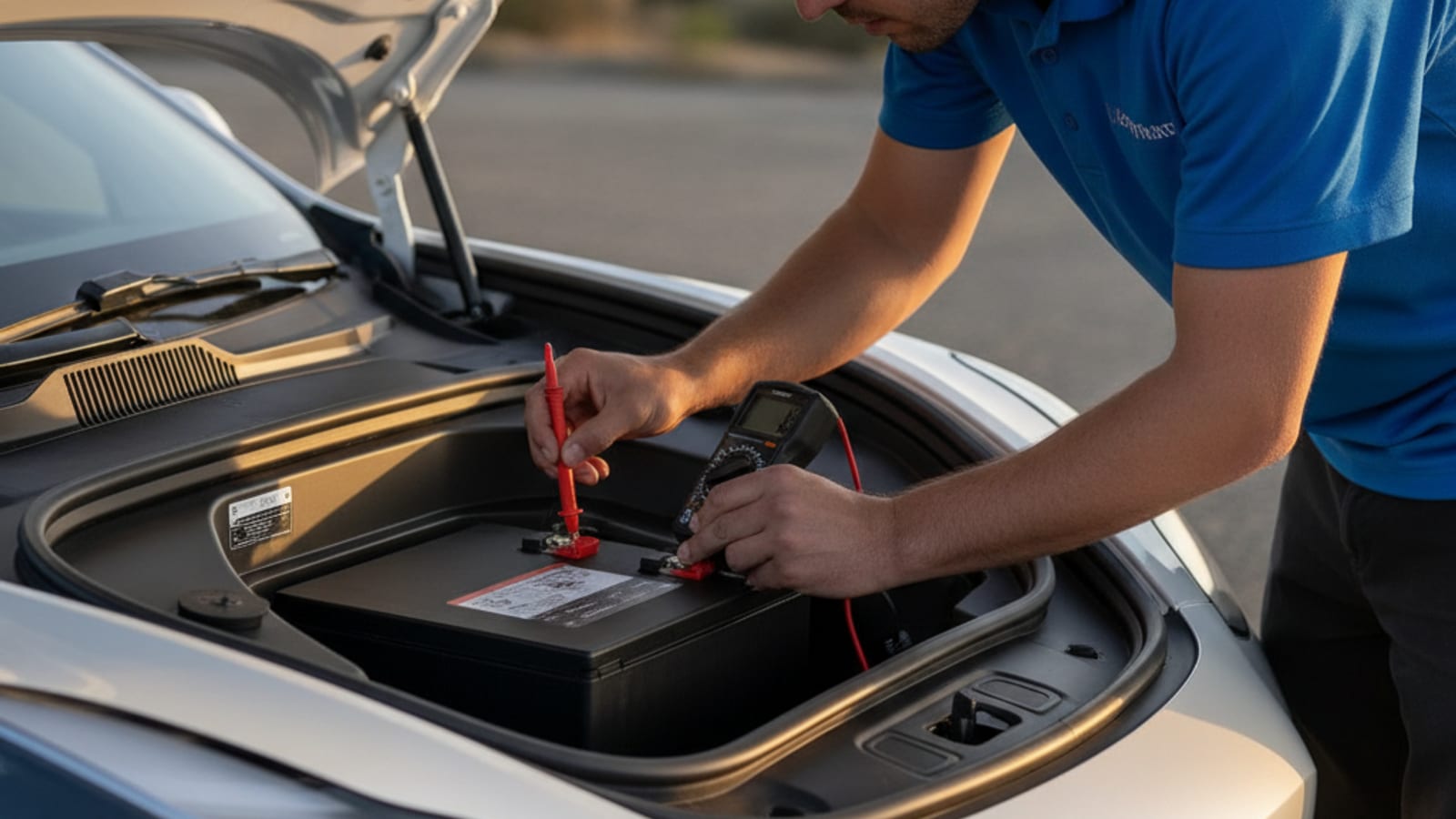
Tesla puts a 12-volt jump point on most models. On Model S and Model X, it sits in the front trunk near the firewall. On Model 3 and Model Y, it’s under the hood, front right. Use that port. Don’t clamp the charge port. Don’t feed another car’s traction battery from yours.
A standard jump pack on those 12-volt terminals will often wake the screens. Doors unlock and the app comes back. That jump is a test, not a repair. If the 12-volt pack failed, the car can go dark again once you disconnect. Jump-start steps for Model 3, Y, S, and X map those ports. If you can’t open the hood or frunk, don’t force latches. Wait for someone who does this work.
If the display comes up with a healthy drive-pack percent, the 12-volt side failed. The big battery didn’t. If it comes up at zero range, the drive pack is empty too. Tesla can arrange help for a depleted charge, but it’s not a financially covered service. Confirm that on Tesla’s roadside-assistance page before you assume coverage. Tesla Roadside Assistance is 877-798-3752, posted on the Santa Ana service listing. Ask Tesla in the app what they’ll actually send.
After the car wakes: replacement, a stall, or an on-site operator
A weak 12-volt pack can die again in the same lot. Waking the car is step one.
If you can drive, a Supercharger is useful only after the car will move. Tustin has a Tesla Supercharger at 1705 Flight Way. AFDC lists 7 stalls there at 250 kW, opened December 21, 2022. Newport Beach has one at 4241 MacArthur Blvd. AFDC lists 12 stalls there at 250 kW, opened June 22, 2023. Costa Mesa Superchargers sit at 1400 Bristol St, 1475 S Coast Dr, and 3303 Hyland Ave. Check the Tesla app before you roll. A listed stall can still be occupied.
Tesla service-center street addresses should be checked on Tesla’s find-us pages. This research couldn’t fetch those pages directly, so they aren’t reprinted here. Ask Tesla for the current appointment slot on your VIN.
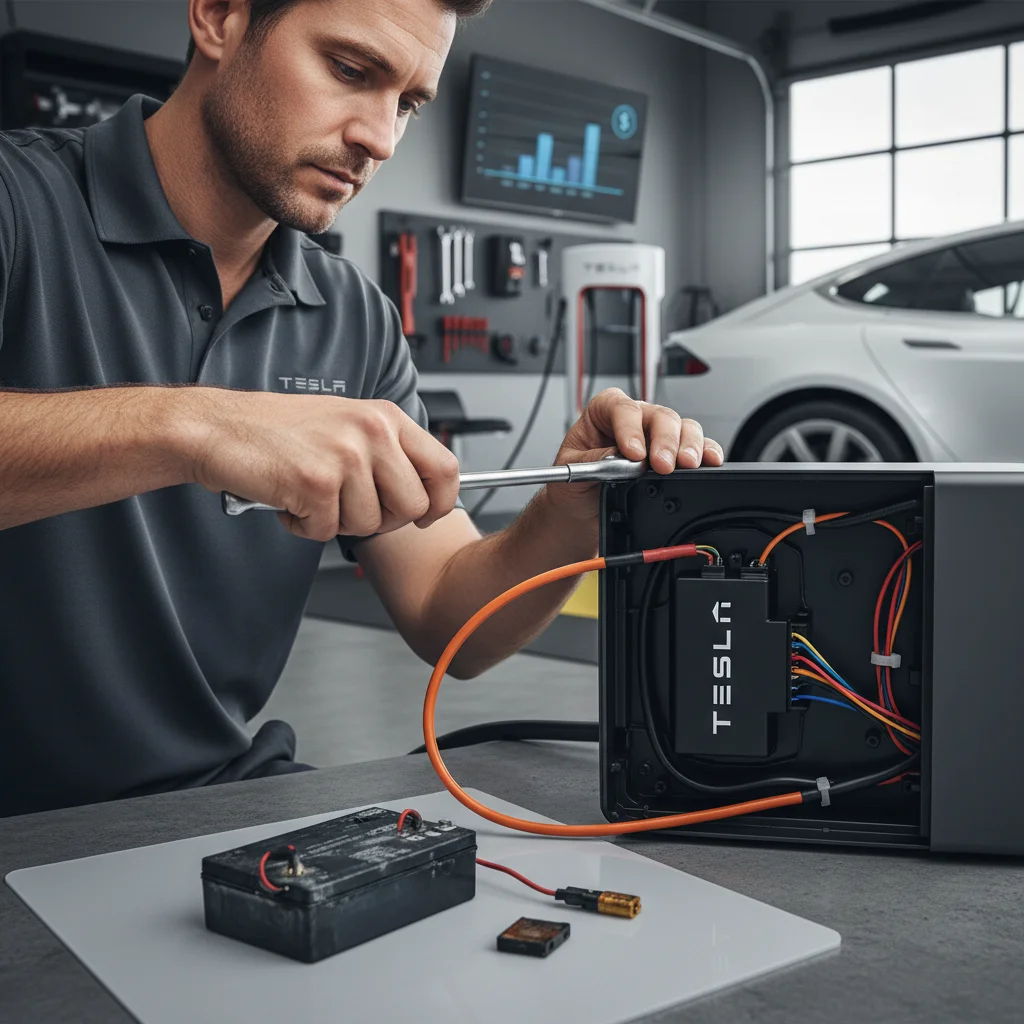
If the car won’t hold 12-volt power to a stall, stop hunting plugs. The Costa Mesa airport-lot rescue path is for that exact sit. Charge Pro OC is a referral line. It matches you with an independent local operator. The pros we send can jump or replace that 12-volt pack on site. The operator quotes you before work starts and bills you directly. Charge Pro OC owns no trucks and employs no technicians.
Replacement prices aren’t a verified public number for Orange County. Tesla doesn’t post a countywide 12-volt menu we could confirm. Skip the forum guesses and ask for a quote on your spec. Lead-acid and lithium 12-volt packs aren’t interchangeable. Which Tesla uses which 12-volt type depends on model and year. What 12-volt replacement looks like for OC owners is the sequence, not a price.
If the drive pack is also empty once the car wakes, you still need range. The same operator can bring a 240-volt Level 2 source. Teslas take a native NACS plug. Typical add is 10 to 20 miles of range. That takes 15 to 30 minutes of charging time. That’s time on the plug. It’s not an arrival time.
How this differs from a high-voltage failure
A high-voltage fault usually still powers something you can see. You may see error text on the screen. Range may drop hard. The car may enter a limited mode and still wake. A fully dark cabin, with no app and no handles, points at 12-volt power.
Don’t use the Tesla to jump a gas car. That can leave both of you stuck.
Frequently asked questions
What should I do first when the Tesla is fully dark?
Try the Tesla app and the key card once. If nothing responds, treat it as a 12-volt problem until a jump proves otherwise. Use the 12-volt jump port, not the charge port. If you can’t access the frunk or hood, call for an operator rather than forcing latches.
Will Tesla roadside fix a 12-volt pack in the airport lot?
Tesla’s published depleted-battery path is transportation, not on-site charging. Separate 12-volt dispatch language couldn’t be confirmed on a live Tesla page fetch. Call 877-798-3752 or use the app and ask what they’ll send. An independent operator can quote a jump or a 12-volt replacement at the car.
After a jump, do I still need a new 12-volt battery?
Usually yes, if the pack couldn’t hold the car awake on its own. Have the spec replaced before the next long sit. Get the quote from the operator or from Tesla service. No public installed price for Orange County could be verified.
If your Tesla is dark in a long-term lot, start with the 12-volt check. Call (949) 444-0151 to get connected with a local operator. That operator can quote a jump or a replacement at the car.