When an EV’s 12-volt battery dies, the car looks fully dead. Screens stay dark. Handles may not present. The drive pack can still hold a full charge. Tesla’s Model Y owner’s manual adds a second trap. Once range is gone, the low-voltage battery loses support. You need external power before the high-voltage pack can charge. Either failure looks the same from the driver’s seat. The next move is to tell them apart, then restore 12-volt power.
Two dead cars that aren’t the same problem
Orange County had 210,842 battery-electric cars on the road. That’s the California Energy Commission count as of December 31, 2025. Teslas were 138,121 of those. That’s 65.51% of the county’s BEV fleet. This market is more Tesla-heavy than the state. California’s Tesla share of BEVs was 61.34% on the same date. A dark Model 3 in an Orange County lot is a common scene here. Drivers usually blame the big pack. A lot of the time, the 12-volt side quit first.
The high-voltage pack moves the wheels. The 12-volt battery wakes every computer that lets that pack connect. Headlights, locks, the screen, and the contactors all run on 12 volts. No 12-volt power means those contactors stay open. The energy in the pack stays boxed in. You can’t drive. You often can’t even read the state of charge.
A second path leads to the same dark cabin. Tesla’s running-out-of-range manual entry is the one to read. After the pack is exhausted, the low-voltage battery loses support. The car then needs an external power supply. Only after that can the high-voltage battery take a charge. A zero-range Tesla and a failed 12-volt Tesla can look identical. The fix isn’t identical. If you want that split in one place, read dead Tesla: how to tell 12V failure from a dead pack.
What Tesla’s own range page is telling you
Tesla isn’t vague about this sequence. Range hits zero. The low-voltage battery stops getting support from the pack. Accessories fade. Then the car won’t take a charge until something outside feeds the 12-volt system. That’s why a Supercharger stall can sit a few rows away and still not help. The car can’t talk to the stall until the low-voltage side is alive.
Irvine’s Supercharger at 1920 Main Street has 40 DC fast stalls. San Clemente’s site at 101 W Avenida Vista Hermosa has 49. Tustin’s site at 14661 Franklin Avenue has 36. Garden Grove’s Harbor Boulevard site has 32. Those counts come from U.S. DOE and NREL AFDC station data. They’re real ports. None of them wake a Tesla that can’t close its contactors.
Tesla roadside assistance treats a depleted pack as transport, not as a covered repair. Tesla’s own page says that when charge is depleted, Tesla can assist, but this isn’t a financially covered service. The 500-mile transport Tesla describes is for a warrantable breakdown that leaves the car undrivable. An empty pack isn’t that. Tesla’s published roadside number, listed on the Santa Ana service page, is 877-798-3752. Open Tesla’s roadside page and confirm the current wording before you assume coverage.
A local operator can jump the 12-volt battery on site. The same operator can bring a 240-volt Level 2 source if the pack itself is empty. Charge Pro OC is a referral line. We match stranded drivers with independent mobile rescue operators. We don’t own trucks. We don’t employ technicians. We don’t set prices. The operator quotes you before work starts, then bills you directly.
Why the 12-volt battery still runs the show
New owners often skip this part. The big pack doesn’t run the small stuff. Climate, airbags, power steering, and the main computer all live on 12 volts. So do the contactors. Those are the heavy relays that connect the high-voltage battery to the rest of the car. Without a healthy 12-volt feed, they never close.
That’s the start in an EV. There’s no starter motor. There’s a computer that has to boot, then a relay that has to click. If the 12-volt side is flat, you get silence. A full drive pack doesn’t override that silence.
Tesla has used both lead-acid and lithium 12-volt packs across models. A county-level replacement interval isn’t a figure we can confirm from public files. If the app or the dash has been nagging you, treat that as a service item, not a maybe later.
Warnings that show up before the car goes mute
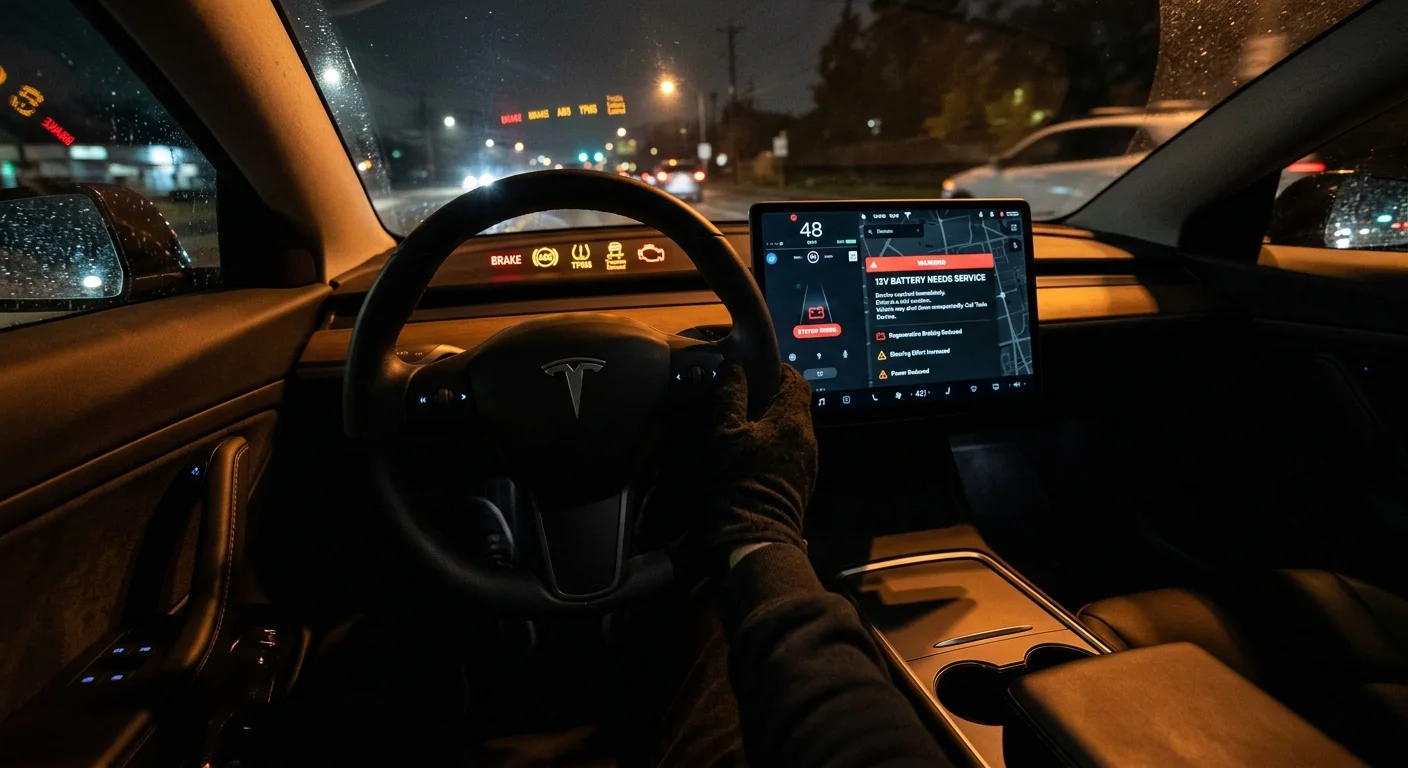
A 12-volt failure rarely starts with a clean black screen. You may see flicker on the display first. Climate may blow, then cut. Steering assist may drop. Regenerative braking warnings can pop with no other context. Random service banners stack up. Those banners don’t always name the 12-volt battery in plain words.
Then the start sequence fails. You press the brake. You wait for the ready chime. Nothing. The screen stays black, or it ghosts a dim logo. Door handles stay flush. The phone key does nothing. That’s not proof the drive pack is empty. It’s proof the low-voltage side can’t finish the wake-up. Tesla owners sometimes see a vehicle-cannot-be-driven alert. Other brands use a replace-battery message for the same class of fault.
Catch the early flicker if you can. Tesla 12V clues you can catch before a stranding walks through that window.
Locked out of a car that still has range
Many EVs hide the mechanical key. Tesla handles are electronic. They need 12-volt power to present. If that feed is gone, the fob and the phone app can both fail. You can stand next to a car you own and still be outside it.
Some models still hide a physical key. Even then, getting in may not wake the computers. Windows, latches, and the frunk release can stay dead. Jump posts are often in the frunk. If you can’t open that lid, you can’t self-rescue. That’s the lockout loop. Don’t pry a handle. Don’t force the charge port. Get 12-volt power to the car first.
What this looks like on Orange County streets
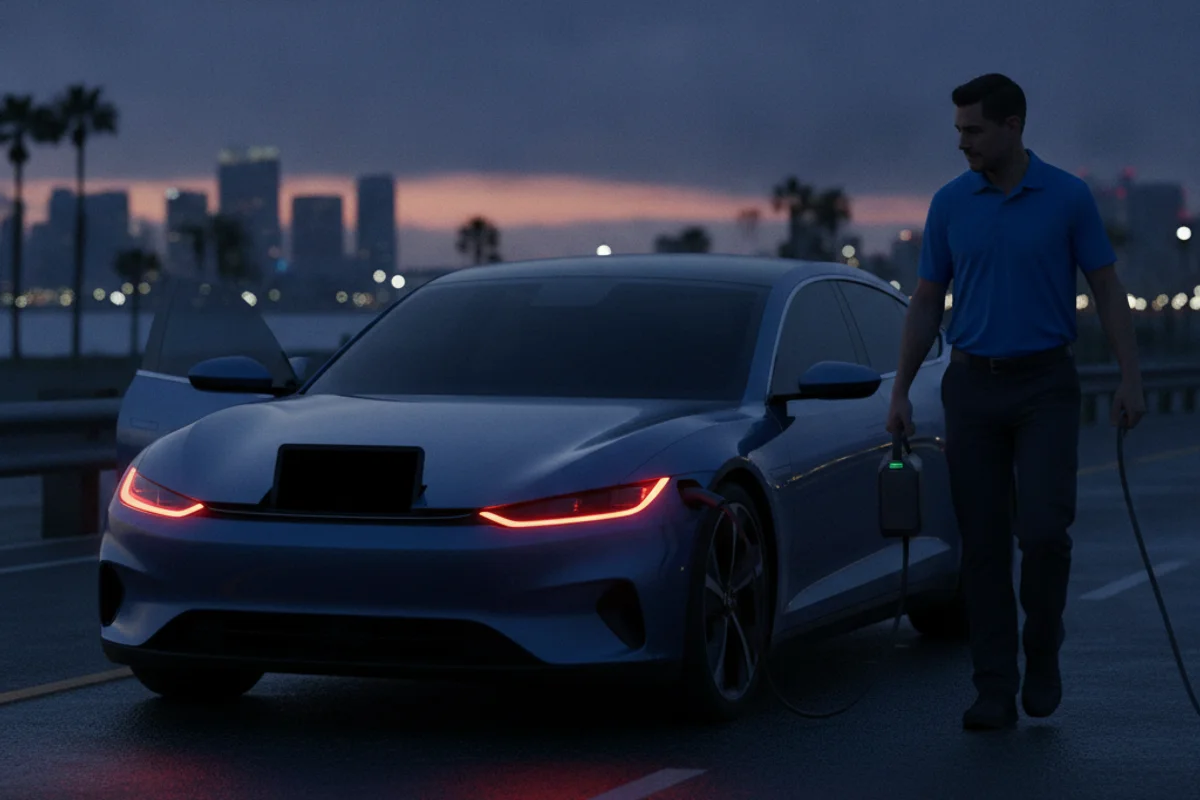
A dead 12-volt battery doesn’t care that the county has 48 Tesla Supercharger sites and 861 Tesla DC fast ports. CEC counted 7,095 public charging ports in Orange County as of December 31, 2025. That’s 36.8 ZEVs per public port, versus 24.4 statewide. Those ratios describe the network. They don’t wake a car that can’t boot. If the car can’t wake, you aren’t driving to 1920 Main Street. You’re sitting where you stopped.
Huntington Beach after a long parked day is one version of this. The pack may still have range. The 12-volt side sat in sun and accessory load and quit. Huntington Beach lot after a long day: 12V dead and no drive home covers that pattern. You can see the same dark cabin on a Santa Ana curb, or in an Anaheim lot near Lincoln Avenue. Lincoln has multiple Tesla Supercharger sites. A 16-stall site sits at 1128 W Lincoln Avenue. A 20-stall site sits at 1734 W Lincoln Avenue. A 20-stall site sits at 2270 E Lincoln Avenue. Those stalls still need a car that can talk.
The high-voltage pack is usually still fine
People fear the expensive battery first. In most 12-volt failures, the high-voltage pack is unhurt. It’s a separate system. It has its own management. The 12-volt side is the key that lets that system come online. Lose the key, and the vault stays shut. The charge inside is still there.
Once 12-volt power is restored, the car should boot. The pack should read as it did. You may see a small dip if the car tried to keep the 12-volt battery alive. That dip isn’t a ruined pack. If you were already low on range, drive to a stall after the car is awake.
The exception is Tesla’s empty-range case. There the pack really is at zero. The 12-volt battery has also lost support. You still need external 12-volt power first. Then you can charge the high-voltage battery. Jumping the 12-volt system is still the first move. Charging the pack is the second.
Wake the car without cooking the computers
The goal is modest. Feed the 12-volt system long enough for the computers to boot. Then the contactors can close. Most EVs have marked jump posts in the frunk or under the hood. The physical battery may sit elsewhere. Use the posts the maker labeled.
A portable jump pack made for vehicles is the clean tool. Connect positive to the positive post. Connect negative to a chassis ground. Wait a minute. Then try the wake sequence. Once the car is on, the DC-DC converter should start charging the 12-volt battery from the pack.
If the 12-volt battery is worn out, that charge won’t hold. The car may go dark again in the same lot. That’s when you want a Tesla 12V battery jump from an operator who carries the right pack, or a replacement on site. The walkthrough is in how to jump start an electric car without making it worse.
Don’t treat this as a must-do yourself. If handles won’t present, stop. If you can’t find the posts, stop. Call rather than prying panels.
Skip the gasoline donor car
A gasoline donor car is a poor 12-volt source for an EV. Alternators spike. Cables get connected in the wrong order. EV computers are picky about voltage. A spike can damage modules a 12-volt swap wouldn’t touch. Use a pack with a controlled output, or let a mobile operator do it.
Tesla-to-gas jumps fail in the other direction too. Why jumping a gas car with a Tesla can strand you both is the related warning. Keep the 12-volt work on the EV, with EV-safe gear.
What the operator actually brings
The operators we connect you with handle Tesla and every major EV brand. They can jump or replace a dead 12-volt battery on site. If the pack is empty, they bring a 240-volt Level 2 source. Native NACS on Teslas. CCS or J1772 adapters for everyone else. Charging time is typically 15 to 30 minutes for about 10 to 20 miles of range. That’s charging time, not a clock on arrival. We don’t publish arrival times.
Call when the cabin stays dark
If the screen is black and the handles won’t move, you’re past the guesswork. If range was already at zero, Tesla’s manual says you need external power anyway. Sitting and hoping the pack will revive the 12-volt system is the wrong wait.
Call Charge Pro OC at (949) 444-0151. We connect you with a local operator. That operator quotes before starting and bills you directly.