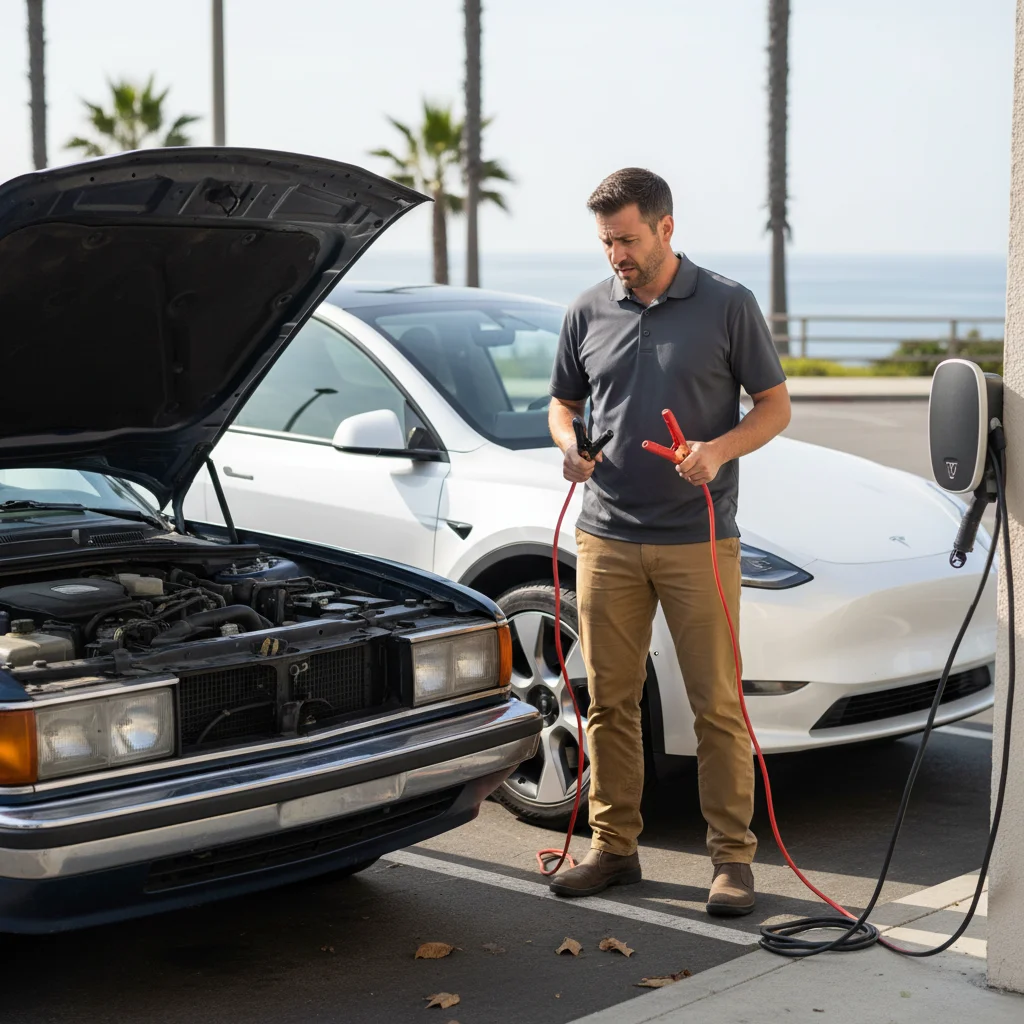
A gas car sits on the I-405 shoulder with its hood up. You’ve got jumper cables in the frunk. Your Tesla still shows range. That doesn’t make it a donor. A Tesla shouldn’t jump-start another car. A gasoline car is the worst case. The 12-volt pack can take a jump. It isn’t built to give one.
Why Orange County drivers keep reaching for the cables
Orange County is a Tesla-heavy county. It isn’t a generic EV market. The California Energy Commission counted 210,842 battery-electric cars here. That’s the on-the-road figure as of December 31, 2025. Teslas were 138,121 of those. That’s 65.51 percent of the county’s BEV fleet. It’s 5.59 percent of all light-duty vehicles. Tesla’s statewide BEV share was 61.34 percent. Orange County runs 6.4 points more Tesla-concentrated than the state.
The county holds 12.02 percent of California’s battery-electric vehicles. It makes up 8.33 percent of the state’s light-duty fleet. ZEVs overall were 260,833. That’s 10.56 percent of the local light-duty fleet.
So when a hood goes up, the nearest helper is often in a Tesla. A Model 3, Model Y, Model S, or Model X. The instinct is old and kind. Two gas cars, a set of cables, a few minutes, and everybody leaves. A Tesla still has 12-volt posts under a frunk panel. The layout looks familiar. The job behind those posts isn’t the same.
You’ll meet that mix on the 91 through North County. You’ll meet it on I-5 south of Irvine. You’ll meet it on SR-22 at the Crush. Anaheim lots produce it after a stadium or theme-park day. Huntington Beach and Newport Beach lots produce it after a long beach afternoon. Irvine and Tustin office parks produce it at night. The dead car is often gasoline. The helper is often in a Tesla. The electrical systems still don’t match.
A gas 12-volt and a Tesla 12-volt aren’t the same part
A gasoline car uses its 12-volt battery as a starter battery. It has to dump a huge pulse into a starter motor. That pulse turns a heavy engine over. Lead-acid packs in that role are built for a short, violent discharge. Then they rest while the alternator takes over.
Your Tesla never cranks an engine. There’s no starter motor to feed. The 12-volt battery wakes computers, the screen, locks, and lights. It also closes the contactors that connect the high-voltage pack to the drive unit. Older Teslas used a small lead-acid 12-volt. Newer Model 3 and Model Y cars moved to a lithium 12-volt. Neither one is a starter battery for a stranger’s Camry.
The high-voltage pack keeps the 12-volt topped off. It does that through a DC-to-DC converter. That loop is meant for a steady, low draw. It isn’t meant to be yanked backward through jumper cables.
What usually fails when you try it anyway
Clip your Tesla to a dead gas car. You’re asking that small 12-volt system to act like a starter pack. The gas car wants a cranking spike. Your Tesla can only offer a thin, protected feed.
A few things can go wrong in that moment. The DC-to-DC converter can take a reverse surge it wasn’t designed for. The Tesla’s own 12-volt battery can be stressed past a safe discharge. Voltage sag and spikes can upset the modules that run the car. You can also flatten your own 12-volt. The other car still may not start.
That last one is the shoulder version of the failure. You tried to help, and now two cars sit in live traffic. See why jumping a gas car with a Tesla can strand you both for the failure modes. The same donor problem shows up in other EVs. We cover that in can an EV jump-start a gas car.
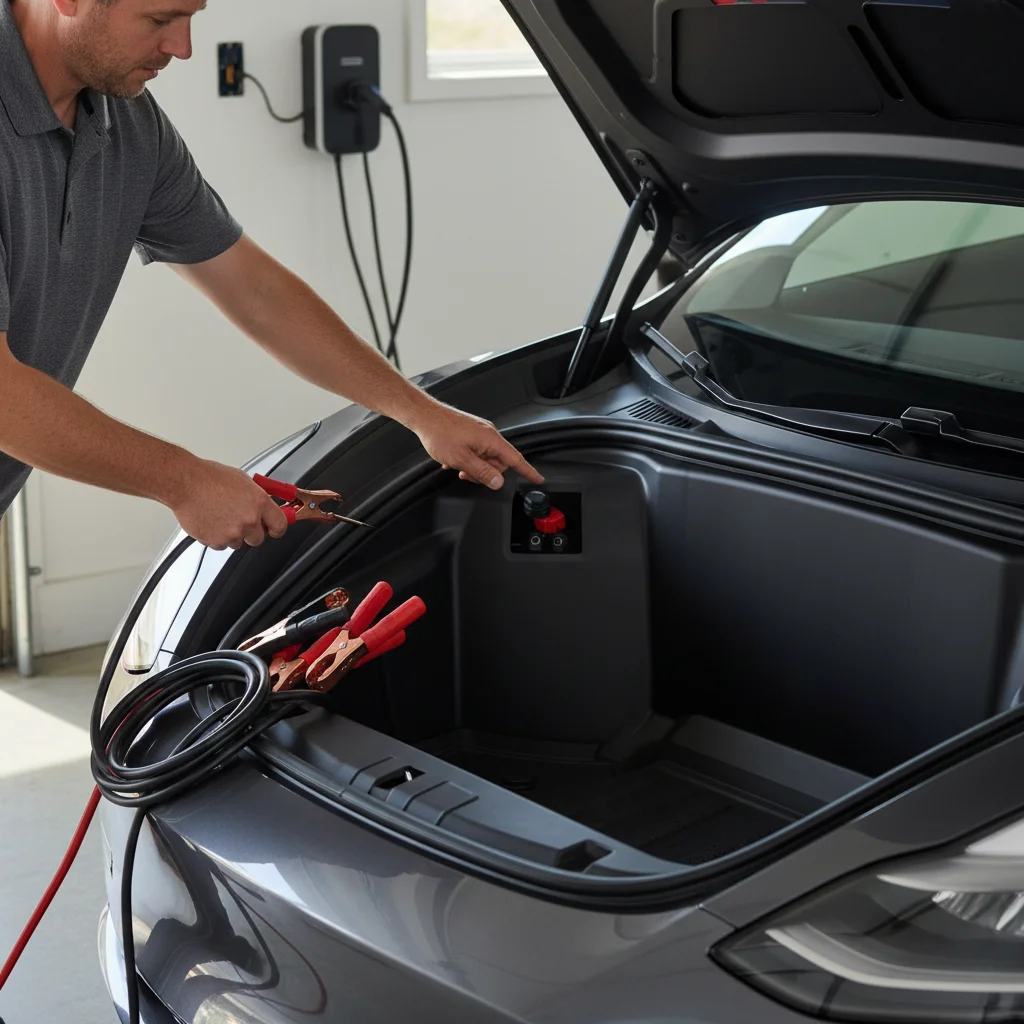
The posts in the frunk aren’t a permission slip. They exist so an external source can feed power into your Tesla. Those posts are an inbound connection only. Tesla’s owner’s manuals carry the same notice. That covers Model 3, Model Y, Model S, and Model X. Don’t jump-start another vehicle with your Tesla. Doing so can result in damage.
That’s Tesla’s published policy, not a local preference. The manuals also walk you through receiving a 12-volt jump. Those inbound steps aren’t permission to donate current. A clip that worked once in a Fullerton driveway doesn’t prove the system is safe. It only proves you got lucky that time.
An Orange County shoulder is a bad place to test a clip
Online videos make this look easy. Someone clips on, the gas car fires, and both cars leave. You don’t see the converter that failed later. You don’t see the Tesla that wouldn’t wake. The helper’s 12-volt had dipped.
On a quiet curb in Garden Grove or Westminster, a failed experiment still blocks parked cars. On the I-405 shoulder, you’re in live traffic. Same on I-5 near San Clemente. Same on the 91 in Anaheim. Santiago Canyon Road and Ortega Highway add grades and a thin shoulder. If your own car dies there, you’ve doubled the problem. Laguna Canyon Road is the same kind of bind.
Stay in the car with hazards on if you’re on a freeway. Don’t stand between bumpers with cables in your hands. A portable jump pack is the tool for a gas car, not your Tesla. If you don’t have a pack, help the other driver call their own roadside coverage. Do it from a safe spot. Offer a ride off the shoulder if that’s the safer move. Don’t become the second disabled vehicle.
If the stranded car is an EV with an empty pack, a jump won’t fill it. That’s a charging problem, not a 12-volt problem. For that scene, start with out of charge on an Orange County freeway.
What actually helps without putting your Tesla at risk
Kindness doesn’t require you to donate current. Carry a self-contained lithium jump starter if you want to help gas cars. It has its own cables, and it’s built for cranking amps. You never connect the two vehicles.
If you skipped the pack, you can still help. Walk them through a roadside call and share a pin drop. Wait nearby from a safe place until a truck is on the way. In a parking structure in Costa Mesa, a ride can matter more than a cable. Same in an office park in Tustin.
A Supercharger stall is a different tool. Federal station data counts 48 Tesla Supercharger sites in Orange County. Those sites have 861 DC fast ports. They charge Teslas that can still drive. They don’t jump a gas car. They also don’t replace a 12-volt battery.
Named sites exist if you need a charge after you’re moving again. 2404 E Katella Ave in Anaheim has 16 stalls. 1920 Main St in Irvine has 40. 12891 Harbor Blvd in Garden Grove has 32. 101 W Avenida Vista Hermosa in San Clemente has 49. 6913 Warner Ave in Huntington Beach has 24. Get there under your own power. Don’t treat a jump myth as a shortcut.
Tesla holds 59 percent of the county’s public DC fast ports, 861 of 1,452. The rest sit on Electrify America, EVgo, ChargePoint, and smaller networks. None of those plugs turn your Tesla into a donor battery.
When your Tesla is the one that won’t wake
The 12-volt in a Tesla does fail. When it does, the whole car can look dead. Doors may not open the usual way. The screen stays black, and the car ignores the app. You may have seen a 12-volt battery needs service alert earlier. Treat that as a real warning.
This is the opposite of the donor question. Your Tesla can receive a 12-volt boost from an external source. Tesla’s manuals describe that inbound jump. The steps differ by model. Read Tesla won’t crank: jump-start steps for Model 3, Y, S, and X before you clip anything on. If you want the diagnostic path first, start with how to tell your Tesla 12V is dead, then jump it.
A wrong hookup can still damage the car. Many owners would rather not guess on a dark shoulder. The operators we connect you with jump or replace a dead 12-volt on site. They handle Tesla and every major EV brand. The pros we connect you with are licensed and insured. Charge Pro OC is a referral line. It matches you with local mobile rescue operators. It doesn’t own trucks, employ technicians, or set prices. It doesn’t promise an arrival time. The operator quotes you before starting and bills you directly.
If the high-voltage pack is empty, a 12-volt jump isn’t the fix. Tesla’s Model Y owner’s manual covers a depleted pack. Once range is exhausted, the low-voltage battery can lose support. It can need an external supply before the high-voltage pack can charge. Tesla’s roadside policy answers a depleted pack with transportation. It doesn’t answer with charging at the car. Running out of charge isn’t treated as a warrantable breakdown.
For a 12-volt failure, ask for a 12-volt jump. Don’t start with a tow by default. For an empty pack, you want range added at the car. Operators typically bring a 240V Level 2 source. They use a native NACS plug. They bring CCS or J1772 adapters for non-Tesla EVs. They typically add 10 to 20 miles of range in 15 to 30 minutes of charging. That’s charging time, never an arrival time.
If you need that 12-volt help, the Tesla 12V battery jump page explains what the operators do. For broader rescue after a stall, see Tesla roadside rescue.
The lot doesn’t change the wiring
A Model Y in a Brea Mall Supercharger queue still shouldn’t jump the SUV in the next stall. A Model 3 on MacArthur Boulevard in Newport Beach still shouldn’t jump a dead Camry. Costa Mesa stalls on Bristol and Hyland don’t change that either. Get the Tesla moving first. Help the other driver without using your 12-volt as a donor.
Frequently asked questions
Can a Tesla jump start another car?
No. Don’t use a Tesla as the donor. The 12-volt system is a low-voltage gateway, not a starter pack.
Can a Tesla jump start a gas car?
No. A gasoline starter wants a cranking spike your Tesla shouldn’t deliver. Use a portable jump starter. Or help the driver call roadside help.
Can you jump a Tesla from another car?
A Tesla with a dead 12-volt can receive external power. Follow the owner’s manual for your model. Connecting another vehicle as the source is still a last resort. A dedicated jump pack or a trained operator is the cleaner path.
If your own Tesla won’t wake on an Orange County road, call (949) 444-0151. We’ll connect you with an independent local operator. The operator quotes before work starts and bills you directly.