A dark Tesla isn’t always an empty pack. Tesla’s owner’s manual on running out of range ties the two failures together. Once the high-voltage pack is exhausted, the 12V loses support. The car then needs an external power supply before the pack can charge. That’s why tesla battery dead mornings in Orange County hide two failures, not one.
Two batteries, two different jobs
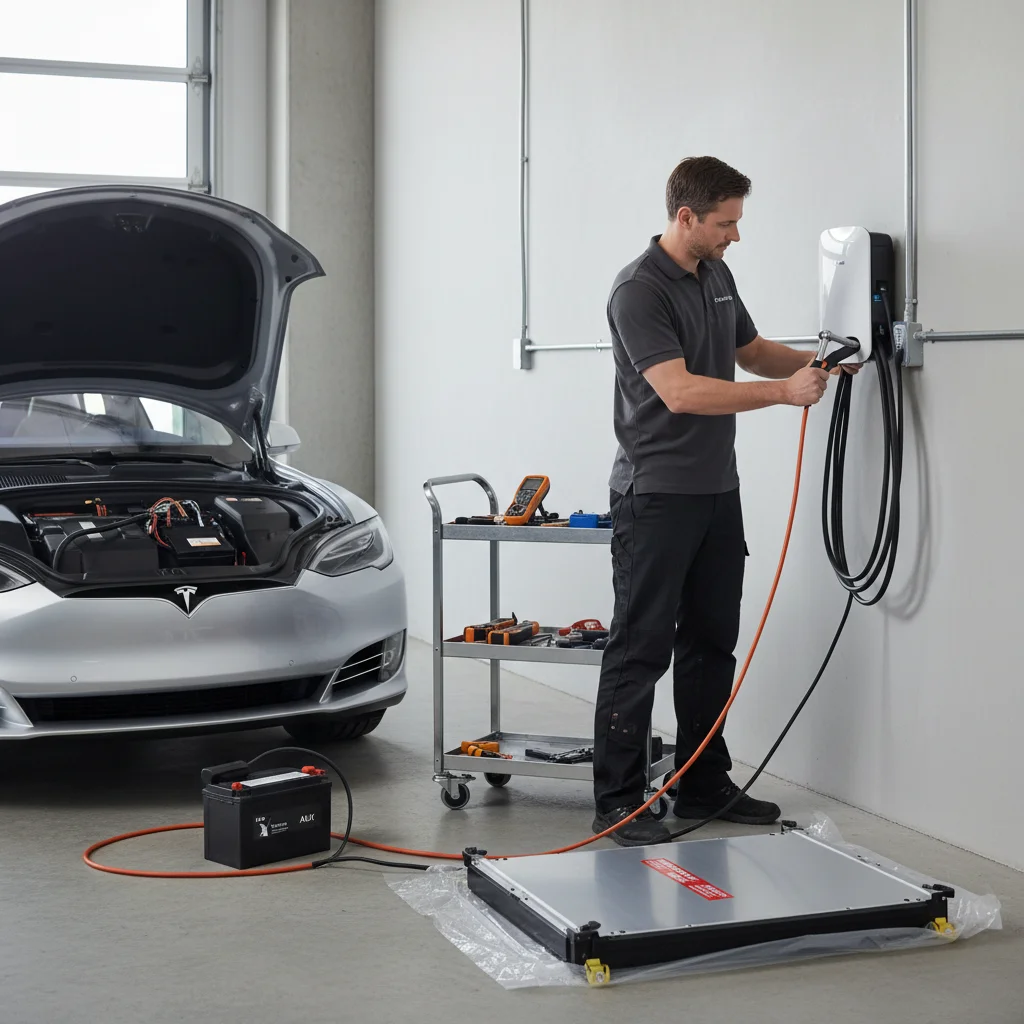
Every Tesla has a high-voltage pack under the floor. That pack turns the wheels. A separate 12V battery runs the computers, locks, lights, and door handles. On most Model 3 and Model Y cars, that 12V sits in the frunk. Model S and Model X place it in a different spot. If you need the layout, use the Model 3 battery locations guide.
The 12V also closes the contactors. Those contactors let the big pack connect to the rest of the car. Without the 12V, a Tesla with range left still won’t wake. Empty the pack, and Tesla says the 12V then loses support. The cabin goes blank either way. That’s why the first look is so misleading.
What Tesla’s running-out-of-range page actually says
Tesla publishes this chain in the Model Y owner’s manual. The entry is titled Running Out of Range. Once range is gone, the low-voltage battery loses support. The high-voltage pack then needs an external power supply before it can charge. You can’t treat that as a simple 12V jump. You also can’t treat it as a simple plug-in. That fails if the 12V is already dark.
Most dead-battery searches miss that link. The pack and the 12V aren’t independent at zero. A Tesla at 14661 Franklin Ave in Tustin may still talk to the app. That’s if it still has a few percent. A Tesla at zero at 6913 Warner Ave in Huntington Beach may not. The second car may need the 12V brought back first. Only then can a Supercharger session start.
Tesla’s roadside policy answers a depleted pack with transportation. It doesn’t send a charge to the bumper. Tesla says that help isn’t a financially covered service. Confirm the current wording on Tesla’s roadside assistance page. Direct fetches of that page failed during research for this piece. Tesla’s roadside number is 877-798-3752. That number was published on the Santa Ana service page.
Read the last drive, then the cabin
Start with what the car showed when you parked. The dark glass comes second.
When the 12V failed by itself
You shut down with a healthy range number. The car sat unused, and now nothing wakes. Model 3 and Model Y handles stay flush. The screen never boots at all. The Tesla app can’t ping the car. Phone key and key card both fail. You hear no chime, no fan, and no click.
That pattern points at the 12V. It doesn’t point at a pack that vanished overnight. Walk the checks in how to tell your Tesla 12V is dead, then jump it. If lockouts keep repeating, Tesla 12V battery failure covers what follows.
When the high-voltage pack is the empty one
The screen still comes on. You may see a low-battery warning or a prompt to charge. The app shows single digits, or zero. Handles still present and the car unlocks. You drove until traction quit. Or a charge session didn’t finish. The car may roll a short stretch. Then it cuts power while the cabin stays awake.
That’s an empty pack with the 12V still alive. Jumping the 12V adds no miles. You need energy in the high-voltage system. The operators we connect you with bring a 240-volt Level 2 source. Teslas take a native NACS plug. Charging time typically adds about 10 to 20 miles in 15 to 30 minutes. That’s time on the plug. It’s never an arrival window. Out-of-charge recovery is the service path for that job.
When empty range already took the 12V with it
This is Tesla’s manual on the street. The pack hit zero. The 12V then lost support. The cabin goes fully dark. The first failure was still range. You may need a 12V jump first. Then you need a mobile charge before a stall matters.
Orange County had 138,121 registered Teslas as of December 31, 2025. That’s 65.51% of the county’s 210,842 battery-electric cars. The source is the California Energy Commission vehicle population file. The county sits 6.4 points more Tesla-heavy than California as a whole. CEC charger data also puts 7,095 public ports in the county. That’s 36.8 ZEVs per public port. Statewide the same math is 24.4. A dead Tesla here is a common local event. It isn’t a freak one.
What each failure actually needs
12V path
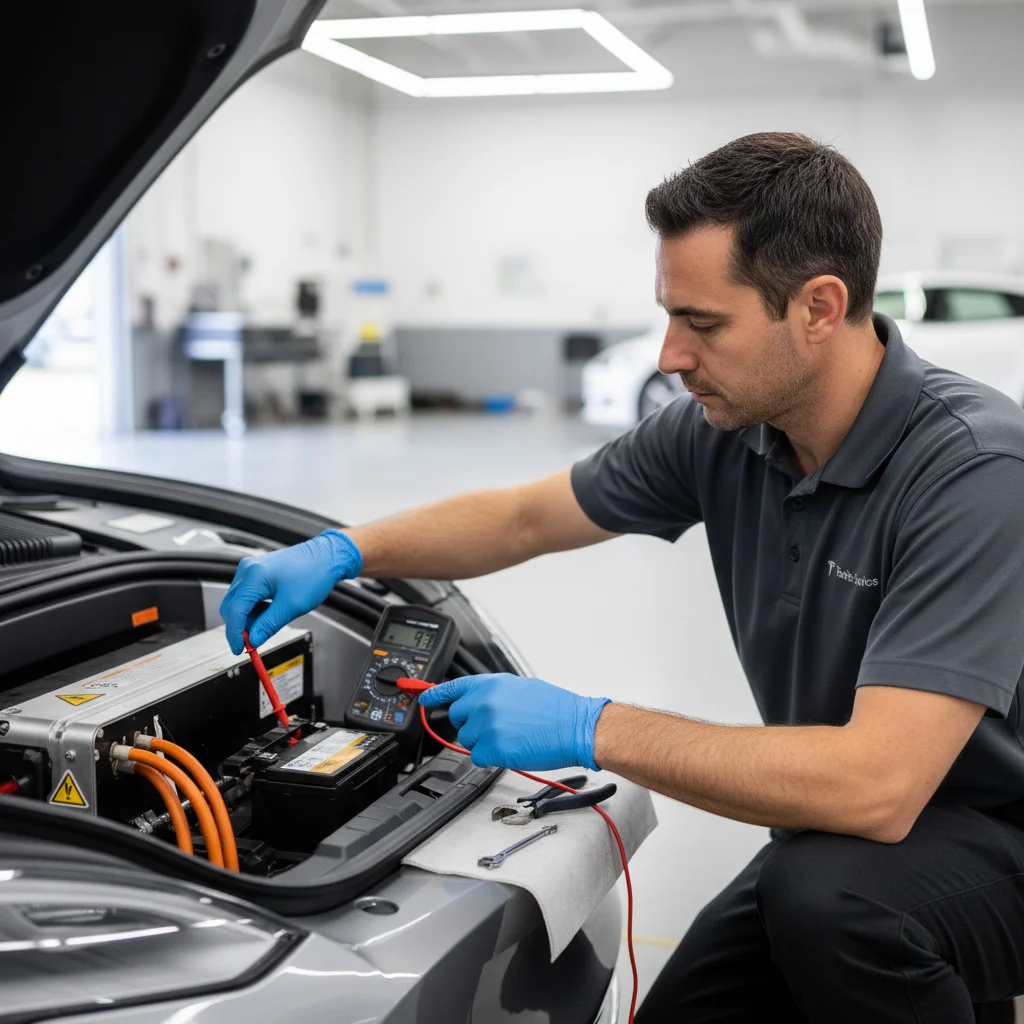
Tesla publishes jump points in the owner’s manual. The usual DIY path is a manual frunk release. Then you put a known-good 12V source on the marked terminals. If you can’t open the frunk, stop there. The operators we send jump or replace a dead 12V on site. They handle Tesla and every major EV brand.
A jump only holds if the battery is discharged. It won’t hold if the battery has failed inside. If it dies again after you disconnect, it needs replacement. Another jump won’t fix that. Call for a Tesla 12V battery jump if you can’t reach the terminals yourself.
Empty pack path
The pack needs kilowatts. A jumper pack from a gas car won’t do it. Charge Pro OC doesn’t set prices. We don’t promise a clock. The operator quotes you before starting. The operator bills you directly.
If the car can still move, Orange County’s Tesla network is large. Federal AFDC data shows 48 Supercharger sites in the county. Those sites hold 861 DC fast ports. Tesla holds 59% of public DC fast ports here. San Clemente’s site at 101 W Avenida Vista Hermosa has 49 stalls. Irvine’s site at 1920 Main St has 40. Tustin’s site at 14661 Franklin Ave has 36. Garden Grove’s site at 12891 Harbor Blvd has 32. Anaheim has Lincoln, Katella, Euclid, and Santa Ana Canyon Road sites. Huntington Beach has 24 stalls at 6913 Warner Ave. If you’re already in one of those lots, a dark car still won’t charge. The stall beside you waits on the 12V.
If you can’t roll, a charge at the bumper is the next honest step. Tesla at zero on an Orange County road walks that choice.
When it isn’t a battery at all
A collision, flood, or a battery-management fault belongs at a shop. Tesla lists service in Costa Mesa, Buena Park, Santa Ana, Irvine, Anaheim, and Aliso Viejo. Those city names came from Tesla’s findus paths. We didn’t open each page in a browser for this article. Confirm the live location on Tesla’s service locator before you drive. Charge Pro OC is a referral line. The brand holds no license. It doesn’t repair cars.
North county, the coast, and south county aren’t the same map
Orange County’s Supercharger list isn’t one generation. Fountain Valley’s Newhope Street site dates to 2015. AFDC lists it at 150 kW with 16 stalls. Garden Grove’s Valley View Street site opened in 2026. AFDC lists that one at 500 kW with 16 stalls. Mission Viejo’s Shops site is 10 stalls. Tesla’s own listing for that site is 72 kW. That’s the figure to use. AFDC disagrees on the power, so we went with Tesla.
North county clusters in Fullerton, Brea, Buena Park, Yorba Linda, and Anaheim. Central county clusters in Santa Ana, Garden Grove, Tustin, and Cypress. Coastal sites sit in Huntington Beach, Newport Beach, and Costa Mesa. South county sites sit in Mission Viejo, Laguna Hills, and Lake Forest. They also sit in San Juan Capistrano and San Clemente.
Santa Ana has a 28-stall, 325 kW site at 1008 17th St. It also has a 20-stall, 75 kW site at 300 E 5th St. Yorba Linda has two smaller sites on Yorba Linda Blvd, eight stalls each. Lake Forest now has Muirlands Blvd and a 16-stall Rockfield Blvd site. The Rockfield site is a Magic Dock with CCS1 and NACS.
A dark Tesla at 6940 Beach Blvd in Buena Park faces the same test. So does a dark Tesla at 27741 Crown Valley Pkwy in Mission Viejo. The city changes which stall you might roll to later. It doesn’t change whether you need a jump, a charge, or both. For city-level stall maps, start at EV charging in Orange County.
Once you know which battery failed
If the screen is on and the app shows zero, you need a charge. That charge has to happen at the car. If the car is dark and the app is dead, start with the 12V. That’s the call when you parked with range left. If Tesla’s empty-pack chain already took the 12V, say that when you call. The operators we connect you with carry 12V gear. They also bring a 240-volt Level 2 source. A standard gas-car jump pack is the wrong truck. So is a tech with no Tesla terminal map.
Charge Pro OC matches stranded EV drivers with independent local mobile rescue operators. We don’t own trucks. We don’t employ technicians. We don’t set prices. We serve every city in Orange County. The number to call is (949) 444-0151. The operator quotes you before any work starts.