You packed up from a Huntington Beach lot after a full day at the water. The fob clicks, and nothing in the car answers. That’s usually a dead 12-volt, not an empty pack you can drive to Warner. The Supercharger in town can’t wake a car that won’t start.
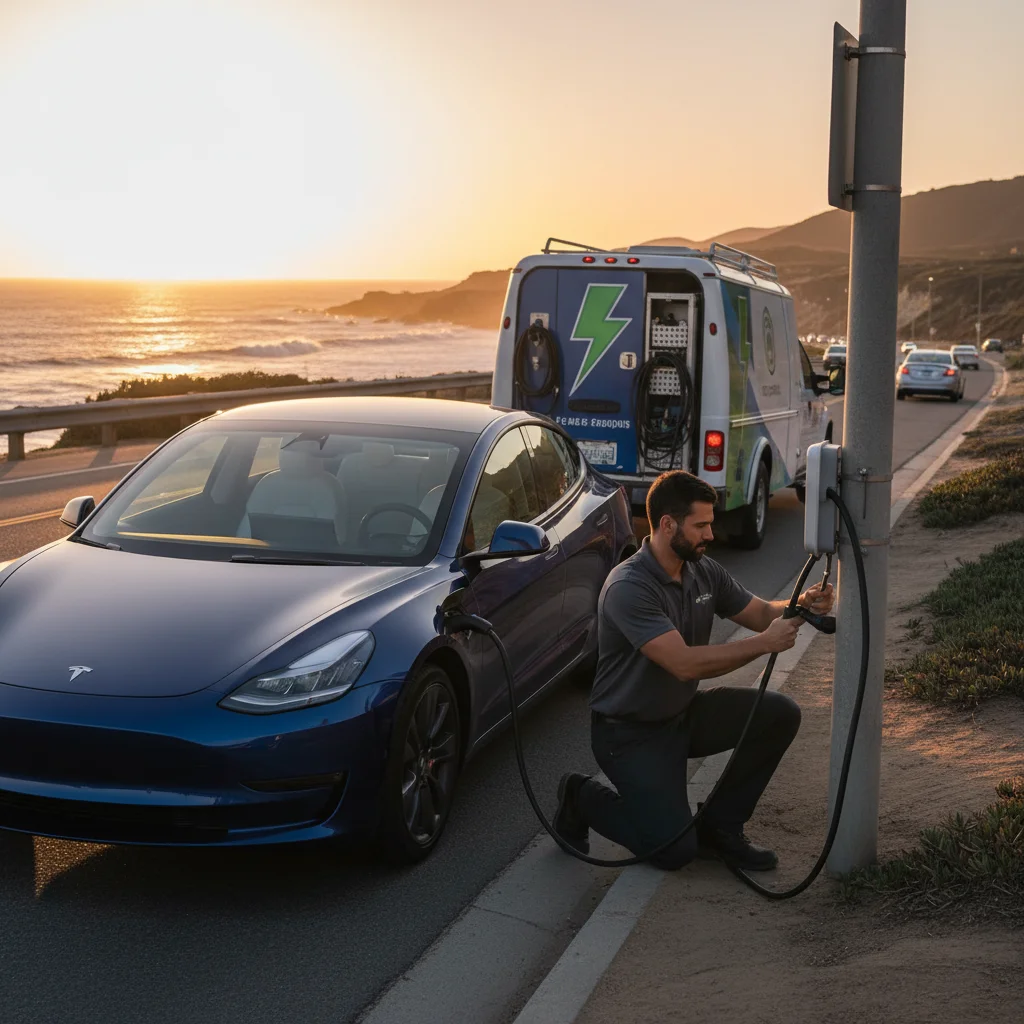
A long beach day drains the small battery first
Huntington Beach has 196,010 people and ten miles of coastline. It also carries Orange County’s heaviest beach-lot parking load. A typical run starts with climate control on Beach Boulevard or Pacific Coast Highway. Then the car sits from morning until sunset. Pier-area stalls, Bolsa Chica State Beach, and Pacific City all produce that all-day dwell. The traction pack can still hold range when you walk back. The 12-volt battery is what went quiet. It runs the computers, the locks, and the contactors that wake the pack.
Heat isn’t the local story. Huntington Beach has no NOAA temperature normals station of its own. Newport Beach Harbor is the nearest verified coastal proxy for that marine air. It points to year-round marine moderation, not inland heat. What kills the 12-volt here is hours of sitting closed. There isn’t a Huntington Beach temperature number you can quote.
Surf contests and the Fourth of July parade pack those lots even tighter. Those are the two heaviest single-day parking events on the Orange County coast. You’re not circling for a charger at that point. You’re parked, the car is locked, and the clock runs.
The Warner Supercharger can’t help a silent car
Huntington Beach has a Tesla Supercharger at 6913 Warner Ave. It opened in September 2025 with 24 stalls, rated up to 325 kW. Older pages still say the city has none. That’s wrong now. There’s also EVgo at 21190 Beach Blvd, with three stalls. Electrify America sits at 5922 Edinger Ave.
Orange County had 7,095 public charging ports at the end of 2025. That’s 36.8 ZEVs per public port, versus 24.4 statewide. That county ratio doesn’t erase the Warner Avenue Supercharger. A silent car in a beach stall still needs help at the bumper.
None of those plugs matter if the car won’t come out of park. A dead 12-volt can look like a brick. Screens stay black. Doors don’t unlock. The charge port may not wake. You can’t crawl inland to Warner Avenue in that state. The Huntington Beach beach-day guide covers a car that still talks but has no range. This page is the lot where the car never starts.
Tesla’s published roadside path for a depleted pack is transport, not a stall-side charge. Running out of charge isn’t a warrantable breakdown on that policy. A 12-volt failure is a different job anyway. The operators we connect you with jump or replace that battery on site. They also bring a 240-volt Level 2 source when the pack itself is empty.
Where the all-day parking actually sits
The pier, Bolsa Chica State Beach, and the Bolsa Chica Ecological Reserve all pull long stays. So does downtown around the International Surfing Museum. Drivers drop off I-405 onto Beach Boulevard and treat the last miles as easy. Others roll SR-1 along the water and do the same. The lot is where the hours add up.
Huntington Harbour is another pattern. It sits on islands linked by bridges, well off the Beach Boulevard commercial spine. A lot of houses give the garage to a boat. The EV lives in the driveway or on the street. After a full day on the water, the same 12-volt failure shows up. You’re not threading Warner Avenue from a quiet island street. The car won’t even unlock.
Hospital structures produce the same dwell. Hoag Hospital Huntington Beach on 17th Street has structured parking. Huntington Beach Hospital sits on Beach Boulevard. A visit that runs long leaves the car closed for hours. That’s a 12-volt call, not a Supercharger errand.
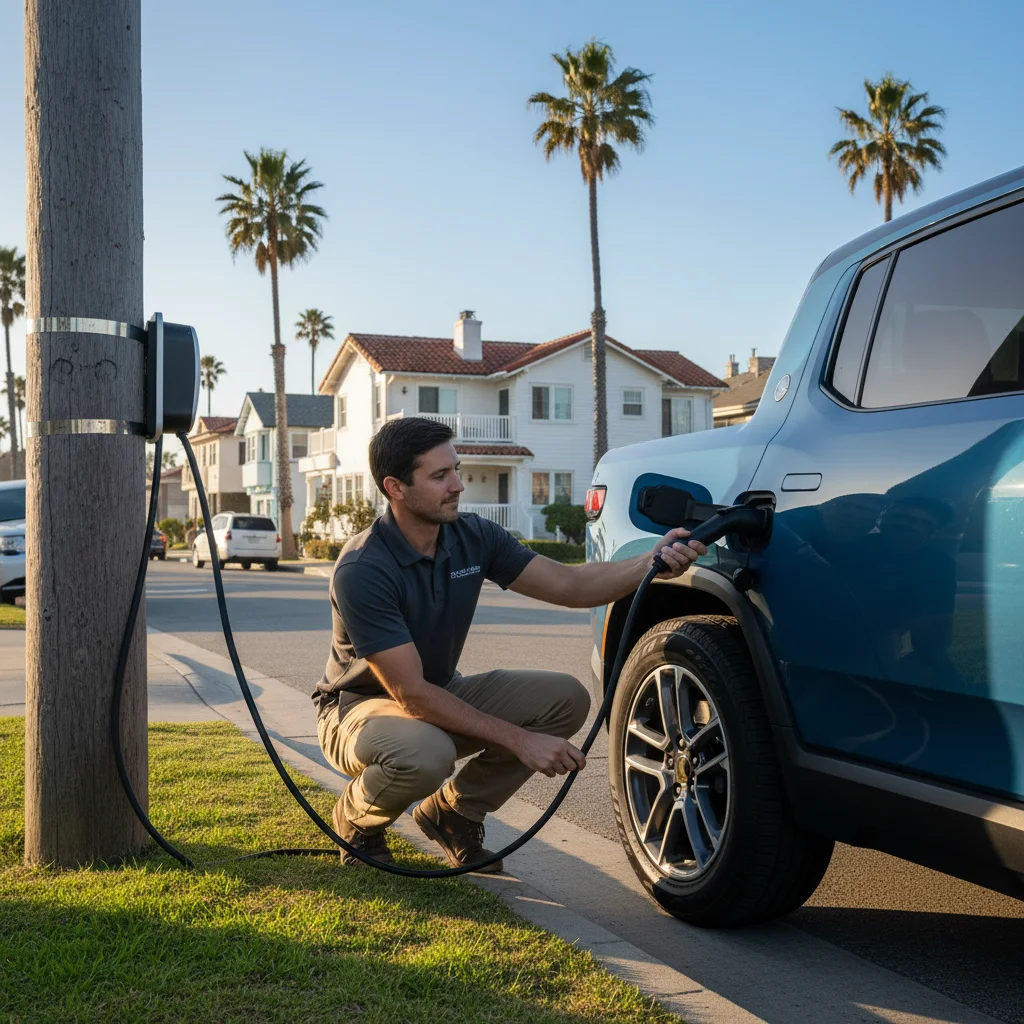
Sunset Beach is Huntington Beach now. The city annexed it in 2011, and ZIP 90742 still marks that strip. It’s a neighborhood, not a separate town. If the car is dead in a Sunset Beach stall, you still need help there.
How a dead 12-volt looks versus an empty pack
A traction pack at zero still usually talks to you. You get warnings, a range figure, maybe a limp message. A dead 12-volt often gives you nothing. Tesla’s owner’s manual notes that once range is exhausted, the low-voltage battery can lose support. Then the car needs an outside supply before the high-voltage pack can charge. You can also lose the 12-volt with range still on the display. That’s why a Huntington Beach lot after a long day fools people.
Run a short check before you call a flatbed. See if the car will show 12-volt health at all. Try the card key and the phone key. Look for any interior light. Teslas strand this way on Model 3, Y, S, and X when that battery drops. Other brands do it too. The 12-volt versus dead-pack guide walks that split without guessing.
Orange County had 210,842 battery-electric vehicles on the road as of December 31, 2025. That’s the California Energy Commission count. Teslas were 65.51% of that BEV fleet. Plenty of the silent cars in these beach stalls are Teslas. The same 12-volt logic applies to CCS and J1772 EVs. Operators bring a native NACS plug plus adapters.
What shows up at the stall
Charge Pro OC is a referral line. It doesn’t own trucks, employ technicians, or hold a license. It matches you with an independent local mobile rescue operator. That operator quotes you before any work starts and bills you directly.
For a 12-volt failure, the field job is a jump or an on-site replacement. For an empty pack, the truck brings 240-volt Level 2 to the car. Typical charging time is 15 to 30 minutes for 10 to 20 miles of range. That’s time on the plug. It isn’t a promise of when someone arrives.
Give the operator your exact lot, the cross street, and the brand. Say whether screens are dark or the car still talks. That split decides whether they bring jump gear or the Level 2 lead first. They handle Tesla and every major EV brand.
A tow still belongs if something mechanical is broken. It also belongs if the stall isn’t safe to work in. For a quiet EV in a Huntington Beach lot, start with a jump or a charge. You drive out under your own power. You aren’t waiting on a hook in a packed pier lot.
Tesla 12V battery jump is the Tesla-shaped version of that call. Mobile EV charging is the empty-pack version.
If a jump brings the car back and it dies again, replace that 12-volt. Don’t keep cycling it with borrowed cables.
Older inland streets, and Oak View without a garage plug
68.8 percent of Huntington Beach’s 81,812 housing units were built before 1980. The 1960s and 1970s tract belt inland of Beach Boulevard is a consistent old-panel pattern. A home Level 2 charger isn’t a given there. Oak View in ZIP 92647 is denser older multifamily with street parking. Spanish at home is 9.3% citywide, and Oak View runs far above that.
That housing mix shows up after a beach day. You may have spent the afternoon on PCH, then aimed inland on Warner or Edinger. Goldenwest and Magnolia feed the same weak-12-volt last stop. If the 12-volt was already weak, Huntington Central Park can be where it dies. The car never makes the driveway.
The city is mostly a flat coastal plain. It isn’t all flat. Huntington Mesa and Bolsa Chica Mesa sit above the wetlands. The Seacliff and Goldenwest bluff line adds a short climb. Inland of PCH there’s a peat and subsidence belt. None of that is a mountain grade. It’s still extra work for a pack that already ran climate inbound.
Seacliff, Goldenwest, Meredith Gardens, and Edwards Hill all feed the same arterials. So does the Franklin and Adams area. Downtown and the Harbour feel like different towns. The 12-volt failure doesn’t care which ZIP you parked in. 92646, 92647, 92648, and 92649 all produce the same dark-screen call.
Neighboring coast cities if you parked one town over
Huntington Beach sits against Fountain Valley, Costa Mesa, Westminster, Seal Beach, and Newport Beach. Fountain Valley has Superchargers on Warner Avenue and Newhope Street if the car can still roll. Westminster Mall has a Tesla Supercharger if the car can still drive north. A Saturday can start in a Seal Beach lot and end on PCH here. The Seal Beach lot guide is the same long-dwell idea one city north. The Huntington Beach charging map lists local stalls if the car will still move.
I-405 and SR-22 from the north are the inland approaches. SR-39 is Beach Boulevard. SR-1 is the water. Name Bolsa Chica, Brookhurst, Goldenwest, Warner, Edinger, Adams, Magnolia, or Springdale when you call. Give the operator a lot name, a cross street, and the vehicle brand. On a holiday near the pier, a stall number helps if you have one.
Call when the car won’t wake
Stay with the vehicle if the lot feels safe. Don’t keep cycling a weak 12-volt with borrowed cables from the next space. If the traction pack is truly empty, Tesla’s published path is paid transport. That path isn’t a mobile charge at the stall. If the 12-volt failed, you want a jump or a replacement at the stall.
Call (949) 444-0151 to have Charge Pro OC connect you with a local operator. The operator quotes before starting. The brand doesn’t set prices or publish an arrival clock. You get a person who can jump the 12-volt at the stall. They can also put 240 volts on the car. That’s the way out of a Huntington Beach lot after a long day.