The first clue is rarely a silent stall. It’s a slow handle in a Huntington Beach lot. A screen that blinks once in a Costa Mesa structure is the same tell. Tesla 12V battery failure symptoms show up while the car still moves. Catch them there, and you walk out of the garage on your own. Miss them, and an 80% pack still can’t wake the car.
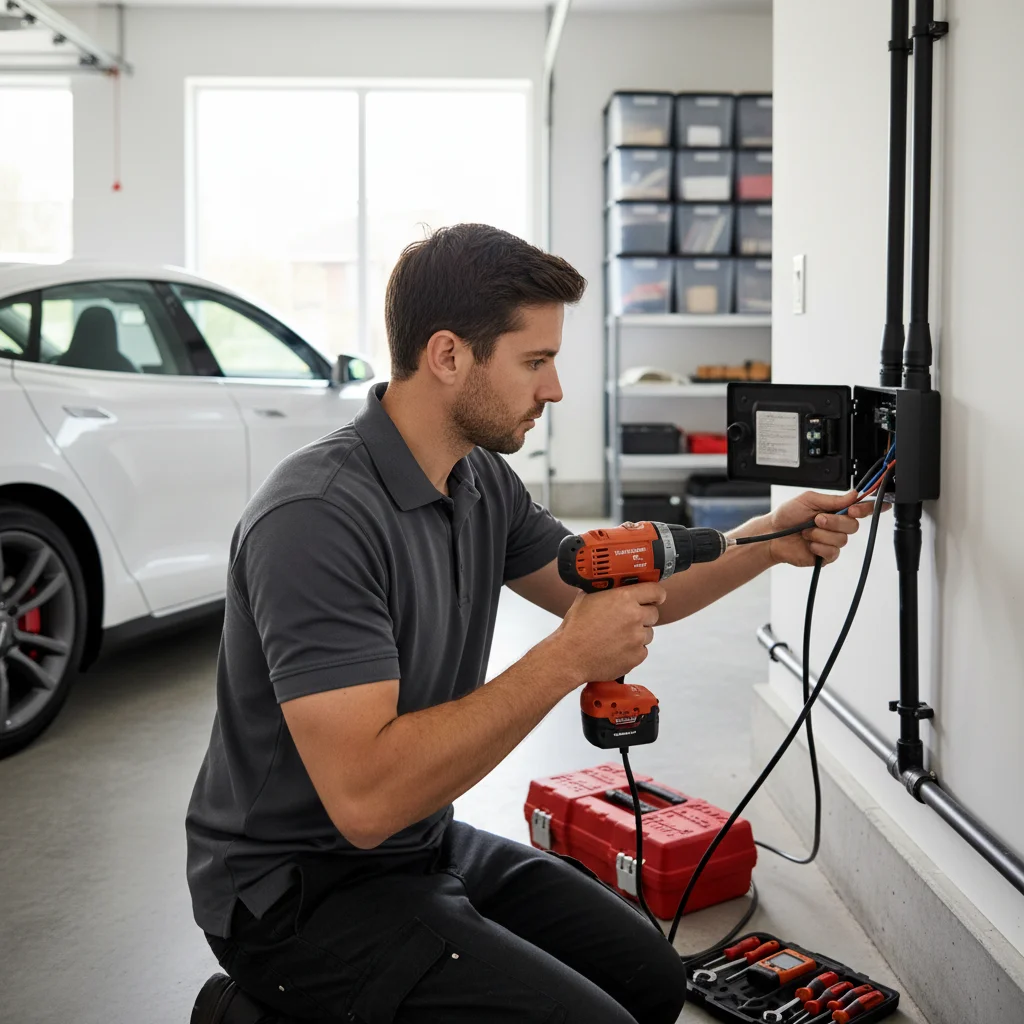
The small battery that decides if the car wakes
Your Tesla still has a 12-volt battery. Model 3, Y, S, X, and Cybertruck all do. The pack under the floor moves the wheels. The 12V runs the computer, handles, screen, and lights. It also powers the contactors that close the high-voltage circuit. If that small battery sags, the car can’t turn on. Range on the main pack doesn’t matter in that moment.
Tesla’s Model Y owner’s manual is blunt on a cousin of this failure. Once the traction pack is empty, the low-voltage battery can lose support. The car then needs outside power before the high-voltage pack can take a charge. A dying 12V can strand you the same way. Miles left on the display won’t help.
Orange County is a Tesla-heavy county. That’s why this shows up so often here. CEC data through December 31, 2025 counted 210,842 battery-electric cars in the county. Teslas were 138,121 of those, or 65.51 percent of the BEV fleet. Statewide, Tesla’s share of BEVs was 61.34 percent. More Teslas per street means more 12V alerts here. Beach lots, office structures, and HOA garages see them.
The 12V charges from the main pack through a DC-DC converter. That happens when the car is awake or plugged in. The car still tries to tell you before that loop fails.
Clues you notice in the lot, not on the freeway
You don’t need a scan tool. You need to trust odd behavior that used to be instant. Most owners first feel this in a stall, not in a merge.
Screen alerts you shouldn’t swipe away
A yellow or red “12V battery needs service” message is the car talking to you. Yellow means the 12V is already weak. Red means stop treating it as a maybe. Don’t wait for a second alert. Don’t assume the next Supercharger session will clear it. A stall at 6913 Warner Ave in Huntington Beach charges the pack. So does 1920 Main St in Irvine. Neither rebuilds a dying 12V.
Handles, keys, and a car that feels late
On Model S and X, the handles should pop out as you walk up. A lag or a handle that stays flush is classic low-voltage behavior. On Model 3 and Y, the interior release can feel sticky for the same reason. Phone key lag of a couple of seconds is another tell. Unlock used to be instant. That delay often traces to the same sag. When the body controllers starve, the car feels slow even though the pack is fine.
This is the beach-lot version of the problem. You walk back to a Model Y that doesn’t greet you. The fob works on the third try. That’s not salt air in the electronics. That’s a 12V that’s already on the way down.
A frunk, a charge-port ring, and a groggy wake
The frunk latch is a 12V actuator. If the app or the screen button won’t pop the hood, think 12V first. If it lifts an inch and dies, think 12V before a broken latch. Use that half-open hood to get the car to a shop. Don’t treat it as a fluke.
The charge-port LED is another low-voltage tell. Flicker or a dead ring when you plug in can be the 12V. Don’t blame the Supercharger first. Don’t unplug and replug ten times in a Tustin office park. Check the 12V message first. A healthy Tesla wakes in about a second when you press the brake. Several seconds of black screen, then a slow boot, is a fading 12V.
Random faults that don’t belong together
Parking brake, stability control, and HVAC errors in the same minute are a pattern. Low 12V makes modules throw codes that look unrelated. If nothing hit a curb and you didn’t change a setting, start with the 12V. Overnight range loss that’s worse than your usual vampire drain can also point here.
Irvine apartment garages and Santa Ana overnight street parking make this easy to miss. You plug in, or you think you did. In the morning the car is groggy, not empty.
If the car is already dark, skip the clue hunt. Start with the steps for a dead Tesla 12V, then a jump.
Lead-acid or lithium, and why the window changes
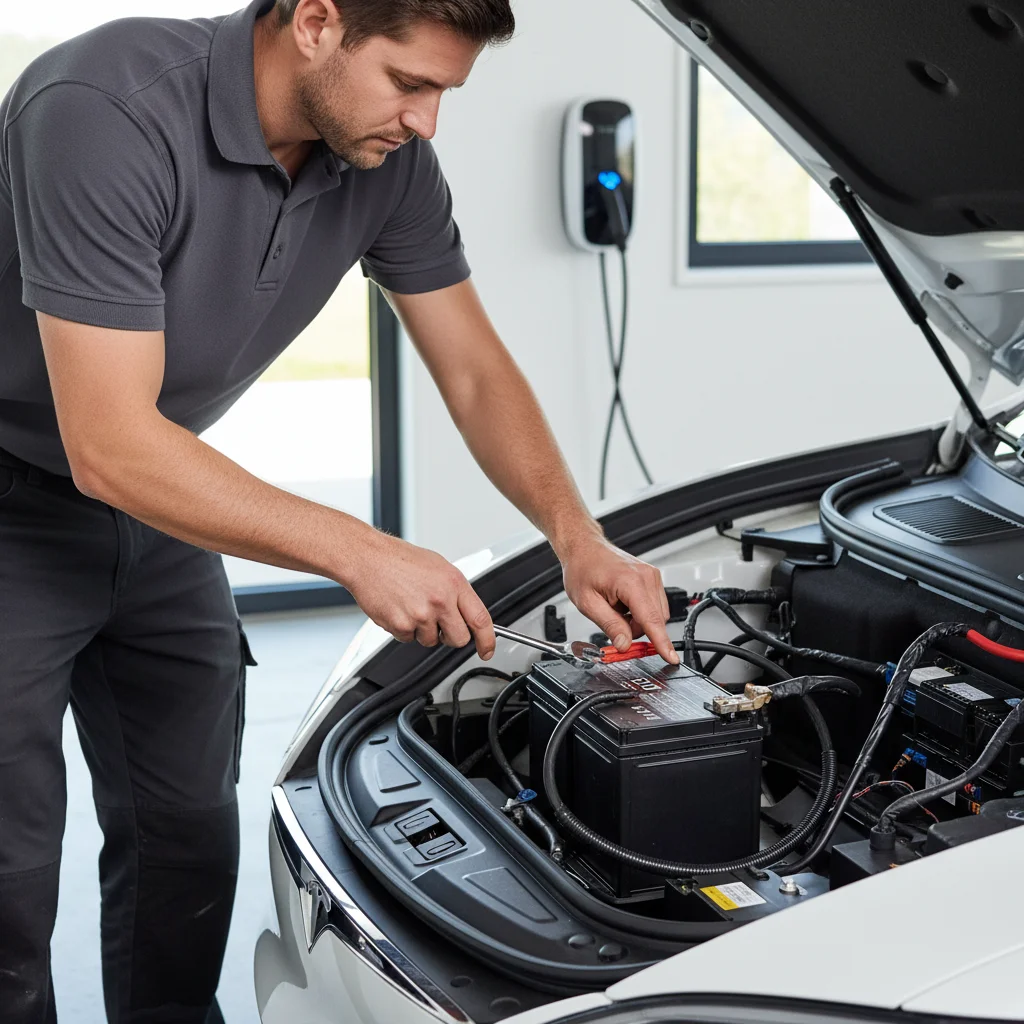
Open the frunk and look. Older Teslas, generally before late 2021, used a sealed lead-acid 12V. It’s the same family as a gas car. It’s the larger unit, often with a vent on top. Later cars use a smaller lithium-ion 12V, closer to a hardcover book. Lead-acid units often fade in stages, so the clues above can last days. Lithium 12V packs can look fine, then drop fast. On a newer Model 3 or Y, treat one alert as the whole window. The model-by-model 12V guide maps which cars use which pack. Newer lithium 12V failures have their own next steps.
Don’t guess voltage at the curb from a number that looks about right. A shop or an operator with a meter can read it. Tesla service centers sit in Costa Mesa, Buena Park, and Santa Ana. There are also sites in Irvine, Anaheim, and Aliso Viejo. Confirm the current address and hours before you drive there. Ask if they’ll take a 12V job on a weak battery.
Yorba Linda and North Tustin grades work a 12V harder. So do Anaheim lots after a long park. Seal Beach and Dana Point harbor parking add hours of sit time after a walk. Watch the car, not a calendar.
Empty pack, dead 12V, or both
A low traction pack and a dying 12V can look the same from the sidewalk. They aren’t. If the screen still boots and the app still talks, read the range. If the car is fully dark, the 12V is the gate. Tesla’s owner’s manual notes that an exhausted pack can starve the low-voltage battery. Then you need an external supply before the high-voltage pack will charge. That’s two jobs, in order: wake the 12V, then add range.
Orange County has 48 Tesla Supercharger sites and 861 Tesla DC fast ports. That’s AFDC station data for the county. Those stalls help a car that can still roll in. They don’t help a car that won’t unlock. Walk to a stall only if the car will still move.
What to do while the car still wakes
Don’t treat this like a tire-pressure light. Cut extra 12V load as soon as you see the alert. Turn off Sentry Mode. Turn off cabin overheat protection if you can. Close the Tesla app so you aren’t poking the car awake. Those steps don’t repair the battery.
Then book Tesla service, or a shop that actually works on Teslas. Warranty coverage depends on your car and the date. Confirm it with Tesla. Charge Pro OC doesn’t sell parts and doesn’t run a service bay.
If you still need to move the car, keep the drive short. A Supercharger stop at 1475 S Harbor Blvd in Fullerton won’t fix the 12V. It can keep the DC-DC converter feeding the small battery while you get home. Leave the car next to a known plug if you can. Get the 12V replaced before the next long sit.
When the lot goes quiet: beach parking and structures
A dead 12V in a Huntington Beach lot is a common OC version of this. The car won’t unlock from the phone. The screen stays black. The frunk won’t pop. You’re not out of range. You’re out of low-voltage power. Nearby stalls, including the Warner Ave Supercharger, can’t help a car that won’t wake. See that beach-lot stall after a long day.
Costa Mesa is the other classic trap. Airport-adjacent structures and retail decks hide the car from a simple curb jump. Pedestrian ramps, tight stalls, and a sealed frunk stack up. Help that comes into a Costa Mesa structure is the practical path. Newport Center parking has the same shape. You sit a long time, then the car won’t greet you. Fashion Island has public DC fast charging at 401 Newport Center Dr. AFDC lists eight Electrify America stalls there. Those stalls still can’t wake a Tesla whose 12V is dead.
Anaheim theme-park and stadium lots add hours of Sentry and app checks. Santa Ana office blocks and Irvine apartment garages do the same overnight.
If the handles are dead, don’t pry them. Don’t jump random terminals under the hood. Model 3 and Y jump posts sit under the frunk trim. Model S and X posts sit in the frunk. Tesla publishes those locations in the owner’s manual. If you can’t see them, wait. Run the seven-check Tesla won’t-start list first.
Tesla roadside, a depleted pack, and a 12V that won’t wake
Tesla Roadside Assistance is a real option. The number Tesla publishes on the Santa Ana service page is 877-798-3752. Tesla’s own roadside language treats a depleted pack as help that isn’t financially covered. That wording was indexed from tesla.com/support/roadside-assistance, not fetched live. Tesla describes transport of up to 500 miles to the nearest service center. That applies to a warrantable breakdown that leaves the car undrivable. Running the pack to empty sits outside that covered transport. Tesla’s public policy answers a dead pack with transportation, not with charging at the bumper.
A 12V failure is a different fault. It can look identical from outside: no lights, no app, no drive. Tesla’s 12V-specific roadside wording couldn’t be confirmed from a live page during this research. Ask Tesla what they’ll send for a 12V before you wait.
The operators Charge Pro OC refers can jump the 12V at the car. They can replace it on site when that’s the right fix. Charge Pro OC is a referral line. It matches you with independent local operators. It doesn’t own trucks, employ technicians, or set the price. The operator quotes you before work starts, and bills you directly.
Call before the structure closes around the car
If the screen is already dark, or several clues hit at once, you’re past watching. Stay with the car if it’s safe. Don’t leave it blocking a ramp. For a 12V jump at the stall, start with Tesla 12V battery jump. Call (949) 444-0151. We connect you with a local operator who can quote the work at the car.