Tesla roadside assistance in Orange County is a dispatch line. The person who arrives is almost always a contractor. That Tesla roadside contractor is usually a local tow yard. Tesla isn’t sending a Tesla employee with a branded charger. It’s pinging independent operators who already haul cars for motor clubs and insurers. That distinction matters on the I-5 shoulder. It also matters in an Anaheim stadium lot, and inside a Costa Mesa parking structure.
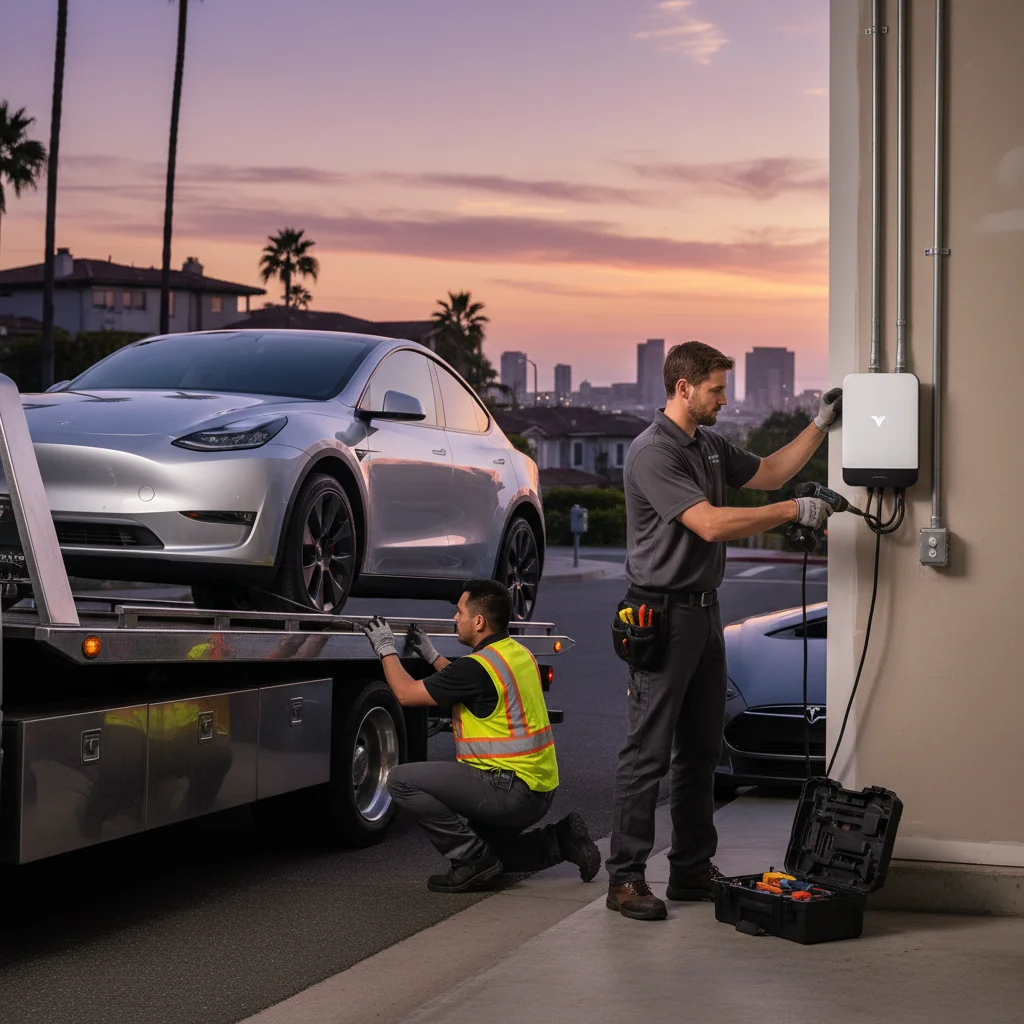
Tesla’s roadside desk is a dispatcher
Tesla doesn’t run a countywide fleet of its own tow trucks. The app request goes into a contractor pool. The system looks for a partner truck that can take the job. The first yard that accepts it gets your pin. Proximity and availability drive that choice, not EV specialization.
You can request help in the app or call Tesla’s roadside number. The dispatch logic is the same either way. Tesla’s published Santa Ana service information lists 877-798-3752 as the roadside line. Either path still lands on a contractor, not a Tesla technician.
That model covers a lot of Orange County ground. The county runs from La Habra down to San Clemente. It includes the 91, the 405, and the Crush on SR-22. The 91 corridor is theme-park lots and Fullerton Harbor Boulevard stalls. The system isn’t asking who has jumped the most Model Y packs. It’s asking which contracted truck can roll to you.
What Tesla covers, and what it only arranges
A warrantable breakdown that leaves the car undrivable is one kind of call. An empty pack is a different kind of call. Tesla’s published roadside language ties covered transport to that warrantable case. Covered transport runs up to 500 miles to the nearest Service Center. Running out of charge is help Tesla can arrange. It isn’t described as a financially covered service.
The honest read of Tesla’s 2026 roadside policy is blunt. A depleted battery is answered with transportation. It isn’t answered with a charger at the bumper. Don’t wait on the shoulder for a Tesla-branded mobile charge. That isn’t how the published policy is written.
Orange County Tesla Service listings include Costa Mesa, Buena Park, and Santa Ana. Irvine, Anaheim, and Aliso Viejo are on that list too. On an empty pack, the contractor’s usual job is to load the car. Then they take it somewhere you can plug in. Confirm the destination with the driver before the winch comes out.
Why Orange County Tesla calls land on general tow yards
This county is unusually Tesla-heavy by statewide standards. California Energy Commission vehicle-population data as of December 31, 2025 is the source. It counts 138,121 Teslas on Orange County roads. That’s 65.51% of the county’s 210,842 battery-electric cars. Statewide, Tesla’s share of BEVs is 61.34%. Orange County sits 6.4 points more Tesla-concentrated than California as a whole.
Those cars still share the same contractor pool as every other disabled vehicle. Friday traffic on Katella by the Anaheim stalls is one pile-up of calls. A packed lot at 1920 Main Street in Irvine is another. When the EV-familiar drivers are already out, the next truck takes it.
Federal Alternative Fuels Data Center data shows 48 Tesla Supercharger sites inside the county line. Those 48 sites hold 861 DC fast ports. Tesla holds 59% of Orange County’s public DC fast ports. Orange County has 36.8 ZEVs per public port. That’s CEC data as of December 31, 2025. The statewide figure is 24.4 ZEVs per port. Stalls exist, and they don’t roll to the shoulder.
San Clemente’s Avenida Vista Hermosa site lists 49 stalls. South of Irvine, the I-5 grade eats range on a different clock. A Costa Mesa structure off Bristol and a Yorba Linda hillside driveway aren’t the same stop. The contractor pin still treats them as one job type.
The contractor’s job is to haul, not to charge
The yards Tesla contracts with are independent tow businesses. Those yards already work Beach Boulevard, Harbor, and the 405 connectors. They run flatbeds, wheel-lifts, and heavy wreckers. They take manufacturer work, insurance work, and motor-club work on the same shift.
Most of their day is still gasoline vehicles. An EV call can be routine for one driver. It can be a first Tesla for the next. Hands-on time with a locked Model 3 is a different skill. They’re paid per job, not per minute of care. The incentive is to hook up, clear the lane, and take the next pin.
An empty traction pack makes charging on site versus taking a tow the real fork. The contractor Tesla sent is set up for the second option.
A black screen changes the stop
A lot of Tesla roadside calls aren’t “out of range.” They’re often a dead 12-volt battery. The big pack can still hold energy. The small battery that runs computers, locks, and the display has dropped out. Transport Mode on the screen is out of reach.
Tesla’s Model Y owner’s manual covers running out of range. Those notes describe the low-voltage battery losing support once range is exhausted. It then needs an external power supply before the high-voltage pack can charge. That’s a technical sequence, not a tow sequence. A driver who only knows how to winch may skip the jump.
A specialist’s first move is often to restore 12V power. Diagnosing a dead Tesla 12V, then jumping it can wake the car. That can be enough to open, shift, or take a charge. A general contractor may not lead with that. Ask out loud what they plan to do.
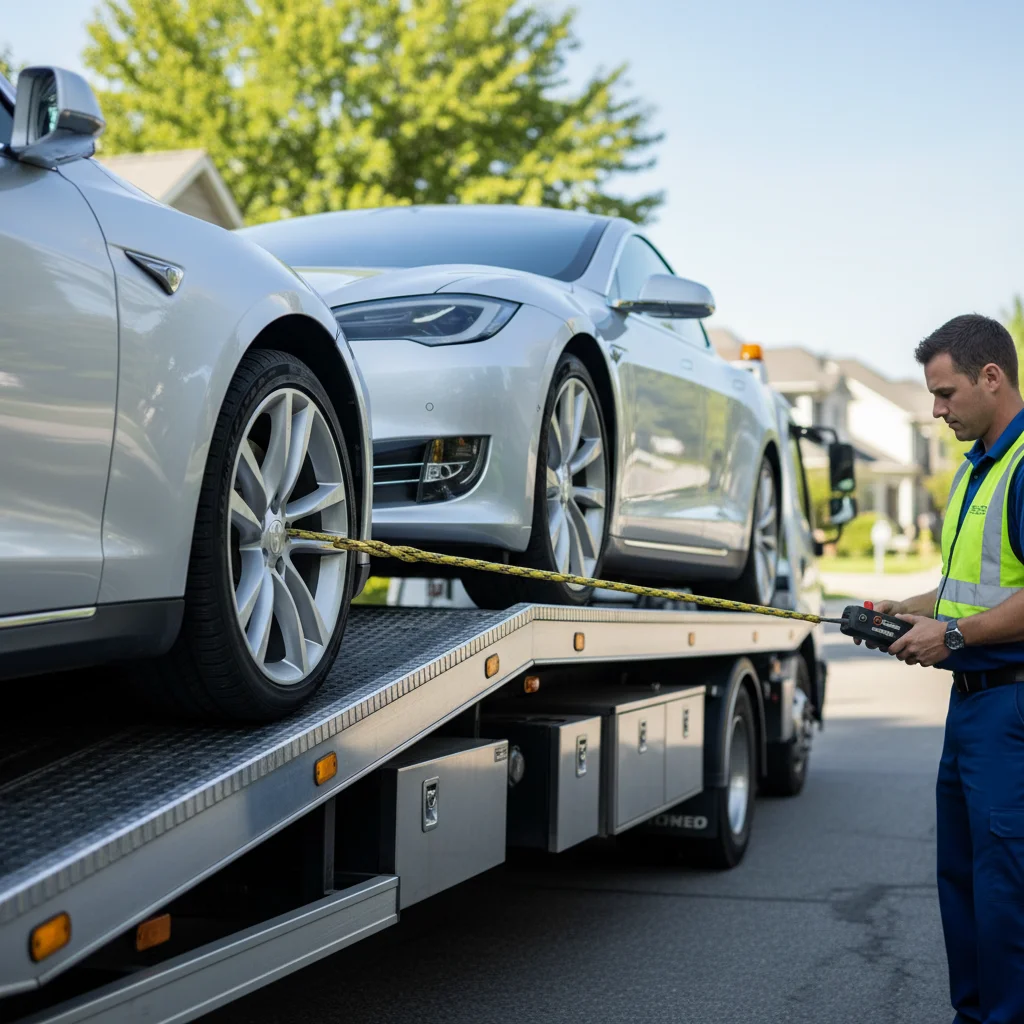
Before anyone loads the car, walk the plan
Every Tesla needs a flatbed for a safe load. Dual-motor cars especially can’t ride on two wheels. A wheel-lift or a hook-and-chain setup can wreck a drive unit. If anything else shows up, you can refuse the load.
The tow eye comes before the hook
Tesla hides a tow-eye point in the bumper. The winch cable belongs on that eye, once it’s threaded. Hooks on control arms, subframes, or suspension pieces can bend those parts. If you see a hook going anywhere else, stop the driver. Wheel dollies slide under locked tires so the car can roll onto the bed.
Dark glass means power first
A dead 12V takes the screen with it. Transport Mode is then unavailable until power comes back. The careful sequence is to jump the 12V first. An operator with no plan for a dark car isn’t ready for this stop.
Transport Mode, only if the display still works
The clean path is on the touchscreen: Controls, then Service, then Towing. It releases the parking brake so the wheels can roll onto the bed. Dragging the car with the brake still clamped chews tires and stresses the brake system. If the driver doesn’t know that menu path, pause the job.
You can cancel a dispatch that looks wrong
You can cancel a Tesla dispatch in the app. Do that if the truck is wrong for the car. You don’t have to accept a load that looks unsafe.
- The truck isn’t a flatbed. Send it on.
- The driver asks you how to open the charge port.
- They’ve never heard of Transport Mode at all.
- They want to hook the winch to suspension parts.
- The car is dark, and they have no 12V jump and no dollies.
Cancel, then choose a path that matches the failure. An empty pack and a dead 12V are different jobs. A tow contractor is the right tool for a crash. It’s the wrong first tool for a car that only needs power.
The local option is an operator who quotes, then charges
Charge Pro OC is a referral line. We don’t own trucks, and we don’t employ technicians. We match stranded Tesla drivers with independent local operators. The operator quotes you before any work starts, and bills you directly.
What those operators bring is a 240-volt Level 2 source to the car. Teslas take a native NACS plug. Other EVs use a CCS or J1772 adapter. A typical session adds about 10 to 20 miles of range. That happens in 15 to 30 minutes of charging at the car. It isn’t a promise of when someone arrives. They can also jump or replace a dead 12V on site. They handle Tesla and every major EV brand.
That’s the Tesla roadside rescue path. It fits an empty I-5 stop south of Irvine. It also fits a Huntington Beach lot after a long day.
When the contractor tow is still the right call
If the car has collision damage, a flatbed is the tool. Follow Tesla’s routing to a listed Service site. Confirm the driver will use a flatbed and the tow eye.
If you only ran the pack to zero, start with power at the car. You can still tow later if the charge doesn’t restore a drive. You can’t undo a bad load after the fact.
For a low-range warning before you actually strand, use a stall you can reach. If you can’t reach one, stay put. Then choose Tesla’s contractor tow, or a local operator.
If you’re already stopped and you want the operator path, call (949) 444-0151. We’ll match you with a local operator who quotes first. They bill you directly for the work. No arrival time is promised on this line.