Zero percent on an Orange County shoulder is a choice, not a mystery. You can wait for a freeway patrol stop on a covered stretch. You can call a flatbed and hope the drop has an open stall. Or you can have range added at the car you’re sitting in. Freeway Service Patrol help is free where the program runs. It doesn’t put range in the traction pack.
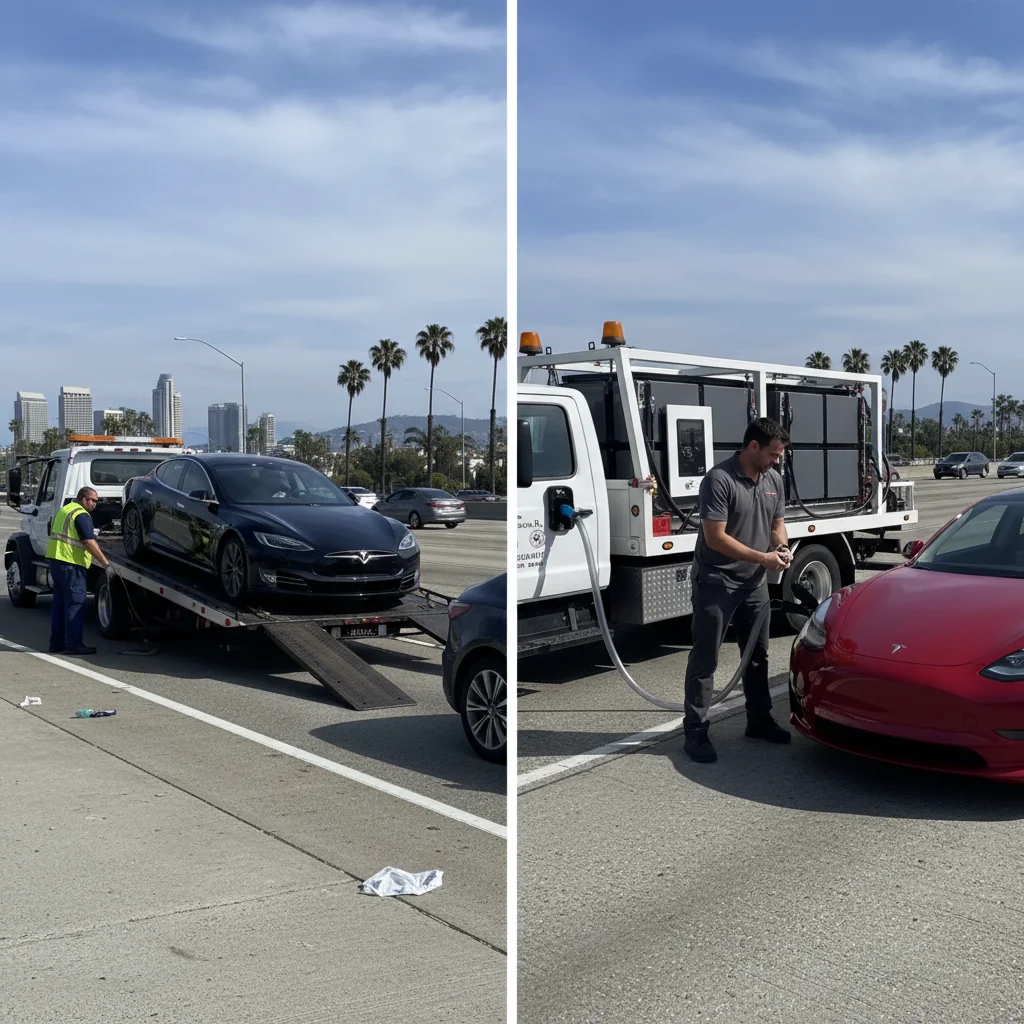
Most drivers miss that last point until they’re already waiting. A patrol stop can get you out of a live lane. Confirm current routes and hours with the agency that runs it. None of that fills a traction battery, and it never will. The mobile EV charging cost vs tow question starts after that free stop.
The CEC’s year-end 2025 file counts 210,842 battery-electric cars in Orange County. That figure comes from the Commission’s vehicle population file. The same December 2025 charger file lists 7,095 public ports in the county. That’s 36.8 ZEVs for every public port. Statewide, the same math is 24.4 ZEVs per public port. A long wait at a packed stall is a county pattern.
What you’re actually comparing
A tow moves the empty car, and a mobile charge fills the pack. They’re different jobs, and they produce different invoices. Treating them as one line item is how people overpay.
The operators Charge Pro OC connects you with bring a 240V Level 2 source. It plugs into the car where it sits. Teslas take a native NACS plug on that lead. Other brands use a CCS or J1772 adapter. A typical session adds about 10 to 20 miles of range. That’s 15 to 30 minutes of charging time, not travel time. Nobody here promises when a truck shows up.
The operator quotes you before any work starts. You hear the number and you accept it, or you don’t. The operator bills you directly after you agree. Charge Pro OC doesn’t set prices or run a yard. It doesn’t own the truck that rolls up.
A mobile EV charging quote usually tracks the job in front of the operator. Access, location, and how much range you need all figure in. Read what goes into a mobile EV charging quote for those pieces. Confirm the current figure with the operator before you pay. No public sticker price for this work was verified for this page.
What a flatbed invoice is built from
An EV generally needs a flatbed, not a hook-and-chain lift. A dolly tow can damage the drive unit on many models. Most makers tell owners to use a flatbed. That’s a manufacturer instruction, not a city ordinance.
A tow bill is rarely a single line. There’s a hook-up, and there’s mileage after that. Tight parking structures and steep grades can add labor. Nights and weekends can change the rate too. No dollar figures for Orange County tows could be confirmed here. Ask the dispatcher for a quote before the truck hooks up. Then ask where the car is going after the hook. Ask whether that site can take your plug.
Here’s the part people skip on the shoulder. After the drop, you still have to charge. The tow didn’t fill the pack at all. It moved an empty car to a stall you hope is open.
Why hauling to a charger is a weak plan here
Orange County is heavy with EVs and only average with public plugs. The county holds 12.02% of California’s battery-electric fleet. It’s 8.33% of the state’s light-duty fleet. Those shares come from the same CEC year-end 2025 file.
Tesla accounts for 138,121 of those 210,842 BEVs, or 65.51%. AFDC records show 48 Tesla Supercharger sites and 861 DC fast ports in the county. Tesla holds 59% of public DC fast ports here. The big arrays are real, and they still fill up.
The Irvine Supercharger at 1920 Main Street has 40 stalls. San Clemente’s site at 101 W Avenida Vista Hermosa has 49. Anaheim clusters stalls on Lincoln Avenue and Katella Avenue near park and stadium traffic. Those lots still queue after a long park day.
Non-Tesla drivers have other DC fast names on the map. Electrify America lists eight DC fast ports at Fashion Island in Newport Beach. EVgo lists 14 DC fast ports at Plaza Antonio in Rancho Santa Margarita. A stall on a map isn’t a stall that’s open.
Towing toward a charger on the map can dump you into that queue. You’ve paid for the haul, and you still wait. Out-of-charge recovery at the car skips that second wait.
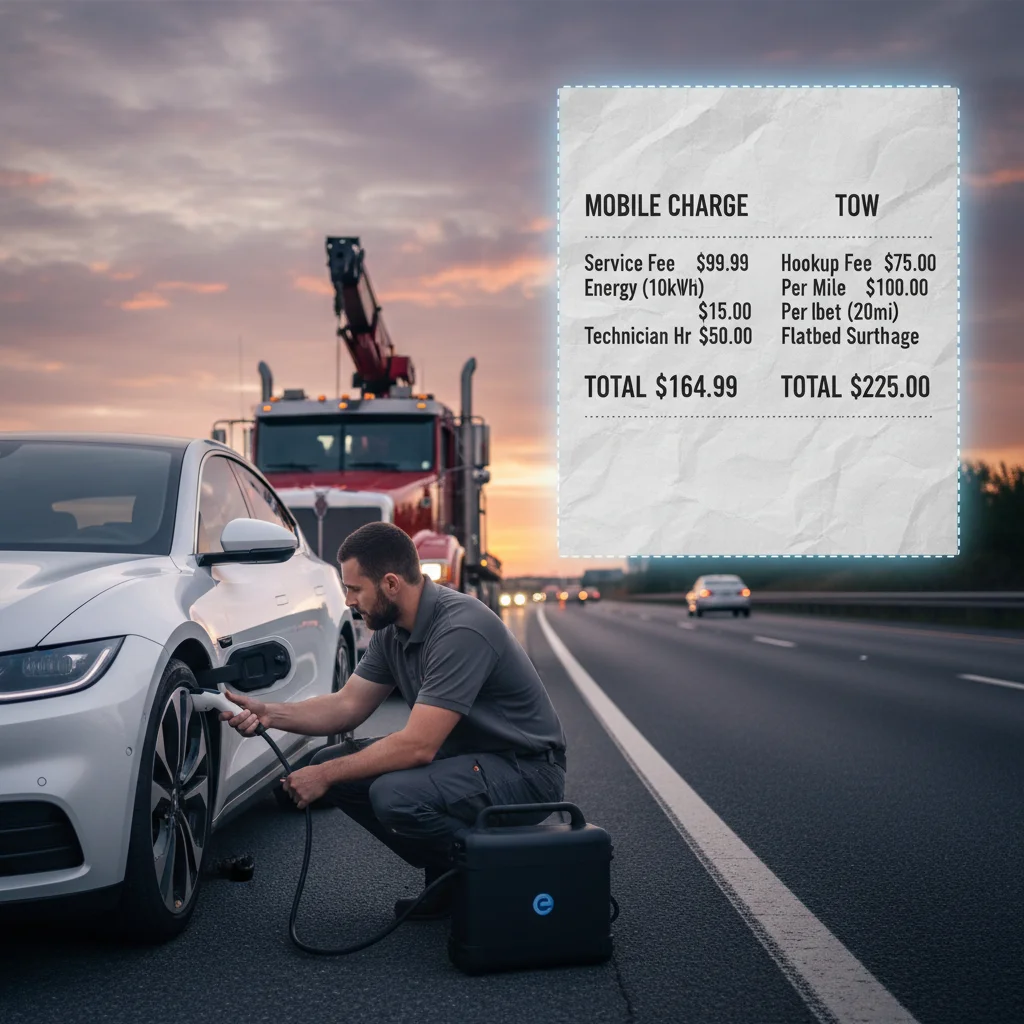
Free help that still leaves the pack empty
On covered Orange County freeways, Freeway Service Patrol is the cheap first call. It’s free, and that’s the point of the program. Confirm which stretches and hours are in force before you count on a truck. Coverage isn’t something to invent from the shoulder.
A patrol driver can make the scene safer. A patrol driver can’t charge a traction pack. Toll roads don’t always match the freeway map in your head. Confirm before you wait on SR-241 or another toll stretch. For the broader shoulder sequence, start with out of charge on an Orange County freeway. A separate walkthrough covers Tesla flat tire coverage, and Orange County’s free freeway option.
Patrol help still doesn’t add miles to the car. Once you’re out of the lane, it’s mobile charging versus a tow.
Time, distance, and why the quote shape differs
Tow cost climbs with miles, because the drop point is the meter. A short hop off SR-22 at the Crush is one conversation. A long haul from the San Clemente I-5 stretch is another. No per-mile tow rate was verified for this page. Get the miles and the rate from the dispatcher.
A mobile charge is quoted as a job, not as a taxi. You’re buying range at the bumper of your car. After-hours work can change either bill, and holidays can too. The operator still quotes you before starting work. You aren’t guessing when the work is done.
Don’t treat surge talk as a published Orange County tariff. No verified surge schedule turned up in this research. Ask for the number on the record, then decide.
When a tow is the right call anyway
An empty, healthy pack is a fuel problem. A red powertrain alert isn’t a fuel problem. A high-voltage battery fault isn’t one either. If the car is throwing those warnings, don’t add energy at the curb. Have it flatbedded to a qualified shop instead.
Tesla lists service in Costa Mesa, Buena Park, Santa Ana, Irvine, Anaheim, and Aliso Viejo. Confirm the current address on Tesla’s own finder before you roll. A collision center isn’t the same counter as a service center.
A dead 12V is a different failure from an empty pack. The car can look fully dead either way. Locks, screens, and the high-voltage system all lean on that small battery. Tesla’s Model Y owner’s manual notes a support loss after range hits zero. The low-voltage battery then needs external power before the pack can charge. The operators in this network jump or replace a dead 12V on site. That isn’t a reason to hook a flatbed first. See electric car died: should you charge, jump, or tow it for that fork.
If the car won’t roll, a tow can be the only path. Some structures won’t let a charging van in. Ask the operator what the site allows before you decide. Towing a dead EV in Orange County is the last move, not the first.
What Tesla, clubs, and insurance actually change
Tesla roadside assistance publishes 877-798-3752 as its number. Tesla’s roadside policy treats a depleted pack as the driver’s problem. Transport for that event isn’t the free, warrantable-breakdown benefit. That free transport runs up to 500 miles to the nearest service center. It covers a warrantable breakdown that leaves the car undrivable. Running out of charge sits outside that covered benefit. Tesla answers a dead pack with transportation, not with a charger at the bumper. Don’t count on Tesla sending a mobile charge.
AAA and insurer add-ons vary by plan. No verified 2026 benefit sheet for Orange County members is in this research. Don’t spend a long-distance tow benefit on a short charger hop. Your plan may still have a better use for that call. Confirm EV charging and flatbed rules with the club before you burn a call. If a club will only dispatch a tow, you still choose the destination. A charger is right for an empty, healthy pack. Sitting at the car for a Level 2 top-off can be cleaner than both.
How to choose in three checks
First, read the dash and the fault list. Empty with no fault is a charge job. Powertrain or high-voltage errors are a tow to a shop. A silent 12V death is often a jump.
Second, look at the road and the lot around you. Shoulder of the 5, the 405, the 91, or the 22: make the scene safe. Call patrol if you’re on a covered freeway, then decide charge versus tow. Theme-park structures in Anaheim are access problems as much as power problems. Beach lots along Huntington Beach or Newport work the same way. Tell the operator about gates, height limits, and attendants.
Third, ask what happens after the truck leaves. A mobile charge should leave you with about 10 to 20 miles. You should also have a path to a stall or to home. A tow should leave you at a site that can take your plug. Or it should leave you at a shop that can take the fault. If the drop is a crowded Supercharger, you’ve only moved the wait.
If the pack is empty and the car is otherwise fine
Charge Pro OC is a referral line for stranded EV drivers. It matches you with independent local operators in the county. It doesn’t hold a license, employ technicians, or own trucks. The operator on scene quotes you, then bills you.
Start with a charge at the car if the pack is empty. Skip that path if you have a red powertrain warning. Call (949) 444-0151 to be matched with an operator. An operator can add range where you sit, or jump a dead 12V.