Your Tesla sits dead on the I-405 shoulder. The app’s roadside tab and Tesla’s phone line look like the same rescue. Both reach a person at Tesla, and neither path brings a charger to the bumper.
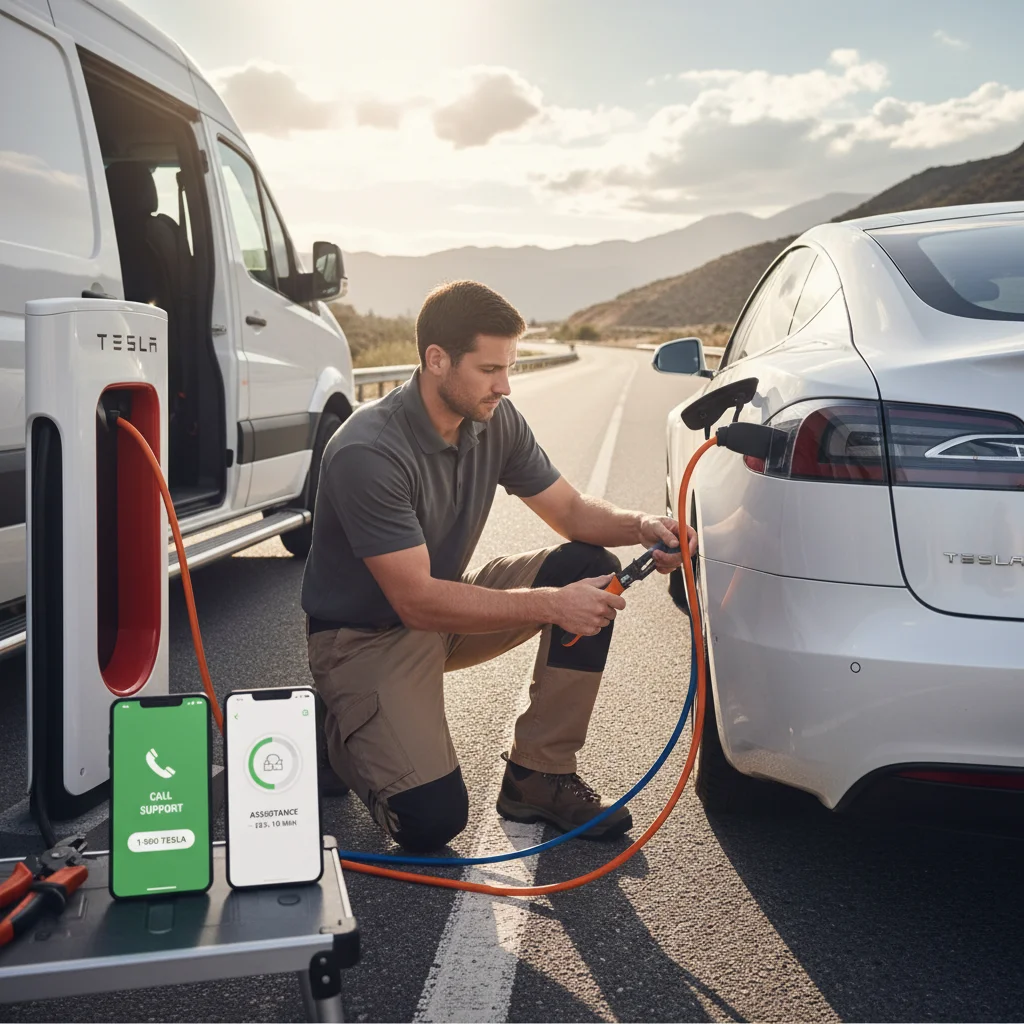
Orange County is a Tesla-heavy county, so this mix-up happens a lot. The California Energy Commission counted 138,121 Teslas here as of December 31, 2025. That’s 65.51% of the county’s 210,842 battery-electric cars. Owners treat the app and the phone as a speed contest. Both doors still open Tesla’s roadside network. Tesla’s own roadside policy answers a depleted pack with transportation, not with on-site charging. Confirm the live wording on Tesla’s roadside-assistance page before you rely on it.
What both paths actually get you
Search-index copies of Tesla’s roadside page were reviewed on September 5, 2026. Tesla can assist when you can’t make a charging station. That help isn’t a financially covered service. The ask is to arrange transportation, not a charge at the car. Covered transport of up to 500 miles is for a warrantable breakdown to the nearest Service Center. Running out of charge sits outside that bucket. Confirm those sentences on tesla.com, since the page blocked a direct fetch during research.
So app versus phone is a routing question, not a charging-product question. You’re asking who logs the ticket, not whether a 240V source rolls up. Tesla lists service centers in Costa Mesa, Buena Park, and Santa Ana. It also lists Irvine, Anaheim, and Aliso Viejo. Check Tesla’s findus list before you treat a pin as current. Street addresses were snippet-sourced, not opened as live pages. A tow toward one of those shops is the Tesla path. A charge at the bumper is a different trade.
The Model Y owner’s manual adds a technical reason this split matters. Once range is exhausted, the low-voltage battery can lose support. The high-voltage pack then needs external power before it can take a charge. A transporter moves the car. It doesn’t feed that 12V system unless the contractor brings jump gear. If the pack is empty, what Tesla roadside covers in Orange County is transport, not a curb charge.
How the app door works
Open the Tesla mobile app and find Roadside Assistance. Pick the issue from Tesla’s menu, then confirm the GPS pin your phone already has. Submit the request, and Tesla’s system logs a ticket and routes a contracted provider.
That menu is built for common bins: won’t start, flat tire, lockout, out of charge. The GPS pin is the real advantage. You aren’t reading a mile marker off I-5 to a stranger. The dispatcher sees coordinates, and the app can also push vehicle data with the ticket. A tech who already knows you have a 12V event shows up better prepared.
The app also leaves a timestamped record, so you’ve got a case number if you need to call later. A voice call doesn’t mint that trail unless you ask and write it down.
The weak spot is data, since a roadside request needs a live mobile connection. Voice can sometimes connect on a thin signal when the app won’t submit. We couldn’t confirm a public map of Orange County dead zones. If the spinner never finishes, stop tapping and dial instead.
How the phone door works
Tesla’s roadside number, as published on the Santa Ana service page, is 877-798-3752. Save it in your contacts on a calm day. The call reaches a North America agent, not a local Orange County desk. You describe the problem and confirm where you are. The agent enters the ticket and dispatches a contracted provider. That number is also on our Tesla roadside phone number explainer.
A live person helps when the dropdown doesn’t fit. A charge port that won’t release is a conversation. If you already filed in the app and no provider is assigned, call and escalate with the case number.
Hold time isn’t a figure we can publish as verified. Tesla doesn’t post a county-level wait. If an agent answers, you still land in the same contractor pool the app uses. Read the 2026 Tesla roadside policy for Orange County owners before you assume a free tow.
Orange County’s Tesla map isn’t the same as Tesla rescue
The county is dense with Tesla hardware. AFDC station data shows 48 Supercharger sites and 861 DC fast ports inside the county boundary. Irvine’s 1920 Main Street site lists 40 stalls. San Clemente’s Avenida Vista Hermosa site lists 49. Those counts describe plugs, not who Tesla sends when you can’t reach a plug.
Tesla holds 59% of Orange County’s public DC fast ports. That’s 861 of 1,452 countywide DC fast ports in the same AFDC pull. Owners feel surrounded by Tesla charging. Then they hit zero on SR-22 at the Crush, or on the 91. Empty pack versus a warrantable breakdown is the coverage line that decides what Tesla bills.
Public charging in the county is also tighter per EV than the state. The CEC counted 260,833 ZEVs here as of December 31, 2025, and 7,095 public ports. That’s 36.8 ZEVs per public port, against California’s 24.4. If Anaheim stalls are full, the app still only files a Tesla ticket. It doesn’t invent a charger at the curb.
When the app is the cleaner first move
Use the app when you’ve got data and the problem fits a menu item. Stay with the car if you can. You want the GPS pin and the ticket trail. Dead 12V, a pack at zero, a tire, a lockout: those are app-shaped. Submit, screenshot the confirmation, and wait for Tesla’s contractor note.
Don’t treat that confirmation as a charger on the way. Tesla is lining up transport or a contracted roadside stop. If the high-voltage pack is empty, plan for a tow conversation. If the 12V is the failure, say that in the notes. Tesla’s 12V-specific roadside wording couldn’t be confirmed on a direct page fetch. Confirm it in the app or with the agent. For the mechanical side, see Tesla 12V failure.
When the phone is the better door
Call when the app won’t send, the story is messy, or you already have a silent ticket. A voice agent can hear you’re on the SR-241 shoulder. They can hear the app never submitted. You still get Tesla’s network, and you just skip the dropdown.
If you’re on a freeway shoulder, stay with hazards on. Get out only if you’re safer off the lane. That’s basic shoulder sense, not a Tesla rule we can quote. Tesla’s published policy file is the North America roadside PDF on tesla.com. Open it before you need it.
What a local mobile operator does instead
The operators Charge Pro OC matches you with are a parallel path. They aren’t Tesla, and they don’t replace Tesla’s warranty desk. Independent local mobile rescue operators bring a 240V Level 2 source to the car. Tesla cars take a native NACS plug, and other EVs use a CCS or J1772 adapter. A typical session adds 10 to 20 miles of range. That’s 15 to 30 minutes of charging at the bumper, not an arrival window.
Those same operators can jump or replace a dead 12V on site. That matters when the car looks fully dead and the pack still has range. Tesla transport still has a role when the car is unsafe to drive. On-site charging is what you want for an empty pack you can still drive.
Read how that referral works on the Tesla roadside rescue page. The operator quotes you before any work starts and bills you directly. Charge Pro OC doesn’t set the price, own trucks, or employ technicians. The same matching line covers every city in the county. For the charging map, start at EV charging in Orange County.
If you’ve got data, file in the Tesla app first so the GPS pin is clean. If the app fails, call 877-798-3752 and ask whether they’re sending transport. If you need range, not a hook, leave Tesla’s two doors. Call Charge Pro OC at (949) 444-0151 and ask to be matched with a local operator. Name the Tesla, your spot, and 12V versus a zero pack. Don’t wait on a path that can’t bring electrons. The app and the phone both reach a person. That person works Tesla transport, and a mobile charge is a different call.