Teslas were 65.51% of Orange County’s battery-electric fleet on December 31, 2025. That’s 138,121 cars, per the California Energy Commission. A Tesla that won’t wake here is often the 12V. The traction pack can still be full.
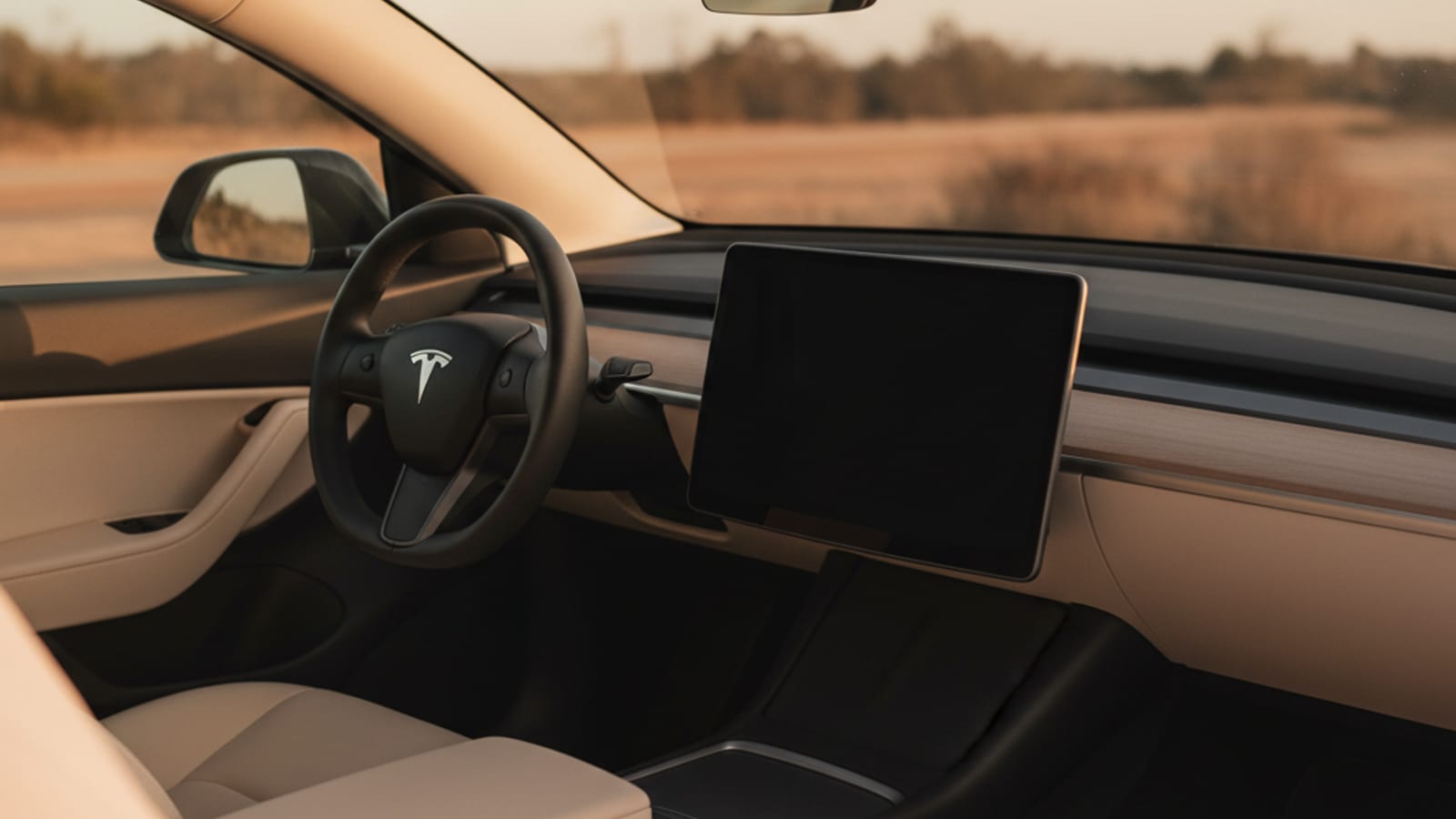
Handles stay flush, and the screen stays black through the glass. The app says the car is offline. That cluster is the small battery, not a ruined pack.
How a dead Tesla 12V actually looks
A dead 12V fails as a group of symptoms, not one odd light. The center display is black, and flush handles never present when you walk up. The Tesla app reports the vehicle offline, and the in-app frunk release does nothing. Interior lights, horn, and signals stay dark, and the charge port stays locked.
If only one of those is true, pause. A live screen with a stuck handle is often a door module. If the driver’s handle presents and the rest don’t, that’s not the 12V. For earlier warning lights, see Tesla 12V clues you can catch before a stranding. The pack-versus-12V split is in Dead Tesla: how to tell 12V failure from a dead pack.
Why Orange County sees this so often
Orange County is more Tesla-heavy than California as a whole. Statewide, Teslas are 61.34% of battery-electric cars. Here they’re 65.51%, 6.4 points above the state, per CEC make data. The county had 210,842 battery-electric cars on the road at the end of 2025. A 12V failure on this fleet looks like a total dead car. That’s why it shows up as a common roadside call.
Those cars also sit in places that quietly drain the 12V. Theme-park lots in Anaheim keep Sentry running for hours. Beach parking in Huntington Beach and Newport Beach adds a long sit. HOA garages in Mission Viejo and Aliso Viejo can leave a car untouched for days. Sentry keeps cameras awake. Cabin overheat protection cycles the climate system in inland heat. Both draw on the 12V. The main pack tops it up, but only while the pack still has charge.
Inland north county runs hotter than the coast. Yorba Linda, Anaheim, Fullerton, and Brea bake a cabin the marine layer never cools. Leave Sentry on at a low state of charge and the 12V can starve. Tesla’s Model Y owner’s manual notes a related trap. Once the high-voltage pack is exhausted, the low-voltage battery can lose support. You then need an outside 12V source before the pack will take a charge.
This failure also shows up on the shoulder. A Tesla that went dark on I-405 or the 91 is often the 12V. Stay with the car, and don’t walk the shoulder hunting a stall.
Being next to a Supercharger doesn’t help if the 12V is dead. Irvine’s site at 1920 Main St has 40 stalls. Orange County had 7,095 public ports at year-end 2025. A flat 12V still won’t let you use them.
What that small battery is actually for
Every production EV, Tesla included, has a 12V battery besides the traction pack. Older cars used a lead-acid AGM unit. Newer Model 3, Y, S, and X cars shipped with a lithium 12V. Tesla doesn’t publish a replacement interval we could confirm for this piece. Check the service screen on your car, and the owner’s manual for your model. Do Teslas have a 12V battery? A model-by-model guide maps where it sits.
The 12V doesn’t move the car. It wakes handles, screens, lights, locks, and the contactors. The contactors have to close before the traction pack can feed the motors. No 12V means those contactors stay open. That’s why a pack at 90% can still leave you locked out.
Age wears the battery. Tesla’s service screen may show a low-voltage warning days or weeks ahead. If you’ve seen that message, a jump is a temporary fix. Plan a replacement through Tesla or an independent shop. No verified price turned up for this piece. Ask the shop for the current figure.
Jump it without making the car worse
Don’t jump from a running gas car. A running engine can push more than 12 volts at high current. Tesla’s 12V circuit isn’t built for that. You can damage the converter that keeps the 12V charged. Use a dedicated lithium jump pack rated for 12 volts.
The access point depends on the model. Follow Tesla’s published tow-hook path. For the click-by-click version, use Tesla won’t crank: jump-start steps for Model 3, Y, S, and X.
Model 3 and Model Y
Tesla put emergency jump terminals behind a small cover on the front fascia, driver’s side. It’s the tow-eye door, a rectangular insert a couple of inches wide.
Press one edge until it pops. If it fights you, a thin card under the top edge usually frees it. You’ll see a red positive lead and a black ground. Clip the jump pack, red to positive, black to ground. Wait about 30 seconds. The frunk should unlatch. Pull the interior release and open the hood. The real 12V terminals are in the frunk once you’re in.
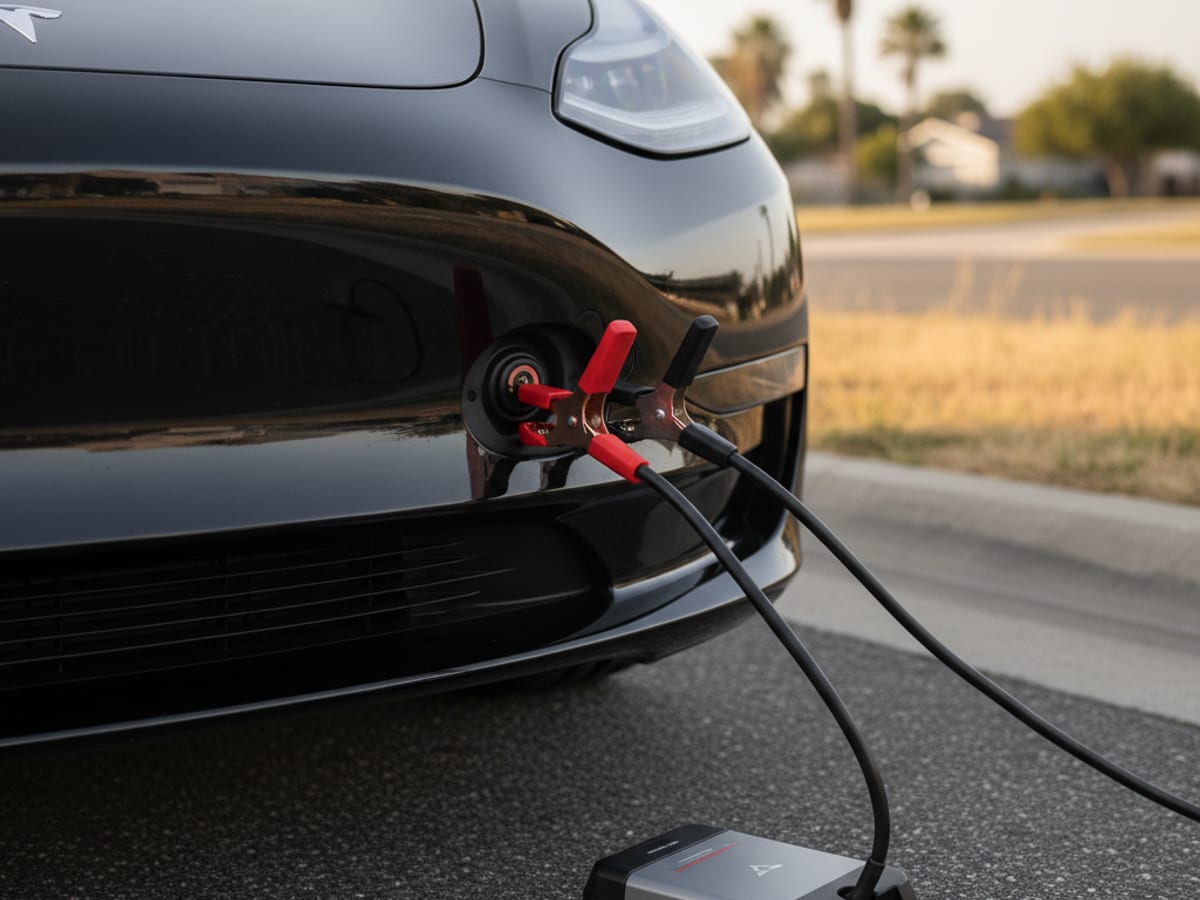
Newer 3 and Y cars with a lithium 12V use the same bumper access. Lithium 12V dead on a newer Model 3 or Y: your next steps covers that split.
Refreshed Model S and Model X
On 2021 and later S and X cars, Tesla moved the 12V rearward. There’s no front tow-eye jump point. Use the mechanical door release by the window switch. Once you’re in, find the manual frunk release in the footwell or under the carpet. Open the frunk. Jump terminals are inside.
Older Model S and Model X
Pre-2021 S and X cars keep the 12V in the frunk. The front fascia still has tow-style jump points. Treat them like the Model 3 path.
After it wakes, pick the next move
Tesla often flags a weak 12V in service menus before a full failure. If that warning already appeared, replace the battery. A jump gets you off the street. It doesn’t restore a worn cell.
If the car sat for weeks near empty, the 12V may have been healthy. The car shut systems down to protect itself. Plug into Level 2 once the 12V is up. After a stretch of charging, the car should hold a wake on its own. Local operators in this referral network typically add 10 to 20 miles of range. That takes 15 to 30 minutes of charging at the car. That’s charge time, not an arrival time.
Tesla has service centers in Costa Mesa, Buena Park, Santa Ana, and Irvine. There are also shops in Anaheim and Aliso Viejo. Confirm hours and 12V parts on Tesla’s own finder before you drive in. Street addresses for those shops weren’t verified from a page we could open for this piece.
Tesla’s roadside page, as indexed for this piece, answers a dead pack with paid transport. It isn’t a covered tow. Free transport up to 500 miles is for a warrantable breakdown that leaves the car undrivable. Running out of charge sits outside that. Tesla’s 12V-specific roadside wording couldn’t be confirmed from a page we could open. Call Tesla at 877-798-3752 to ask.
When to stop DIY and call a local operator
Call if you can’t pop the frunk. Call if a jump fails again within a day. Call if the car wakes and throws service alerts. Call if you have no jump pack.
Charge Pro OC is a referral line. It matches stranded EV drivers with independent local mobile rescue operators. It performs no work, owns no trucks, and employs no technicians. It doesn’t set prices or publish hours. The operator quotes you before starting and bills you directly. Pros in the network can jump or replace a dead 12V on site. They can also bring a 240V Level 2 source if the pack itself is too low. That source uses a native NACS plug, or a CCS or J1772 adapter.
For the on-car service path, see Tesla 12V battery jump and Tesla roadside rescue.
A dead 12V in this Tesla-heavy county is a common call, not a mystery. Diagnose the cluster of symptoms. Jump from a pack, not a running engine. Then replace a tired 12V or charge a starved pack. If you can’t get in, call (949) 444-0151. We’ll connect you with a local operator who can.