The Tesla roadside assistance number on Tesla’s Santa Ana service page is 877-798-3752. That’s the factory roadside desk for Orange County Tesla owners. Save it in your phone today, then learn what that desk actually sends. An empty pack isn’t a warrantable breakdown. Tesla’s published policy treats those two problems as different jobs.
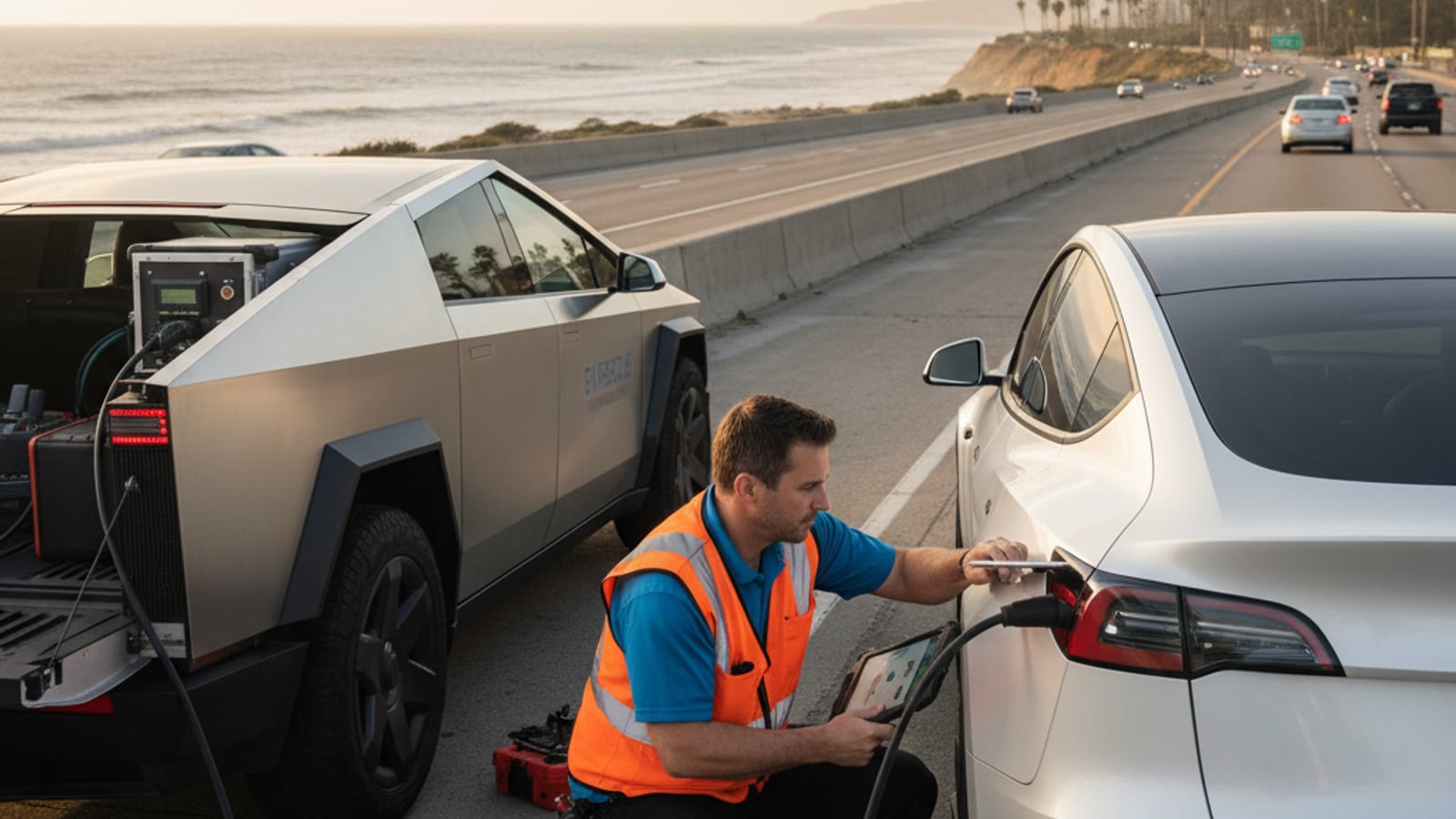
Your Model Y can quit on the 91 through Anaheim. A Model 3 can go dark in a Tustin office garage. A Model X can sit at 1008 17th Street in Santa Ana. The search is the same each time. People type tesla roadside assistance number and expect a charger on a truck. Tesla’s own roadside page was indexed for this article. It says a depleted battery isn’t a financially covered service. Tesla can still help, and the help it describes is transportation. Charge Pro OC is a referral line. It matches you with independent local operators. Those operators bring 240V to the car.
Tesla’s published number, and how you reach that desk
Tesla lists 877-798-3752 on the Santa Ana service page. That’s the number to use from a Costa Mesa lot. It’s the same number from Buena Park auto row. It’s the same number from a San Clemente beach street. You can also open the Tesla app and tap Roadside. The app can pass your VIN and live location. That saves you from spelling a mile marker over wind noise.
Keep the phone number anyway. Cell service drops on Santiago Canyon Road. A dead 12V can leave the car and the app both asleep. If the phone in your pocket still has signal, use Tesla’s published line, 877-798-3752.
Before you call, grab three facts. Your VIN sits on the title, the app, and the windshield sticker. Your location should be a freeway, an exit, and a cross street. Your problem should be one sentence. Empty pack, dark screens, and a car that won’t unlock are different failures.
Tesla also publishes a North American roadside policy PDF. Open that file before you assume a repair is free. The file lives on tesla.com under Updated_NA_Roadside_Policy_0.pdf. Confirm the live wording in a browser. This research couldn’t fetch Tesla support pages directly. They returned HTTP 403 to automated requests.
App, phone, or both
The app is convenient when the car still talks to the network. It’s a poor plan when the car is a brick. A lithium 12V on a newer Model 3 or Y can fail with little warning. Then the screens stay black. The handles may not present. The app may show the car offline.
Call Tesla on the published number if the app won’t load Roadside. You can also call a local referral line after you sort the two jobs. Tesla’s desk is the path for a warrantable breakdown. A local operator is the path for range or a 12V wake-up. For a longer split on those two routes, read Tesla roadside by app or by phone.
What Tesla says it’ll do when the pack is empty
Tesla’s roadside-assistance page, as captured in search snippets on 2026-09-05, is blunt. When the charge is gone, Tesla is able to assist you. That assistance isn’t a financially covered service. You contact Tesla Roadside Assistance to learn more. You can also arrange transportation. Confirm that wording on Tesla’s live support page before you rely on it.
The same page ties free transport to a different event. Tesla describes transportation of up to 500 miles to the nearest Service Center. That’s for a warrantable breakdown that leaves the car undrivable. Running out of charge sits outside that bucket. Tesla can still tow an empty car. It bills that move as paid transport, not as covered service. This article doesn’t publish a price. Ask Tesla’s desk what it’ll bill for your VIN.
Don’t wait for a charger on that truck. Tesla’s published roadside answer for a depleted pack is transport. That means a ride to a charger or a service bay. It isn’t an on-site charge at the bumper. That distinction matters on I-5 south of Irvine. It matters in a Huntington Beach lot after a long beach day. A flatbed is a long way to move a car that only needs miles.
Tesla’s Model Y owner’s manual adds a technical catch. Once range is exhausted, the low-voltage battery can lose support. The high-voltage pack then won’t take a charge. It needs an external power supply to wake the low-voltage side. That’s why a dark, empty Tesla can look like a total loss. It may only need a 12V boost, then a Level 2 session. Tesla publishes that entry in the Model Y owner’s manual.
For what Tesla covers versus what it bills, see what Tesla roadside assistance covers.
Why this county dials that number so often
Orange County is a Tesla-heavy market by government count, not by guesswork. The California Energy Commission vehicle file is the source. Data as of December 31, 2025 puts 210,842 battery-electric cars on Orange County roads. Teslas are 138,121 of those BEVs, or 65.51% of the county’s battery-electric fleet. Statewide, Tesla is 61.34% of BEVs. Orange County is 6.4 points more Tesla-concentrated than California as a whole.
ZEVs as a group are 260,833. That’s 10.56% of the county’s light-duty fleet. BEVs alone are 8.54% of that fleet. California’s ZEV share of the light-duty fleet is 7.54%. Orange County holds 12.02% of California’s battery-electric vehicles. It’s 8.33% of the state’s light-duty fleet.
New-sale data tells the same story, with a caveat. In 2025, Orange County’s ZEV share of new light-duty sales was 28.76%, against California at 22.93%. In 2026 Q2, Orange County was 24.77% and the state was 19.09%. The county runs about 5 to 6 points above the state. The trend isn’t a straight climb. California’s ZEV share of new sales peaked at 25.31% in 2024. 2026 Q1 was the weakest quarter in that series at 15.76%. CEC also changed its new-sale method in 2023 and again in 2025. Year-over-year comparisons across those breaks aren’t clean.
Tesla’s share of new Orange County ZEV sales moved around too. It was 56.9% in 2023 and 47.2% in 2024. It was 44.7% in 2025 and 56.4% in the first half of 2026. The installed fleet is still majority Tesla. That’s why a Santa Ana roadside number is a daily search here.
Public charging didn’t keep the same pace. CEC’s charger file is dated December 31, 2025. It counts 7,095 public ports in Orange County. That’s 20 Level 1, 5,600 Level 2, and 1,475 DC fast. Shared private ports add 4,685. Orange County holds 7.75% of California’s public ports. The ratio that matters is ZEVs per public port. Orange County has 36.8 ZEVs per public port. Statewide it’s 24.4, so more EVs share each public plug here than in California as a whole.
Superchargers Tesla already built in Orange County
Tesla still owns most of the fast-charge map. Federal AFDC station data is the inventory used here. The filter is Tesla DC fast sites inside the county boundary. That filter shows 48 Supercharger sites and 861 DC fast ports. Countywide there are 223 DC fast stations and 1,452 DC fast ports. Strip out Tesla and you have 175 stations and 591 ports. Tesla holds 59% of Orange County’s public DC fast ports.
You can name real stalls. San Clemente at 101 W Avenida Vista Hermosa lists 49 stalls. Tustin at 14661 Franklin Ave lists 36. Garden Grove at 12891 Harbor Blvd lists 32. Irvine at 1920 Main St lists 40. Santa Ana at 1008 17th St lists 28 stalls at up to 325 kW. Buena Park at 8888 Knott Ave lists 28. Huntington Beach at 6913 Warner Ave lists 24 at up to 325 kW. Brea Mall at 1065 Brea Mall lists 20. Anaheim has 20 stalls at 1734 W Lincoln Ave. It has another 20 at 2270 E Lincoln Ave. Cypress lists 16 stalls at 4959 Katella Ave.
Mission Viejo at 555 The Shops lists 10 stalls. Tesla’s own findus page rates those stalls at up to 72 kW. Use Tesla’s 72 kW figure there. AFDC’s power field isn’t always right. Lake Forest added a Magic Dock site at 24372 Rockfield Blvd. AFDC lists 16 stalls at up to 325 kW, with CCS1 and NACS. Garden Grove at 12161 Valley View St lists 16 stalls at up to 500 kW. Fountain Valley has sites at 17940 Newhope St and 9430 Warner Ave. Fullerton has Harbor Blvd and Orangethorpe. Yorba Linda has two small sites on Yorba Linda Blvd, eight stalls each.
Laguna Hills has Moulton Parkway and Cabot Road. Each site lists 16 stalls at up to 250 kW. Newport Beach lists 12 stalls at 4241 MacArthur Blvd. San Juan Capistrano has Verdugo Street and Camino Capistrano. Those sites help when you can still drive to them. They don’t help when the car is already sitting on the shoulder. For a county map of charging and city pages, start at EV charging in Orange County.
Service centers Tesla lists in this county
Tesla’s findus list shows service in six Orange County cities. That list came from search snippets, not a live page fetch. Costa Mesa has two listings, on Pullman Street and Cadillac Avenue. Buena Park lists Auto Center Drive. Santa Ana lists South Standard Avenue. Irvine lists Barranca Parkway. Anaheim lists East La Palma Avenue. Aliso Viejo lists Aliso Creek Road. Confirm each address on tesla.com/findus before you navigate there. This research couldn’t open Tesla’s California service-center list directly.
A warrantable breakdown still belongs on Tesla’s line. That’s the path to a Service Center tow. Tesla publishes a 500-mile transport rule for covered failures. An empty pack on the 405 doesn’t become a covered failure. Proximity to the Costa Mesa shop doesn’t change that.
When Tesla’s number is the right first call
Call 877-798-3752 when the car has a mechanical failure Tesla should own. A warrantable breakdown that leaves you undrivable is that case. Tesla’s policy language points you at transport to the nearest Service Center. Ask the desk whether your VIN is in warranty. Ask whether this failure is covered, and don’t guess. This article can’t invent a year or mileage cap. Tesla’s live policy PDF lists what’s in and what’s out.
Call Tesla first if you already opened a service ticket. Call Tesla first if a warning names a high-voltage fault. A low state of charge is a different job. A local operator can charge a healthy pack. A local operator isn’t a Tesla Service Center.
Santa Ana is a useful example. The city has a Tesla Service Center listing. It also has two Supercharger sites. Those sites are 300 E 5th St and 1008 17th St. Downtown streets still fill with cars that won’t move. A dead pack or a dead 12V is often a stay-put job. Charging on site beats a hunt through downtown. For that local pattern, see EV roadside assistance in Santa Ana.
When a local operator is the better path
Charge Pro OC doesn’t own trucks. It holds no licence and employs no technicians. It sets no prices and promises no arrival time. It’s a referral line. It matches stranded EV drivers with independent local mobile rescue operators. The operator quotes you before work starts. The operator bills you directly.
What those operators do is simple. They bring a 240V Level 2 source to the car. Teslas take a native NACS plug. Other EVs take a CCS or J1772 adapter. A typical session adds 10 to 20 miles of range. That takes 15 to 30 minutes of charging. It isn’t a promise about when someone arrives. Operators can also jump or replace a dead 12V on site. They handle Tesla and every major EV brand.
That’s the job Tesla’s roadside page doesn’t describe. You may only need enough range to reach 1920 Main St in Irvine. You may only need Harbor Blvd in Fullerton. A Level 2 session at the bumper can be the whole fix. If the screens are black and the pack has miles, start with the 12V. A jump can wake the car. Don’t load a Tesla on a flatbed for a 12V fault.
The Tesla roadside rescue page explains how that referral works. For the charge itself, see mobile EV charging. For a dark car, see Tesla 12V battery jump.
Empty on the freeways this county actually drives
You can stall on I-5 through Irvine and down toward San Clemente. You can stall on I-405 through Costa Mesa and Fountain Valley. The 91 across Anaheim and Fullerton stacks up around the theme-park exits. SR-22 through the Orange Crush mixes three freeways in a short knot. SR-241 is a toll road through the foothills. Santiago Canyon Road and Ortega Highway are two-lane grades, not mall frontage. Laguna Canyon Road is a climb with little room on the edge.
If the pack hits zero on any of those roads, stay out of live lanes and set the hazards. Stay with the car if it’s safe to sit there. Then pick a desk. Tesla’s number arranges transport, and a local operator brings 240V. Neither option is a reason to walk along the 405.
You don’t need a hunt for another stall while the car is already dead. Named Superchargers exist across the basin cities. Anaheim, Brea, Buena Park, Costa Mesa, and Cypress have Tesla DC fast sites. So do Fountain Valley, Fullerton, Garden Grove, Huntington Beach, and Irvine. So do Laguna Hills, Lake Forest, Mission Viejo, Newport Beach, and San Clemente. So do San Juan Capistrano, Santa Ana, Tustin, Westminster, and Yorba Linda. If you can still roll, those are real AFDC-listed sites. If you can’t roll, the site down the road isn’t the plan. The plan is power at the bumper. The other plan is a tow Tesla will quote as unpaid transport.
Non-Tesla DC fast sites exist too. Electrify America lists a 12-port site at 25825 Las Vegas in Capistrano Beach. It lists a 10-port site at Walmart on Euclid in Anaheim. Fashion Island in Newport Beach has eight Electrify America stalls. EVgo lists 14 DC fast ports at Plaza Antonio in Rancho Santa Margarita. It lists four at 801 Pacific Coast Hwy in Seal Beach. Those plugs help a car that can still drive. They don’t replace a truck when the Tesla is already sitting.
When the car is dark, not empty
A Tesla can look fully dead while the high-voltage pack still holds range. The 12V runs the computers, the locks, and the contactors. Newer Model 3 and Model Y cars use a lithium low-voltage pack. If that small battery is down, nothing wakes. Owners often call this a dead main battery, and it frequently isn’t.
Tesla’s owner’s manual describes a related failure after you hit true zero. The low-voltage side can lose support. The high-voltage pack then won’t charge. It needs something outside the car to power the low-voltage system. That’s a roadside job, not a Service Center mystery by default.
Symptoms are dull and consistent. There’s no screen and no chime. Doors that won’t release. An app that shows the car offline. If you had range on the display ten minutes ago, start with the 12V. You may have both problems after a canyon grade. The pack can sit at zero. The low-voltage system can drop out at the same time.
Operators in the referral network can jump or replace that 12V on site. Then they can add Level 2 range if the pack is also empty. Tesla’s desk can arrange a tow. Ask which problem you actually have before you request a flatbed.
What to have in the car before you need either number
Keep a charged phone and a small power bank. The Tesla app and a voice call both die with your battery. Keep the mobile connector if you have one. It won’t save you on a freeway shoulder. It can matter in a friend’s garage. Teslas don’t ship with a spare. Confirm tire help on Tesla’s live policy page.
Know your VIN and which model you drive. A Model S tow is a different conversation from a Model 3 12V jump. In a Lake Forest, Ladera Ranch, or Irvine HOA garage, know the gate code. Know the stall number too. Operators need a way in. Tesla’s tow contractor will too.
Don’t treat a public stall as a reservation. Irvine’s 40-stall site at 1920 Main St is large, and it still fills. Garden Grove’s Harbor site is large, and it still goes offline. A packed Supercharger is a reason to call for a charge at the car. It isn’t a reason to sit in a fire lane.
Frequently asked questions
What’s the Tesla roadside assistance number in Orange County?
Tesla’s Santa Ana service page lists 877-798-3752. That’s the United States roadside desk Tesla publishes for local owners. You can also request help in the Tesla app under Roadside. If the car is dark and the app is offline, use the phone number.
Does Tesla send a charger when the pack is empty?
Tesla’s roadside page, as indexed here, says a depleted battery isn’t financially covered. Tesla is able to assist. The help it describes is transportation. Confirm the live wording on Tesla’s support site. Also open the North American roadside policy PDF. Local operators in this referral network bring 240V Level 2 to the car instead.
What if my Tesla won’t wake up at all?
A fully dark Tesla is often a 12V, or low-voltage, failure. It can also be a pack at true zero. That then starves the low-voltage side. Tesla’s Model Y manual says the high-voltage pack may not charge. It may need an external supply to support the low-voltage battery. Call Tesla at 877-798-3752 for the factory desk. Use the local referral line if you want an on-site jump and a Level 2 charge.
When you want that local backup, call (949) 444-0151. We’ll match you with an independent operator. The operator quotes you before any work starts. The operator bills you directly. Tesla’s number stays 877-798-3752. Keep both.