Tesla roadside assistance covers a warrantable breakdown that leaves the car undrivable. An empty traction pack is a different problem. Tesla’s published policy answers that one with transport, not a plug. Orange County drivers hit this split often. Teslas are most of the battery-electric fleet here.
What Tesla actually publishes
Tesla’s roadside page was checked through public search on September 5, 2026. Confirm the live wording at tesla.com/support/roadside-assistance before you rely on it. Direct fetches of that page were blocked during research. Treat what follows as Tesla’s published position, not a private transcript.
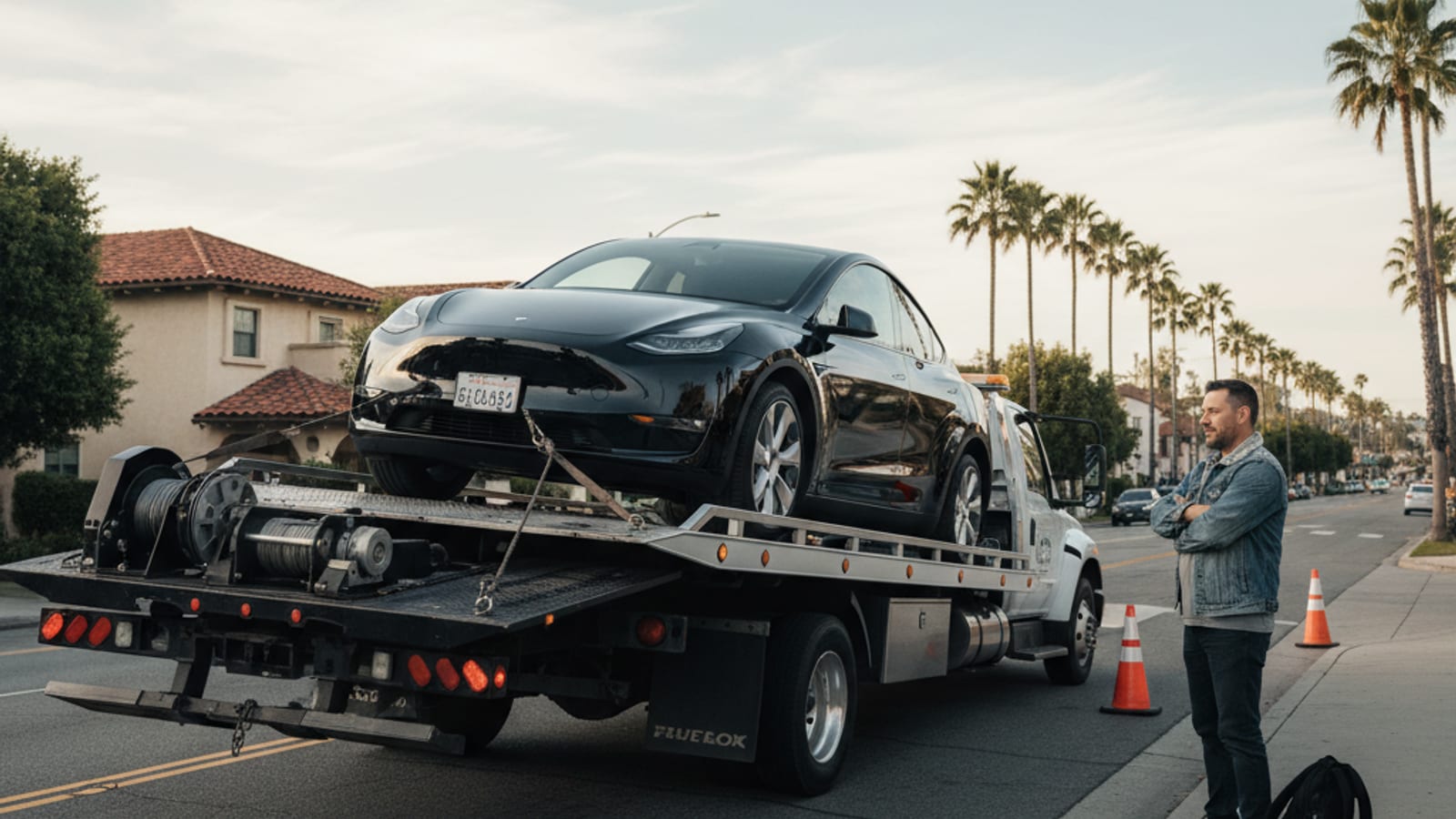
If the high-voltage pack is depleted, Tesla says it can still help. That help isn’t a financially covered service, so Tesla describes transportation next. Tesla doesn’t describe charging the car on the shoulder.
Tesla describes transport of up to 500 miles for a warrantable no-drive. That ride goes to the nearest Tesla Service Center. Running out of charge sits outside that covered trip. Read empty pack versus a warrantable breakdown for the same split in more detail.
The full covered and excluded list lives in Tesla’s North America roadside policy PDF. Open the current file in a browser and read it for your VIN. Tesla also lists 877-798-3752 on its Santa Ana service page. You can request help in the Tesla app as well.
Don’t assume a tire, a lockout, or a 12-volt jump is included. Those line items weren’t confirmed from a page we could open. Check the policy PDF and the in-app request flow.
Why this split matters in Orange County
Orange County is a Tesla-heavy county by the state’s own count. As of December 31, 2025, CEC counted 210,842 battery-electric cars here. Teslas were 138,121 of those BEVs, or 65.51 percent. That share sits 6.4 points above California’s Tesla share of BEVs. Orange County holds 12.02 percent of California’s battery-electric vehicles.
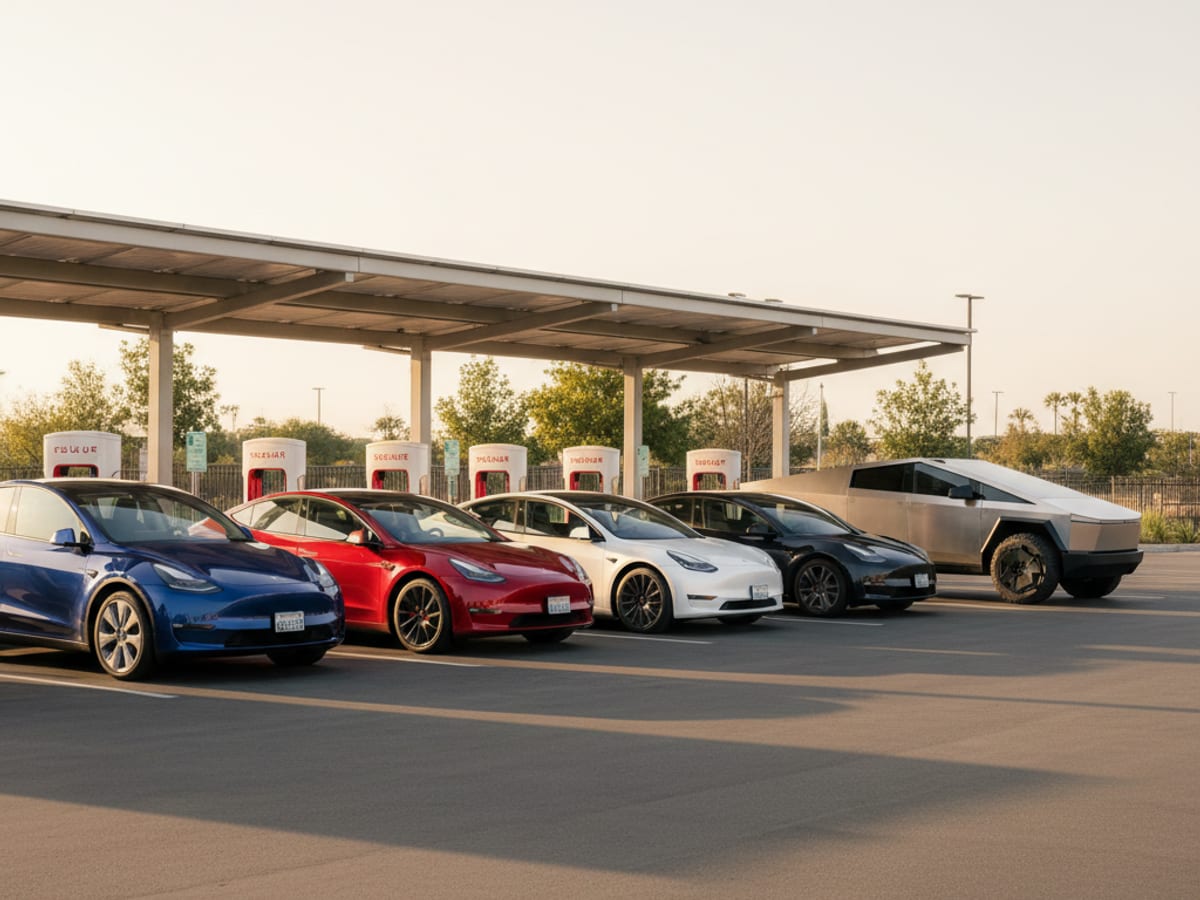
Those cars have a large Supercharger map to aim at. Federal AFDC data puts 48 Tesla Supercharger sites inside the county line. Those sites hold 861 DC fast ports among them. Tesla holds 59 percent of Orange County’s public DC fast ports.
Named sites include 40 stalls at 1920 Main St in Irvine. San Clemente has 49 stalls at 101 W Avenida Vista Hermosa. Tustin has 36 stalls at 14661 Franklin Ave. Mission Viejo’s site at 555 The Shops is smaller, and slower. Tesla lists those 10 stalls at up to 72 kW.
A tow to a stall is still a tow. The car sits on a bed, then waits for a plug. An open stall when the flatbed arrives isn’t a fact anyone can promise.
Countywide, Orange County had 7,095 public charging ports as of December 31, 2025. It also had 260,833 ZEVs on the CEC light-duty count. That’s 36.8 ZEVs per public port, against California’s 24.4. The county is worse served per EV than the state. A covered ride to a Supercharger isn’t always the shortest path home.
What a warrantable truck is for
Tesla lists service centers in Costa Mesa, Buena Park, and Santa Ana. Irvine, Anaheim, and Aliso Viejo have shops on Tesla’s list too. Confirm the current street address on tesla.com/findus before you navigate. Search snippets named those shops, and the pages weren’t opened directly here.
If a covered part fails and the car won’t drive, that’s Tesla’s warrantable path. Published transport aims at the nearest Service Center, up to 500 miles. You still confirm coverage in the app for your VIN.
A collision isn’t a job for a charging truck. A mechanical no-start that isn’t an empty pack belongs with Tesla. Tesla roadside rescue is the local backup for an independent operator at the car.
The arriving truck may be a Tesla crew or a contracted tow partner. Tesla doesn’t publish a named Orange County partner, so we can’t name one.
What Tesla sends when the pack is empty
Tesla’s published answer is a ride, not a plug. The car goes on a truck toward a charger, or wherever you arrange. That depleted-pack transport isn’t the covered warrantable trip. See what Tesla roadside actually treats as free for billed versus covered help.
Tesla’s Model Y owner’s manual adds a technical wrinkle. Once range is exhausted, the low-voltage battery can lose support. The car may then need outside power before the pack will accept a charge. An empty pack and a sleeping 12-volt can show up together. A tow to a Supercharger doesn’t jump the 12-volt on the way.
A local 240V option at the bumper
Charge Pro OC is a referral line for Orange County. We match stranded EV drivers with independent local operators. We don’t own trucks, employ technicians, or set prices. The operator quotes you before any work starts, and bills you directly.
What those operators bring is a 240V Level 2 source to the car. Teslas take a native NACS plug on site. Other EVs use a CCS or J1772 adapter. Typical charging time is 15 to 30 minutes at the bumper. That window usually adds about 10 to 20 miles of range. That’s session time at the car, never an arrival window. The same visit can jump or replace a dead 12-volt battery.
That’s the coverage stop Tesla’s policy leaves open. Tesla then answers a dead pack with transportation. A mobile EV charging stop answers it with enough range to drive. For the hardware on the bed, see what an EV charging truck actually brings.
Operators cover Tesla and every major EV brand. If you’re empty on a freeway shoulder, stay put with hazards on. For the empty-Tesla sequence, use Tesla at zero on an Orange County road.
When Tesla roadside is the first call
Call Tesla first when the car has a warrantable failure. A covered breakdown that needs the Service Center is their job. Use the app or 877-798-3752 for that request. Read Tesla’s current policy PDF so you know what they’ll send.
Call Tesla first when the problem isn’t an energy problem. If you need covered transport under the warrantable rule, start there. Don’t wait on a charge truck for a car that still can’t drive.
When a 240V truck is the better fit
Call a local operator when the pack is empty and nothing else is broken. You want to leave under the car’s own power.
Call a local operator when a dead 12-volt keeps the car asleep. Tesla’s 12-volt roadside language couldn’t be confirmed from an open page. A mobile tech with a jump pack can still work that curb.
Call a local operator when you’re already parked. Irvine’s Main Street Supercharger is large, and so is San Clemente’s Vista Hermosa site. You still have to get the car there first. A Level 2 session where you sit skips that hop.
You can start both requests at the same time. Open Tesla in the app, and call a local operator through our line. Cancel the one you don’t need once a workable plan is in motion.
What the pros we send won’t do
The pros we connect you with don’t fix tires. They don’t winch a car out of sand or clear a collision. They don’t diagnose a failed high-voltage pack either. If that’s your problem, say so on the call. We’ll point you back to Tesla or a tow.
They also don’t promise an open stall at 1920 Main St. The same goes for 2404 E Katella Ave in Anaheim. Public hardware is real, but an open stall isn’t a fact we can guarantee.
Stay with the car in a safe spot. On the 5, the 405, or the 91, stay off the travel lanes. Call Tesla if you think this is a warrantable no-drive. Call us at (949) 444-0151 if the pack is empty. Ask for a 240V quote at the car.
Ask Tesla, in the app, whether this event is covered transport or paid transport. Ask the local operator for a price before they roll. Keep both answers, then pick the path that gets the car moving.
Tesla roadside is the right tool when a covered part fails. It’s a tow plan when you simply ran the pack down. Orange County has Superchargers, and more than 210,000 battery-electric cars sharing them. A local Level 2 visit is the option Tesla’s policy doesn’t send.