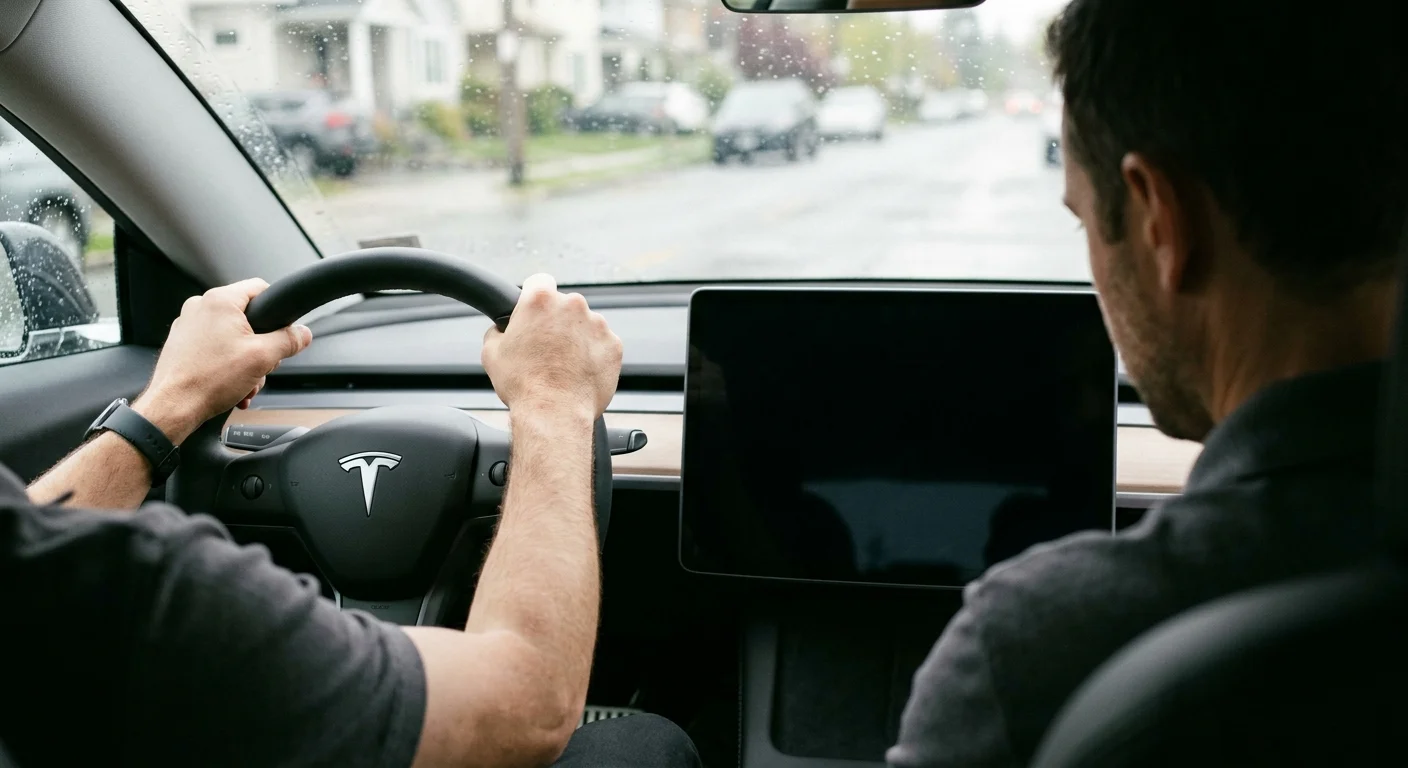
A 2023 Tesla Model 3 can look fully dead after a long sit. The lithium 12V battery is usually the reason. Screens stay dark, and locks ignore the phone key. The drive pack can still hold range. It just can’t power the car’s brain yet. That small lithium pack has to wake first. Model Y cars from those same years use the same 12V type. This is the 2023 Tesla Model 3 lithium 12V battery dead pattern. It shows up after parked Orange County days, not just an empty pack.
The lithium 12V is a different failure than a flat pack
Older Teslas used a lead-acid 12V auxiliary battery. Newer Model 3 and Y cars, from about 2023 on, switched to lithium-ion. Check your own year in the Tesla app or on the sticker. The 12V’s job didn’t change. It still runs locks, lights, the screen, and the contactors for the drive pack.
What changed is how the pack protects itself. A lithium 12V has a battery management system. When voltage falls too far, that system can shut the cell down. After a hard shutdown, a typical jump pack may do nothing useful. The car isn’t trying to crank an engine. It’s waiting for the low-voltage side to accept power again.
Tesla’s Model Y owner’s manual describes a related stall. Once driving range is gone, the low-voltage battery can lose support. The car then needs an external power supply before the high-voltage pack can charge. A dead lithium 12V with range still showing is a cousin of that state. The brain is offline. The drive pack can’t help until 12V power returns.
If you’re unsure which battery failed, start here. Read how to tell a dead 12V from a dead pack. A silent cabin with range still in the app often points at 12V. An empty energy graph with a car that still wakes is the other problem.
Why a long Orange County sit still knocks these out
Orange County is a Tesla-heavy county. As of December 31, 2025, the California Energy Commission counted 210,842 battery-electric cars here. Teslas were 138,121 of those. That’s 65.51% of the local BEV fleet. It’s 5.59% of all light-duty vehicles in the county. Statewide, Tesla is 61.34% of BEVs. Orange County runs 6.4 points more Tesla-concentrated than California as a whole.
Newer 3 and Y cars keep arriving. Tesla took 44.7% of Orange County’s new ZEV sales in 2025. It was 56.4% in the first half of 2026. Those shares come from the CEC make field. Don’t read that as the market speeding up. The county’s ZEV share of new light-duty sales peaked in 2024 and cooled after. The point is simpler. A lot of 2023-and-later Model 3 and Y cars now sit in local lots.
They sit at Anaheim theme-park and stadium parking. They sit in Irvine office structures and apartment garages. They sit after a beach day, then fail to wake. Cabin climate, Sentry, and the car’s computers can keep a small draw going. This research didn’t publish a verified drain rate for those features. There’s no honest number to quote. Watch the warnings instead of guessing how many hours you have.
A Supercharger down the block doesn’t wake a bricked 12V. Orange County had 48 Tesla Supercharger sites in the federal AFDC snapshot used here. Those sites totaled 861 Tesla DC fast ports. Tesla holds 59% of the county’s public DC fast ports. Countywide, CEC counted 7,095 public charging ports as of December 31, 2025. That’s 36.8 ZEVs per public port, versus 24.4 statewide. More cars per plug can mean longer waits in a lot. A longer sit is exactly when a weak lithium 12V gives up.
You can be close to a huge site and still be stuck. Irvine’s Supercharger at 1920 Main St has 40 stalls, up to 250 kW. San Clemente’s site at 101 W Avenida Vista Hermosa has 49 stalls. Anaheim has 16 stalls at 2404 E Katella Ave. Huntington Beach has 24 stalls at 6913 Warner Ave. Garden Grove has 32 stalls at 12891 Harbor Blvd. Buena Park has 28 stalls at 8888 Knott Ave. Those are real plugs. They don’t motor a charge-port door when the 12V is already offline.
The same dead-cabin pattern shows up after a Huntington Beach lot day. It shows up in Tustin office parks around Red Hill and Flight Way. It shows up in Santa Ana structures near 17th Street. It shows up on Buena Park auto row. The car sat, and voltage sagged. The lithium pack’s protection did its job, then left you with a brick.
Tesla lists service in Costa Mesa, Buena Park, Santa Ana, Irvine, Anaheim, and Aliso Viejo. Confirm the street address on Tesla’s findus pages before you tow. This research couldn’t open every Tesla page directly. A silent car often can’t drive itself to those bays anyway.
Clues a 2023-or-later 12V is fading
Lithium 12V packs often fuss before they go fully quiet. The clues look like software bugs, not dim headlights. These cars don’t crank, so you get electronics instead.
Watch for a screen that flickers or blanks for a beat. Menus that lag when you tap. A car that used to wake as you walked up, then pauses. A “12V Battery Service Required” alert. A low-voltage notice in the car or the app. A charge session that won’t handshake even though the pack isn’t empty.
One clue is easy to shrug off. Two or three together are the time to act. There’s a longer field list in Tesla 12V warning signs before you strand. Don’t wait for a totally dark cabin if the car is already complaining.
If the car still drives, get it to a charger you already trust. Then book Tesla service while it still wakes. The operators in this network don’t replace that shop visit. They help when you’re already stuck in a lot.
Get a door open before you touch anything else
A dead lithium 12V often kills the phone key and the card reader. Tesla hides a mechanical key in the key card. Your owner’s manual shows how to open the driver’s door with that key. Some builds also document a small-battery wake at a point on the front fascia. Confirm that step for your year before you go hunting with a 9V.
Don’t pry the charge port yet. With 12V gone, the door and lock usually won’t respond. Opening the port isn’t the first job. Waking the low-voltage system is.
Open the frunk with the mechanical release
The in-car frunk button is dead too. Tesla’s manuals for Model 3 and Y describe a mechanical release. On many builds you reach it from the front passenger wheel area. It’s behind part of the liner. Your year may differ. Read the manual for your VIN before you start pulling plastic.
Pull the cable firmly once you find it. You should hear the latches pop. Then lift the hood. Jump terminals sit up front, often under a small cover near the wiper area. Match that layout to your manual. Don’t clamp unmarked cables.
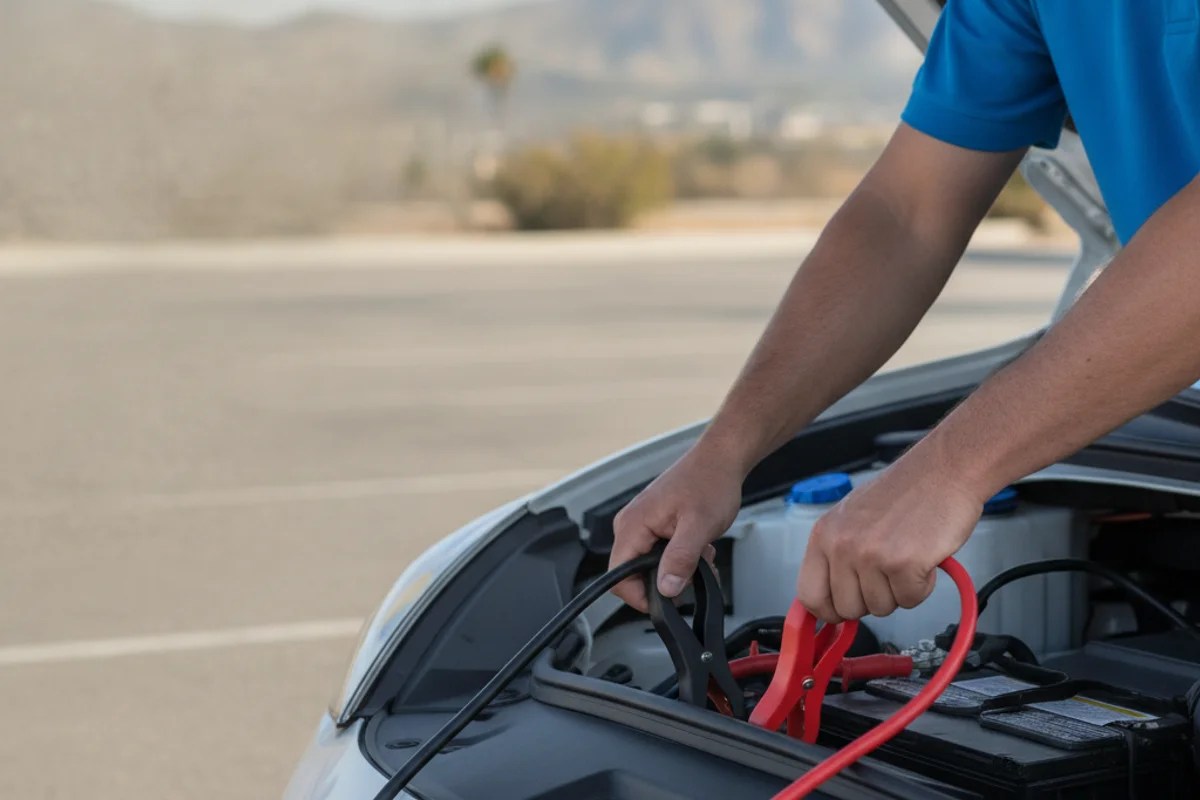
With the terminals exposed, you’re ready to wake the lithium pack. You’re not starting an engine. You’re feeding enough 12V for the computer and the 12V management to come back.
A dedicated check sequence is in how to tell your Tesla 12V is dead, then jump it. Treat a lithium unit as the gentle version of that job.
Wake the pack. Don’t dump engine-starter current into it.
A hard-shutdown lithium 12V can ignore a brute jump. A running gas car is the wrong donor. A giant lead-acid pack built for engines is the wrong tool too. You’re trying to present a stable 12V so the management system will reconnect.
Better sources, if you already have them on hand:
- A small 12V pack with a lithium-recovery or low-current mode
- A known-good 12V auxiliary battery and proper clips
- A smart 12V maintainer, if you can reach an outlet
Connect red to the Tesla’s positive jump terminal. Connect black to the marked negative terminal or a chassis ground the manual names. Keep clamps off other metal. Then wait. Lights, locks, or a flickering screen are the signs you want. You may hear contactors click.
Once the brain is awake, the DC-DC can recharge the 12V from the pack. Leave the donor connected a bit longer if the screen is still weak. Then, if the charge port will open, plug in. A Supercharger or a 240-volt home circuit both give the high-voltage side a job. The 12V ride-along charge is the point.
After a wake-up in Irvine, Main St or Spectrum Center stalls are the next stop. After Anaheim, Katella and the Lincoln Avenue sites are the usual hunt. After Costa Mesa, check 1475 S Coast Dr or 1400 Bristol St. After Santa Ana, 1008 17th St is the larger 325 kW site. None of that matters until the port actually unlocks.
If you’re not set up for this, stop. The Tesla 12V jump path exists for that reason. Independent operators in the Charge Pro OC network bring the gear. They quote you before they start. They bill you directly. Charge Pro OC is a referral line. It doesn’t own trucks, and it doesn’t touch the terminals.
When a wake-up isn’t enough
Stay with the car if nothing changes. A still-dark cabin can mean a failed 12V, a fuse, or a deeper fault. Repeating the same jump all afternoon rarely fixes that. If it wakes and dies again in the same lot, that 12V is likely done. It needs replacement, not another bump. Tesla service handles that replacement. Confirm parts and scheduling with Tesla. No honest public figure for wait time turned up in this research.
Tesla roadside is one call. The number published on Tesla’s Santa Ana service page is 877-798-3752. Tesla’s roadside material treats a depleted battery as paid transport. That comes from Tesla’s own support pages, as indexed. It isn’t a financially covered service. Covered 500-mile transport is for a warrantable breakdown that leaves the car undrivable. Running the pack empty sits outside that. Tesla’s published answer on a depleted battery is transportation, not on-site charging. Confirm the live wording on Tesla’s roadside support page and its North America policy PDF. Several Tesla pages returned blocks during this research, so Tesla’s own pages remain the authority.
A dead lithium 12V with range still on the pack is a different breakdown. Don’t assume the empty-pack transport rules apply. Don’t assume a free tow either.
Local Tesla roadside rescue is the other path. The operators we connect you with jump or replace a dead 12V on site. They also bring a 240-volt Level 2 source if the drive pack itself is empty. That’s useful when both problems stack, as Tesla’s manual warns once range is gone. Native NACS on the truck, plus CCS or J1772 adapters for other brands. Typical charging time is 10 to 20 miles of range. That’s 15 to 30 minutes on the cable. That is charge time, not a promise of when someone arrives.
If you’re on a freeway shoulder, stay in a safe spot and call. If you’re in an Irvine garage or a Costa Mesa structure, say so up front. Gates, permits, and height bars change the job. The operator quotes before work starts.
Name the car as a 2023 or newer Model 3 or Y. Say the lithium 12V looks dead, and give the last range you remember.
Charge Pro OC matches stranded EV drivers with independent local mobile rescue operators. The pros we connect you with are licensed and insured. Call (949) 444-0151 when the lithium 12V has already shut the car down. They’ll connect you with an operator who quotes before starting.