Most Orange County pack-life questions are Model 3 and Model Y questions. Tesla holds 138,121 of the county’s 210,842 battery-electric cars. That’s 65.51 percent, per California Energy Commission counts as of December 31, 2025. The high-voltage pack is built to outlast the rest of the car. The small 12V battery is the one that usually leaves you stuck.
Why this is a Model 3 and Model Y question here
Orange County’s Tesla share sits above the California average. California’s Tesla share of battery-electrics is 61.34 percent in the same CEC file. Orange County sits 6.4 points above that. Teslas are 5.59 percent of all light-duty vehicles on county roads. New Tesla share of local ZEV sales has moved around. It was 56.9 percent in 2023 and 44.7 percent in 2025. The first half of 2026 came back to 56.4 percent. The cars already registered still skew to the volume models. Pack-life questions here usually mean a Model 3 or a Model Y.
Two batteries, and only one of them strands you
Every Tesla has two batteries with two clocks. The floor pack stores the miles you drive. It’s a slab of lithium-ion cells under the cabin. The 12V unit runs locks, the screen, and the contactors. Those contactors are what wake the big pack. When a Model Y sits dark in a Tustin lot, treat the 12V first. A full charge in the app doesn’t rule a 12V failure out. That’s a no-start, not a worn pack. Our dead pack versus 12V guide splits those two failures. Tesla 12V locations by model covers the 3, Y, S, and X.
What real aging looks like after year one
Independent fleet tracking has shown a fairly stable curve. Most Tesla packs keep most of their original capacity past 150,000 miles. Many still look healthy well past 200,000 miles. The first year or two often shaves a few percentage points. After that, the fade usually slows down. A pack that loses range every year for a decade is the exception. That still isn’t a guarantee for every VIN. Charge speed, heat, and how you park all move the number.
What actually wears a pack on Orange County roads
Odometer miles matter less than a few habits. Those habits show up here for a reason. Tesla holds 59 percent of Orange County’s public DC fast ports. That’s AFDC station data, filtered to the county.
Daily Supercharging as the default is the first one. A session at Irvine’s 1920 Main Street site is ordinary trip fuel. Garden Grove’s Harbor Boulevard site has 32 stalls in the same file. Anaheim has seven Supercharger sites in that federal inventory. Occasional DC fast charging is just normal ownership. Using it as your only method heats cells more than home charging. Mix in slower charging when you can.
Holding 100 percent as a daily target is the second. For many Tesla chemistries, you shouldn’t live at the top. Tesla’s daily guidance for those packs is a mid band. That’s often around 20 to 80 percent. Save a full charge for a long trip. LFP packs follow a different Tesla charging rule. Tesla tells those owners to fill to 100 percent on a regular cadence. Check the charge screen for your car, not a neighbor’s.
Parking hot, or parking empty, is the third. Lithium-ion cells age faster under sustained heat stress. Closed-structure parking ages a pack harder than shade. Leaving the car near empty for weeks is a separate stress. Store it in a mid charge if you’ll be gone a while.
How to read pack health without a phone-style score
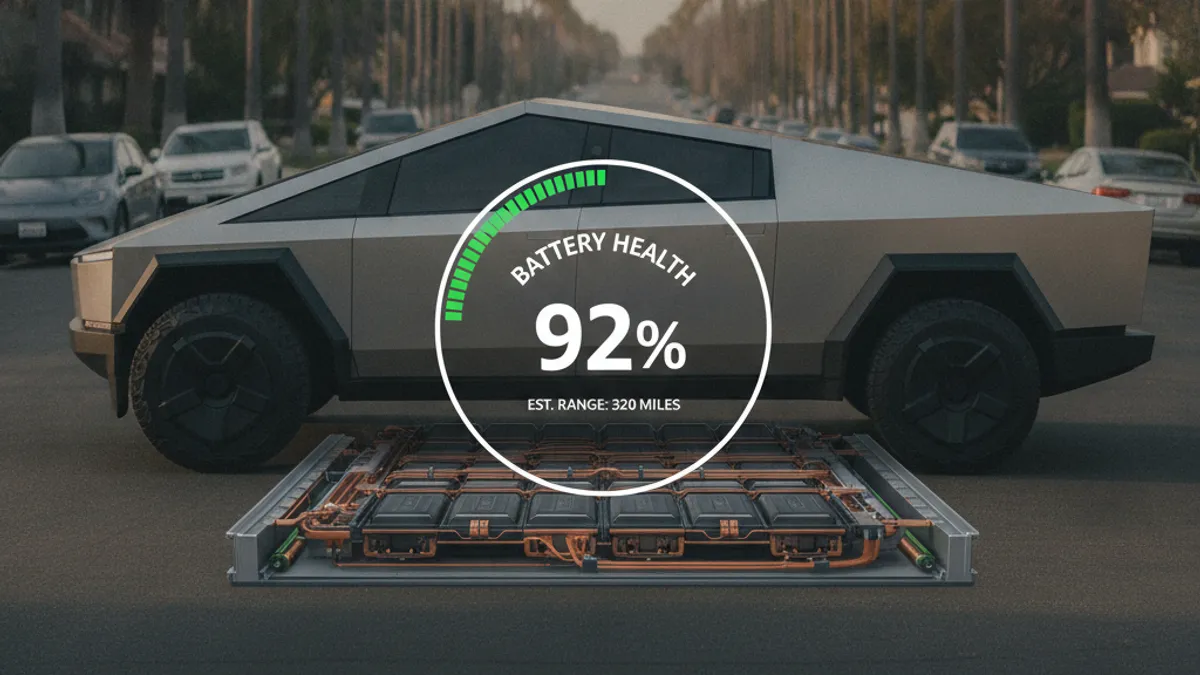
Tesla doesn’t show one battery-health percentage like a phone. Compare current maximum range to the original rated range. Use the figures for that model year. Both live in the car’s settings menu. A small gap after the first year or two is ordinary. A sudden, large drop is a service question. Tesla lists service centers in Anaheim, Irvine, and Santa Ana. Costa Mesa, Buena Park, and Aliso Viejo have sites too. Confirm the right site in the Tesla app before you go.
Buying used in a county with 138,121 Teslas
Used Model 3s and Model Ys aren’t a niche here. They’re the bulk of the county’s electric fleet. High mileage isn’t the automatic red flag a gas-car buyer expects. After the early fade, most packs settle. Ask how the car was charged, and how often it Supercharged. Ask whether it’s still inside Tesla’s battery and drive-unit warranty window. That window follows the in-service date, not the day you buy it. Tesla sets the years and mile caps, and they vary by model. We don’t invent those figures on this page. Read Tesla’s current terms before you buy. Then read our Orange County Tesla battery warranty explainer. Before you sign, look at max range on the screen. Compare it to the original rated range. A modest gap is ordinary wear, not a crisis. A steep one is a reason to wait.
When a main pack actually gets replaced
Outright pack failure outside a crash is uncommon. When it happens under Tesla’s battery warranty, Tesla’s own coverage is the path. A roadside truck doesn’t swap a high-voltage pack on the shoulder. Out of warranty, replacement is a shop job. What pack replacement means for Orange County owners is the process, not a price. Charge Pro OC doesn’t replace packs and doesn’t run a service bay. It matches you with independent mobile operators when the car won’t move. A worn pack still drives, with less range. A dead 12V often won’t wake at all. Daily habits sit in EV battery care across Orange County. Commute range sits in how long a Tesla charge lasts through an Orange County day. If the car won’t start, that’s a 12V problem, not a pack swap.
Frequently asked questions
How long do Tesla batteries last in real miles?
Most packs keep most original capacity well past 150,000 to 200,000 miles. Early loss of a few percentage points is common. Ongoing collapse year after year is rare.
Does Supercharging every day ruin the pack?
Occasional DC fast charging is just normal ownership. Making it your only method adds more heat than home charging. Mix in Level 2 when you can.
Does the main pack or the 12V fail first?
The 12V is the short-cycle part in every Tesla. The main pack is built around the car’s full life. If the car won’t wake, start with the 12V.
If your Tesla won’t power on anywhere in Orange County, call (949) 444-0151. Charge Pro OC is a referral line, not a shop. The operator quotes you before starting and bills you directly.