A Huntington Beach lot and a Santiago Canyon climb aren’t the same job. Electric vehicle battery maintenance in Orange County starts with that split. Beach parking leaves the car still for hours. Canyon grades ask the motors for a long pull. Your maker’s app still sets the charge limits. The roads here decide how often those limits matter.
Two batteries, two kinds of trouble
Most dead-battery calls mix up two systems that fail in different ways. The traction pack is the big battery under the floor. Range on the dash is that pack talking to you. When it runs low, you still get warnings first. The car keeps moving until the pack can’t feed the motors.
The 12V battery is much smaller, and it wakes the car. It runs locks, the screen, and the computers that boot the pack. When the 12V dies, the car can look fully dead. Doors may not answer, and the display may stay dark. The traction pack can still hold plenty of energy. The car just can’t boot without that low-voltage feed.
Tesla’s Model Y owner’s manual is useful on this point. Once range is exhausted, the low-voltage battery can lose support. The high-voltage pack then needs external power before it can charge. That’s a maker fact, not a county guess.
If range looked fine and the car won’t wake, start with the 12V. Our guide to telling a dead pack from a dead 12V walks through that split. A jump on site often clears a 12V stall. It doesn’t refill an empty traction pack.
Beach days and canyon grades
Orange County isn’t one driving pattern, even on the same Saturday. Coastal lots and inland grades pull on a pack in different ways.
A day in Huntington Beach often means hours in a public lot. Climate control and the screen still draw while you sit. Then you ask the car to leave the coast with whatever is left. That’s a common pattern, not a rare one. Our Huntington Beach lot guide covers what to do when the car won’t wake after that sit.
Newport Beach has a similar beach-to-home shape. Tesla lists a Supercharger at 4241 MacArthur Blvd, with 12 stalls. Electrify America lists eight DC fast ports at Fashion Island, 401 Newport Center Dr. Both show up on the federal station file. Neither is a promise that a stall will be free when you pull in. Check a live map before you count on one.
Costa Mesa sits between those beach cities and the inland basin. Tesla lists Superchargers at 1400 Bristol St, 1475 S Coast Dr, and 3303 Hyland Ave.
Canyon driving is a different ask. Santiago Canyon Road, Ortega Highway, and Laguna Canyon Road add sustained grade. A loaded EV working uphill isn’t the same as a flat coastal cruise. We can’t confirm a mile-loss figure for your model on those climbs. No public source gives one that covers every pack. If you’re already low, stay put and treat it as a recovery. The Santiago Canyon empty-pack steps are the calm version of that call.
Yorba Linda sits inland and uphill from the central basin. Tesla lists two Supercharger sites on Yorba Linda Blvd, eight stalls each. That names a place you can plan around. It doesn’t cancel the grade on the way there.
Irvine is a different mix again. Tesla lists several Supercharger sites there, including 40 stalls at 1920 Main St. A commute across the basin can still end on I-5 or I-405. You may have less range than the dash first showed. Grade, cabin load, and a long sit all stack. We can’t assign a percent of pack life to any of those. Your maker’s guidance is still the rule for charge limits.
Follow the maker, not a county-wide chart
Every EV brand publishes its own traction-battery guidance. Tesla, Rivian, Ford, Hyundai, Chevrolet, and Kia don’t share one chart. Charge limits, software updates, and service intervals differ by model. They also change when the maker updates the app or the manual.
We can’t confirm a single degradation rate for Orange County. We can’t confirm one charge-limit percentage that fits every pack. Any post that assigns a percent of life lost to heat or grade is guessing. Your owner’s manual is the source built for your car. Check that first, not last.
Tire rotations and cabin filters still matter. They’re not the traction pack. Our EV maintenance schedule for every owner covers those non-battery items. This page stays on the pack, the 12V, and the roads that stress them.
What the state file actually shows about this county
Orange County is a dense EV county on California Energy Commission data. The Commission counted 210,842 battery-electric vehicles here as of December 31, 2025. ZEVs were 10.56% of the county’s light-duty fleet. California sat at 7.54% on the same file. Orange County held 12.02% of the state’s battery-electric vehicles, while holding 8.33% of the state’s light-duty fleet.
Tesla made up 138,121 of those BEVs, or 65.51% of the county’s battery-electric fleet. That’s 6.4 points more Tesla-heavy than California overall. New ZEV share here also runs above the state. In 2026 Q2, ZEVs were 24.77% of Orange County’s new light-duty sales, against 19.09% statewide. Don’t read that as a rising curve. California’s ZEV share of new sales peaked in 2024. The first quarter of 2026 was the weakest quarter in that series.
Public charging is on the same CEC file. Orange County had 7,095 public ports as of December 31, 2025. That breakout was 20 Level 1, 5,600 Level 2, and 1,475 DC fast. That’s 36.8 ZEVs per public port. Statewide the ratio was 24.4. The county is busier per plug than California as a whole. That’s a government ratio, not a map of any one city.
Tesla Superchargers are part of that mix. Federal AFDC data showed 48 Tesla Supercharger sites and 861 DC fast ports in the county. Huntington Beach has 24 stalls at 6913 Warner Ave. San Clemente has 49 stalls at 101 W Avenida Vista Hermosa. Garden Grove has 32 stalls at 12891 Harbor Blvd. The Orange County charging hub is the place to start. Use it for city-level context before a longer drive.
Non-Tesla DC fast charging exists too. AFDC counted 175 non-Tesla DC fast stations and 591 ports countywide. Tesla still held 59% of the county’s public DC fast ports. Electrify America’s Dana Point Station at 25825 Las Vegas in Capistrano Beach has 12 DC fast ports. EVgo lists 14 DC fast ports at Plaza Antonio, 22351 Antonio Pkwy, in Rancho Santa Margarita. EVgo also lists four stalls at 801 Pacific Coast Hwy in Seal Beach. Those are named sites, not a guarantee of an open stall.
Level 2 at home or on a public pedestal is 240V in most houses. Many commercial lots run 208V instead. DC fast is the high-power public option. Your car’s acceptance rate, state of charge, and cabin load still set the real session. Treat published kW as an equipment ceiling, not a promise.
Before a longer loop, open a live map. The DOE Alternative Fuels Data Center station locator is the federal directory. Don’t assume a stall will work when you arrive.
Roadside help, a tow, or a service visit
Once you know which battery failed, the next call sorts itself.
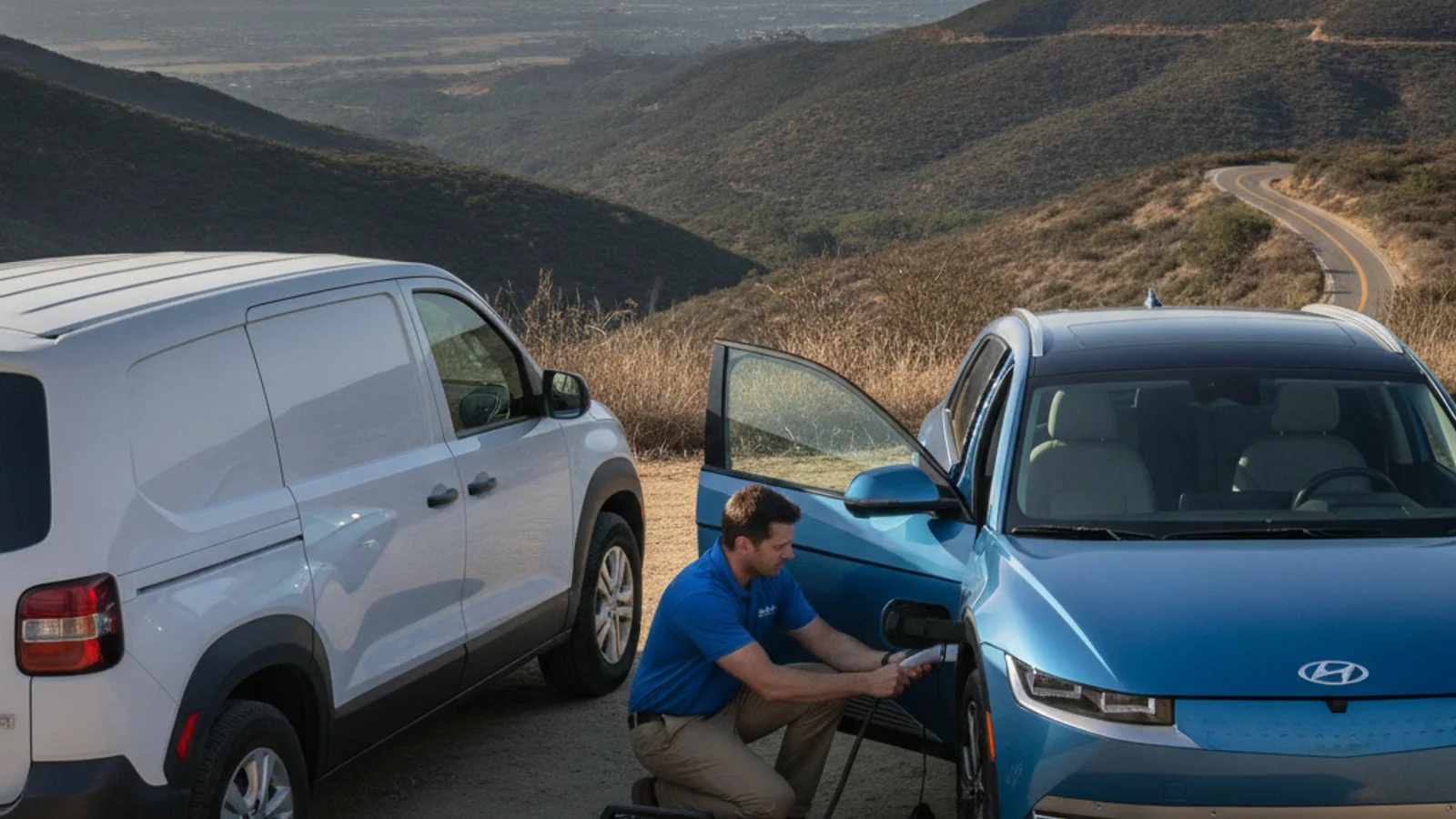
If the traction pack is empty, that’s a charge-on-site question. The independent operators we connect you with can bring a 240V Level 2 source to the car. Teslas take a native NACS plug. Other EVs use a CCS or J1772 adapter. Operators typically add 10 to 20 miles of range in 15 to 30 minutes of charging. That’s charging time, never an arrival time. The operator quotes you before work starts and bills you directly. You can request out-of-charge recovery when the pack is the issue.
If the car won’t wake and range looked fine, think 12V first. A jump or a 12V swap on site can restore the boot. EV roadside assistance is the path for that kind of stop. The operator decides on scene what the car needs. That call isn’t a diagnosis over the phone.
Tesla’s roadside policy, as described on its support pages, answers a depleted pack with transportation. Running out of charge isn’t treated as a warrantable breakdown. Confirm the current wording on Tesla’s own roadside page before you rely on it. A local operator’s job is range at the bumper, not a trip to a shop.
If the car charges, drives, and wakes normally, skip the shoulder. Pack health, warranty questions, and software diagnostics belong with the maker or an authorized service center. Roadside operators get you moving. They don’t replace a service-center health check.
If you’re already stopped
An empty pack on I-5, I-405, the 91, or SR-22 is a stay-put problem. So is a dark car in a beach lot or a canyon turnout. Charge Pro OC is a referral line. It matches you with an independent local mobile rescue operator. It doesn’t own trucks, set prices, or perform the work.
Call (949) 444-0151 and we’ll connect you with a local operator.