A Tesla charge can cover a full Orange County day. It can also fall short on the drive home. The California Energy Commission counted 138,121 Teslas on Orange County roads as of December 31, 2025. That’s 65.51% of the county’s 210,842 battery-electric cars. Hillside grades eat more of that daily range than a flat stretch. Yorba Linda, North Tustin, and the canyon roads are where that shows up. Trust the estimate on your screen, then plan the whole way home.
Daily miles and pack life are different questions
The search “how long does tesla battery last in a day” mixes two jobs. One is whether today’s charge covers the route still ahead. The other is how long the high-voltage pack stays useful over ownership.
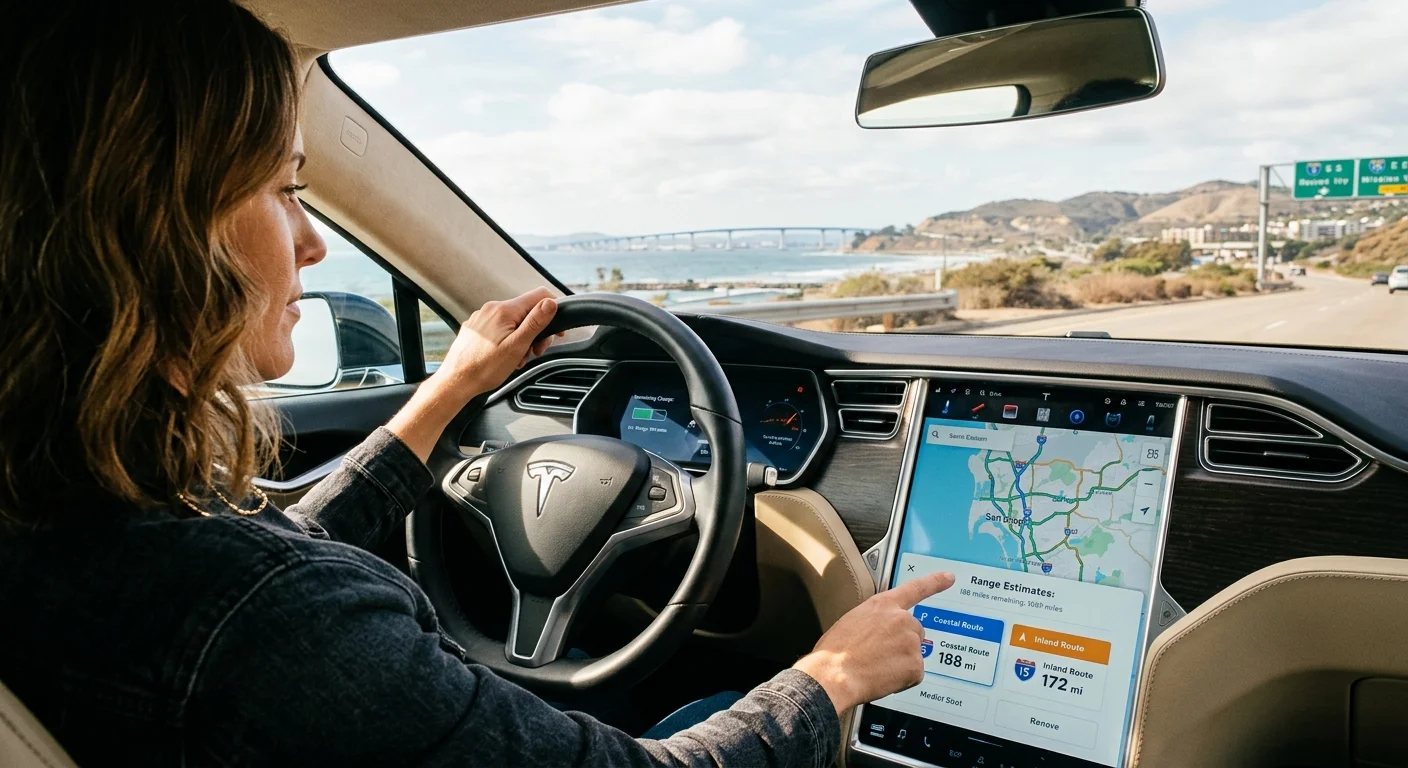
Today’s job starts in the car you’re driving. Read the percent and the estimated miles before you leave. Match them against every remaining stop, including the return. A Model Y with a comfortable buffer isn’t comparable to a Model 3 on a thin estimate.
Pack life over the years is a separate ownership file. It won’t tell you whether this afternoon’s charge reaches Huntington Beach and back. One short-charge Tuesday also doesn’t mean the pack is failing. For that longer view, read how long Tesla batteries last in 2026. Orange County is 6.4 points more Tesla-heavy than California’s battery-electric fleet.
Start with the car, not a spec sheet
Write down the model, the percent, and the estimated miles before you pull out. Recheck those figures when you add a stop or change the route. Treat the display as a planning input, not a promise.
Don’t copy another owner’s number. Dual Motor and rear-wheel cars don’t share one daily figure. If you need a spec, use Tesla’s current documentation for your exact configuration. The car in front of you is the source for today.
Then count the whole day, not the first errand. Add the commute, extra stop, return, and last miles to a charger you can use. Ending near a Supercharger isn’t the same plan as street parking after a beach lot.
The U.S. Department of Energy describes the charging levels that shape that last piece. Level 1 on a 120-volt outlet adds about five miles per hour for a midsize EV. Level 2 at 240 volts adds about 25 miles per hour. Real speed still depends on the pack, the state of charge, and the air temperature. Those rates explain why a wall outlet and a Supercharger aren’t the same backup. They don’t tell you how far you’ll travel today.
If the estimate already looks tight, change the day early. Add a stop you can still reach, or leave the Tesla home.
Orange County roads don’t share one range
Orange County isn’t one driving climate. A Harbor Boulevard hop in Fullerton or Santa Ana is short and mostly flat. A climb toward Yorba Linda, Santiago Canyon Road, or Laguna Canyon isn’t. Coastal air and inland heat also move the number on the screen as the day goes on. There’s no verified public figure for a countywide hill, traffic, or temperature penalty. Watch the estimate as the road changes. Don’t apply a made-up correction.
Use the freeways as a sequence, not as a range promise. I-5 runs north to south through Anaheim, Irvine, and San Clemente. I-405 carries the coastal cities. SR-91 cuts across North County, and SR-22 hits the Orange Crush. Write destinations in order, then pick a charger on that corridor. Add a second option before you leave.
A comfortable Irvine estimate can shrink after a hillside driveway in North Tustin and the return to Santa Ana. Don’t plan only to the farthest pin. Plan the drive back.
Local geography should pick the backup, not a county outline. Someone staying in Yorba Linda can look at the Superchargers on Yorba Linda Boulevard. AFDC lists two sites there, each with eight stalls at up to 250 kW. Someone heading south on I-5 can look at 101 W Avenida Vista Hermosa in San Clemente, listed at 49 stalls. A stall across the county isn’t a useful spare just because it sits on a regional map.
Once you decide to stop, how long a Tesla charge takes at Orange County Superchargers is the next question.
Name the Superchargers you’d actually use
As of December 31, 2025, Orange County had 48 Tesla Supercharger sites and 861 Supercharger ports. The count comes from U.S. Department of Energy station data. Tesla holds 59% of Orange County’s public DC fast ports.
Sites that show up on real days include 2404 E Katella Ave in Anaheim and 1920 Main St in Irvine, which has 40 stalls. Huntington Beach has 24 stalls at 6913 Warner Ave. Confirm current access with Tesla or the network that runs the site.
Non-Tesla DC fast charging exists too. AFDC counts 175 non-Tesla DC fast stations and 591 ports in the county. Electrify America at Fashion Island, 401 Newport Center Drive, has eight DC fast ports. EVgo at Plaza Antonio in Rancho Santa Margarita has 14. Use those only if your Tesla can take them.
CEC public-port counts put Orange County at 7,095 public ports. That’s 36.8 ZEVs per public port, versus 24.4 statewide. More plug-in cars share each public plug here than the California average. A day that looks fine on paper still needs a second option.
Act while a stall is still in reach
Low charge is easier when you act before the remaining miles no longer cover a real stall. Stop adding destinations. Pick a compatible charger the car can still reach. Confirm it’s working through Tesla’s app or the site’s operator. If the first one fails, switch while you still have charge.
Reaching the neighborhood isn’t the same as reaching the stall. Count the last streets, the parking entrance, and any extra loop into the lot. Our guide to an empty pack on Santiago Canyon Road walks that choice on a grade where a late U-turn costs real miles.
If the Tesla is already very low, write down where you are. Note the road, direction, nearest exit, parking level, or a clear landmark. Don’t stop in a live lane just to make the description easier.
The same idea sits in what to do before you’re actually stuck. Don’t keep rolling toward a charger you can no longer clearly reach.
A Supercharger, a charge at the car, or a tow
The next step depends on the car’s state and where it’s sitting. It also depends on what an independent operator can safely do there. One low-battery day isn’t always the same job.
If you still have usable charge and a compatible Supercharger remains in range, driving to it is often the cleanest move.
If you can’t reach a stall, ask whether a mobile 240-volt charge can happen where you sit. Charge Pro OC is a referral line. We match stranded Tesla drivers with independent local operators. We don’t own trucks, we don’t employ technicians, and we don’t set prices. The operator quotes you before starting and bills you directly. Typical on-site charging adds 10 to 20 miles of range. That’s in 15 to 30 minutes of charging time, never an arrival time. Operators bring a native NACS plug, plus CCS or J1772 adapters for other EVs. See out-of-charge recovery for how that referral works.
Tesla’s own roadside policy answers a depleted pack with transportation, not with charging at the car. Running out of charge isn’t a financially covered Tesla service. Covered transport is tied to a warrantable breakdown that leaves the car undrivable. Confirm the current wording on Tesla’s roadside page before you assume coverage. Tesla Roadside Assistance publishes 877-798-3752.
A Tesla that won’t wake may be a 12-volt problem, not an empty drive pack. Tesla’s owner’s manual notes that the low-voltage battery can lose support once range is exhausted. Tell the operator the exact warning, screen state, and what the car does. The Tesla roadside rescue page explains the local referral for that mix of jobs.
Before you agree to work, have the independent operator explain the service, the price, how you pay, and any warranty they offer. Charge Pro OC doesn’t set those terms and doesn’t warrant the work. You contract with the pro directly.
When to call this referral line
Call when the remaining estimate no longer covers a safe drive to a charger you can still reach. Call when you need an operator to compare a curb charge with a tow. Charge Pro OC connects you with a local EV rescue operator at (949) 444-0151.