A roadside jump on an EV is a 12-volt job. Orange County’s Freeway Service Patrol still lists a battery jump as classic shoulder help. On an electric car, that listed jump is the small 12-volt battery. It doesn’t refill the traction pack that moves you. If the pack is empty, cables won’t wake the car. The operator has to sort those two failures first.
The Freeway Service Patrol jump is the 12-volt battery
That search is a diagnosis question first, not a simple yes. Orange County had 210,842 battery-electric cars as of December 31, 2025. Tesla held 138,121 of those BEVs, or 65.51 percent. That’s the California Energy Commission vehicle file, not a brochure. Plenty of local no-start calls still sound like a dead battery. The 12-volt battery and the traction pack fail in different ways.
The 12-volt battery wakes computers, locks, and contactors. Without it, the car can look fully dead. Screens stay dark, the key may not register, and drive won’t engage. On-site, a jump or a 12-volt swap can restore that system. Range still doesn’t come back from jumper cables.
The traction pack is the high-voltage battery that actually moves the car. An empty pack needs energy at the charge port. Jump posts are the wrong tool for that job. Confirm the current Freeway Service Patrol menu before you wait on a shoulder. Our guide to Tesla help versus the freeway patrol covers that split in more detail. Treat their listed jump as a 12-volt service, not a mobile charge.
Tesla’s Model Y owner’s manual is blunt on an empty pack. Once range is gone, the low-voltage battery can lose support. The car may then need an external power supply. Only after that can the high-voltage pack accept a charge. An empty Tesla can look like both problems at once.
An empty pack needs a charge, not cables
Don’t lead with the word dead when you call. Say what the car did before it quit. Report the last range or percent you saw. Read every warning exactly as it’s written on the screen. If the screen is dark, say the screen is dark. Guessing which battery failed sends the wrong truck.
Orange County is Tesla-heavy, but it isn’t Tesla-only. The rest of the battery-electric fleet is every other major brand. Procedures differ by model and year, so don’t guess. The operator should check your exact car before anyone clips on.
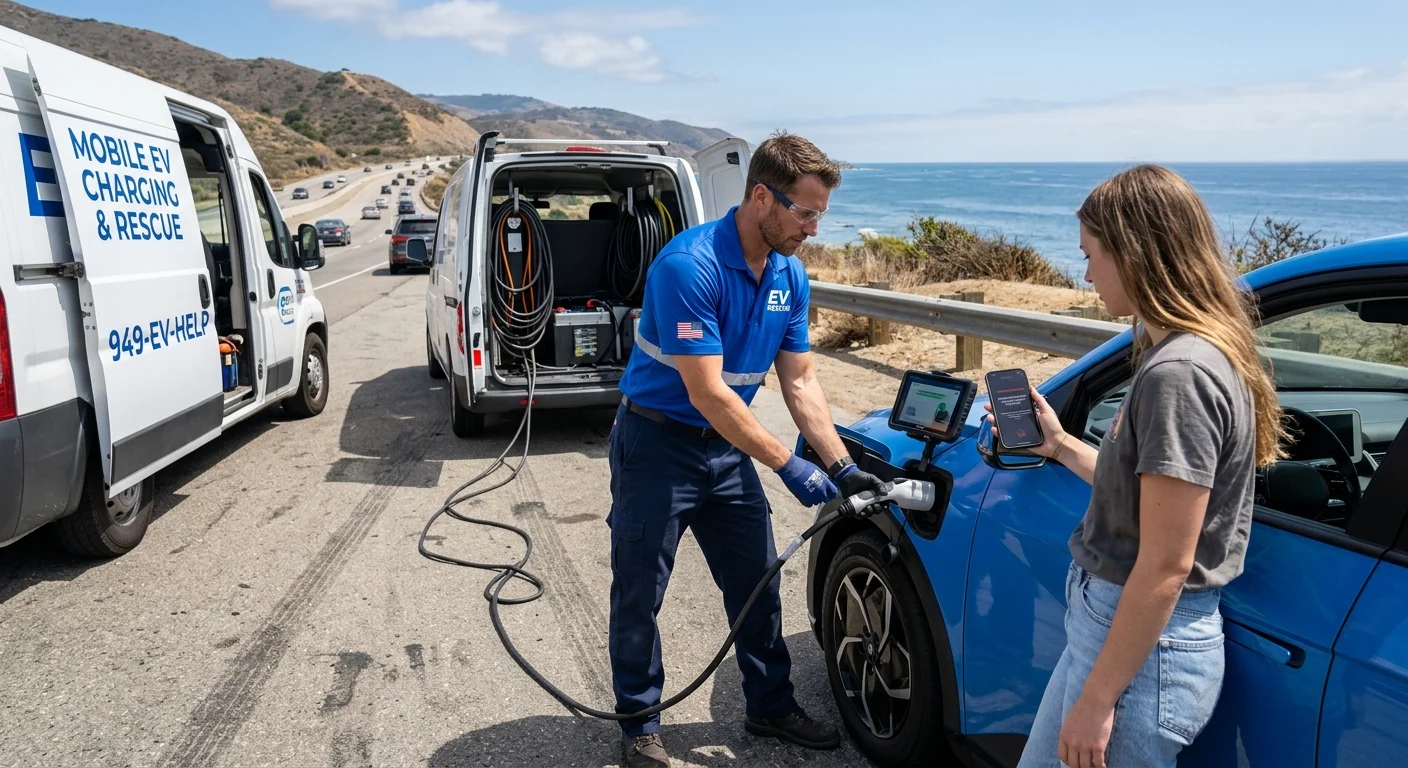
If the last number you saw was near zero, call it an out-of-charge car. That’s a mobile charge request, not a jump. The operators we connect you with bring a 240-volt Level 2 source. They use a native NACS plug, or a CCS or J1772 adapter. Charging time is typically 15 to 30 minutes. That window adds about 10 to 20 miles of range. It isn’t an arrival time you can clock.
After that top-up, you can roll to a verified stall. Irvine’s Supercharger at 1920 Main Street has 40 DC fast ports. San Clemente’s site at 101 West Avenida Vista Hermosa has 49. Santa Ana’s site at 1008 17th Street has 28. Garden Grove’s Harbor Boulevard site has 32, per AFDC station data. They don’t help if the car can’t move.
Tesla’s own roadside policy answers a depleted pack with transportation. That help isn’t a financially covered Tesla service. Covered transport is for a warrantable breakdown that leaves the car undrivable. Running out of charge sits outside that covered transport. Tesla’s roadside number, as listed on the Santa Ana service page, is 877-798-3752. A local operator can still review a jump or an on-site charge.
Tell the operator the last charge you saw
Gather facts before you call, and skip DIY steps written for another model. Don’t open battery covers on the street while you wait. Your current owner’s manual is the authority for your car. Our safe jump-start guide is extra context for the call. It doesn’t replace the pages printed for your VIN.
Share the last charge the display showed you. Then read each warning out, line by line. A photo of the cluster helps when the operator accepts images. Tell them whether the screen lights, the car sees the key, or it enters drive. Those are observations, not a diagnosis you should force.
You can also read how a dead 12-volt leaves the car looking fully dead. Tesla owners can use the walkthrough on telling a dead pack from a 12-volt failure. For general EV owner material, the U.S. Department of Energy keeps a public overview.
Give the make, the warning, and the exact spot
Tesla or electric Hyundai isn’t enough model detail. Give the full make, model, and model year. A 2021 Model 3 and a 2025 Model Y don’t share one 12-volt layout. The same is true across other brands the operators handle.
Location has to be tighter than Orange County. Name the street, freeway, lot, or a nearby landmark. A car on the 91 shoulder isn’t a car in an Irvine garage. A Huntington Beach lot after a beach day isn’t a Santa Ana structure. A gated street in Yorba Linda isn’t a Harbor Boulevard curb in Fullerton.
Access changes the job for whoever rolls up. Say if you’re behind a gate, in a tight structure, or on a freeway shoulder. I-5, I-405, SR-22, and SR-91 are common places OC drivers stall. The operator needs that before they decide whether a jump even fits.
Orange County holds 12.02 percent of California’s battery-electric vehicles. It’s only 8.33 percent of the state’s light-duty fleet. That’s why a vague pin wastes the operator’s time. Theme-park lots in Anaheim get logged as Orange County. So do Tustin office parks and Newport Beach coastal lots. They don’t drive the same for a truck.
For a Tesla 12-volt no-start, start with Tesla 12V battery jump. For other brands, the matched operator still reviews the exact model. Charge Pro OC refers Tesla and every major EV brand, without doing the work.
When a jump is the wrong call
A jump request isn’t automatically the right request. An empty traction pack is the cleanest reason to skip cables. The operator may then discuss a mobile charge, or transport if charging doesn’t fit.
A jump may be a poor fit when the warnings don’t point to 12-volt trouble. An unfamiliar message, a gauge at zero, or a model-specific limit needs a pause. Guessing isn’t a sound basis for clipping on.
Tell the operator about visible damage, heat, smoke, or odd smells. Mention standing water or a recent collision too. Don’t turn those notes into a battery diagnosis. They’re conditions that can take a jump off the table.
The right next step may be an assessment or a model-appropriate jump. It may also be a 240-volt charge or a tow. Charge Pro OC doesn’t pick the procedure for the operator. The independent operator evaluates the car and explains the option. Confirm the work, the quote, and the terms with that operator before you approve.
How Charge Pro OC routes the request
Charge Pro OC is a referral line for stranded drivers. We match stranded EV drivers with independent local mobile rescue operators. We don’t jump batteries, charge cars, tow vehicles, or own roadside gear. We hold no trade license, set no prices, and publish no hours.
When you contact us, lead with the facts. Include make, model, and year, plus the warning text. Add the last charge you saw and the exact pin. We pass that to an operator who can review the job and their equipment.
The operator decides whether a 12-volt jump or a 12-volt swap fits. They may instead choose a Level 2 charge or transport. You’ll contract with that operator and pay them directly. Ask them to explain the service and the quote before they start.
Call when the car won’t start and you need a mobile operator. Have the model, the warning, the last charge, and the location ready. For broader matching, our EV roadside assistance page is the start. Call (949) 444-0151 and we’ll connect you with a local EV rescue operator.