A Tesla with a flat on the 405 isn’t out of charge. That’s a tire problem, and it stays one. Tesla roadside assistance tire repair is mostly about moving the car. It isn’t a mobile tire shop on the shoulder. On many Orange County freeways, Freeway Service Patrol treats a flat as a disabled vehicle. Confirm the current beat with OCTA or CHP. Don’t assume a factory truck is your only move.
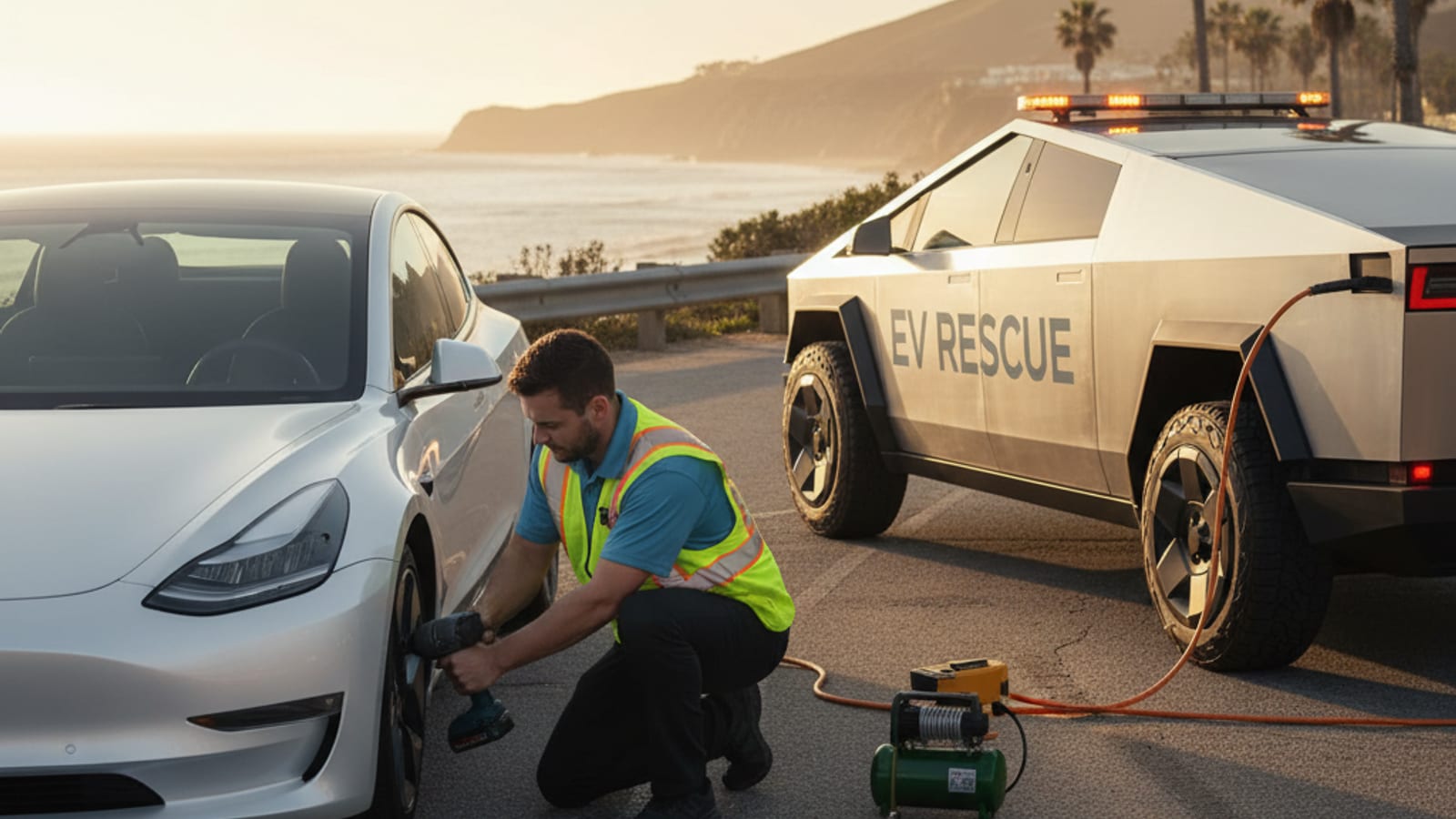
A flat isn’t an empty pack
Orange County had 210,842 battery-electric cars on the road as of December 31, 2025. Teslas were 138,121 of those. That’s 65.51% of the county’s BEV fleet, per the California Energy Commission. California’s Tesla share of BEVs was 61.34% in the same file. This county sits 6.4 points more Tesla-heavy than the state. A lot of those cars have no spare in the frunk. That’s why this search is a local one, not a generic EV tip.
The mix-up happens because the car sits low. The app throws warnings. The shoulder feels like a zero-percent strand. It isn’t. A shredded tire won’t take you to the 40-stall Supercharger at 1920 Main Street in Irvine. A dead pack with good rubber might. Those are different calls.
If the wheels still hold air and the display reads zero, you’re in charge trouble. If the car pulls hard and a sidewall is down, you’re in tire trouble. If the screens are dark after a long sit, that’s often the 12-volt. Sort those three before you pick a number.
For pack versus 12-volt, use a checklist, not a guess. We’ve walked that split in Dead Tesla: how to tell 12V failure from a dead pack. Skip it if you can already see cord.
What Tesla’s roadside page actually answers
Tesla publishes a North American roadside policy PDF. It also publishes a support page for stranded cars. Direct fetches of tesla.com were blocked during this research pass. Treat the live page as the authority. Open it in the app or a browser before you quote coverage.
What we could confirm from Tesla’s own language on a depleted pack is narrow. When the battery is empty, Tesla says it can assist. It also says that help isn’t a financially covered service. Transportation of up to 500 miles to the nearest Service Center is for a warrantable breakdown that leaves the car undrivable. Running out of charge sits outside that. Tesla’s published answer to an empty pack is transport, not a charger at the bumper.
A flat isn’t that event. A puncture is usually a road hazard, wear, or a curb. It isn’t a warrantable drivetrain failure. The 500-mile covered haul doesn’t turn a nail into a warranty job. The tire is still yours to buy or repair. Tesla Roadside Assistance, on the Santa Ana service listing, is 877-798-3752. Call that number for Tesla’s own dispatch. Then ask what they’re actually sending.
The document worth opening is Tesla’s updated North American roadside policy PDF. This brief didn’t pull a verified, line-by-line tire clause from that file. If the agent says they’ll inflate, seal, or tow, make them pick one. Don’t assume a plug and a patch on the shoulder.
Covered events versus owner-pay events are unpacked in What Tesla roadside covers, and what it sends a truck for. Use that when the question is the plan, not the rubber.
Freeway Service Patrol on Orange County shoulders
Here’s the local step a lot of Tesla owners skip. A freeway flat in this county may already have a public patrol aimed at it.
Orange County’s Freeway Service Patrol is a CHP, Caltrans, and OCTA program. The trucks exist to clear disabled vehicles from the freeway system. A flat is a classic reason those trucks stop. This research appendix didn’t include a fetched beat map. It didn’t include a published hours table. It also didn’t include a confirmed Tesla-wheel procedure. So we won’t invent those. We’ll tell you who sets them.
OCTA and CHP publish the live coverage. Ask them whether your stretch is in a beat right now. Ask whether the truck will change a passenger-car tire on a Tesla wheel. Ask where they can drop you if they can’t mount anything. If you’re not on a freeway, FSP is the wrong agency. City streets, HOA gates, beach lots, and canyon two-lanes sit outside that program.
Toll roads need a second look. Published FSP coverage is widely described as skipping Orange County toll roads. Confirm that against current OCTA materials before you wait on SR-241. We’ve written that shoulder in Empty on SR-241: published FSP coverage skips the toll roads. An empty pack on 241 and a flat on 241 are still different jobs. Neither one should start with a guess.
The deeper rubber comparison lives in Tesla flat tire coverage, and Orange County’s free freeway option. Read that if you’re already on a numbered freeway and the tire is down.
FSP won’t add range. The operators we connect you with won’t remount a tire. Get those lanes straight while you’re still in the lane.
What a Tesla contractor will usually do
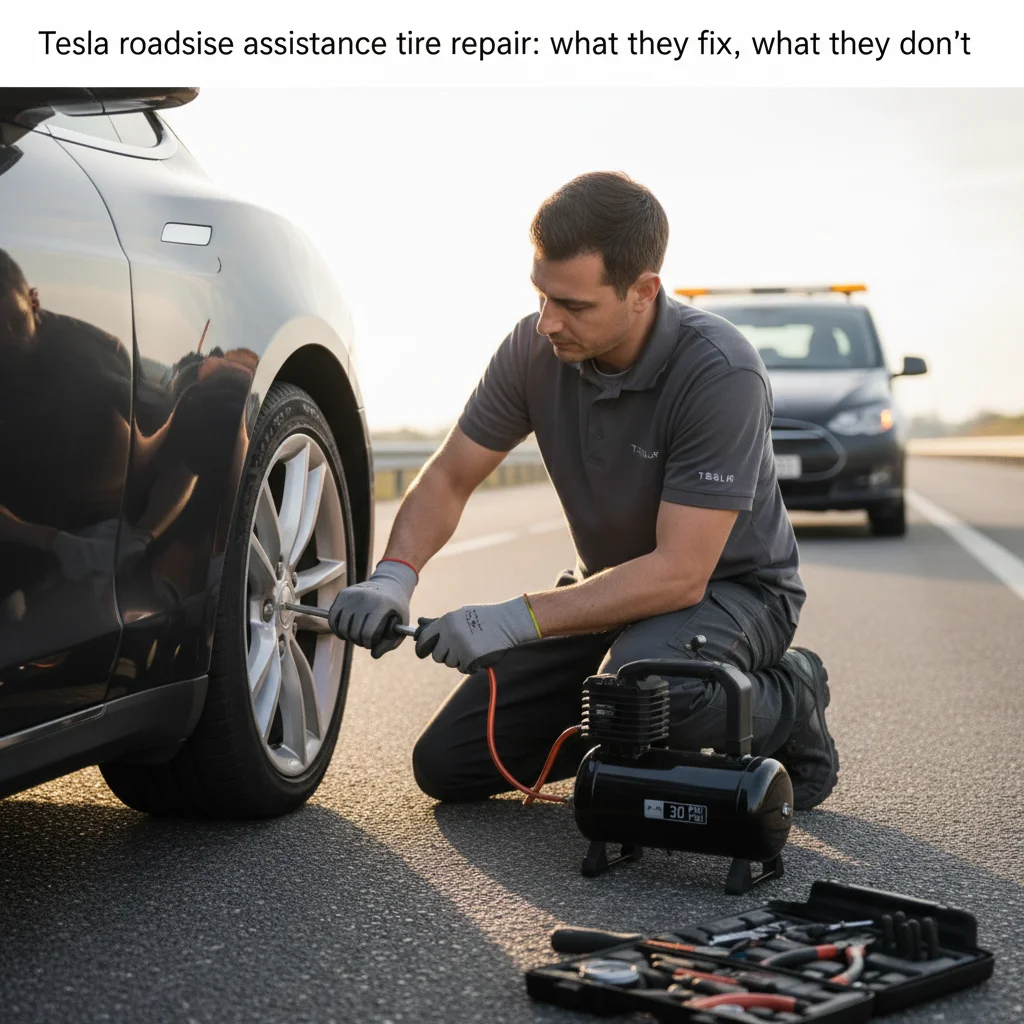
Tesla doesn’t roll a factory tire shop on a truck. It dispatches third-party roadside vendors. What shows up is the vendor’s van or a flatbed. It isn’t a Service Center on wheels.
Expect an assessment first. They look at the tread, the sidewall, and the wheel. They decide if the car can move under its own power.
For a small hole in the tread, some vendors will add air. Some will use bottled sealant as a get-you-to-a-shop hold. That’s temporary. It isn’t a shop-quality patch from inside the carcass. Sidewall cuts, inner-shoulder damage, and a tire that’s come off the bead usually fail that test.
If you carry a spare, which most Teslas don’t, they can often swap the wheel. That’s the easy version. It’s rare in this fleet.
The common ending is a flatbed. Teslas aren’t meant to sit on a standard hook with a destroyed corner. A flatbed to a Tesla Service Center or a tire shop is the path Tesla roadside uses when the car can’t roll. Anaheim, Costa Mesa, Irvine, Santa Ana, Buena Park, and Aliso Viejo are the Orange County cities where Tesla lists service. We didn’t open each Tesla service page live. Confirm the address in the Tesla app before you approve a long tow.
A contractor who inflates a slow leak is trying to mobilize you. They’re not finishing a repair on the shoulder.
What they won’t do on the shoulder
They won’t build you a new tire at the car. Tesla roadside doesn’t show up with a full-size replacement in the right size and load rating. If the carcass is done, the car has to move to a shop that stocks it.
They won’t pull a nail, buff the inner liner, and install a proper patch plug the way a tire shop would. Some owners hear tire service and picture that. The vendor’s job is safety and movement. Permanent work happens on a machine, with the tire off the wheel.
They also won’t treat a road-hazard tire as a warranty motor. You still pay for the rubber and the shop labor. Tesla arranging the tow doesn’t make the tire free. If your insurance has roadside or hazard coverage, that’s a separate claim with the carrier. We don’t have a verified Orange County average for that. We won’t invent one.
Severe damage is a tow. A blown sidewall on the 91 doesn’t get sealant. A wheel cracked on a pothole doesn’t either. Two flats after debris ride a bed.
Run-flats don’t change this as much as people hope. Most Teslas in this county aren’t on run-flats. Check your own spec in the app and on the door sticker. If you are on run-flats, they still have a distance and speed limit after a puncture. That limit is in your manual, not here. For the local read, see Run-flats on a Tesla: what Orange County owners should assume.
Why there’s no spare to hide behind
Tesla skipped the spare to save weight and space. That choice shows up the first time you pick up a screw on Katella. You can’t do the old jack-and-swap unless you bought a kit. Practice with it before you need it on the shoulder.
The car still has a tire-pressure system. The app will usually tell you which corner fell. It won’t plug the hole. Inland heat in north county makes an already-low tire worse. Long sits in Anaheim theme-park lots do the same. We don’t have a verified temperature threshold in this file. We won’t quote one. Check pressures in the app before a freeway run. That’s free, and it takes a minute.
If you do carry a compact spare or a full-size take-off, say so when you call Tesla or FSP. Hidden spares don’t help a driver who never mentioned them.
Where the bed even goes
A tow from the Orange Crush isn’t a tow from San Clemente. Tesla service sits in a handful of cities, listed above. Independent tire shops sit in every city. You can ask Tesla’s vendor to take you to a shop you name. You can also take the nearest Tesla site the app offers. Confirm hours with that shop. This page doesn’t publish hours.
South county on I-5, a bed toward San Clemente or San Juan Capistrano may be shorter than a haul to Irvine. North county on the 91, Anaheim and Buena Park are the usual Tesla dots on the map. Coastal lots in Huntington Beach and Newport Beach are city-street problems first. FSP doesn’t work a beach parking stall.
If the car still holds a slow leak, a short, legal drive to a shop can beat a bed. That’s your judgment with the vendor, not a promise from us. If the belts are showing, don’t drive it.
When a mobile charge call is the wrong one
Charge Pro OC is a referral line. We match stranded EV drivers with independent local mobile rescue operators. We don’t hold a shop license. We don’t own a yard of tires. We don’t send a plug-and-patch crew. We serve every city in the county on the electrical side of a strand. We don’t pretend that rubber is the same job.
The operators we connect you with bring a 240-volt Level 2 source to the car. They use a native NACS plug, and a CCS or J1772 adapter for other brands. They typically add 10 to 20 miles of range in 15 to 30 minutes of charging time. That’s charging time, not a clock on arrival. They can also jump or replace a dead 12-volt on site. They handle Tesla and the other major EV brands.
None of that remounts a tire.
Call that network when the pack is empty. Call it when the 12-volt is dead. Call it when you need range after the tire is already sorted. Don’t call it because Tesla roadside assistance tire repair felt slow. A Level 2 lead on a rim with no air is wasted work.
If you’re empty and the tire is down, say both facts. The operator can quote a charge only if the car can take current. The scene also has to be safe. They still can’t invent a tire. You’ll need FSP, Tesla’s vendor, or a shop for the rubber. Our Tesla roadside rescue page is for the electrical side of a strand, not for a new sidewall.
The operator quotes you before they start. They bill you directly. We don’t set that number. We won’t guess it here.
Shoulder scenes that look the same and aren’t
Same county, different job.
On SR-22 at the Crush, you’re in a dense freeway weave. If the tire is down and you’re in the lane of traffic, stay in the car with belts on. Get behind a barrier if you can do that safely. CHP and FSP are the agencies that own that shoulder. An empty pack on the same asphalt is the other playbook. We cover that in Out of charge on an Orange County freeway: what to do next. Don’t mix them.
On the 91 through north county, theme-park traffic and the grade toward Yorba Linda both chew tires and range. Superchargers on Lincoln and Imperial in Anaheim don’t help a flat on the shoulder. A mobile charge doesn’t either. Get the wheel sorted, then think about stalls.
On I-5 south of Irvine, the San Clemente Supercharger at 101 W Avenida Vista Hermosa is a large site. Federal station data lists 49 stalls there. That’s useful after you have air. It’s useless while the car sits on a bent rim.
Laguna Canyon Road and the Newport Coast climb punish range. They also hide debris. If you hear the thump, pull into a legal, visible spot. Don’t limp a shredded tire toward a mall stall in Laguna Hills. Cabot Road and Moulton Parkway have Superchargers. They aren’t tire shops.
Santiago Canyon Road and Ortega Highway are two-lane roads, not FSP freeway beats. A flat there is a private tow or a friend with a bed. That changes only if you’ve reached a numbered freeway the patrol covers. Confirm that. Don’t wait on a yellow truck that was never assigned to the canyon.
Beach cities add parking structures and sand-lot edges. Huntington Beach, Newport Beach, Laguna Beach, Dana Point, and San Clemente all produce the same afternoon: you come back and the tire is down. That’s a city-street tire. FSP won’t enter the structure. Tesla may still send a vendor. A charge operator only matters if the 12-volt died in the heat after the car sat.
Gated streets in Coto de Caza, Ladera Ranch, and Irvine HOAs add a gate code. Tell whoever you call. A patrol truck on the 5 can’t use that code.
After the tire holds air
Once you have a safe inflate, the next stop is a tire shop, not a DC stall. Sealant can foul sensors and needs to be cleaned. A plugged hole in the tread still needs a real inspection off the wheel.
Tesla Service can mount tires. So can independent shops that stock the size on your door sticker. Performance sizes are picky. Don’t guess a replacement from memory.
Countywide, Tesla holds 59% of public DC fast ports. That’s 861 of 1,452 in the AFDC extract. None of them fix a bulge. Garden Grove’s Harbor Boulevard site, Santa Ana’s 17th Street site, Tustin’s Franklin Avenue site, and Buena Park’s Knott Avenue site are big Tesla plugs after the car can roll. They don’t matter while the rim is on the asphalt.
If the car won’t wake after it sat on the shoulder, suspect the 12-volt. Tesla’s own Model Y manual notes that once range is gone, the low-voltage battery can lose support. It needs external power before the high-voltage pack will charge. A flat that turned into a long wait can become that second failure. Then the charge-and-jump operators are the right call.
Pressure, heat, and the app
You prevent most of this in the driveway.
Open the Tesla app and read the four corners. Tesla prints the cold pressure on the door sticker. Use that, not a generic chart. Underinflation costs range and cooks the shoulder of the tire. Overinflation makes debris hits sharper. We don’t have a verified Orange County mileage interval for rotations in this file. Follow the service interval Tesla shows you for your car.
Look at the tread when you charge at home. Nails show up in Irvine office parks. They show up on Buena Park auto-row streets too. A slow hiss today is a sit-down tomorrow.
Watch construction cones on Harbor, Katella, and the 405 connectors. We won’t invent a pothole map. Give yourself room.
If you load the frunk for a coastal weekend, read the load rating on the sidewall. That’s on the tire, not on a blog.
Who pays for what, without fake numbers
Tesla may cover the vendor’s dispatch or a tow under a plan you’re already in. The tire, the shop, and a non-covered transport are usually on you. Tesla’s empty-pack transport is explicitly not a financially covered service. A flat is even less of a warranty event.
FSP, where it applies, is a public freeway program. Don’t pay a random shoulder walker who isn’t that truck.
A mobile rescue operator quotes before they start. That quote is for charge or 12-volt work. It isn’t a hidden tire invoice.
We can’t confirm a typical Orange County tire price, shop labor, or tow invoice from this research. Ask the shop. Ask the vendor. Ask your insurer. A made-up average would be a liability.
Questions after a Tesla flat
Does Tesla roadside assistance tire repair mean a patch on the shoulder?
Usually no. Tesla’s vendors may inflate, use sealant, swap a spare you already have, or send a flatbed. They don’t run a tire shop at the shoulder. A proper patch happens off the car. The rubber and the shop bill stay with you unless your own policy says otherwise. Confirm the live offer when you call 877-798-3752.
Should I call a charge truck for a Tesla flat in Orange County?
Not for the tire. Charge Pro OC refers operators who bring 240-volt charging and 12-volt help. They don’t mount tires. Call them if the pack is empty. Call them if the car is electrically dead after the wait. Call FSP or Tesla roadside for the flat itself.
What if I’m already on an Orange County freeway shoulder?
Stay visible and follow CHP direction. Ask whether Freeway Service Patrol covers that beat right now. Confirm hours and limits with OCTA or CHP, because this page doesn’t have a fetched schedule. Toll roads like SR-241 may sit outside published FSP coverage. If the car is empty too, that’s a second problem. Sort the tire first if it won’t roll. Then use a charge referral only if the car can take current.
A flat Tesla in Orange County is a rubber problem first. Tesla roadside assistance tire repair is a dispatch to move you, not a cure. FSP may already be the freeway answer if you’re on a covered beat. When the pack or the 12-volt is the actual failure, call the operators we connect you with. They can add range or wake the car. For that electrical side, call (949) 444-0151. That’s a referral line. It isn’t a promise of a tire, a clock, or a factory truck.