A Tesla at zero in Santa Ana stays put. Superchargers on 17th Street and inside the 5th Street garage don’t change that. Tesla lists a Service Center at 3240 S Standard Ave. That shop can’t reach a car that won’t roll. EV roadside assistance in Santa Ana is help at the bumper. An independent operator brings a 240-volt Level 2 charge, or a 12-volt jump.
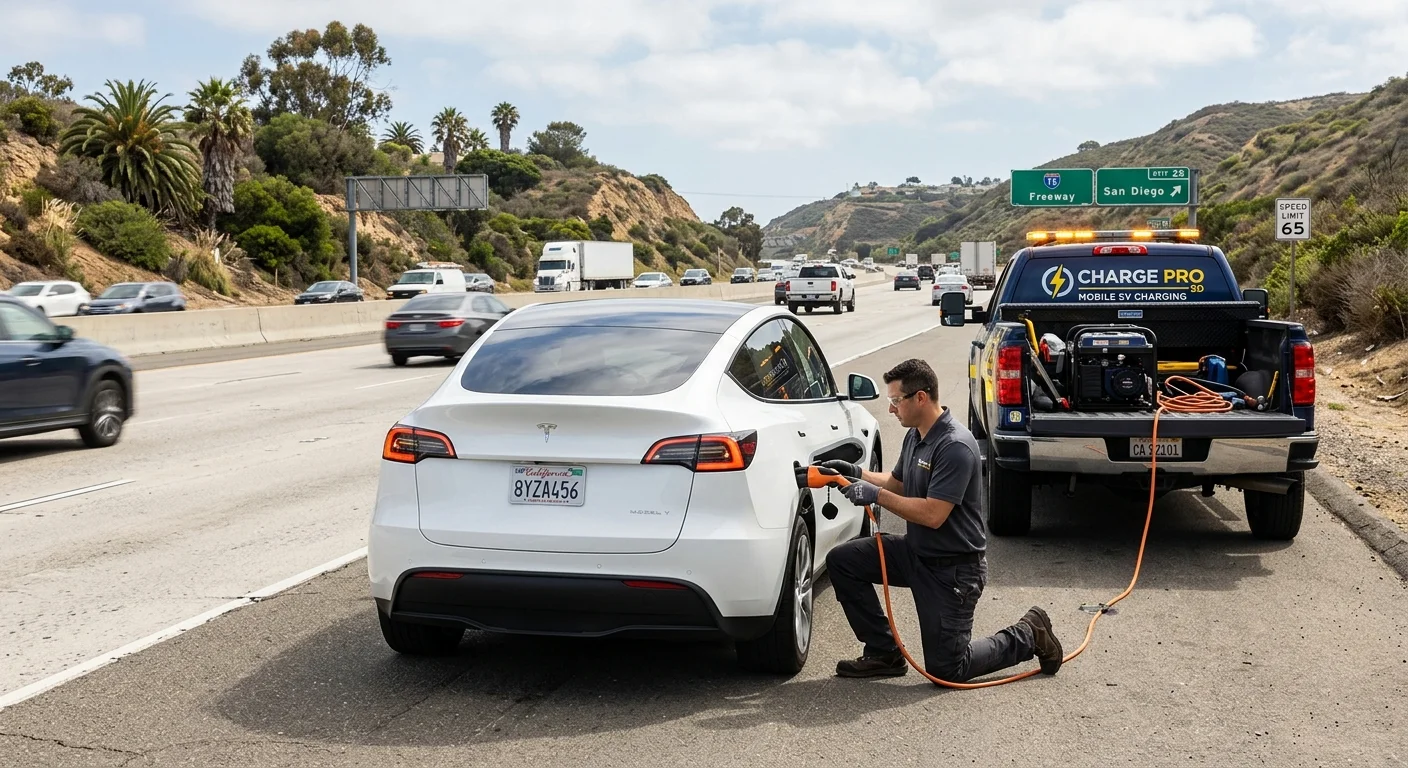
Santa Ana has Tesla stalls. An empty pack still sits.
This city is the county seat, and the second-largest in Orange County. Census figures put the population at 311,639. Tesla hardware is in town. Tesla lists 28 Supercharger stalls at 1008 17th St. It lists 20 more inside the city garage at 300 E 5th St, at up to 72 kW. Electrify America has sites at 3600 W McFadden Ave, 3300 S Bristol St, and 2127 E 17th St.
Those plugs help when you can still drive. They do nothing for a pack that already hit empty. A driveway in 92704 is the same problem. So is a juror stall downtown. So is a shoulder on the 5. The car needs power where it sits.
Santa Ana sits on a flat coastal-plain floodplain. Elevation is about 80 feet at the centroid. The only real relief is northeast, toward the Tustin and Orange bench. The Santa Ana River channel runs the west side. Grades aren’t what drains the pack here. Traffic is.
The I-5, the Santa Ana Freeway, cuts through town. So does SR-55, the Costa Mesa Freeway. Those segments are among the most congested in the county. Air conditioning in stop-and-go is a continuous 1 to 3 kW load, per Recurrent. That draw runs on Bristol, Main, First, and Harbor. It runs before you ever reach a stall.
Empty pack or dead 12-volt: tell them apart
A Tesla that won’t move isn’t always out of range. The 12-volt battery runs the computers, the contactors, and the latches. When that small battery dies, the car can look fully dead. Miles may still sit in the high-voltage pack.
Tesla’s Model Y owner’s manual describes the empty-pack case. Once range is exhausted, the low-voltage battery loses support. The car then needs an external power supply. Only after that can the high-voltage pack take a charge. Towing to a Supercharger is a weak first move in that state. The stall may not start a session until the 12-volt system is awake.
Dark screens, sticky doors, and an app that won’t wake the car point to 12-volt failure. A Tesla 12V battery jump on site is the usual field fix. If the display still works and the car reports zero range, the pack is depleted. That’s a mobile EV charging job. We walk through dead pack versus a dead 12-volt in another post. The checks go in order.
Old housing, apartment lots, and a public-charging life
More than three quarters of Santa Ana housing predates 1980. The Census share is 76.5 percent. The 1970s, 1960s, and 1950s dominate that stock. A large share is multifamily. Assigned uncovered parking is common. Home chargers aren’t common.
Those drivers charge in public, every day. A public-charging life has no overnight buffer. A stall blocked by a gas car ends the evening. So does a failed session. So does a long wait behind another car.
ZIP 92704 covers the largest share of city land, at 26.4 percent. 92705, 92707, 92703, 92706, and 92701 fill out the rest. Delhi, Logan, Artesia Pilar, Willard, and Madison Park are dense, older, and apartment-heavy. Floral Park, French Park, Washington Square, and Wilshire Square sit closer to downtown. Park Santiago and Santa Anita sit east toward Tustin Ave. Mar-Les and South Coast Metro sit south, toward MacArthur and the 405.
Spanish is spoken at home in 67.1 percent of Santa Ana households. That’s the highest share in the county. About 27.3 percentage points of residents speak English less than very well. A stranded driver here is more likely than not describing the problem in Spanish. That’s the city’s language mix.
Orange County had 210,842 battery-electric vehicles on the road as of December 31, 2025. That’s per the California Energy Commission. Teslas were 138,121 of those BEVs, or 65.51 percent of the county battery-electric fleet. Santa Ana sits in the middle of that Tesla-heavy county. Service on S Standard Ave and Superchargers downtown still don’t move a car that can’t drive.
CEC figures also put Orange County at 36.8 ZEVs per public port. The statewide figure is 24.4. That’s 260,833 ZEVs against 7,095 public ports in the county. A Santa Ana driver who lives on public stalls feels that squeeze first.
Civic Center days, medical shifts, and the garage Supercharger
Downtown Santa Ana holds people for full days. The Civic Center keeps jurors and staff on site through the afternoon. So does the Orange County Superior Court Central Justice Center. So does the Ronald Reagan Federal Building. Orange County Global Medical Center at 1001 N Tustin Ave holds cars through shifts. Santa Ana College adds campus dwell. The Santa Ana Regional Transportation Center holds rail and bus connections. Discovery Cube at 2500 N Main St adds long visits on the north side. So does MainPlace Mall at 2800 N Main St. Bowers Museum and the Santa Ana Zoo at Prentice Park do the same for weekend trips.
The 5th Street Supercharger sits inside a city parking garage. Drivers come downtown specifically to charge. Some arrive with almost nothing left. If those 20 stalls are full, the car is already past hunting another site. Same if a session won’t start. That downtown pattern is why stalling downtown in Santa Ana is its own write-up.
You can still try 1008 17th St if the car will roll. You can’t will a zero-mile Tesla through Fourth, First, or Main to get there.
Shoulders on the 5, the 55, and SR-22
I-5 runs through the city as the Santa Ana Freeway. SR-55 is the Costa Mesa Freeway. SR-22, the Garden Grove Freeway, tracks the north edge. I-405 clips the south edge. Shoulder stops on those segments are routine.
If you’re already on the shoulder, stay in the car with hazards on. Don’t walk the lanes looking for a stall you can’t reach. Share a pin, not a hoped-for mall.
Harbor Blvd, First St, Fourth St, and 17th St feed those freeways. So do McFadden Ave, Edinger Ave, Warner Ave, and Grand Ave. Dyer Rd, Tustin Ave, and Bristol St do too. An empty Tesla in a left-turn pocket on Bristol is as stuck as one on the 5. The operator comes to the pin you share.
Heat on the plain, traffic on the freeways
NOAA 1991 to 2020 normals at Santa Ana Fire Station are on record. July’s mean maximum is 82.5 F. August is 84.6 F. That’s warmer than the coast. Newport Beach Harbor, the coastal proxy in the same normals set, sits at 73.3 F in August. It’s cooler than inland Anaheim, which hits 88.8 F in August at the Anaheim station.
AAA’s 2026 dynamometer study measured range in heat. EVs lost 8.5 percent of driving range at 95 F with air conditioning running. Recurrent puts continuous A/C draw at roughly 1 to 3 kW. Santa Ana’s summer highs often sit under that 95 F mark. Stop-and-go on the 5 still keeps the compressor on. Range fades in traffic even on a flat floodplain.
The National Weather Service glossary defines a Santa Ana wind as a southern California condition. Strong, hot, dust-bearing winds descend to the Pacific Coast around Los Angeles from inland desert regions. Season, speed, and humidity figures weren’t confirmed on a live weather.gov page. Treat a hot, dusty offshore wind as extra cooling load. Leave the rest to the forecast office.
What Tesla roadside does with an empty pack
Tesla’s own roadside page, as returned in Tesla’s indexed wording, covers a depleted battery. It says the company can assist when you can’t make a charging station. It also says that help isn’t a financially covered service. Covered transport of up to 500 miles to the nearest Service Center is for a warrantable breakdown. That breakdown has to leave the car undrivable. Running out of charge sits outside that.
The honest read is simple. Tesla’s published roadside path for an empty pack is transportation, not a charge at the bumper. Confirm the current policy with Tesla before you approve a tow. Confirm any transport bill the same way. Tesla publishes roadside at 877-798-3752, including on the Santa Ana service listing.
A tow to 3240 S Standard Ave can make sense for a warrantable failure. It’s the wrong tool for a pack that only needs miles. Shop intake still leaves you without the car. If the 12-volt has already dropped, the car may not charge at a stall. That system has to be supported first.
What a general auto club usually sends
AAA and similar clubs send a contractor. Ask what that truck can do on site. Jumping a 12-volt is a different job from charging the pack. If they’re sending a tow to a stall, say so up front. You may be back to a car that can’t accept a Supercharger session.
Compare the coverage you actually have in AAA or a local Tesla rescue. Membership terms change by plan. Confirm yours with the club. Don’t assume an EV charge is included.
What the operator actually brings to the car
Charge Pro OC is a referral line. It doesn’t own trucks, employ technicians, or set prices. It matches a stranded EV driver with an independent local mobile rescue operator. That operator quotes you before starting, then bills you directly.
The work at the bumper is specific. The operator brings a 240-volt Level 2 source to the car. Teslas take a native NACS plug. Other EVs use a CCS or J1772 adapter. A typical session adds 10 to 20 miles of range in 15 to 30 minutes of charging. That’s charging time. It’s not a promise of when someone arrives. If the 12-volt is the failure, the operator can jump it or replace it on site. The same operators handle Tesla and every major EV brand.
That’s Tesla roadside rescue in practice. You get a charge or a jump where you sit. Then you drive to a stall on your own. The Santa Ana charging page is the local hub. Use it if you still have enough range to choose a site.
If you crossed in from Tustin, Orange, or Garden Grove
Santa Ana shares edges with Orange, Tustin, Garden Grove, Costa Mesa, and Fountain Valley. A Tustin commute can die on the 55. That’s still a Santa Ana pin if the car stopped here. A South Coast Metro miss can leave you on the Santa Ana side of MacArthur. A Garden Grove trip that fades on the 22 lands on the north edge.
Stay with the car. Share the closest cross street. Main and 17th is a readable pin. So is Bristol and Dyer. So is Tustin Ave near the hospital, and Harbor at the 22. Don’t try to limp a zero-mile Tesla into the 17th Street Supercharger through arterial traffic. You won’t make a light you can’t clear.
Stay with the car, then make the call
Turn on hazards. If you’re on a freeway shoulder, stay in the vehicle. If you’re in a garage or an apartment lot, stay with the car. The operator needs to find it.
Open the Tesla app and note whether it still connects. Note the last range figure. Note any 12-volt warning. Note whether the charge port will open. Those details tell the operator which kit to bring.
If you can still roll a mile, you can try a stall. Check 1008 17th St or 300 E 5th St if either is showing open. If the car is already at zero, or the 12-volt is down, skip the hunt. Call for a charge or a jump at the pin.
Charge Pro OC connects Santa Ana drivers with those operators. Call (949) 444-0151 when you need that match. The operator quotes you before any work starts, then bills you directly.