Your EV died in a Seal Beach parking lot. You can charge it where it sits. The EVgo site at 801 Pacific Coast Highway has four DC fast stalls. Use that site if the car can still roll. If it won’t move, a local operator can charge at the space. They bring a 240V Level 2 source to the car. Charge Pro OC connects stranded drivers with independent mobile rescue operators. We don’t perform the work, own trucks, or set a price. The operator quotes you first, then bills you directly.
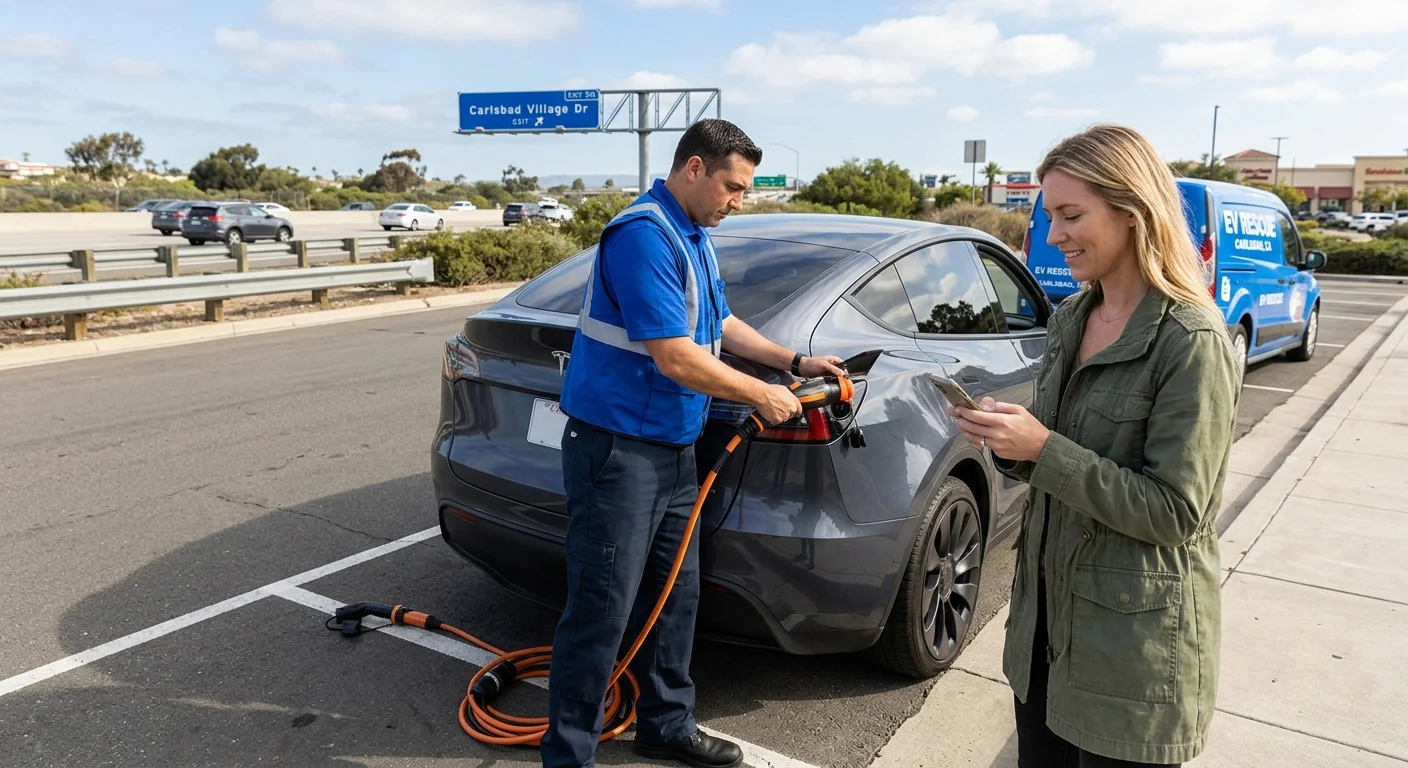
Seal Beach lots sit on a flat coast
Seal Beach is a flat coastal plain at sea level. There are no bluffs to climb on the way in. Range here is a parking story, not a heat story. The marine air stays mild, and the terrain costs almost nothing. What strands people is time in a lot, then a car that won’t wake.
About 87.3% of the city’s 14,616 housing units were built before 1980. Old Town, The Hill, and College Park still have alley garages. They also have a lot of street parking. Drivers park at the pier, along Main Street, and in beach lots. Then they come back to a car that sat for hours.
The western end of SR-22 meets Pacific Coast Highway here. I-405 and I-605 also dump traffic toward the coast. Seal Beach is where a freeway run stops. If you arrive low, the lot is often where the car dies.
Nearby streets that matter include Seal Beach Boulevard, Westminster Avenue, Marina Drive, and Main Street. Name the street you’re on, not just the city. “Somewhere in Seal Beach” isn’t enough for an operator to plan the approach.
The EVgo on Pacific Coast Highway
If the car still moves, start with the local DC fast site. That’s the EVgo station at 801 Pacific Coast Highway, with four stalls. That address sits on the same coast road as the beach lots. It won’t help a car that already sits dead in a stall.
Don’t push a nearly empty EV through Old Town traffic to reach it. If you can’t shift into drive, stay with the car. Turn on the hazard lights and stay out of the travel lane. Call from the space you’re in.
Our mobile EV charging service refers those lot calls to local operators. Independent operators bring a native NACS plug for Teslas. They use a CCS or J1772 adapter for other EVs. They typically add 10 to 20 miles of range. That takes 15 to 30 minutes of charging. That’s session time on the cable, not an arrival window.
The California Energy Commission counted 210,842 battery-electric cars in Orange County as of December 31, 2025. When the car won’t roll, the work happens at the bumper. For city-level charging context, see EV charging in Seal Beach.
Leisure World, Surfside, and the Navy gate
Seal Beach has two very different EV populations. Leisure World Seal Beach is a gated, 55-plus community that opened in 1962. It was the nation’s first planned retirement community. It covers 531 acres, with 16 self-governing Mutuals under the Golden Rain Foundation. More than 9,500 people live behind that gate. That’s over a third of the city’s 24,868 residents. Census data put 43.7% of Seal Beach at 65 or older.
Cars sit for long stretches, and trips are short. The usual failure is a dead 12V battery, not an empty pack. An operator going in must pass staffed security. You need to arrange gate access as a resident or guest. Share the Mutual, the gate, and any visitor instructions you were given.
Surfside Colony is gated too, in ZIP 90743. The operator works from the street you can open. Naval Weapons Station Seal Beach is off limits, and they can’t drive onto the installation. Meet at the public gate or on a public street. Don’t ask them to follow you onto the base.
For a wider Seal Beach playbook, see EV roadside assistance in Seal Beach.
Tell a dead pack from a dead 12V
A dead EV can mean two different failures. The traction battery may be empty, or the 12V may have dropped out. The recovery isn’t the same.
Say what you saw before the car quit. Share the last percent or rated miles you saw. Note any low-charge, reduced-power, or low-voltage message. Exact dashboard wording helps more than a guess. If the screen is dark, say that. If doors still unlock, say that too.
A blank screen doesn’t prove the pack is empty. A visible percent doesn’t prove the 12V is healthy. In Leisure World, start with the 12V story. In a pier lot after a long beach day, an empty pack is more common. Report both the sit time and the last reading.
Don’t keep cycling the car when a warning you don’t understand is up. Don’t open high-voltage covers or stand in traffic to inspect the port. Photograph the dash if it’s safe, then wait.
Operators we connect you with can jump or replace a dead 12V on site. They also handle Tesla and every major EV brand. The out-of-charge recovery path is for a pack that looks depleted. The operator still confirms the fit for your car and this lot.
Tesla’s owner’s manual covers a depleted pack. Once range is gone, the low-voltage battery can lose support. It may need external power before the high-voltage pack can charge. Tesla’s roadside policy answers a depleted battery with transportation, not an on-site charge. Empty-pack transport isn’t the covered ride for a warrantable breakdown.
What to share so the operator can quote
Give a meeting point a stranger could find. Use the lot name if it’s posted. Name the closest business, or the Seal Beach Pier if that’s the landmark. Give the street, the cross street, and which way the car faces. Say which side the charge port sits on relative to the aisle. If you’re in a structure, share the garage level and any clearance signs.
If you left I-405, I-605, or SR-22, say the exit and the direction. Then say you’re now in a lot, not on the shoulder. A freeway travel lane isn’t a place to set up charging. Move to a shoulder or a lot only when you can do so safely. Call emergency services if the car is a hazard in a lane.
Identify the year, make, model, color, and plate. Mention any adapter you have, but they confirm the connector.
A neighborhood name isn’t an address. Old Town curb work isn’t a Bridgeport driveway job. College Park alleys and Marina Hill street parking differ too. Heron Pointe and Old Ranch Country Club have their own entries. Describe the actual site, not the nearest neighborhood label.
Huntington Beach lots create the same beach-day sit. If you drifted south, the Huntington Beach lot guide covers that pattern. Los Alamitos and Rossmoor sit inland of here.
Charge in the space, or move the car
Mobile charging isn’t automatic for every stalled EV. The independent operator reviews the pack, the 12V, the port, and the working room. Traffic, gates, and clearance all count in that review. Charge Pro OC doesn’t promise a connector, a power level, or a range result.
On-site charging can fit when the pack looks empty. The lot still has to give them room to work. A small top-up is meant to get you to a stall or home. Check the display before you pull out. Ask the operator what the session is meant to do.
Transport can fit when the space can’t take the truck. It also fits when the symptoms aren’t an empty pack. The operator can talk through destinations you name. We don’t pick the shop or the stall for you.
Once you have a few miles, you can roll to a stall you choose.
Price isn’t a published Seal Beach figure. Charge Pro OC doesn’t set operator rates. Ask for the quote and the terms before you approve the work. Your insurer or automaker plan may or may not apply. You’ll need to confirm that coverage with them.
The charge versus tow choice is the same decision in countywide terms. For how a quote is built, see what goes into a mobile EV charging quote.
When to call us
Call when the EV is stuck in a Seal Beach lot. Ask for an operator who can assess a charge in place. Have the lot, the vehicle, the last reading, and any gate notes ready. The pros we connect you with are licensed and insured. Call (949) 444-0151 and we’ll connect you with a local EV rescue operator.