A mobile EV charging service cost in Orange County isn’t a posted menu. Independent operators quote you before they start, then bill you directly. Charge Pro OC is a referral line. We match stranded drivers with local mobile rescue operators. We don’t set the price, own the truck, or send you a bill. The number you hear is the operator’s. You can accept it or you can pass.
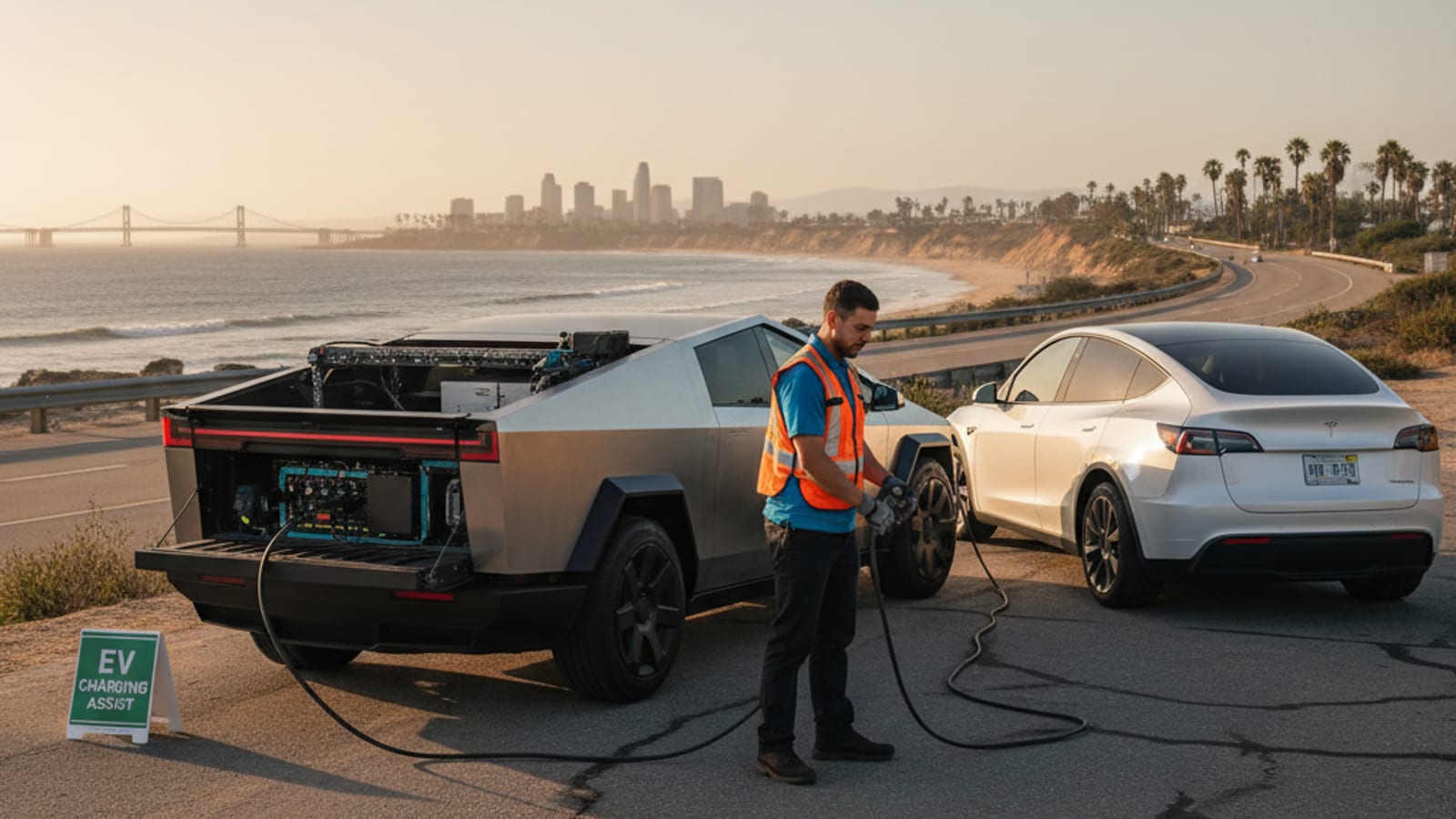
A Supercharger screen shows a stall tariff. A truck at the bumper doesn’t. The operator is pricing a field visit. That includes the drive, the setup, the energy, and the minutes the cable stays in. That’s why this page doesn’t print a county rate. A printed rate would be a guess. Guesses are how drivers get surprised.
What the quote is actually buying
You’re not buying a full pack. You’re buying enough range to leave the pin. The operators we connect you with bring a 240V Level 2 source to the car. Teslas take a native NACS plug. Other EVs take a CCS or J1772 adapter. The session is meant to add about 10 to 20 miles of range. That usually takes 15 to 30 minutes of charging time. That clock is charging time. It’s not a promise of when someone arrives.
If the pack still has energy and the car won’t wake, the 12V is often the fault. Operators can jump or replace a dead 12V on site. Tesla and every major EV brand sit in that mix. Ask for a quote that matches the real job. An empty pack and a silent 12V aren’t the same call.
For a plain look at the truck, read what’s on an EV charging truck. It’s a rolling Level 2 outlet. It’s not a Supercharger on wheels.
Why Orange County generates so many of these calls
The California Energy Commission counted the county’s battery-electric fleet. The figure was 210,842 as of December 31, 2025. Plug-in hybrids added 47,567. Fuel-cell vehicles added 2,424. The ZEV total was 260,833. That’s 10.56% of the county’s light-duty fleet. BEVs alone were 8.54%. California’s ZEV share of the light-duty fleet was 7.54% in the same file. Orange County holds 12.02% of California’s battery-electric cars. It holds 8.33% of the state’s light-duty fleet.
Tesla’s share of that battery-electric fleet is high here. The CEC make field shows 138,121 Teslas out of 210,842 BEVs. That’s 65.51% of the county’s battery-electric stock. It’s 5.59% of all light-duty vehicles. Statewide, Tesla is 61.34% of BEVs. Orange County is 6.4 points more Tesla-heavy than California as a whole.
New sales tell a similar story, with a caution. In 2025, ZEVs were 28.76% of new light-duty sales in Orange County. The state figure was 22.93%. In 2026 Q2 the county was at 24.77%, against 19.09% statewide. The county runs about five to six points above California. Don’t read that as a boom that never slows. California’s ZEV share of new sales peaked at 25.31% in 2024. 2026 Q1 was the weakest quarter in that series, at 15.76%. The CEC also changed its new-sale method in 2023 and again in 2025. Year-over-year comparisons across those breaks aren’t clean.
Tesla’s share of new Orange County ZEV sales has moved too. It was 56.9% in 2023, 47.2% in 2024, and 44.7% in 2025. The first half of 2026 came back at 56.4%. The fleet is still Tesla-heavy. The sales mix isn’t a single brand.
California DMV estimated 2,983,348 fee-paid vehicles in Orange County as of January 1, 2026. Don’t divide ZEV counts by that figure. It includes trailers and motorcycles. The CEC light-duty universe is 2,469,737. Use that denominator for fleet-share math.
Public hardware isn’t matching that fleet on a per-car basis. The CEC charger file for December 31, 2025 lists 7,095 public ports in Orange County. That’s 20 Level 1, 5,600 Level 2, and 1,475 DC fast. Add shared private ports and the grand total is 11,780. California’s public total is 91,520. Orange County holds 7.75% of those public ports. Divide 260,833 ZEVs by 7,095 public ports and you get 36.8 ZEVs per public port. Statewide the same math is 24.4. That crowding is a government-sourced fact. It’s also why a driver can still need a truck when a map looks busy.
Federal station data behind the Alternative Fuels Data Center counted 223 public DC fast stations in the county. It counted 1,452 DC fast ports. Tesla accounts for 48 of those stations and 861 of those ports. That’s about 59% of the fast-port total. Electrify America has 30 stations and 138 ports. EVgo has 30 stations and 131 ports. ChargePoint has the most sites, 71, and only 76 DC fast ports. Most of those ChargePoint plugs are single-stall dealership and office units. They’re not a rescue-grade bank. EVCS has 14 stations and 87 ports. ROVE has two stations and 32 ports. Rivian Adventure has two stations and 22 ports. Shell Recharge has one station and 14 ports.
Those counts explain demand. They still don’t set a mobile EV charging service cost. A stall bills a session. An operator bills a visit.
Named stalls don’t replace a quote at the bumper
Orange County isn’t one charging map with the city name swapped. North county, the central cities, the coast, and south county have different banks. They also have different speeds and different lot patterns. That changes how you plan an exit after a mobile session. It doesn’t create a countywide roadside tariff.
Anaheim alone has seven Supercharger sites in the AFDC file. They sit at 1128 W Lincoln Ave and 1734 W Lincoln Ave. More sit at 2270 E Lincoln Ave, 156 N Imperial Hwy, and 2404 E Katella Ave. 680 N Euclid St and 8148 E Santa Ana Canyon Rd round out the list. Stall counts there run from 16 to 20. Newer sites list 325 kW in the AFDC file. The Santa Ana Canyon Road site lists 20 stalls at 75 kW. Those aren’t the same session.
Irvine’s bank is larger still. 1920 Main St lists 40 stalls at 250 kW. Spectrum Center Drive, Culver Drive, Michelson Drive, and two Walnut Avenue sites fill in the rest. Michelson lists 12 stalls at 75 kW. That’s a slower stop than Main Street. If your exit after a mobile charge is Irvine, say which property you actually trust.
San Clemente’s 101 W Avenida Vista Hermosa site lists 49 stalls. Tustin’s 14661 Franklin Ave site lists 36. Garden Grove’s 12891 Harbor Blvd site lists 32. Buena Park’s 8888 Knott Ave site lists 28 at 325 kW. Santa Ana’s 1008 17th St site lists 28 at 325 kW. Huntington Beach has 24 stalls at 6913 Warner Ave. Lake Forest has 24 at 24301 Muirlands Blvd. Mission Viejo has 24 at 27741 Crown Valley Pkwy. It also has a slower 10-stall site at 555 The Shops. Tesla’s own listing for The Shops is 72 kW. Use that figure, not the AFDC row, when you talk about that property.
Brea has 20 stalls at 1065 Brea Mall and 24 at 175 N Madrona Ave. Costa Mesa has Bristol Street, South Coast Drive, and Hyland Avenue. Hyland lists eight stalls. Fullerton has Harbor Blvd and Orangethorpe. Fountain Valley has Newhope Street at 150 kW and Warner Avenue at 250 kW. Cypress has 16 stalls at 4959 Katella Ave. Newport Beach has 12 at 4241 MacArthur Blvd. San Juan Capistrano has 12 at 26701 Verdugo St. It also has a seven-stall site at 31971 Camino Capistrano, listed at 125 kW, with an AFDC open date in 2014. Laguna Hills has 16 stalls at 23701 Moulton Pkwy. It has 16 more at 25248 Cabot Rd, both listed at 250 kW. Yorba Linda’s two Supercharger sites on Yorba Linda Blvd list eight stalls each.
Garden Grove also has a 16-stall site at 12161 Valley View St. The AFDC file lists that site at 500 kW, opened June 26, 2026. Lake Forest added a 16-stall Magic Dock site at 24372 Rockfield Blvd in late August 2026. That record lists CCS1 and NACS. Westminster Mall lists 24 stalls at 75 kW. Santa Ana’s 300 E 5th St site lists 20 stalls at 75 kW. Tustin has smaller banks on Red Hill Ave, Kensington Park Dr, and Flight Way on top of Franklin.
Non-Tesla fast charging matters when the car isn’t a Tesla. It also matters when a Tesla driver wants another network. Electrify America lists 12 DC fast ports at 25825 Las Vegas in Capistrano Beach. That’s the largest non-Tesla bank in south county in this file. The Anaheim Walmart at 440 N Euclid St lists 10. Fashion Island at 401 Newport Center Dr lists eight. EVgo lists 14 DC fast ports at Plaza Antonio, 22351 Antonio Pkwy in Rancho Santa Margarita. Ocean View Plaza in San Clemente lists 10. Westar Mercantile East in Ladera Ranch lists eight. Seal Beach has four EVgo stalls at 801 Pacific Coast Hwy.
Those addresses are real. They still don’t set a roadside quote. A stall bills energy plus idle rules. A roadside operator bills a visit. If the car can’t roll to 1920 Main St or Harbor Blvd, the stall rate is beside the point.
What usually goes into the operator’s number
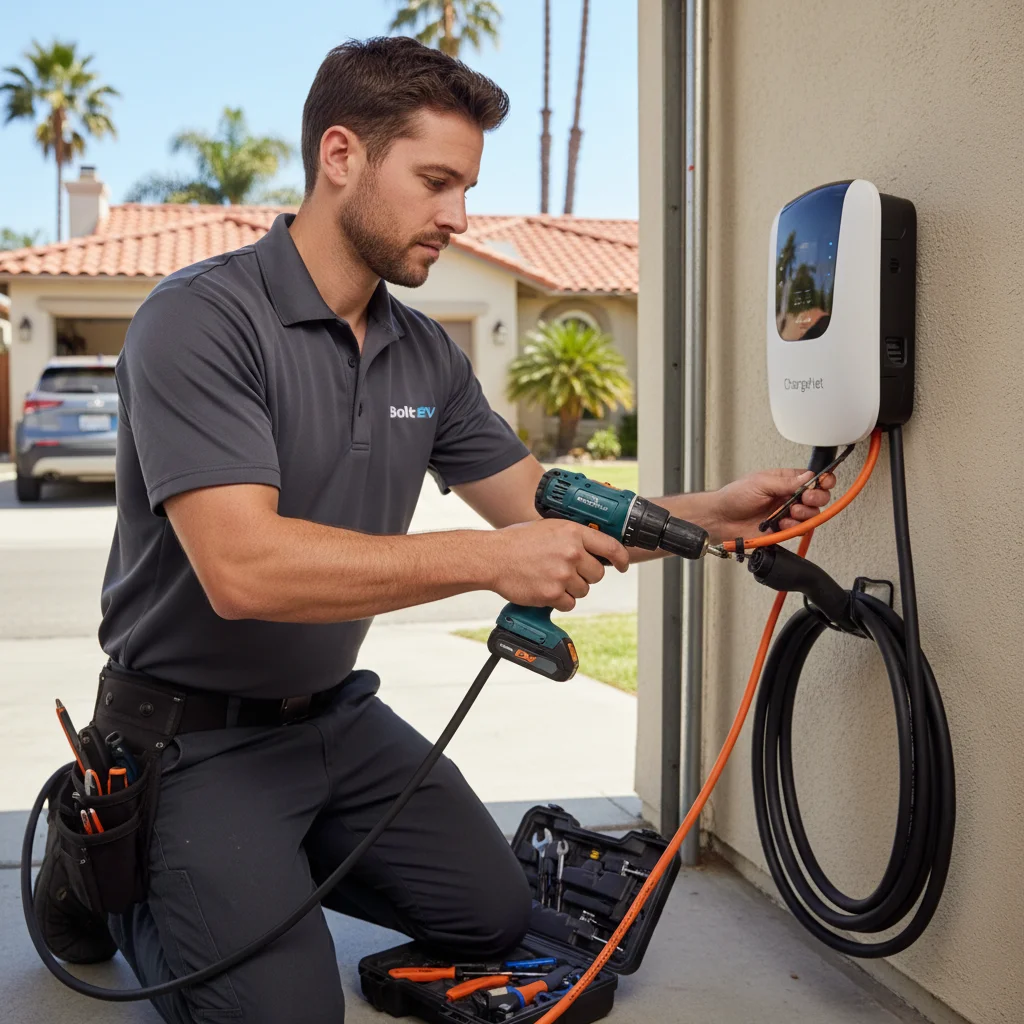
No honest page can print a county price. The operator hasn’t seen your pin yet. What you can know is the ingredients.
Where the car is sitting
Travel is part of the job. A car in a Santa Ana office lot is one dispatch. A car on a quiet shoulder is another. A car in an Irvine garage is one job. A car on Lincoln Avenue in Anaheim is another. The operator prices the path they have to drive, and the time they’ll spend on site. Charge Pro OC doesn’t publish a zone map. We don’t set the rate.
Access matters as much as the city name. A curb on Harbor Blvd is simple. A parking structure or a driveway the truck can’t reach isn’t. Say exactly where the car sits. Floor, structure name, nearest cross street, and whether a truck can idle there. That’s what the quote is built from.
North county lots around Brea Mall, Knott Ave, and Harbor Blvd have their own pattern. South county lots around Avenida Vista Hermosa or Crown Valley look different. Coastal pins near Warner Ave or MacArthur Blvd don’t match a Yorba Linda Blvd pin. That Yorba Linda Supercharger record lists eight stalls per site. Tell the operator the actual street. Don’t make them guess from the city label.
How much range you still need
Operators typically add 10 to 20 miles, not a full pack. That’s enough to reach a working stall you can actually use. Ask for the next safe plug, not a top-off. More energy on the cable means more time on the clock. The operator should tell you what they plan to deliver before they start.
Don’t treat this like a home Level 2 session. You’re not filling overnight. You’re buying an exit. If home is close, say so. If the next stall you trust is the 40-stall bank at 1920 Main St, say so. If you’d rather crawl to the 49-stall San Clemente site, say that too. The quote should match that errand.
A short hop to a Level 2 in a workplace lot is one job. A longer hop to a DC fast bank is another. You don’t need a kWh lecture on the shoulder. You need the operator to say how much range they plan to add. You also need them to say what they’ll bill for that plan.
Tesla, CCS, or a dead 12V
Most of the county’s battery-electric fleet is Tesla. That’s why so many roadside calls are NACS. It isn’t the whole fleet. Plenty of Hyundai, Ford, Chevy, Rivian, and other plugs sit in the same lots. Tell the operator the make, model, and year. Native NACS is one job. CCS or J1772 is another. A 12V that won’t close contactors is a third.
Tesla’s Model Y owner’s manual notes a low-voltage catch. Once range is exhausted, the 12V can lose support. The high-voltage pack may then need an external supply before it will charge. If the screens are dark, say that up front. You may need a jump, a charge, or both. For the 12V-only version of that call, see Tesla 12V battery jump.
Don’t assume the quote for a sleeping Tesla matches a Bolt that still shows a percent. The operator has to bring the right adapter and the right plan. That’s why the make and model belong in the first minute of the call.
When you call, and what the job looks like
Operators price their own calendars. A midday lot in Tustin and a late shoulder job aren’t the same work. Charge Pro OC doesn’t publish hours. We don’t promise a clock. We also don’t add a brand surcharge. The operator names their number. You hear it before they start.
Scheduled work and a sudden stranding can price differently too. If the car is already parked and you know it won’t start in the morning, say that. If you’re on a shoulder with passing traffic, say that. The quote should reflect the job, not a slogan.
Grade, idle, and cabin load can empty a pack faster than the dash guessed this morning. This page doesn’t have a verified Orange County temperature table, and it won’t invent one. What we can say is simpler. If you climbed, idled, or ran climate hard, tell the operator. They’ll plan energy around the car in front of them, not a brochure range.
Tesla’s published path is transport, not a curb charge
Tesla Roadside Assistance is a separate product. Tesla’s roadside-assistance page, as captured for this file, says a depleted pack isn’t a financially covered service. Tesla can still assist, including paid transport. Covered transport of up to 500 miles to the nearest Service Center is for a warrantable breakdown that leaves the car undrivable. Running out of charge sits outside that.
The defensible read is simple. Tesla’s published roadside policy answers an empty pack with transportation, not with on-site charging. Don’t treat that as a mobile EV menu. Open Tesla’s roadside page and confirm the live wording before you rely on it.
Tesla lists a roadside number on the Santa Ana service page: 877-798-3752. Tesla also lists service sites in Costa Mesa, Buena Park, Santa Ana, Irvine, Anaheim, and Aliso Viejo. Those shops are for repairs and appointments. They’re not a quote for a truck at your bumper. For what Tesla bills versus what it covers, see what Tesla roadside assistance covers.
A Tesla tow to a Supercharger can still be the right move. It can also be a longer day than a 240V session at the pin. The operator’s quote lets you compare those paths with a real number, not a hope.
Other options, without inventing a price board
A tow can move the car to a stall, a shop, or home. It doesn’t put miles in the pack while you sit there. Loading an EV has its own rules. If the car can take a 240V session and then roll, many drivers pick that path. If you want the honest fork, read mobile EV charging or a tow.
Waiting for a public stall only works if you can still drive, or if you can leave the car. A shoulder is a bad place to wait on a charger app. Occupied stalls and offline stalls happen at busy sites, including large Tesla banks. That wait has no menu price either. It has time, risk, and whatever the stall later bills.
Vehicle-to-vehicle charging is rare. Most EVs can’t feed another EV on the street. A neighbor with bidirectional hardware isn’t a plan. Don’t count on it while you shop quotes.
AAA, insurers, and factory plans sometimes reimburse or dispatch EV help. Coverage varies by policy and year. Charge Pro OC can’t confirm what your card covers. Call the benefit line. Ask whether they pay an independent operator directly, reimburse you, or only send a tow. Then compare that answer to the quote at the car.
Home Level 2 is how most owners refill for daily driving, when the outlet works and you have time. This page doesn’t have a verified Orange County utility rate for that fill, so it won’t invent one. Confirm your current home rate with your utility. Roadside energy is a different product. Don’t mix the two receipts in your head.
How the referral quote actually happens
Call with the pin, the car, and the symptom. Leave a make, model, and year. Say whether the screens work. Say how much range you think you need, and where you plan to drive once you have it. An operator uses that to quote before they start.
Charge Pro OC’s mobile EV charging page explains the match. Out-of-charge recovery is the empty-pack version of the same idea. We don’t collect the bill. The operator does. If the quote isn’t a fit, you can say no before the cable goes in.
Keep the county charging map in your phone before you need it. Start at EV charging in Orange County. City pages sit under that hub. They won’t replace a quote. They’ll tell you which stalls exist near the pin.
When you’re ready to be matched, the number is (949) 444-0151. That call is a referral. It’s not an arrival clock.
Frequently asked questions
Is there a set mobile EV charging service cost in Orange County?
No. Operators quote before they start and bill you directly. Charge Pro OC doesn’t publish a rate card, because we don’t set the price. Location, access, energy needed, plug type, and the job itself all sit in that quote. Ask for the number first. Then decide.
How much range does a mobile session usually add?
Operators we connect you with typically add about 10 to 20 miles. Charging time is usually 15 to 30 minutes. That’s not a full pack, and it’s not a promise of when someone arrives. It’s enough, in most calls, to reach a stall you can actually use.
Will Tesla pay for a truck that charges me on site?
Tesla’s published roadside language treats a depleted pack as assistance that isn’t financially covered. The covered long-distance transport is for a warrantable breakdown. Confirm Tesla’s current policy on their site. If you want an on-site 240V quote, that comes from a local operator, billed by that operator.