You’re empty on an Orange County street and you’re not in a Tesla. You need a mobile rescue operator who brings CCS or J1772. A Tesla-only playbook won’t match your inlet. Tesla holds 65.51% of the county’s battery-electric fleet. The other third still has to charge a different way.
Tesla is most of the fleet. You still need another plug
The California Energy Commission counted 210,842 battery-electric vehicles in Orange County. That’s the snapshot as of December 31, 2025. Tesla registered 138,121 of them. That’s 65.51% of the county’s BEVs. It’s also 5.59% of all light-duty vehicles here. California’s Tesla share of BEVs was 61.34% on the same file. Orange County runs 6.4 points more Tesla-heavy than the state.
The parked fleet is one story. New sales are another. Tesla’s share of new Orange County ZEV sales was 44.7% in 2025. More than half of those new ZEVs were not Teslas. The first half of 2026 bounced to 56.4% Tesla. The mix on the road is still Tesla-first. CCS and J1772 cars keep arriving every quarter.
Orange County held 12.02% of California’s battery-electric vehicles. It was only 8.33% of the state’s light-duty fleet. ZEVs were 10.56% of the county’s light-duty mix. BEVs alone were 8.54%. A Rivian or Ioniq 5 on Katella is normal here. It just isn’t the default Tesla rescue path.
New ZEV share is not climbing without a pause. In 2024, ZEVs were 30.67% of new light-duty sales in the county. In 2025 that figure was 28.76%. The second quarter of 2026 sat at 24.77%. California sat at 19.09% in that same quarter. The CEC also changed how it counts new sales in 2023 and again in 2025. Year-over-year comparisons across those breaks are messy. The fleet numbers are the stable ones.
The DC fast map still leans Tesla
AFDC station data showed 223 public DC fast stations in Orange County. Those sites held 1,452 DC fast ports. Tesla held 48 stations and 861 ports. That’s 59% of the county’s public DC fast plugs. Remove Tesla and you have 175 stations and 591 ports. Electrify America had 30 stations and 138 ports. EVgo had 30 stations and 131 ports. EVCS had 14 stations and 87 ports. ChargePoint had 71 stations and only 76 ports. That’s about 1.1 plugs per ChargePoint site. Many of those units are single-stall dealership and office posts.
You can name the stalls a non-Tesla driver actually uses. Electrify America at Fashion Island has 8 DC fast ports. That’s 401 Newport Center Dr in Newport Beach. Electrify America at Walmart, 440 N Euclid St in Anaheim, has 10. Electrify America’s Dana Point Station has 12. That’s 25825 Las Vegas in Capistrano Beach, the largest non-Tesla site in south county. EVgo at Plaza Antonio has 14 DC fast ports. That’s 22351 Antonio Pkwy in Rancho Santa Margarita. EVgo at Ocean View Plaza, 638 Camino de los Mares in San Clemente, has 10. EVgo at Westar Mercantile East in Ladera Ranch has 8. That’s 27542 Antonio Pkwy. EVgo at 801 Pacific Coast Hwy in Seal Beach has 4.
Tesla Superchargers run larger. Irvine’s site at 1920 Main St has 40 stalls. Tustin’s site at 14661 Franklin Ave has 36. Garden Grove’s site at 12891 Harbor Blvd has 32. San Clemente’s site at 101 W Avenida Vista Hermosa has 49. One Tesla site is built for mixed plugs. Lake Forest’s Magic Dock at 24372 Rockfield Blvd lists CCS1 plus NACS on 16 stalls. A CCS car can use that one.
The CEC counted 7,095 public ports in Orange County. The ZEV count on the same horizon was 260,833. That’s 36.8 ZEVs per public port. California sat at 24.4. The county is tighter per EV than the state. A mapped stall can still be busy when you roll in. Named sites exist. You still have to reach them with range left.
If the pack is already at zero, hunting a stall is the second job. You want a truck at the car first. That’s non-Tesla EV rescue.
CCS, J1772, and NACS on the truck
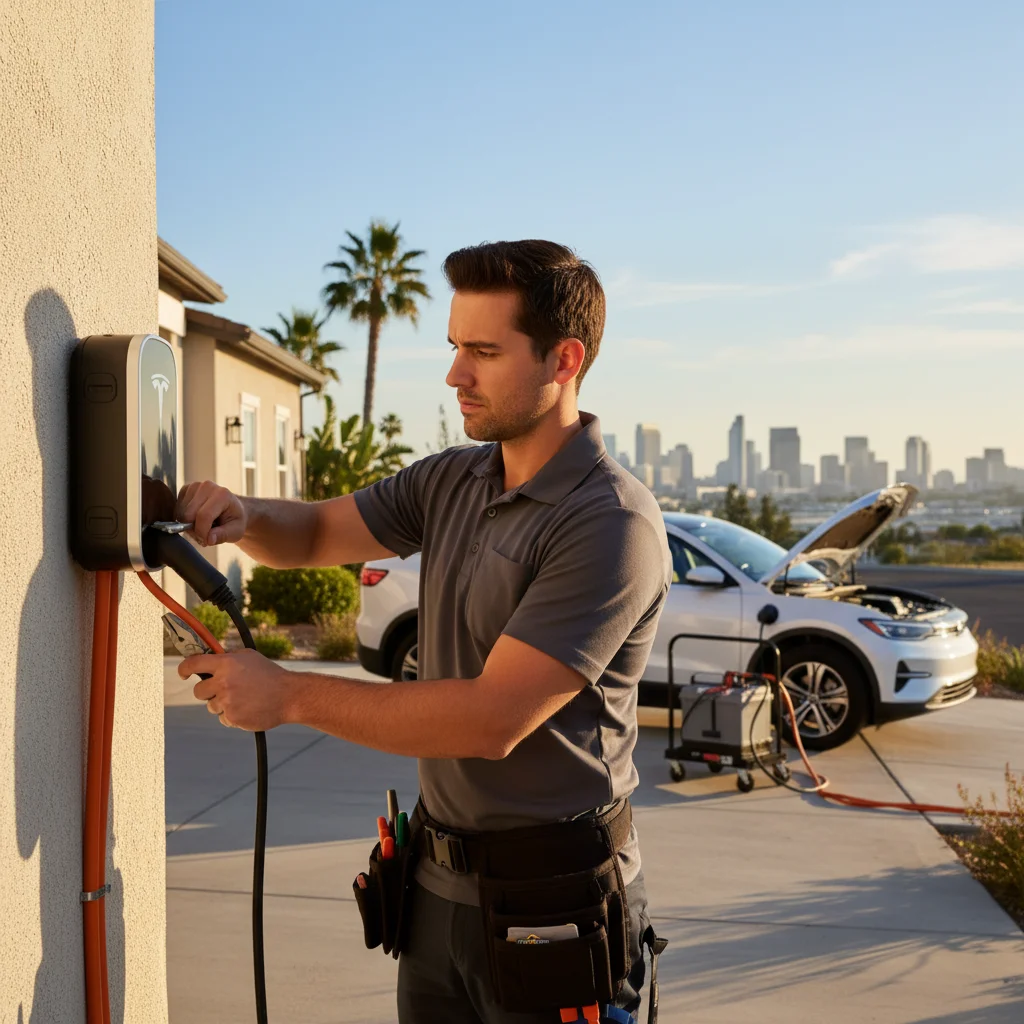
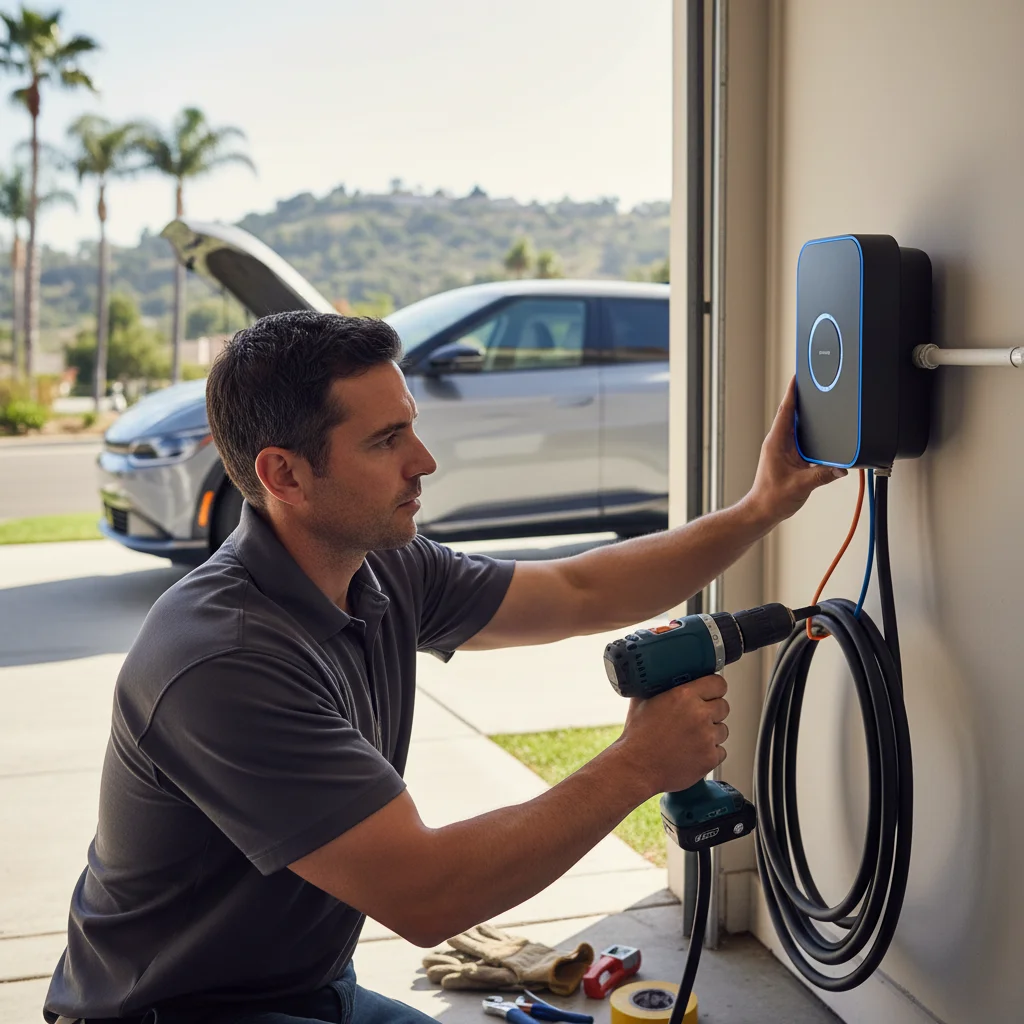
The pros we connect you with bring a 240-volt Level 2 source. The truck’s native plug is NACS. They carry CCS or J1772 adapters for non-Tesla EVs. A typical session adds 10 to 20 miles of range. That takes 15 to 30 minutes of charging. That’s charging time, never an arrival time. The operator quotes you before any work starts. They bill you directly.
CCS1
CCS1 is the common DC-fast inlet on most non-Tesla EVs sold in the U.S. Rivian, Ford, Hyundai, Kia, newer GM, Polestar, and Volkswagen use it for fast charging. You’ll see the J1772 AC face with two extra DC pins under it. A roadside Level 2 session uses the AC half of that inlet. The operator isn’t filling the pack. They’re adding enough miles to reach a working stall.
J1772
J1772 is the North American AC Level 2 connector. Almost every non-Tesla EV here takes it. Some cars have a standalone J1772 port. Others take J1772 through the AC half of CCS. It’s slower than DC fast. On a shoulder, slow is still useful.
NACS
NACS is Tesla’s connector. Some newer non-Tesla models use it now too. If you’re unsure, open the charge door and look. CCS1 is the larger two-tier plug. NACS is the smaller rectangular one. J1772 alone, with no DC pins below, is AC only. Mobile EV charging operators bring the set so they don’t guess at the curb. For a plain look at the gear, read what a mobile EV rescue truck brings.
Empty pack, dead 12-volt, or a port that stays shut
Non-Tesla EVs still run two batteries. The high-voltage pack turns the wheels. The small 12-volt battery runs computers, lights, locks, and the charge-port latch. From the sidewalk they can look identical. The car is dark. The handles may not pop. The port may stay closed.
Tell the dispatcher what you’re seeing. Dim hazards and a low-voltage message usually point at the 12-volt. A port that won’t open often does too. A car that wakes, shows 0%, and still opens the port is an empty pack. Operators can jump or replace a dead 12-volt on site. They can also put Level 2 into the traction pack when that’s the failure.
Don’t push the car on a freeway shoulder. These vehicles are heavy. On I-5, I-405, the 91, or SR-22, stay inside. Keep the seatbelt on. Hazards on. Sit as far right as you can. If you must step out, use the passenger side.
What changes by brand
Hyundai Ioniq 5, Ioniq 6, and Kia EV6
These cars use CCS1. The packs are large. A curb session is a bump, not a full fill. If the car won’t wake, run the 12-volt checks first. We walked that sequence here: Hyundai Ioniq 5 won’t start, the 12V checks to run first. Open PlugShare while you wait so you already know where you’ll aim after the top-up.
Ford Mustang Mach-E and F-150 Lightning
The Mach-E charge-port release is electronic. A dead 12-volt can hold it closed. Ford’s manual covers a pull tab in the front trunk. That tab frees the port by hand. The Lightning has a similar manual path. If you can open the frunk, find that tab before the operator arrives. Stuck-cable steps live here: Mach-E cable won’t release. Confirm whether your inlet is CCS1 or NACS. Don’t assume from a photo of a different year.
Rivian R1T and R1S
Rivian’s port sits on the driver’s-side rear. The door often needs accessory power to open. If the 12-volt is down, the port can stay shut. Check the owner’s manual for a manual release. It’s behind the rear driver’s-side trim on many trucks. Some newer Rivians use NACS. Older ones use CCS1. Look at the inlet before you call it. If the truck won’t wake, start with the R1T and R1S 12V checks.
Chevy, GMC, and other GM EVs
Bolts and many older GM EVs use CCS1. Newer GM models have been shifting toward NACS. Some earlier cars get adapters. A dark Equinox EV, Silverado EV, or Sierra EV is often the 12-volt. That’s the same pattern as the cars above. Polestar uses CCS1, with the port on the driver’s-side rear. If a session won’t start, a fault on the screen can block charging. Cycle power using the owner’s steps. Don’t force the plug.
Tesla roadside is built for Tesla drivers
Tesla’s own roadside policy answers a depleted pack with transportation. It does not send a charge to the car. That’s useful context, and it isn’t your program. Tesla publishes 877-798-3752 on its Santa Ana service page. Running out of charge is not treated as a warrantable breakdown. Covered long-distance transport is tied to a warrantable failure that leaves the car undrivable.
You’re outside that system. Your automaker’s roadside line may send a flatbed. It may not send a 240-volt source with the right adapter. Confirm what they actually dispatch before you wait on it. If you need miles added where you sit, you want an independent mobile operator.
Coast, inland, and south county don’t feel the same in an EV. Beach lots in Huntington Beach and Newport Beach sit after a long, slow day. Theme-park and stadium blocks in Anaheim eat hours on the 12-volt. HOA garages in Irvine and Mission Viejo can leave you behind a gate. Buena Park auto row and a Yorba Linda hillside don’t park the same way. The cars are the same. The parking is not.
Once you’re already stopped
Stay with the vehicle. On a freeway, that means inside, belted, hazards on. Stay visible in a Costa Mesa structure or on a Santa Ana curb. Don’t walk into a lane to watch the range number.
Pick the stall you’ll use after the top-up. Fashion Island and the Euclid Walmart in Anaheim are mapped. So are Harbor Blvd in Garden Grove and the Magic Dock in Lake Forest. The rescue is the hop, not the full fill.
If the 12-volt is questionable, say so on the call. A closed port wastes the first minutes of a Level 2 session. A lot of these cars have a manual release. The glove-box card or the owner’s manual usually shows the tab.
Who Charge Pro OC actually is
Charge Pro OC is a referral line for Orange County. We match stranded EV drivers with independent local mobile rescue operators. We don’t own trucks. We don’t employ technicians. We don’t set prices. We don’t promise an arrival clock. The operator quotes you, then bills you. They handle Tesla and every major EV brand, including the CCS and J1772 cars this page is about.
For the county map and city pages, start at EV charging in Orange County. When the pack is empty or the port is stuck, that’s the moment. Same if the 12-volt has killed the start. Then call (949) 444-0151. We’ll connect you with an operator who brings the plug your car actually uses.