The CCS handle is still locked in your Mustang Mach-E. You plugged in at a coastal Orange County beach lot last night. Or you grabbed a hotel charger after a long day on Pacific Coast Hwy. Morning came, the session looks done, and the connector won’t budge. That’s a stuck charge port, not an empty traction pack. You can usually free it on the street without a tow. You have to sort the car latch from the station lock first. A blocked stall in Huntington Beach or Newport Beach strands the morning around you.
The car lock and the station lock aren’t the same problem
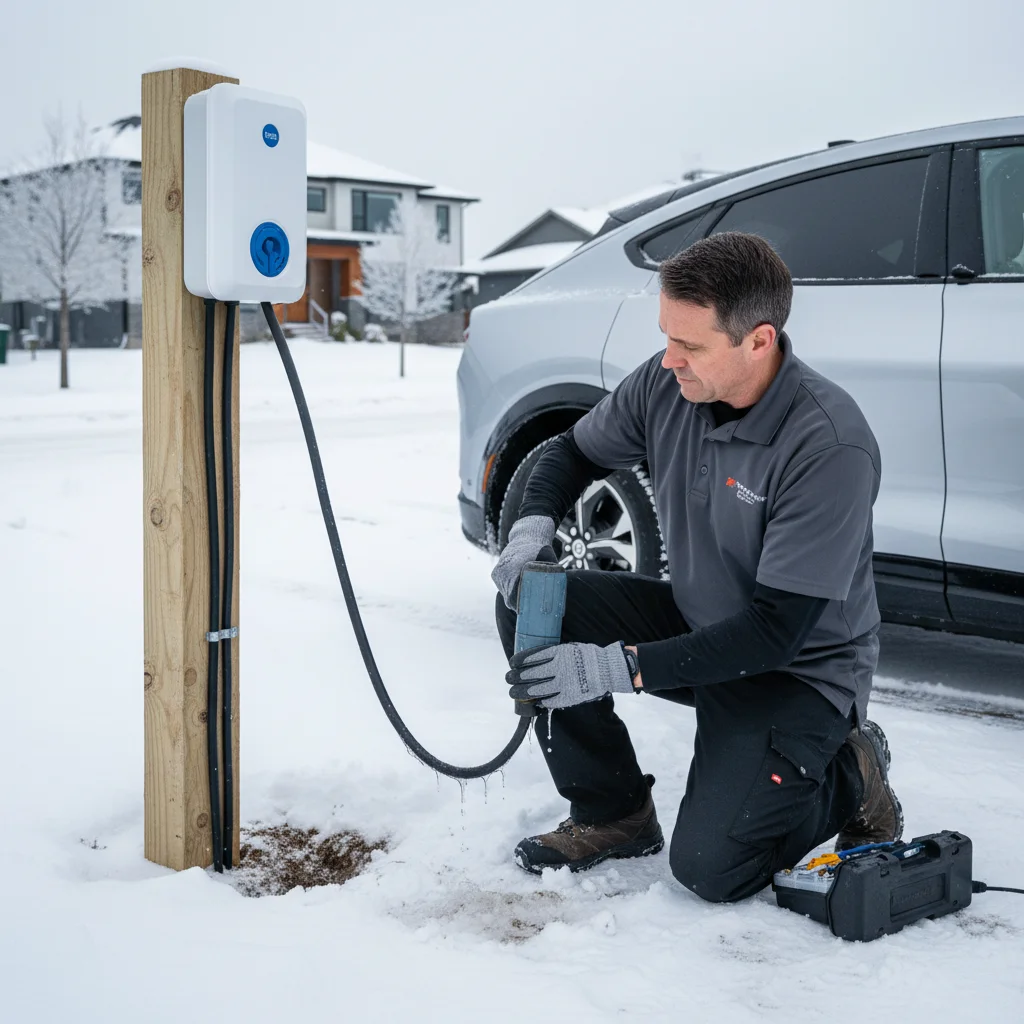
Your Mach-E uses two electric parts at the charge port. A motorized door opens on command from the car. A latch inside the port holds the CCS connector while current flows. Both of those parts run on the 12-volt system. The big traction battery can read full and still leave that latch starved. Yanking the handle won’t override an electric lock. You’ll only stress the pins and the plastic housing.
A public cabinet can add a third lock you can’t see. Some ChargePoint units keep their own software hold on the connector. Other networks hold it until you close the session in their app. The Mach-E can show complete while the stall still refuses to let go. Start by deciding which of those locks you’re fighting. The car tells you one story, and the cabinet tells you another.
Why a beach lot or a hotel stall makes this worse
The California Energy Commission counted 210,842 battery-electric vehicles in Orange County. That count is as of December 31, 2025. Public ports in the same CEC file totaled 7,095. That works out to 36.8 zero-emission vehicles per public port. California’s ratio is 24.4 on the same files. More cars share each plug here than in the state as a whole.
A Mach-E doesn’t use the Tesla Supercharger majority. Tesla holds 59 percent of Orange County’s public DC fast ports per AFDC counts. AFDC lists 591 non-Tesla DC fast ports across 175 stations. ChargePoint has the most DC fast sites in that non-Tesla set. They average about 1.1 ports each, often a single plug.
Coastal sessions stack on a smaller set of CCS cabinets. Electrify America at Fashion Island has 8 DC fast ports. That site is at 401 Newport Center Dr in Newport Beach. EVgo at 801 Pacific Coast Hwy in Seal Beach has 4 stalls. Electrify America’s Dana Point Station sits at 25825 Las Vegas in Capistrano Beach. That’s the largest non-Tesla fast site in south Orange County, with 12 DC fast ports. Hotel Level 2 posts along the same coast create the same bind. If your cable won’t release, you’re blocking a stall people are already circling.
Scan nearby options in our Fashion Island charging guide once the handle is free. Don’t leave a locked connector in someone else’s charger.
Treat a silent port as a 12-volt problem first
The latch solenoid needs 12-volt power to open. A weak auxiliary battery is the usual reason a finished session still won’t unlatch. FordPass may throw a charging error on the phone. The port light may blink and then do nothing. The dash can look awake while the door motor never fires.
If the car is fully dark, jump the 12-volt first. Don’t chase the frunk strap until that battery has power. There’s an auxiliary jump point under the hood. Look behind a small plastic cover near the driver-side strut tower. Clip the positive lead there, and ground to a clean body bolt. Once the 12-volt comes back, try the charge door and the FordPass unlock again. A lot of frozen ports are just a latch that never got enough voltage.
If the Mach-E won’t wake, start with our Mach-E 12-volt checks. Freeing the cable won’t matter if the car still won’t shift out of park.
Use Ford’s frunk strap when the latch won’t fire
Ford put a manual override in the front trunk for this exact bind. Use it after the 12-volt can open the frunk. Jump first if the hood won’t pop on its own.
Open the frunk from FordPass, or use the hood release in the cabin. With the lid up, look to the driver’s side of the frunk floor. You’ll find the strap near the back wall. You want a bright orange pull strap, yellow on some years. It’s a short loop, about the size of a large zip-tie ring. That loop ties to a cable that runs to the charge port latch.
Pull once, firm and steady, and don’t snatch it. You should feel resistance, then hear a light click at the port. Go back to the CCS handle, press the release, and draw the connector straight out. That strap bypasses the solenoid on the latch. It’s a mechanical pull on the latch, not a software command.
The strap is a workaround, not a repair. A low 12-volt or a hung module can lock it again next time. If the strap moves and the handle still won’t come free, stop. The hold is likely on the cabinet side.
Read the strap to tell electrical from mechanical
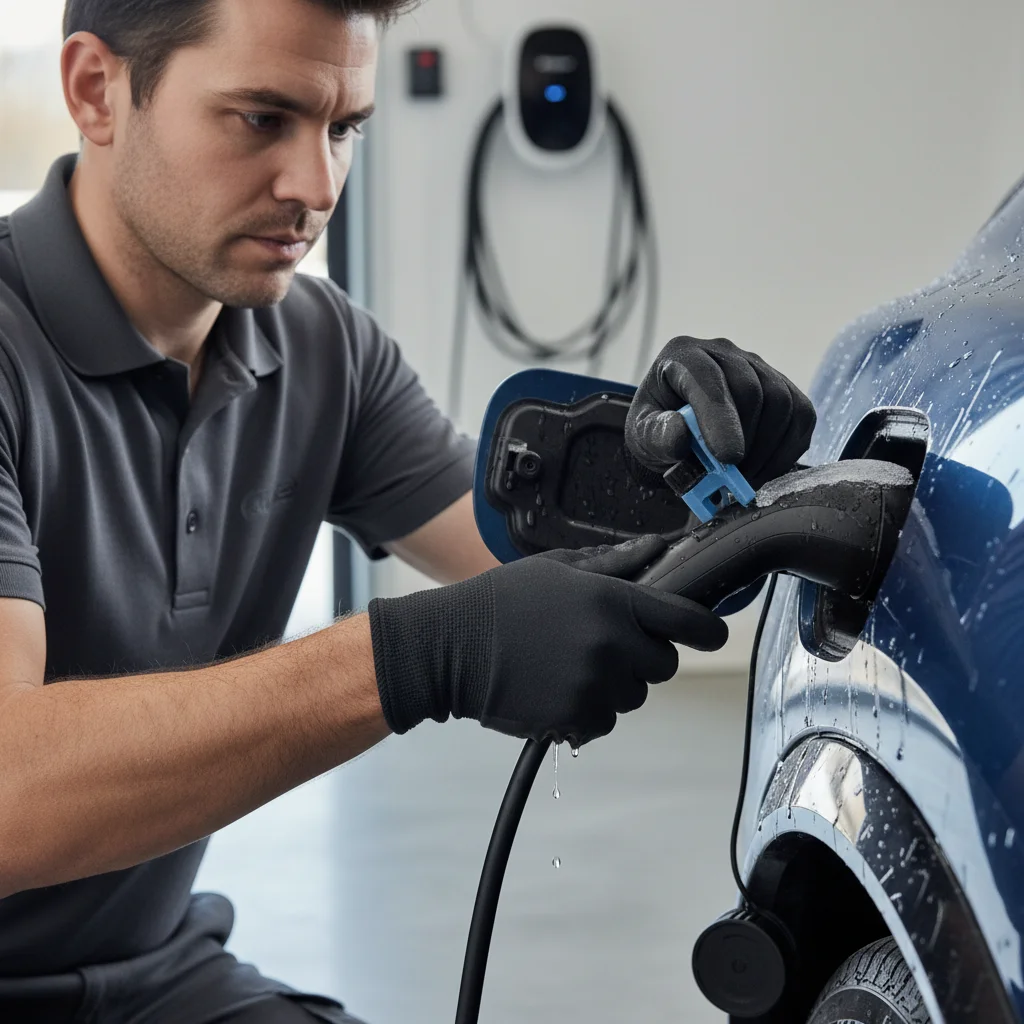
An electrical latch failure means the solenoid got the release command and couldn’t move. Low 12-volt voltage is the usual cause of that miss. The orange strap is built to free this kind of bind. You bypass the solenoid when you pull it.
A mechanical failure inside the port is less common and harder. The hook inside the port can bend, jam, or corrode. The strap may travel with almost no resistance, as if the cable went slack. You won’t fix a bent hook in a beach lot. The port needs a shop inspection after you’re free.
A simple feel test on the strap tells you which failure you have. Firm resistance on the strap means the cable is still attached. A limp pull with no click means the hardware inside is the problem. Don’t pry on the CCS housing to force it. You can crack the handle or bend pins.
For other brands, use our stuck charge cable guide. The Mach-E strap is the Ford-specific piece of this job. The rest of the logic is the same on other CCS cars.
When the public charger is the one that won’t let go
You ended the session in the car, but the handle is still stone. That pattern is the station holding its own lock.
Close the session on the cabinet screen or in the network app. Some ChargePoint units won’t release until you swipe or tap to end. That can stay true even after the pack hits a full charge. If you walked away at 100 percent, the stall may still think you’re charging.
Call the support number printed on the cabinet. Electrify America, EVgo, and ChargePoint print a support line on the unit. Read them the station ID from the label and ask them to unlock remotely. A confirmed remote unlock is the clean path.
If the network can’t release it and your strap already clicked, stop. Forcing a software-locked CCS connector can break the handle or the port. Leave it seated and get a person to the stall.
Our session connected but not charging checks overlap with this bind. A session that never closed cleanly often leaves the latch set. Dry the port once the cable is out. Look inside the inlet before you plug back in. Standing water in the inlet is a separate problem, and you shouldn’t charge through it. Water in the charge port covers that check.
When the strap isn’t enough to free the cable
Most Mach-E port binds end with the frunk strap or a network unlock. A few leave you truly stuck in the stall. The 12-volt is dead and the frunk won’t open after the cabin release. The orange strap is broken, missing, or pulls with no connection to the latch. The CCS housing is cracked or the pins look bent. The cabinet won’t take a remote unlock, and you’re blocking a hotel post.
That’s when you want someone at the car, not another phone menu. Charge Pro OC is a referral line for stranded EV drivers. We match stranded drivers with independent local mobile rescue operators. We don’t perform the work, own trucks, or set prices. The operator quotes you before starting and bills you directly.
They can jump or replace a dead 12-volt battery on site. They bring a 240V Level 2 source and a CCS adapter for a Mach-E. That charge usually adds 10 to 20 miles in 15 to 30 minutes. That’s charging time at the car, never an arrival time. They can’t promise a shop rebuild of a bent latch in a parking stall. If the hook is wrecked, you still need Ford service once you’re free.
Non-Tesla EV rescue is the path for a Mach-E in this bind. If you’re still sitting in a Huntington Beach lot, stay with the vehicle.
Call (949) 444-0151 when the strap, the jump, and the unlock have failed. We’ll connect you with a local operator from the network. The quote comes from that operator, not from us.