A mobile EV charger truck doesn’t haul your car away. It parks beside you and feeds the pack. The operators Charge Pro OC connects you with bring a 240V Level 2 source. They set that source up at the curb. The native plug is NACS. For everything else, they carry a CCS or J1772 adapter. That mix covers Tesla and every major EV brand on Orange County roads.
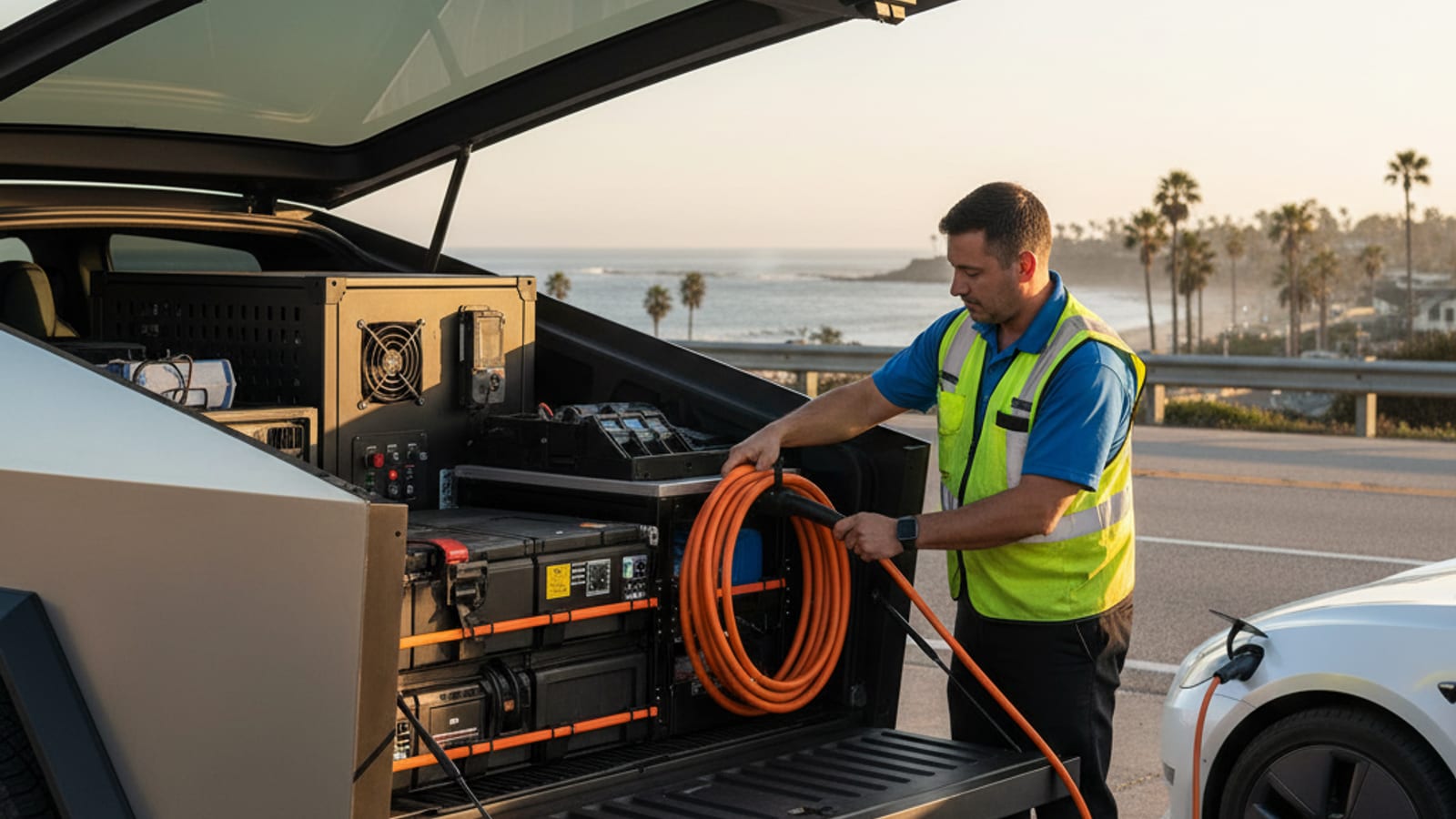
What’s actually in the bed
The useful cargo is power, not a tow hook. Operators roll up with a 240-volt Level 2 source. That’s the same voltage class as a home wall charger. It isn’t a DC fast stall. You shouldn’t expect Supercharger speed on the shoulder. The session is meant to add about 10 to 20 miles of range. Charging time for that bump is typically 15 to 30 minutes. That’s charging time. It isn’t a promise about when anyone arrives.
The plug set is the part most drivers never think about. Tesla owners meet a native NACS connector. Non-Tesla EVs meet a CCS or J1772 adapter, based on the port. One truck can help a Model Y in Anaheim. The same kit fits a Hyundai, Kia, or Ford across town. Read 240-volt charging at home, or on the shoulder for the voltage breakdown.
There’s usually 12-volt gear in the same vehicle. Plenty of “dead” EVs still have range in the pack. The small 12V battery runs computers, locks, and contactors. When that 12V fails, the car looks finished. Operators in this network can jump or replace it on site. A silent Tesla in an Irvine garage often needs that 12V work. A true empty pack needs the 240-volt cable instead. The operator checks which problem you have before they quote.
Charge Pro OC doesn’t own the truck. It doesn’t stock the adapters. It’s a referral line. Independent local operators quote you before they start. They bill you directly. The pros we connect you with are licensed and insured.
Why this county’s fleet shapes the kit
The California Energy Commission counted Orange County’s battery-electric fleet as of December 31, 2025. The BEV total was 210,842. Plug-in hybrids added 47,567. Fuel-cell cars added 2,424. The ZEV total was 260,833. That’s 10.56% of the county’s light-duty fleet. Battery-electrics alone were 8.54%. California’s ZEV share of the state fleet was 7.54% in the same file.
Orange County held 12.02% of California’s battery-electric vehicles. It made up 8.33% of the state’s light-duty fleet. The county is Tesla-heavy on top of that. Tesla accounted for 138,121 of those 210,842 BEVs. That’s 65.51% of the battery-electric fleet. Statewide, Tesla’s share was 61.34%. A native NACS lead isn’t a luxury extra on these streets. It’s the plug most stranded packs will want.
The other third still matters. CCS and J1772 adapters aren’t a footnote. Rivian, Hyundai, Kia, Ford, Chevy, BMW, Volkswagen, and the rest use those ports. For that mix, see non-Tesla EV rescue in Orange County.
New-sale numbers tell a similar story without the hype. In 2025, ZEVs were 28.76% of Orange County’s new light-duty sales. California sat at 22.93%. In 2026 Q2, Orange County was at 24.77%. The state sat at 19.09%. The county runs about five to six points above California. The trend isn’t a straight climb, though. California’s ZEV share of new sales peaked at 25.31% in 2024. CEC changed its new-sale methodology in 2023 and again in 2025. Year-over-year comparisons across those breaks aren’t clean.
Public charging is real, and each plug is busier. CEC data as of December 31, 2025 shows 7,095 public ports in the county. That includes 5,600 public Level 2 ports and 1,475 public DC fast ports. It also includes 20 public Level 1 outlets. Orange County holds 7.75% of California’s public ports. The ratio that actually bites is 36.8 ZEVs per public port. Statewide it’s 24.4. More cars share each public plug than in California as a whole. That’s CEC math, not a guess.
AFDC station data counted 48 Tesla Supercharger sites in Orange County. Those sites hold 861 DC fast ports. Tesla holds 59% of the county’s public DC fast ports. Non-Tesla DC fast totaled 175 stations and 591 ports. Those sit on Electrify America, EVgo, ChargePoint, EVCS, and smaller networks. ChargePoint has many sites and few ports per site. A lot of those are a single dealership or office plug. They aren’t a rescue-grade bank.
NACS, CCS, and J1772 on the same truck
Tesla standardized on NACS. Most other brands in the county still show up with CCS Combo 1. Older Leafs and some other models still use J1772 for AC. The truck carries the native NACS lead first. That’s because 65.51% of Orange County BEVs are Teslas. The adapters ride along for everyone else.
NACS is the connector Tesla owners already know from Superchargers. It’s also on newer home cords. CCS adds two extra DC pins to a J1772-style head. For a Level 2 roadside charge, the operator is feeding AC. The adapter matches the door on your car. That lets the 240-volt source talk to the inlet. J1772 is the older AC-only inlet. If your port is J1772, that’s the adapter that comes out.
You don’t need to sort this on the shoulder. Say the make on the call. A Model 3, Y, S, X, or Cybertruck takes NACS. A Chevy, Hyundai, Kia, or Ford usually needs CCS or J1772. BMW, Mercedes, Rivian, and Volkswagen land in that group too. The operator confirms the port at the car. Wrong adapter is a wasted scene. That’s why the kit carries all three.
After you’ve got range, connector type still matters at the stall. Lake Forest’s Supercharger at 24372 Rockfield Blvd is a Magic Dock. AFDC lists CCS1 plus NACS there. That’s a public stall both Tesla and CCS cars can use.
What a roadside session actually looks like
You call. You give a location and the car’s make. Charge Pro OC matches you with an independent local operator. That operator covers the part of the county you’re in. The operator quotes the job before any cable comes out. You accept or you don’t. If you accept, they bill you. The brand in the middle doesn’t set the price.
Once the truck is at the bumper, the sequence is plain.
- Confirm it’s an empty pack, a 12V failure, or both.
- Pick NACS, CCS, or J1772 to match the port.
- Park so passing traffic still has a lane.
- Run Level 2 until you’ve got a usable cushion.
- Send you toward a stall you can finish at.
That last step is the point of mobile EV charging. Ten to twenty miles isn’t a road trip. It’s enough to leave a shoulder, a garage, or a curb without a hook.
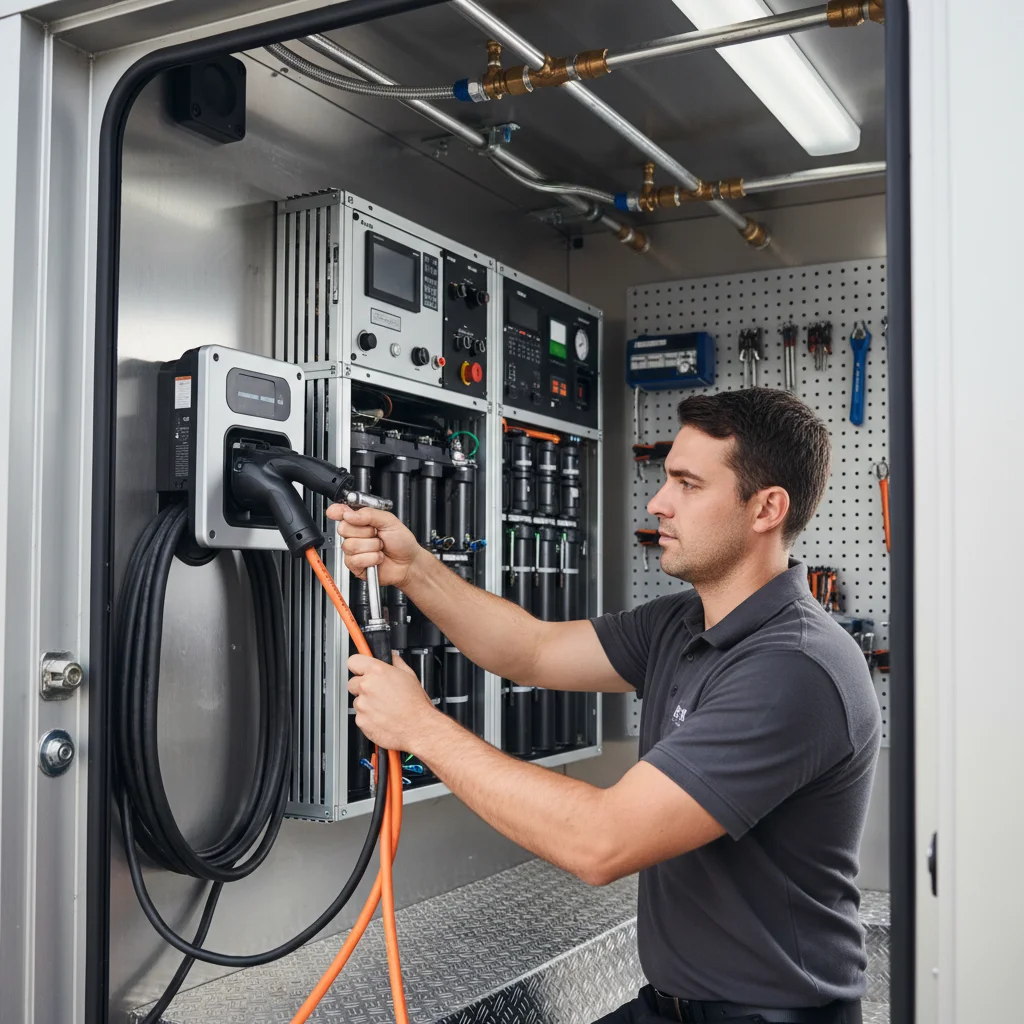
Where those extra miles are supposed to go
Orange County driving isn’t one pattern. Anaheim and Buena Park sit on Lincoln, Katella, Beach, and Knott, with large Supercharger banks on those corridors. Santa Ana, Garden Grove, and Tustin mix street parking with Supercharger banks on Harbor, Franklin, and 17th. Huntington Beach, Newport Beach, and San Clemente sit on the coast, with Superchargers plus Electrify America and EVgo DC fast sites in that belt. Irvine, Lake Forest, and Mission Viejo have large Supercharger banks of their own. The truck’s job is to meet the car in those spots. Then you drive on the miles you just bought.
After a Level 2 bump, you’re aiming at a working stall, not a guess. Named Tesla Superchargers you can plan around include 1920 Main St in Irvine. That site has 40 stalls. San Clemente’s site at 101 W Avenida Vista Hermosa has 49 stalls. Garden Grove’s bank at 12891 Harbor Blvd has 32. Tustin’s site at 14661 Franklin Ave has 36. Buena Park’s site at 8888 Knott Ave has 28. Anaheim has Lincoln Avenue and Katella Avenue Supercharger banks as well. Those are AFDC records, with stall counts attached.
Not every Supercharger is the same speed. Tesla lists 555 The Shops at Mission Viejo at up to 72 kW. Westminster Mall at 1025 Westminster Mall is another 75 kW bank. Santa Ana’s site at 300 E 5th St reports 75 kW as well. Many newer banks in Anaheim, Fullerton, and Buena Park report 325 kW in AFDC. Your 10 to 20 miles should aim at a stall that’s actually online. The finish stall’s power then changes how long you sit.
Non-Tesla DC fast is on the same map. Electrify America lists eight DC fast ports at 401 Newport Center Dr by Fashion Island. A 12-port Electrify America site sits at 25825 Las Vegas in Capistrano Beach. That record is filed as Dana Point Station. EVgo lists 14 DC fast ports at Plaza Antonio in Rancho Santa Margarita. Ocean View Plaza in San Clemente has 10 EVgo DC fast ports. Seal Beach has an EVgo site at 801 Pacific Coast Hwy with four stalls. Ladera Ranch has eight EVgo DC fast ports at 27542 Antonio Pkwy. Those are AFDC records too.
Level 1 through a truck is mapped in EV charging levels for stranded drivers. The city hub is EV charging in Orange County.
What the truck is not
It isn’t a portable 120-volt suitcase charger from an online cart. Those Level 1 bricks trickle. They’re built for an overnight wall outlet, not a live curb. A mobile EV charger truck is a 240-volt Level 2 source. That difference is what gets you rolling.
It also isn’t Tesla’s own roadside product. Tesla’s published roadside policy answers a depleted pack with transportation, not with on-site charging. Running out of charge isn’t treated as a warrantable breakdown. Tesla can arrange a tow. That tow is paid transport. It isn’t a free covered trip to a Supercharger. Tesla’s Model Y owner’s manual also notes a second catch. Once range is gone, the low-voltage battery can lose support. The car may need external power before the high-voltage pack will take a charge. That’s why the 12V jump belongs on the same truck. The 240-volt cable belongs there too.
It isn’t a full DC fast station on wheels either. Some drivers hear “charger truck” and picture 250 kW. Operators in this network bring Level 2. You leave with a cushion. You finish at a public stall.
And it isn’t a tow first. A hook has a place when the car can’t roll. It also fits when the port is damaged. If the pack is empty and the car can sit still, charge on site. Compare the two paths in mobile EV charging or a tow.
How the referral actually runs
Charge Pro OC serves every city in Orange County. The brand holds no trade license and employs no technicians. It owns no fleet. When you call, you’re matched with an independent local mobile rescue operator. That operator quotes before starting. You hear the quote from the person doing the work.
Bring the basics when you call. Say where the car sits. Say the make, and the connector if you know it. Say whether the screens are dark or the range just hit zero. Dark screens often point at the 12V. A car that still talks but won’t move often points at an empty pack. The operator confirms that in person.
Access changes the job. A Seal Beach curb isn’t an Irvine Supercharger stall. A Rancho Santa Margarita block isn’t a Santa Ana stall on 17th. Nobody here publishes a rate card, because Charge Pro OC doesn’t set rates. The operator on scene does.
After the cable comes off
Don’t treat 10 to 20 miles as a full tank. Pick a stall you can reach with margin. Confirm it’s online in your car’s app before you roll. A dead public post with an empty pack behind you strands you twice. If you’re in a Tesla, the NACS plug is already on the truck. If you’re not in a Tesla, say so on the call. Then the CCS or J1772 adapter comes along.
When you’re ready to request a match, call (949) 444-0151. The operator who takes the job quotes you. They may charge the pack or jump the 12V. They may also tell you a tow is the honest next step.
Frequently asked questions
What plug does a mobile EV charger truck bring?
Operators bring a 240V Level 2 source with a native NACS plug. Non-Tesla cars use a CCS or J1772 adapter from the same truck. That covers Tesla and every major EV brand the network handles.
How much range does that Level 2 session add?
A typical roadside charge adds about 10 to 20 miles of range. Charging time for that bump is usually 15 to 30 minutes. That’s time on the cable, not a clock for arrival. It’s meant to reach a public stall, not to fill the pack.
Can the truck help if my 12V is the problem?
Yes. A lot of stranded EVs still have energy in the traction pack. The 12V battery is what failed. Operators in this network can jump or replace that 12V on site. If the high-voltage pack is empty, they switch to the 240-volt cable instead.