The charge handle won’t click out of an Orange County stall. The NACS or CCS cable is still locked in the port. Don’t yank it: stop the session on the screen, then use the manual release. Every major EV in this county has one.
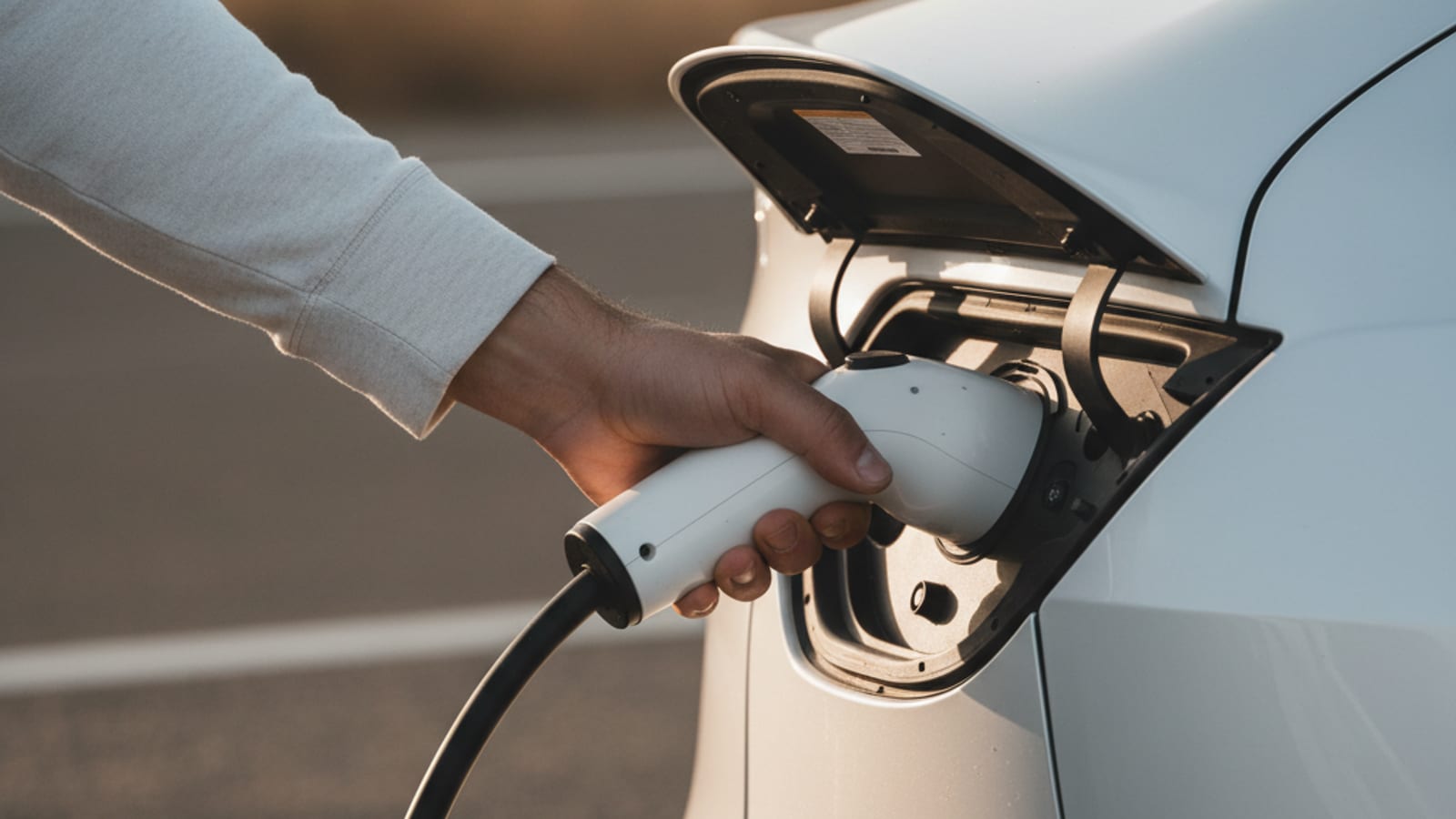
As of December 31, 2025, Orange County had 210,842 battery-electric cars on the road. Teslas accounted for 138,121 of them. That’s 65.51% of the county’s BEV fleet. Most locked plugs here are NACS. CCS handles use the same kind of latch. The workaround is mechanical either way.
Why this happens at OC stalls
This county’s fast charging sits in clusters. The Alternative Fuels Data Center was checked on September 5, 2026. It listed 48 Tesla Supercharger sites in Orange County. Those sites hold 861 Tesla DC fast ports. Tesla holds 59% of the county’s public DC fast ports.
A handle that won’t let go blocks the next car. That’s a problem at 1920 Main Street in Irvine, a 40-stall Tesla site. It’s a problem at 12891 Harbor Boulevard in Garden Grove, with 32 stalls. San Clemente’s site at 101 West Avenida Vista Hermosa has 49 stalls. Tustin’s 14661 Franklin Avenue site has 36. Buena Park’s 8888 Knott Avenue site has 28. Santa Ana’s 1008 17th Street site has 28.
Coast stalls feel different from inland ones. Huntington Beach’s Supercharger at 6913 Warner Avenue sits in beach-day traffic. Newport Beach’s Electrify America sits at Fashion Island, 401 Newport Center Drive. That site is CCS, with eight DC fast ports. Inland Anaheim stacks Superchargers along Lincoln, Katella, and Euclid. Irvine’s stalls serve office-park days. The plug standard changes. The latch does not.
South County CCS drivers see the same lock on a different handle. Electrify America has a Dana Point Station at 25825 Las Vegas, Capistrano Beach. That site has 12 DC fast ports. Lake Forest has Tesla Magic Dock at 24372 Rockfield Boulevard, CCS1 plus NACS. You still need the manual release.
The California Energy Commission counted 7,095 public ports in Orange County. That count is as of December 31, 2025. It also counted 260,833 ZEVs. That’s 36.8 ZEVs per public port. California’s ratio is 24.4. More cars share each plug here. A stuck cable is not a private moment.
What actually holds the handle
A small solenoid lives in the charge port. During a session it keeps a latch over the connector. The car waits until charging stops. Then it commands the solenoid to pull the latch back. If that command never arrives, the handle stays. If the 12-volt battery is too weak to move the solenoid, the handle stays. Pulling harder doesn’t fix either case.
Manufacturers also lock the cable at home. That keeps a passerby from unplugging you and taking the session. The same lock is what you’re fighting at a public stall.
Do this before you peel any trim
Work the session first. On a Tesla, open the charging card and stop charging. Wait until the car shows the session has ended. Then press the handle button. On other brands, tap Stop on the charging screen. Wait for the confirmation, then try the handle.
Wake the car: open and close the driver’s door. A sleeping EV can ignore a release command.
If the screens look lost, reboot. On a Tesla, press both steering-wheel scroll wheels for about ten seconds. Wait until the display restarts. On a Rivian, hold the cruise-control stalk down for about ten seconds. On most other EVs, hold the power button until the car restarts. Then try the handle again.
If the car is dark, treat it as a 12-volt problem. The latch motor runs on that small battery, not the pack. Jump the 12V, then retry the release. The on-site EV jump-start steps cover that sequence.
A mushy handle can mimic a stuck port. Some older Tesla Mobile Connector latches, and some stall cables, don’t fully depress. If the next stall is open, try that cable. If it drops free, the first handle was the fault.
Tesla: start with the trunk cable
Most Orange County BEVs are Teslas. Start here on a Model 3 or Model Y.
Open the trunk. On the passenger side, peel the carpeted trim along the inner wall. Remove the small access cover. You’ll see a plastic tab on a cable. Pull that cable straight down and hold it. Keep holding while you pull the charge handle out.
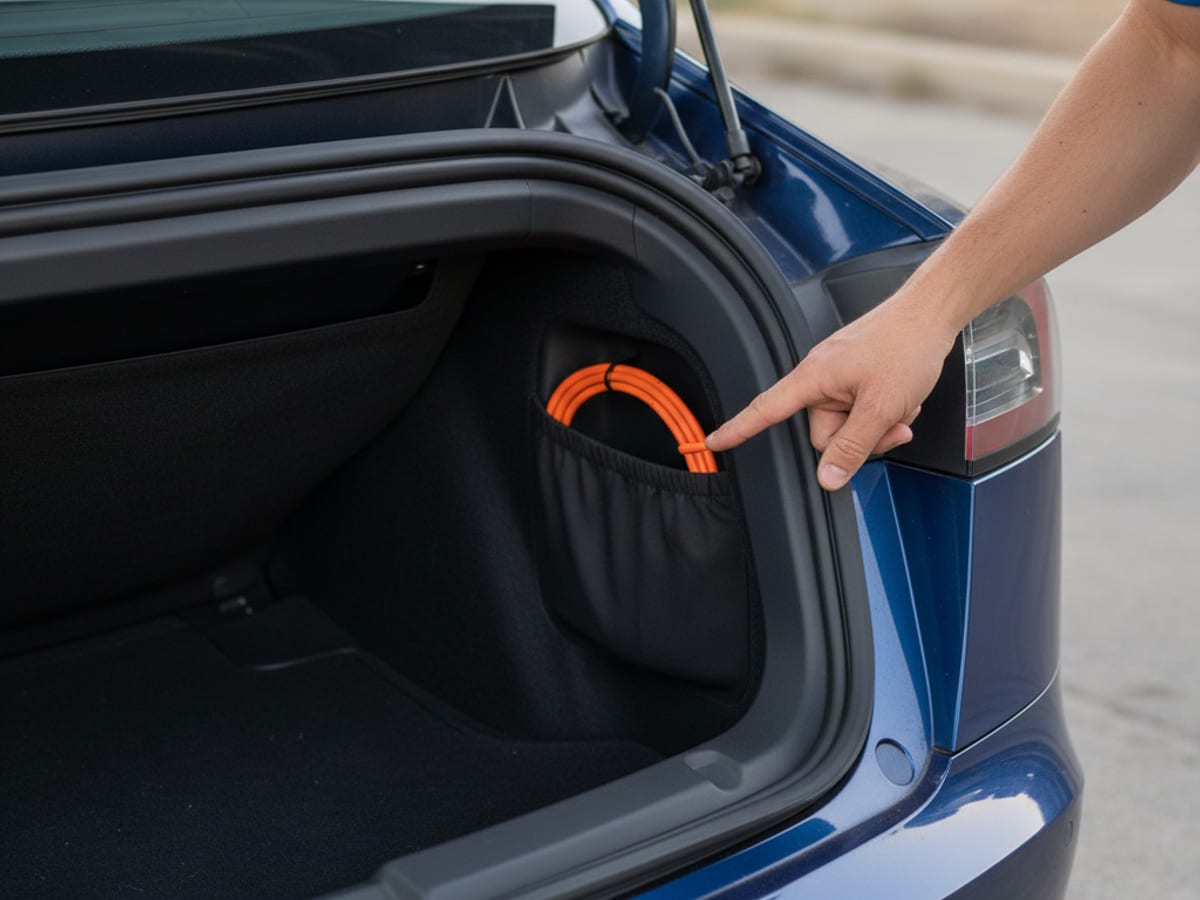
Model S and Model X use the same kind of cable in a different corner. Open the rear hatch. On older cars, look on the driver’s side near the taillight, behind carpeted trim. Pull the cable toward you. On the refresh S and X, look in the passenger-side trunk trim. It’s closer to the Model 3 layout.
If you can’t open the trunk, the car is likely asleep. Restore 12-volt power first. Then retry the screen release. Then pull the manual cable.
CCS cars: the pull is in a different place
Ford put the override on the port itself. Open the charge-port door on an F-150 Lightning or a Mustang Mach-E. Check the top or bottom edge of the housing. Look for a small triangular tab with an unlock icon. Pull that tab away from the port while you pull the cable. On a Lightning, FordPass can send a release if the dash is blank. The Mustang Mach-E charge port stuck guide covers ice and a dead 12V.
Hyundai and Kia use a button in the cargo area. That’s the Ioniq 5, the EV6, and the EV9. Open the rear cargo area. On the driver’s side wall, pull off the small plastic cover. Press and hold the button while you pull the handle. The Ioniq 5 charge-port steps go deeper on that car.
Rivian put the cord under the rear seat. Open the rear passenger-side door. Lift the seat bottom. Open the service panel and pull the release cord. Hold it, then pull the handle. The longer version is the Rivian charge-port stuck post.
Chevrolet Bolt: lift the rear cargo floor. The cord sits near the 12V area. Pull the cord and the handle together.
Polestar 2: check the trunk by the driver’s-side tailgate hinge. The cord sits behind a small trim panel.
Volkswagen ID.4: lift the cargo cover. On the passenger side, behind the C-pillar trim, there’s a labeled pull loop.
Hold the manual release, then move the handle. Don’t saw at the connector.
When the manual release still fails
Make sure the car is awake. Open the door, close it, then retry.
Wiggle the connector slightly while you hold the release. Go side to side, not a hard yank. The latch can sit on the handle’s locking lip. A small rock often clears it.
Then reboot once more. After the screens return, the software sometimes drops the lock on its own.
If that still fails, stop pulling. A seized solenoid needs a shop, not a harder tug. Forcing the handle can break the port. Leave the cable seated.
If you’re blocking an Irvine, Anaheim, or Garden Grove stall, get help at the car. Independent operators in this network can jump a dead 12V on site. That can give the solenoid the power it needs. The operator quotes you before any work starts, and bills you directly.
When the pull did nothing, or the car won’t wake, call Charge Pro OC. Same if the handle button is broken, or you’re occupying a live stall. It’s a referral line that matches you with a local operator.
Tesla drivers can start on Tesla roadside rescue. Everyone else can use non-Tesla EV rescue.
After the cable comes free
Charge again when you can, and finish a full session. If it ends and the handle releases, you likely had a glitched session. If it locks up again, get the port inspected.
If you jumped the 12V to free the cable, plan a 12V replacement. That battery was already fading.
A stuck NACS or CCS cable in Orange County is still a latch. The county has the stalls, and your car still has a manual release. Use that before you fight the handle.
If the cable still won’t come out, call (949) 444-0151. Charge Pro OC takes the call and connects you with an independent local operator.