Your F-150 Lightning can share power with another EV. It still can’t refill an empty pack on an Orange County job site. Ford’s Pro Power Onboard feeds tools and a portable charger. It doesn’t turn your truck into a DC fast stall.
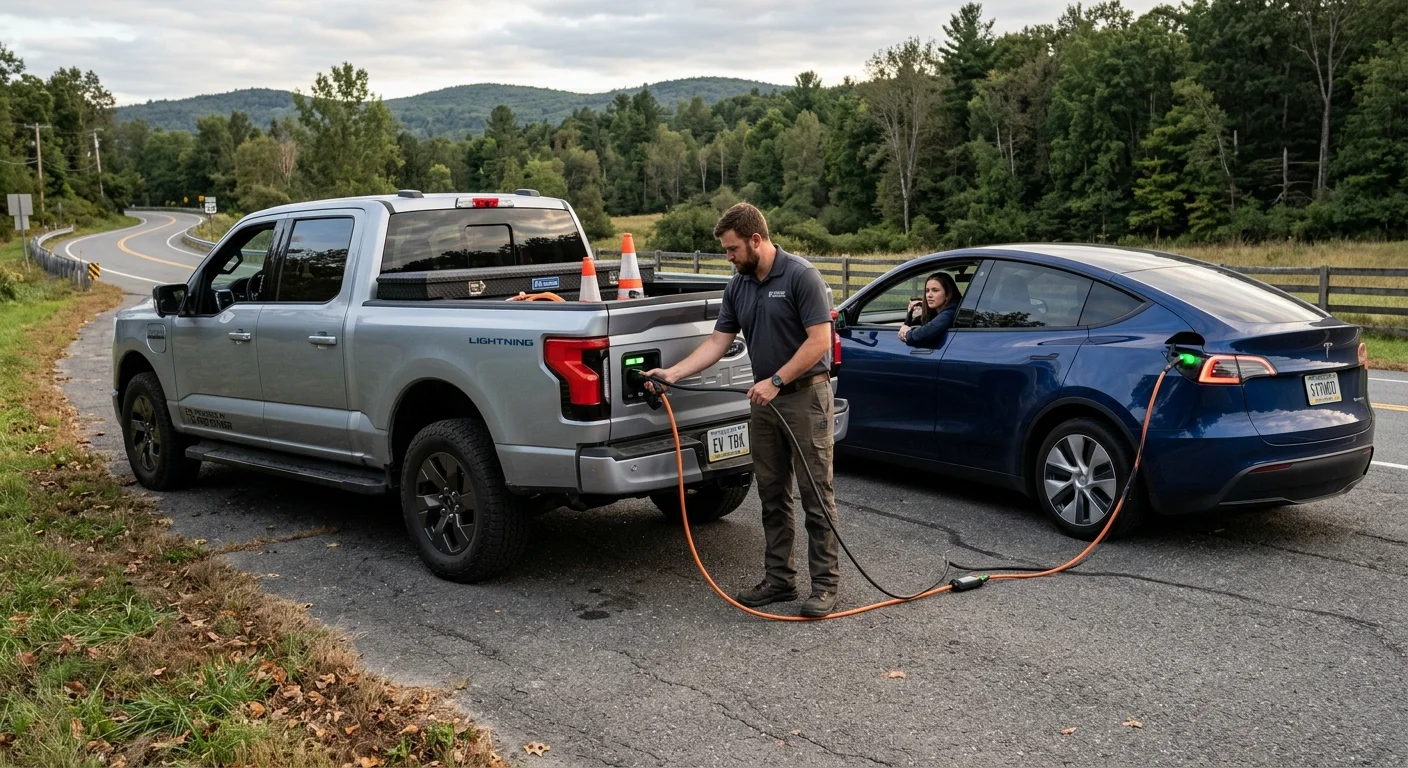
Orange County is packed with EVs. Your bed still has a day job.
As of December 31, 2025, the California Energy Commission counted 210,842 battery-electric vehicles here. That’s 8.54% of Orange County’s light-duty fleet. The county holds 12.02% of California’s BEVs. It’s only 8.33% of the state’s light-duty fleet. Teslas make up 138,121 of those local BEVs. That’s 65.51% of the battery-electric mix.
The empty car beside you is often a Tesla. The stranded driver needs a plug you may not be carrying.
CEC counted 7,095 public charging ports in the county at year-end 2025. That’s 36.8 ZEVs per public port. Statewide the same ratio is 24.4. Stalls are real, and they also fill up. An empty EV on a job site isn’t a brochure problem. It’s a cable problem.
In 2025, Orange County logged 50,822 new ZEV sales. That’s 12.43% of California’s new ZEVs. New-sale ZEV share here ran 28.76% in 2025, against 22.93% statewide. 2026’s first quarter was the weakest in the CEC series, at 15.76% statewide. Don’t treat the local fleet as a boom that’s still speeding up. CEC also changed its new-sale method in 2023 and again in 2025. Comparisons across those breaks aren’t clean. What is clean is the fleet already on the road.
Lightnings show up in that mix as work trucks. You’ll see them on jobs in Buena Park, Anaheim, and Irvine. The stranded EV is often a commuter, not another trade truck. Your Pro Power bank was bought for the job. It wasn’t bought to refill their pack.
Pro Power Onboard was built for tools
Ford sells Pro Power Onboard as a rolling outlet bank. The standard package is 2.4 kW. Higher trims publish up to 9.6 kW. You get 120V and 240V receptacles in the bed and cabin. Check your window sticker or the owner’s manual for your truck’s number. Output varies by trim. Ford is the source.
Those outlets earn their keep on a trade day. A compressor on a Buena Park lot. Saws near Anaheim’s Supercharger at 2404 E Katella Ave. Feeding another EV is a side trick. Power still leaves through AC outlets. It doesn’t leave through the Lightning’s DC charge port.
You’re standing up a Level 2 session from a pickup. You aren’t cloning a Supercharger.
The missing piece is the EVSE, not goodwill
A 240V bed outlet doesn’t speak EV by itself. You need a portable Level 2 EVSE. It has to take a NEMA 14-50 plug that matches Ford’s high-power receptacle. Then the other car needs the right inlet.
Most non-Tesla EVs in North America still take J1772 on AC. A Chevy Bolt, Hyundai Ioniq 5, or VW ID.4 can use that connector. A Tesla needs a J1772-to-NACS adapter unless your EVSE already ends in NACS. Teslas are 65.51% of Orange County’s BEV fleet. That adapter isn’t a niche part. It’s the usual case.
If that kit lives in the garage, it isn’t in the bed. On Katella or in a Tustin lot, goodwill isn’t enough. A Costa Mesa job still needs a 14-50 EVSE.
This sits next to whether one EV can charge another. The Lightning is the rare truck with 240V onboard. The session still fails without the EVSE and the adapter.
Don’t daisy-chain a cheap extension cord into a charge port. Use gear rated for the outlet and the EVSE. If you don’t have that gear, stop. Call for a truck that already carries it.
A Level 2 trickle won’t refill the pack
Even 9.6 kW Pro Power is still AC Level 2. Ford doesn’t publish a roadside miles-per-hour figure for charging someone else’s car. Treat forum guesses as guesses.
The session adds range slowly. It also drains your Lightning. You still have to get that truck home, or reach a stall of your own. How long a Lightning takes to charge is a separate clock. Don’t empty yours to nurse theirs.
The operators Charge Pro OC connects you with also bring 240V Level 2. They typically add 10 to 20 miles of range. That’s in 15 to 30 minutes of charging. That’s charging time, not an arrival time. The difference is the kit on the truck. Native NACS on the lead. CCS or J1772 adapters for everyone else. You aren’t digging for a 14-50 brick in a job box.
A mobile EV charging stop moves a stranded car toward a stall. Your Lightning is built to work. Those are different jobs.
Aim for a real stall after a short boost
If you do have the EVSE, a short session can buy a hop. It can’t refill the pack on site. After that hop, Orange County has named DC fast sites you can drive to.
The Alternative Fuels Data Center lists Tesla Superchargers across the county. Irvine’s 1920 Main St site has 40 stalls. San Clemente’s site at 101 W Avenida Vista Hermosa lists 49 stalls. Tustin has 36 stalls at 14661 Franklin Ave. Garden Grove has 32 at 12891 Harbor Blvd. Buena Park has 28 at 8888 Knott Ave. Anaheim has 16 stalls at 2404 E Katella Ave. The Shops at Mission Viejo site lists 10 stalls. Tesla’s own figure for that site is 72 kW. Use Tesla’s number when AFDC disagrees.
Non-Tesla DC fast is on the map too. Electrify America lists 10 ports at the Anaheim Walmart at 440 N Euclid St. Fashion Island has 8 Electrify America ports at 401 Newport Center Dr. Dana Point Station at 25825 Las Vegas in Capistrano Beach has 12. EVgo lists 14 ports at Plaza Antonio in Rancho Santa Margarita.
None of that means your Lightning should sit as a charger for a long session. It means the empty car needs enough range to reach a stall that exists. Countywide, AFDC counts 223 public DC fast stations and 1,452 DC fast ports. Tesla holds 59% of those ports.
For the county stall picture, start at EV charging in Orange County.
When a Lightning top-off is the right call
A neighbor in the driveway, with time and the right cord, is a different scene. A friend who needs a few miles, with time to spare, can work. You’re both parked, and nobody’s blocking a lane. You packed the EVSE.
An Orange County job site is usually the opposite. Crews need the truck. The empty EV is in the way. The other driver needed a stall before your lunch break. Sitting there as a 2.4 kW or 9.6 kW generator steals your workday. It also steals your own range.
If the other car won’t wake, you may not have a pack problem. Many EVs look dead when the 12V battery quits. A Lightning outlet won’t fix that. Jumping or replacing that 12V is a different job. Operators here handle Tesla and every major EV brand on 12V work too.
What shows up when you call a rescue truck instead
You aren’t asking Charge Pro OC to roll a fleet. This line matches you with an independent local operator. The operator quotes you before any work starts. They bill you directly. Charge Pro OC holds no license, owns no trucks, and doesn’t set the price.
What the operator brings is the kit a rescue truck actually carries. A 240V Level 2 source. A native NACS plug. CCS or J1772 adapters for non-Tesla EVs. That’s the point of how mobile rescue works here. Get the empty car to a charger that already exists. Don’t turn a work Lightning into a slow public stall.
The pros we connect you with are licensed and insured. Charge Pro OC isn’t.
If the pack is empty, skip the job-site experiment
Don’t idle in a lot hoping the bed outlets are enough. Don’t block a crew to nurse a stranger’s battery. Call for a charge that comes with the adapters already on the truck.
Charge Pro OC serves every city in the county. Call (949) 444-0151. You’ll get matched with a local operator who quotes before starting.