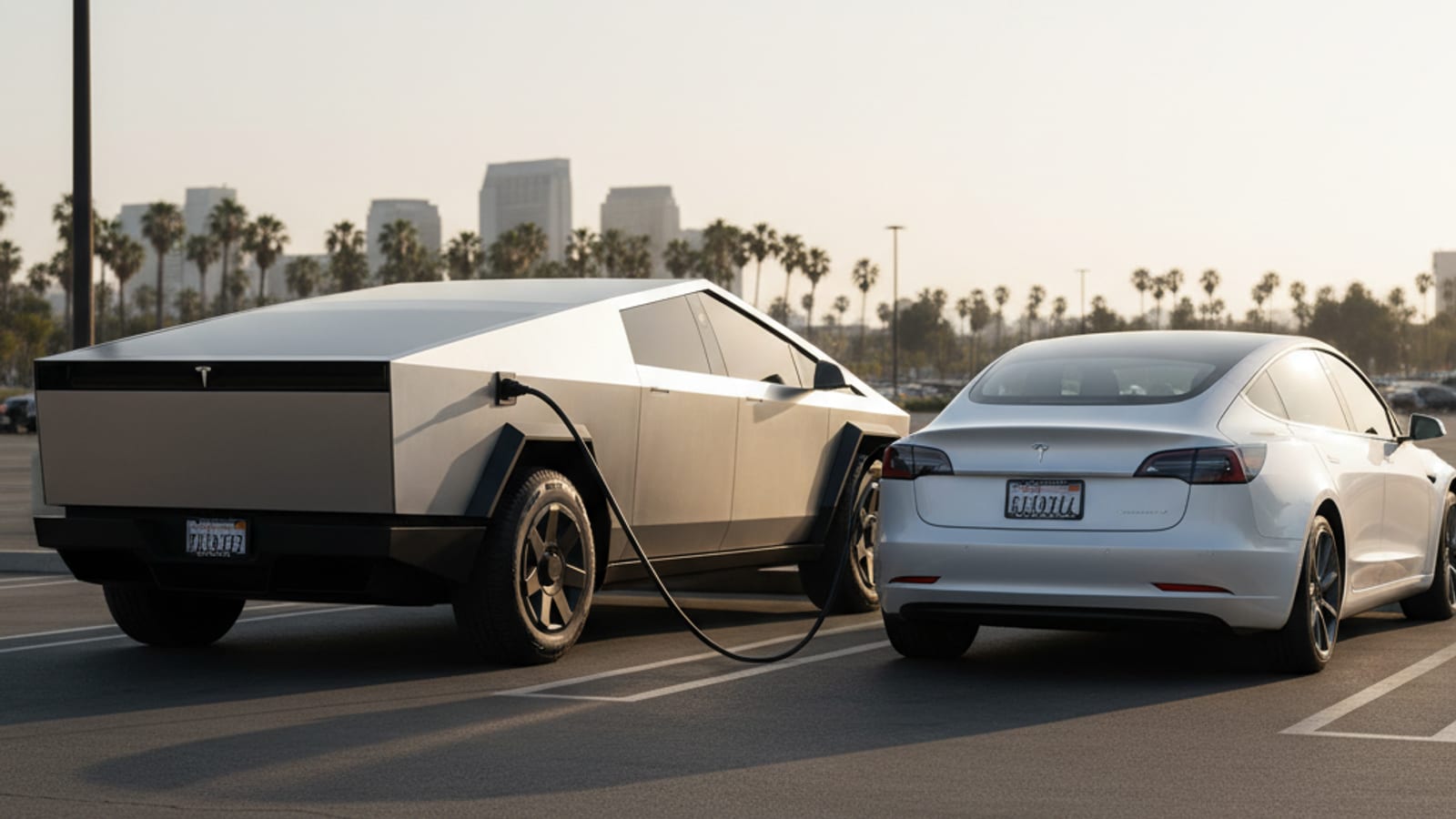
Two Teslas sit a stall apart at Irvine’s Main Street Supercharger. One pack is empty. The other has range to spare. The second driver offers to share charge. That transfer won’t happen. One EV charging another is still rare on Orange County streets. Most of the cars here can’t export power at all.
Why this comes up so often in Orange County
The California Energy Commission counted Orange County’s BEVs as of December 31, 2025. The file shows 210,842 battery-electric vehicles on the road. Teslas were 138,121 of those BEVs. That’s 65.51% of the county’s battery-electric fleet. Statewide, Tesla’s share of BEVs was 61.34%. This county is more Tesla-heavy than California as a whole.
That mix shapes the roadside reality. Model 3, Y, S, and X don’t send pack power out through an outlet. Two of those on Katella or in a Costa Mesa garage can’t help each other.
ZEVs are 10.56% of Orange County’s light-duty fleet. BEVs alone are 8.54%. Orange County holds 12.02% of California’s battery-electric vehicles. It’s only 8.33% of the state’s light-duty fleet. Almost none of the common ones can feed a neighbor.
What has to exist before power can leave the pack
A traction battery stores a lot of energy. Moving some of it into another EV isn’t a 12-volt jump. You need an inverter that can run in reverse. You need an outlet or adapter that exposes that power. You need a cable the stranded car’s charge port will accept.
Most commuter EVs already invert power for cabin heat and the 12-volt system. They don’t route that energy to a plug on the body. Without the plug, the pack stays sealed inside the car.
Which vehicles can export power today
A handful of trucks and a few Korean models ship with vehicle-to-load hardware. Automakers brand it as V2L, Pro Power, or power takeoff.
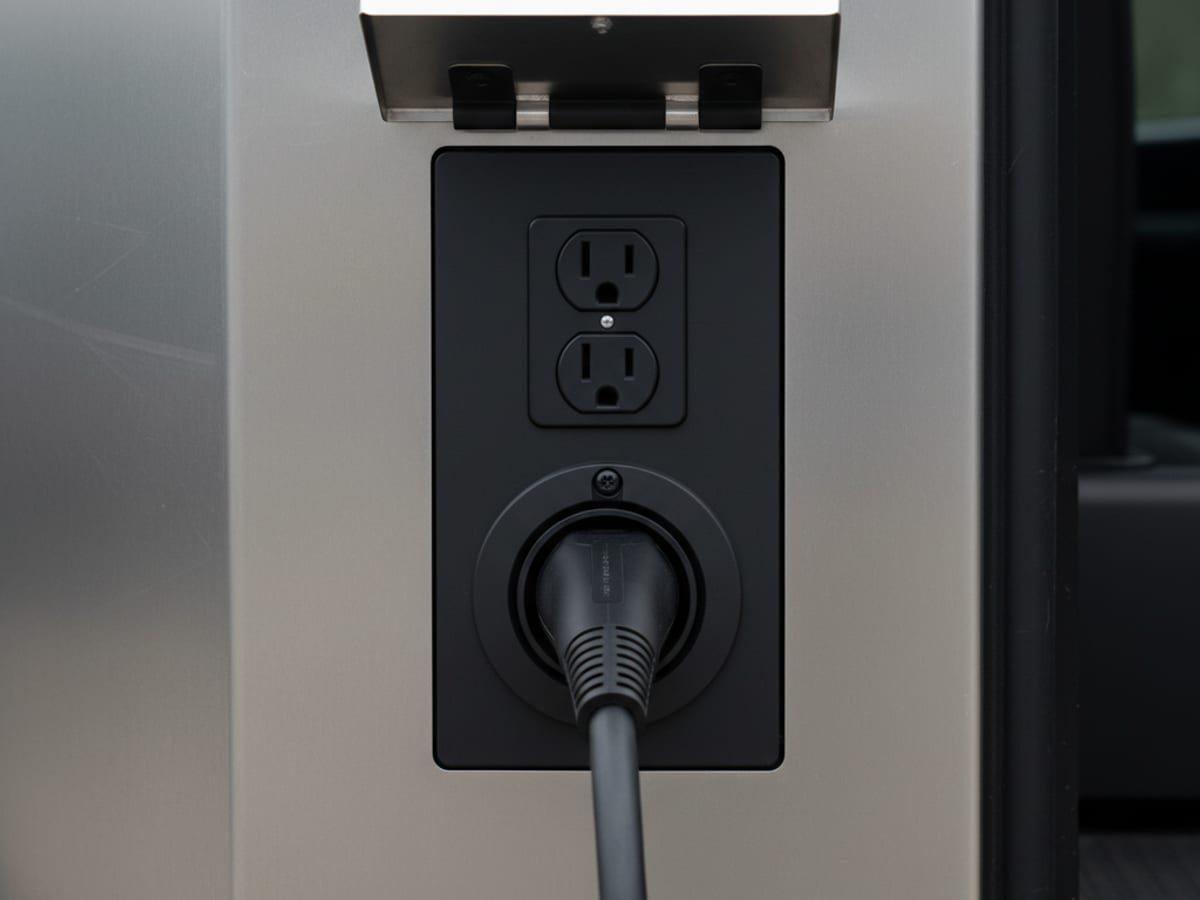
The Cybertruck’s Pro Power setup puts outlets in the bed and the frunk. The bed wall includes a 240-volt NEMA 14-50. Tesla rates that outlet up to 9.6 kW continuous.
The Ford F-150 Lightning offers Pro Power Onboard. Standard output is 2.4 kW. Extended output reaches 9.6 kW through bed and cab outlets. If you drive one, read whether a Lightning can charge another EV on the street.
Hyundai Ioniq 5, Kia EV6, and Kia EV9 support V2L. They use an adapter on the charge port. That path is rated at 3.6 kW. It’s slower than a 9.6 kW truck outlet. It can still add a little range in a pinch.
Rivian R1T and R1S trucks with the Camp Package add 120-volt bed outlets. Output is about 1.4 kW. It isn’t a tool for filling a stranded pack.
Chevrolet’s Silverado EV lists power takeoff up to 10.2 kW through multiple outlets.
Lucid Air and Polestar models don’t export traction power today. The Mustang Mach-E doesn’t either. Tesla’s Model 3, Y, S, and X don’t export.
Trucks sold for job sites and camping often have outlets. The cars that fill Orange County Superchargers usually don’t.
Why a Model 3 can’t feed a Model Y
Tesla fitted those cars with onboard chargers. Those chargers turn AC from a stall into DC for the pack. They didn’t fit an inverter meant to run backward at useful power. The 12-volt pigtail at the tow eye is for waking another 12-volt battery. It isn’t 240-volt output. It won’t fill a traction pack.
Tesla has shown bidirectional hardware in lab clips and investor events. On the cars already registered here, it isn’t a driver feature. Some drivers still try to jump another car from a Tesla. That path fails for the same hardware reason.
How a roadside charge actually moves energy
Charge Pro OC is a referral line. It matches a stranded driver with an independent local operator. The brand doesn’t own trucks and doesn’t perform the work. The operator quotes you before starting, then bills you directly.
Operators bring a 240-volt Level 2 source to the car. Teslas take a native NACS plug. Other EVs take a CCS or J1772 adapter. Charging time, never travel time, is typically 15 to 30 minutes. That session adds about 10 to 20 miles of range.
That’s the same class of power as a Cybertruck bed outlet. AC goes into the stranded car’s onboard charger.
Federal AFDC station data lists 48 Tesla Supercharger sites in Orange County. Those sites total 861 DC fast ports. Tesla holds 59% of the county’s public DC fast ports. Many of those stalls are listed at 250 kW. That’s many times faster than any 9.6 kW vehicle outlet. A mobile charge is a bridge to a stall, not a replacement for one.
After a top-up, drivers often roll to a known site. San Clemente’s Supercharger at 101 W Avenida Vista Hermosa has 49 stalls. Irvine’s 1920 Main Street site has 40. Electrify America at Fashion Island lists 8 DC fast ports. Plan that second hop on the Orange County charging hub.
When the car looks dead, it may not be the pack
Tesla’s Model Y owner’s manual describes what happens when range hits zero. The low-voltage battery can lose support. The car may need external power before the high-voltage pack will charge. That’s a 12-volt problem wearing an empty-pack costume.
If screens are dark and doors won’t release, start with the 12-volt. Mobile EV charging still helps when the pack is truly empty.
The CEC charger file counted 7,095 public ports in Orange County. That count is as of December 31, 2025. That’s 36.8 ZEVs per public port. Statewide the ratio is 24.4. More EVs share each public plug here than in California as a whole. If you’re already at zero, don’t hunt a stall from the curb. Stay with the car and get range brought to you.
Don’t improvise a vehicle-to-vehicle hookup
A dryer cord and a portable Level 2 brick aren’t a rescue setup. High-power AC between two cars needs proper grounding and the right cable. It also needs someone who’s done the work. The cheap version can trip a breaker or overheat a connector.
A friend in a Lightning or Cybertruck can help if the hardware matches. Confirm the outlet rating first. Confirm the stranded car’s charge port will take the connector. Treat it as a short session to reach a public stall. It isn’t a full recharge.
Operators run this as out-of-charge recovery. That’s how an empty pack gets range on site. How a mobile rescue truck works covers what actually shows up.
What’s coming, versus what’s already registered
Ford already sells vehicle-to-home backup on the Lightning with a home kit. Hyundai, Kia, and GM have shipped V2L or related export hardware. Tesla has talked about bidirectional passenger cars. None of that rewrites the 2025 registered fleet.
Plan around the cars you actually meet on the 91, SR-22, and I-5. Most of them can’t share charge. The ones that can are still a small slice. It’s certain trucks, plus a few models with a V2L adapter.
New ZEV sales in Orange County were 28.76% of light-duty sales in 2025. That share sits 5 to 6 points above the state. The on-road mix is still Tesla-heavy. Export-capable trucks haven’t taken over Supercharger queues in Anaheim.
If you’re the one sitting empty
Stay off live lanes. Put on hazards. Don’t walk the shoulder looking for a stall. Tesla’s own roadside policy answers a depleted battery with transportation, not with on-site charging. Confirm coverage in the Tesla app or your owner’s documents. Don’t assume a free tow.
Charge Pro OC can match you with a local operator. Ask for an on-site Level 2 charge. Call (949) 444-0151. The operator quotes before any cable goes in.