A Ford F-150 Lightning charge time depends on pack, plug, and starting percent. Ford lists about 41 minutes for 15 to 80 percent on Extended Range. Standard Range sits around 44 minutes on a stall that can feed it. A 240-volt home fill from empty still takes 6 to 10 hours. In Orange County, that DC session usually runs on the 591 non-Tesla fast ports.
Where a Lightning hunts a DC stall in OC
Tesla holds 59 percent of Orange County’s public DC fast ports. That’s 861 Tesla stalls across 48 Supercharger sites. A Lightning driver is usually looking at the rest. Federal AFDC data counts 175 non-Tesla stations and 591 DC fast ports in the county. Those ports sit on Electrify America, EVgo, EVCS, ChargePoint, and smaller networks.
Countywide there are 223 public DC fast stations and 1,452 DC fast ports. Tesla’s share is the majority. ChargePoint has 71 sites and only 76 DC fast ports. That’s about 1.1 ports per site, mostly dealership and office singles. Those plugs can top off a parked work truck. They’re not a road-trip cabinet.
Electrify America runs 30 stations and 138 DC fast ports here. EVgo matches the site count with 131 ports. EVCS has 14 stations and 87 ports. Those three are the networks that actually cluster stalls for a Lightning.
Electrify America at 440 N Euclid St in Anaheim has 10 DC fast ports. Fashion Island in Newport Beach has 8 Electrify America stalls at 401 Newport Center Dr. South county’s largest non-Tesla site is Electrify America’s Dana Point Station. That’s 25825 Las Vegas in Capistrano Beach, with 12 DC fast ports. EVgo at Plaza Antonio in Rancho Santa Margarita has 14 DC fast ports. The address is 22351 Antonio Pkwy. San Clemente has EVgo at Ocean View Plaza on 638 Camino de los Mares. That site lists 10 DC fast ports. Ladera Ranch has EVgo at 27542 Antonio Pkwy with 8 ports. Seal Beach has EVgo at 801 Pacific Coast Hwy with 4 stalls.
Tesla’s Lake Forest Magic Dock is a special case. AFDC lists 16 stalls at 24372 Rockfield Blvd, up to 325 kW. Those stalls carry CCS1 and NACS. That’s one Tesla site a CCS Lightning can use. Most Superchargers in the county still use Tesla’s own plug.
The California Energy Commission counted 7,095 public ports in Orange County as of December 31, 2025. That’s 5,600 public Level 2, 1,475 public DC fast, and 20 Level 1. The county also has 210,842 battery-electric vehicles. Tesla is 65.51 percent of those BEVs. A Lightning sits in the smaller slice. It shares those 591 non-Tesla fast ports with every other non-Tesla EV.
Orange County holds 12.02 percent of California’s battery-electric vehicles. It’s only 8.33 percent of the state’s light-duty fleet. The county has 36.8 ZEVs per public port. The state average is 24.4. That crowding is why a 41-minute spec can stretch on a shared cabinet.
Two packs, two charging clocks
The Lightning doesn’t have one battery. Standard Range is about 98 kWh total, with about 89.5 kWh usable. Extended Range is about 131 kWh total, with about 120 kWh usable. A bigger pack takes longer to fill from empty at home. On DC fast, it also accepts a higher peak rate. That’s why 15 to 80 percent sits near 41 minutes versus 44. One pack is much larger, and the fast-charge clocks still land close. There’s no single clock for how long it takes to charge a Ford Lightning. You plan around your pack, your starting percent, and the stall you actually got.
What a real DC session does here
Ford’s 41 and 44 minute figures assume a charger that can deliver peak power. They also assume a pack already in a workable temperature window. They assume a start at 15 percent. Public stalls often share a cabinet. Output drops when the stall next to you is pulling too. Starting at 40 percent shortens the clock. It also adds less range.
The curve isn’t flat. The Lightning takes power fastest in the middle of a session. It tapers as you near 80 percent. The last 20 percent can eat as much clock as the rest. Most trip stops should end at 80, not 100.
A loaded bed on I-5 burns range before you ever plug in. So does a grade toward Rancho Santa Margarita. A Newport lot is a different session than a hot Anaheim cabinet. Watch the kW number on the truck screen. If it’s well below the stall’s rating, the session will run long. A colder pack after a long sit accepts power more slowly.
Towing shifts the curve as well. A trailer on I-405 or the 91 makes the pack work harder. You may arrive warmer, or with less buffer than the nav promised.
Home charging is the daily clock
A regular 120-volt outlet can feed a Lightning. It’s not a daily plan for a pack this size. Meaningful overnight range on Level 1 takes many hours. A fill from empty can take several days. Treat that outlet as a backup, not a routine.
Level 2 is the home pattern that matches this truck. Ford’s Charge Station Pro can deliver up to 80 amps on a dedicated circuit. Ford’s published empty-to-full window is about 8 to 10 hours on Extended Range. Standard Range is about 6 to 8 hours. A 48-amp home charger stretches a full charge to around 12 to 14 hours. Plug in after work and the pack is ready by morning.
If the garage still lacks a 240-volt circuit, that’s an electrician’s job, not the truck’s. A licensed electrician can confirm panel capacity before anyone orders a wall unit. Charge Pro OC doesn’t install chargers. We connect stranded drivers with operators. For the overnight-versus-shoulder split, read 240-volt charging at home, or on the shoulder.
When the session never starts
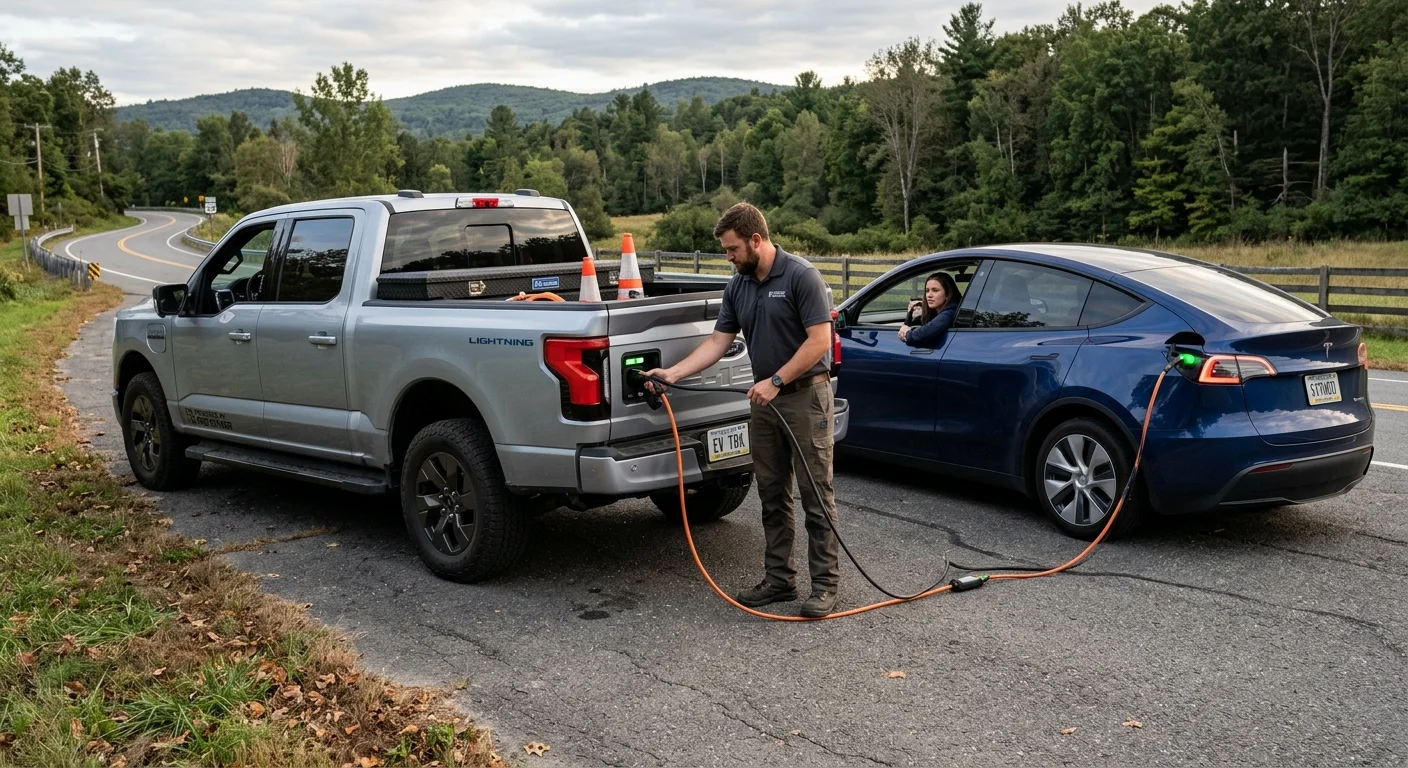
If the truck refuses the plug, you’re not in a slow-charge problem. A Lightning that won’t wake is often the 12-volt battery. It can also refuse a charge with a dead 12-volt. Start with Ford F-150 Lightning won’t start: the 12V checks to run first. Whether this truck can feed another EV from Pro Power Onboard is a separate question. We cover it in Can your F-150 Lightning charge another EV on the street.
Empty on an Orange County shoulder
A 41-minute DC stop only helps if you can reach the stall. A work truck on the 91 can hit zero before the next cabinet. That’s when a 240-volt charge at the curb is the backup.
Charge Pro OC is a referral line. We don’t own trucks, and we don’t charge the Lightning ourselves. We connect you with independent local operators through non-Tesla EV rescue and mobile EV charging. The operator quotes you before work starts, then bills you directly. What they bring is a 240-volt Level 2 source to the truck. They typically add 10 to 20 miles in 15 to 30 minutes of charging. That’s charging time, not a promise of when someone arrives.
The same operators can jump or replace a dead 12-volt on site. They handle Ford and every major EV brand. If you’re sitting in Anaheim or San Clemente, the play is the same. Stay with the truck. Let the operator add enough range to reach a working stall.
For a broader map of public plugs, start at EV charging in Orange County. For Fashion Island stalls, see EV charging near Fashion Island: where to plug in after you park.
Frequently asked questions
How long does a Ford Lightning take to charge at home?
On Charge Station Pro, Standard Range is about 6 to 8 hours empty to full. Extended Range is about 8 to 10 hours. A 48-amp unit can stretch a full charge to around 12 to 14 hours. Your starting percent and the circuit’s real output change that window.
How long does DC fast charging take on a Lightning?
Ford lists about 41 minutes for 15 to 80 percent on Extended Range. Standard Range is about 44 minutes, on a stall that can match peak rate. In Orange County you’re usually on one of 591 non-Tesla DC fast ports. Shared cabinets and a taper near 80 percent often run longer than the spec.
What if my Lightning won’t charge at all?
A session that never starts is usually the 12-volt or a dead station. It’s not the same problem as a slow fill. Stay with the truck and call (949) 444-0151. We’ll connect you with an independent local operator. They can quote a 240-volt charge or a 12-volt jump on site.