The range number just hit zero on Santiago Canyon Road. Stay with the car. You’re in East County canyon country, near Silverado, Modjeska, or Trabuco Canyon. A hill climb isn’t a flat commute. Get a pin and the screen text to an operator first. Charging versus a tow comes after those details.
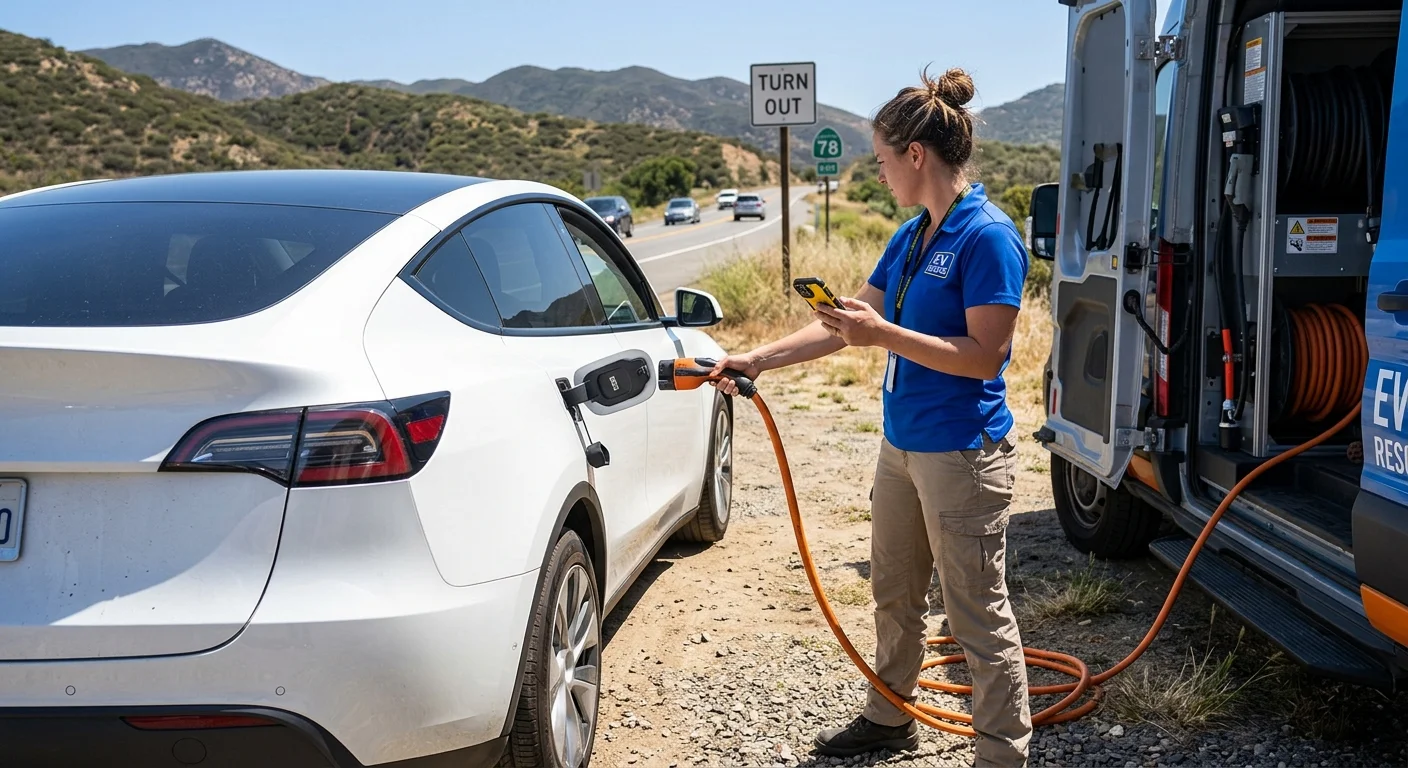
Canyon country changes the empty-pack problem
Santiago Canyon Road is the inland canyon corridor toward Silverado and Modjeska. Trabuco Canyon sits in the same East County fold. Climbs draw more energy than flat streets. If you came in already low, the last miles go quickly.
Orange County had 210,842 battery-electric vehicles on the road as of December 31, 2025. Those figures come from the California Energy Commission file. BEVs were 8.54% of the county’s light-duty fleet. All ZEVs together were 260,833, or 10.56%. California’s ZEV share of the light-duty fleet was 7.54% that year. Orange County holds 12.02% of California’s battery-electric vehicles. It’s only 8.33% of the state’s light-duty fleet.
The same CEC charger file counted 7,095 public ports in Orange County. That count is as of December 31, 2025. That’s 20 public Level 1, 5,600 public Level 2, and 1,475 public DC fast. The ratio that matters is 260,833 ZEVs divided by 7,095 public ports. That’s 36.8 ZEVs per public port. The statewide ratio is 24.4 ZEVs per public port. Orange County is worse served per EV than the state average.
Tesla accounts for 138,121 of those Orange County BEVs. That’s 65.51% of the county’s battery-electric fleet. Federal AFDC data lists 48 Tesla Supercharger sites in the county. Those sites total 861 DC fast ports. Tesla holds 861 of 1,452 public DC fast ports, about 59%. Lake Forest has a Supercharger at 24301 Muirlands Blvd, 24 stalls. Irvine, Laguna Hills, and Mission Viejo also have listed Supercharger sites. They only help if the car can still drive.
If it can’t, your location on Santiago Canyon Road is the job. Don’t spend the last percent chasing a map pin you can’t reach. Start with the out-of-charge recovery path for that stop. Canyon climbs on Laguna Canyon Road and Ortega Highway use the same stay-put idea.
Handle the scene before you handle the pack
If the EV is already clear of moving traffic, say so. If it isn’t, describe the scene before you try another roll.
This page can’t tell you to stay inside, get out, or cross a lane. No verified shoulder or turnout rule for this road turned up. If anyone is in danger, call 911 and follow the responding authority.
Don’t assume a turnout, driveway, or side road is still reachable. A car at zero may not complete one more move. Report whether it will select Drive, roll, steer, or release the parking brake. Don’t test those if a test would put someone in traffic.
If a deputy, firefighter, or road worker is already there, tell the operator. Pass along any order to move or leave the car. That can change whether on-site charging is even possible.
“In a live lane” isn’t the same as “in a turnout.” “On private dirt” isn’t the same as “on the pavement.” An operator needs that difference before quoting a job.
Pin the canyon, not the whole county
“Somewhere on Santiago Canyon” covers too much ground. A pin on the wrong side of a ridge sends help the long way around.
Share what you can actually see:
- Santiago Canyon Road, plus your direction of travel
- The closest named place you can confirm, such as Silverado, Modjeska, Trabuco Canyon, or Williams Canyon
- A live map pin from your phone
- A posted gate, trailhead, or side-road name
- Whether you’re in a travel lane, a turnout, or off the pavement
- Which side of the car the charge port is on
If the app pin and a posted sign disagree, send both. Don’t invent a mile marker you can’t see. Don’t guess a community name to sound precise.
Mention a closed gate or a one-way driveway if you see it. A pin can look close and still put someone on the opposite approach.
Empty range and a dead 12-volt are different jobs
A silent EV hasn’t diagnosed itself for you. Copy the messages exactly as shown. Don’t rewrite them into a story.
- The percent or estimated miles still shown
- Any out-of-energy or zero-range wording
- Any low-voltage warning on the display
- Whether the main screen stays awake
- Whether doors and the charge port still respond
- Any charging or system-fault text still visible
Tesla’s owner’s manual says a depleted pack can starve the 12-volt system. An external supply may be needed before the high-voltage pack will charge. Report what your car actually shows. Don’t assume every no-start is an empty pack.
Use the vehicle app if it still connects. Missing app data isn’t a diagnosis. Note what it shows and when it last updated.
If the car reports a low-voltage problem, say that. Don’t call it an empty traction battery unless the car also reports depleted charge.
Don’t pop panels or try a guess jump from another car. The matched operator should confirm the vehicle, the symptoms, and the fit.
Share make, model, year, and connector type. Tesla owners often have a native NACS port. Other EVs may need CCS or J1772. Ask the operator to confirm the plug before they roll. The U.S. Department of Energy charging guide explains levels and connectors.
Describe the last stretch of access
A correct pin still hides the approach. Equipment needs a place to sit that isn’t a live lane.
Tell the operator how the last stretch looks. Note a live lane, a turnout, a gate, or private land. Say if a limb, sign, or height bar sits over the car. Say whether the car is blocked, and which way it faces. Say whether there’s room at the charge port. Don’t roll the EV just to make space unless the scene is safe. Wait for the operator or an on-scene authority if a move is needed. Mention locked doors, a missing key, crash damage, or a flat. If you’re on private property, say whether you can admit the operator.
Charge Pro OC passes that packet to an independent operator. It doesn’t control operator availability, equipment, pricing, or access decisions. Confirm those points with the operator before you agree.
Let the operator choose a charge or a tow
Mobile EV charging is one recovery path, not the default. The operator has to decide whether the EV can take energy where it sits. Ask the operator to confirm each of these points.
- Whether a mobile charge fits the symptoms you reported
- Whether their connector matches your port
- Where the equipment would stand
- What output they can actually provide
- Whether a tow is the cleaner recovery
Operators we connect you with bring a 240V Level 2 source to the car. They typically add 10 to 20 miles of range in 15 to 30 minutes. That’s charging time at the car, never an arrival time. Don’t assume you’ll get a set number of miles. Confirm what the job is meant to accomplish before you accept.
Tesla’s published roadside policy answers a depleted pack with transportation, not with on-site charging. Running out of charge isn’t a warrantable breakdown. Covered transport is for a warrantable breakdown that leaves the car undrivable. Tesla roadside is 877-798-3752, as listed on the Santa Ana service page. That’s Tesla’s number, not ours.
If a charge is on the table, name the next stop with the operator. That might be home or a public site you can reach. Check live stall status before you treat any address as the plan. Don’t aim at a site you haven’t confirmed.
Transport is on the table when the car won’t accept a charge. It’s on the table when the car can’t be serviced where it sits. The tow provider should confirm loading method, destination, access, and price. Charge Pro OC doesn’t set those terms. Compare both paths in mobile EV charging or a tow.
When to call Charge Pro OC
Call when the EV has stopped on Santiago Canyon Road. You need an independent local operator to assess charging or transport. Charge Pro OC is a referral line. It matches stranded EV drivers with independent local mobile rescue operators. It performs no work, owns no trucks, and sets no prices. The operator quotes you before starting and bills you directly. The pros we connect you with are licensed and insured.
Call (949) 444-0151 and we’ll connect you with a local EV rescue operator.