The cost to tow an EV in Orange County isn’t a simple hook fee. A dead pack on the 91 often starts with a free FSP truck. That same empty Tesla can still become paid transport. Charging at the car usually cuts that chain short.
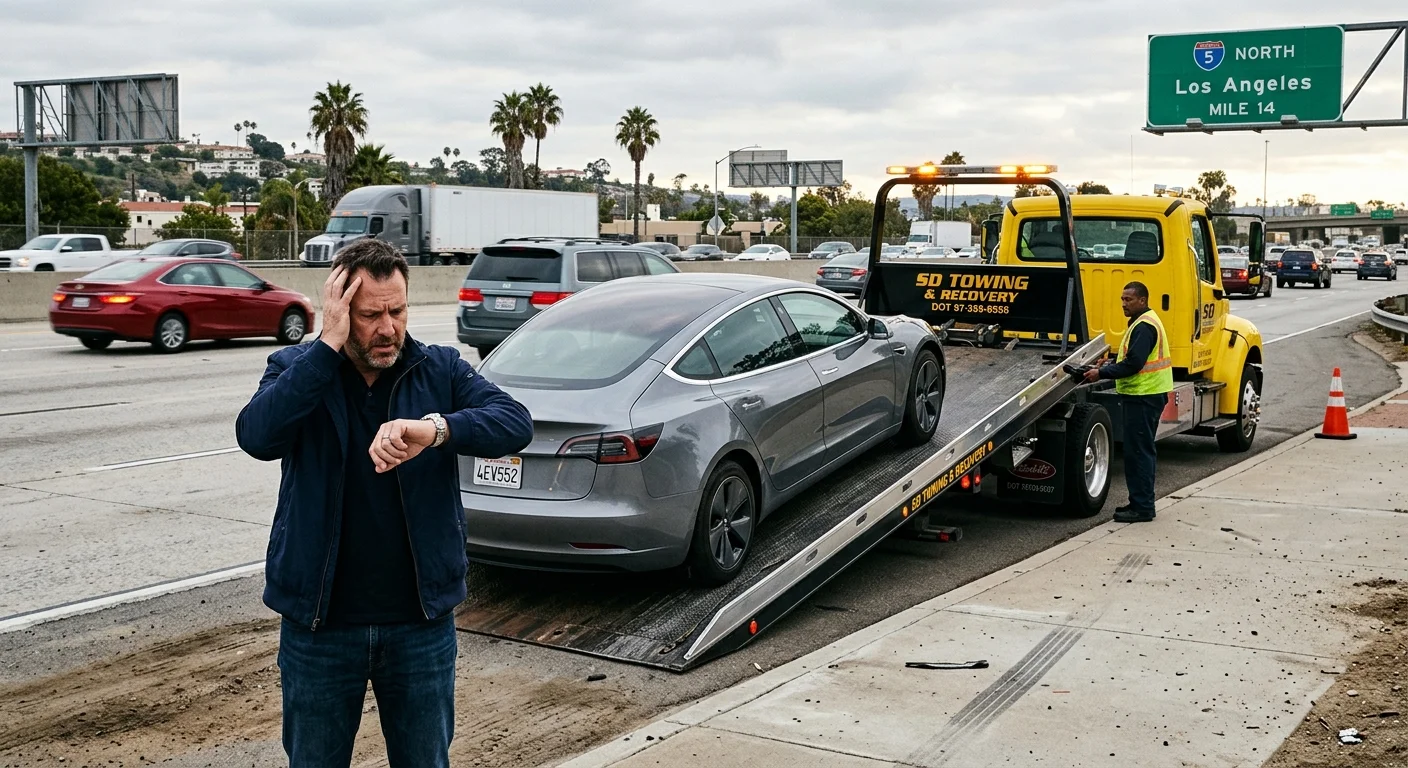
FSP will jump you or drop you, not charge the pack
Orange County’s Freeway Service Patrol is the first truck many drivers meet. On a covered freeway, that patrol can jump a 12-volt battery. It can also tow you to a nearby drop zone. Those covered moves don’t send the driver a bill. They also don’t put miles back in an empty pack.
The patrol handles flats, 12-volt jumps, and live-lane stalls. What it doesn’t bring is a Level 2 charge on the shoulder. If the high-voltage pack is at zero, a jump only wakes accessories. Tesla’s own owner’s manual describes that next failure clearly. Once range is gone, the low-voltage battery loses support. The car needs an external supply before the pack will charge. A drop-zone tow gets you off the freeway and doesn’t fill the battery.
Published FSP coverage skips the toll roads in this county. Empty on SR-241 is a different playbook. Confirm the current map before you assume a free truck will roll. Hours and routes change, and the publishers of that map set them. Charge Pro OC doesn’t run the patrol and doesn’t speak for it.
Tesla treats a dead pack as paid transport
Most battery-electric cars in this county are Teslas. CEC data as of December 31, 2025 counts 138,121 Teslas here. That’s 65.51% of Orange County’s 210,842 battery-electric vehicles. Tesla’s roadside policy is the script a lot of local owners hit.
Tesla can still assist if you run the pack empty. That help isn’t treated as a financially covered service. The company answers a depleted battery with transportation. It doesn’t send a charger to your bumper. Covered transport is for a warrantable breakdown that leaves the car undrivable. Running out of charge isn’t that warrantable breakdown.
You’re still shopping the cost to tow an EV when you tap Tesla Roadside. Someone still has to move a heavy car that may not roll. You still need a safe destination with a working plug. That quote is between you and the contractor Tesla sends. Charge Pro OC doesn’t set that Tesla transport quote. If the car has a warrantable failure, use Tesla’s transport. If the only problem is an empty pack, charge it where it sits.
What drives the cost to tow an EV here
No honest page can publish a typical Orange County tow rate. Yards set their own prices, and they move with the job. Confirm every line with the yard before you sign. A dead EV usually needs a flatbed, not a two-wheel lift. Motors and reduction gears don’t like being dragged. A locked parking pawl with no power means the car has to ride. A flatbed is a different truck, and yards price it that way. That’s true in an Anaheim theme-park lot and on a canyon shoulder.
Then comes the destination problem for an empty pack. Orange County had 7,095 public charging ports as of December 31, 2025. It also had 260,833 zero-emission vehicles on the same date. That’s 36.8 ZEVs for each public port. The California average sits at 24.4 ZEVs per public port. More cars compete for each plug here than in the state as a whole.
A tow to a public charger can still land you in a queue. Tesla holds 59% of the county’s public DC fast ports. The Supercharger at 1920 Main Street in Irvine has 40 stalls. San Clemente’s site at 101 W Avenida Vista Hermosa has 49. Garden Grove’s Harbor Boulevard Supercharger lists 32 stalls. Those are large, real sites, and they’re also busy.
North county, the coast, and south county aren’t the same drop
A tow from the 91 doesn’t aim at the same plug as one from I-5. North county drivers often get pointed at Anaheim and Buena Park. Lincoln Avenue, Katella Avenue, Beach Boulevard, and Knott Avenue all have Superchargers. Central county traffic stacks at the Crush on SR-22. Santa Ana’s 17th Street site has 28 stalls at up to 325 kW.
Coastal trips after a long beach day often head for Warner Avenue in Huntington Beach. Newport Beach has a Supercharger at 4241 MacArthur Boulevard. Fashion Island also has an Electrify America field with 8 DC fast ports. South county has the giant San Clemente field plus Mission Viejo and San Juan Capistrano. The Shops at Mission Viejo Supercharger is 10 stalls at 72 kW. That’s Tesla’s own figure, and it’s a weak place to dump an empty pack.
Lake Forest’s Rockfield Boulevard Magic Dock is different. It lists CCS1 and NACS, so a non-Tesla can actually use it. A Kia or Hyundai can’t use a Tesla-only stall as a drop. Countywide, non-Tesla DC fast charging is 175 stations and 591 ports.
The 12-volt fork, then the pack
Not every dead EV in Orange County is an empty pack. Plenty of strandings are a 12-volt that quit in a parking structure. The car looks fully dead, with dark screens and no ready state. FSP can jump it on a covered freeway. A mobile operator can jump it in a driveway or a gated HOA.
After the 12-volt wakes, check the range number. If you’ve still got miles left, you’re done. If the pack is still at zero, you need energy, not another jump. Towing a car that only needed a 12-volt jump wastes the day. Towing an empty pack into a full Supercharger repeats the same mistake.
The operators we connect you with handle both jobs. They can jump or replace a dead 12-volt on site. They can also bring a 240-volt Level 2 source to the car. Teslas take a native NACS plug on that truck. Other brands use a CCS or J1772 adapter on the same truck. Typical charging time is 15 to 30 minutes. That window is for adding about 10 to 20 miles of range. It isn’t a promise of when a truck arrives.
What you’re paying for when you move the car
Time is part of the cost to tow an EV, even off the invoice. A mobile charge skips the middle of that chain. There’s also damage risk on the load itself. A wheel-lift on a dual-motor Tesla can spin a motor that should rest. That’s true in a Costa Mesa office structure and on a Laguna Canyon shoulder.
Charge Pro OC doesn’t own tow trucks or charging trucks. It’s a referral line that matches stranded drivers with independent local operators. Those operators quote you before they start, and they bill you directly. We don’t set prices, and we don’t promise an arrival window. We connect you with a pro who can charge or jump on site. If you want the decision tree, start with mobile EV charging or a tow. For Tesla loading rules, use the no-power tow checklist.
When a tow is still the right call
Charging first isn’t a rule for every failure. If the car was in a crash, don’t charge it on the street. If it won’t roll, you need a shop, not a curb charge. Tesla covers transport for a warrantable breakdown that leaves the car undrivable. That’s a tow to a service center, not a shoulder charge. A steep driveway or a low garage can also block a simple roll-off. Tell the operator the access problem before anyone dispatches.
On covered freeways, let FSP clear the live lane first if they’re already there. Take the jump if the 12-volt is the failure. Take the drop-zone tow if you’re in danger. Then call for a charge at the drop, not another haul across the county.
How to keep the bill from spreading
Start with the actual failure before anyone hooks a strap. Empty pack, dead 12-volt, and a mechanical no-start are three different calls. Use out-of-charge recovery when the pack is the problem. A 12-volt job shouldn’t become a Supercharger pilgrimage.
Ask any tow yard whether the destination has working, compatible stalls. You can point at the 28-stall Supercharger on 17th Street in Santa Ana. You can point at EVgo on Antonio Parkway in Rancho Santa Margarita. Then check the live app while you wait. If the site is down or full, don’t roll there.
If Tesla Roadside is already on the phone, ask which transport this is. Covered transport and paid transport aren’t the same invoice. Depleted pack versus a warrantable breakdown is the split that decides the bill. Don’t assume an empty battery rides under warranty.
On a toll road, don’t wait on a patrol that may not be scheduled. Published FSP coverage skips the toll roads, including SR-241. The freeway patrol versus Tesla tire help post walks the free-truck side of this. Neither of those paths fills an empty pack. If you want the pieces named, read what goes into a mobile EV charging quote.
When you want energy at the bumper, call Charge Pro OC at (949) 444-0151. We’ll connect you with a local independent operator. That operator quotes the job before any cable goes in.