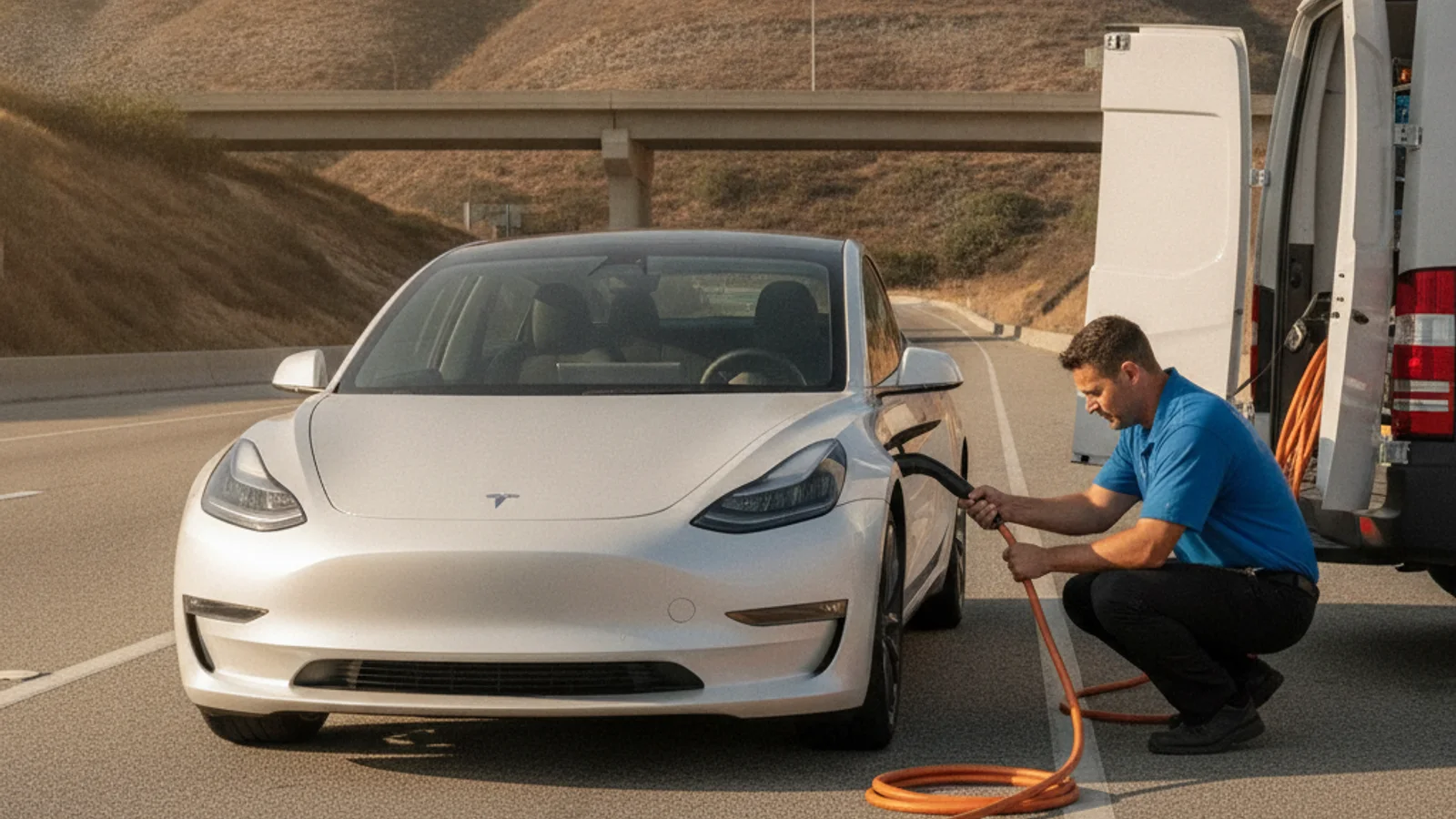
A Fullerton EV that sat all day often won’t move when you come back. Campus ramps, hospital structures, and older hillside apartments are the usual setting. Mobile EV charging in Fullerton is a 240V charge brought to your car. It’s not a walk to a stall, and it’s not automatically a tow.
Why a long sit strands you here
Fullerton is inland north Orange County, and the ground rolls. The city sits at 274 feet. Sunny Hills and Raymond Hills put real grades on the north side. Golden Hill and Coyote Hills do the same on the west. The Brea Dam basin sits in the north. You feel that climb on Bastanchury Road after a full day parked. Many of those hillside homes need a panel upgrade before a charger circuit will fit.
Inland heat works on those same parked cars. NOAA’s 1991 to 2020 normals come from Fullerton Municipal Airport. July’s mean maximum is 84.4 F. August’s mean maximum is 86.7 F. That’s an inland pattern, not a marine layer.
Cal State Fullerton is the largest campus in the CSU system by headcount. Its parking structures hold thousands of cars for full days. Students and staff here overwhelmingly rent, often in older buildings. Census ACS 2023 data shows 72.3% of Fullerton housing was built before 1980. Renters in that older stock often have no plug at home. Drivers arrive on Nutwood Avenue or State College Boulevard already low. They park for eight hours, then leave lower.
Providence St. Jude Medical Center repeats the dwell on a longer clock. Hospital structures hold cars through twelve-hour shifts and multi-day admissions. That sit is what finds a weak 12V battery.
Downtown Fullerton, Amerige Heights, Ladera Vista, and West Fullerton add older lots to the mix. Fullerton Creek and Bastanchury add hillside driveways. Fullerton College and Hope International University keep cars sitting through class blocks. The Fullerton Transportation Center does the same for Metrolink and Amtrak waits. The Muckenthaler Cultural Center and Fullerton Arboretum are quieter lots with the same sit. Brea, Placentia, Anaheim, Buena Park, and La Habra sit next door.
Orange County had 210,842 battery-electric vehicles on the road as of December 31, 2025. That’s per the California Energy Commission. Teslas make up 65.51% of that BEV fleet. The county has 36.8 ZEVs per public port, versus 24.4 statewide. Public stalls in town exist. They don’t help a car that already won’t roll.
Two dead cars, two different calls
Treat “won’t move” as a fork, not one failure.
A drained traction pack usually warns you on the way down. You get a low-charge or zero-range message, then the accelerator stops answering. Tesla’s owner’s manual covers running out of range. It describes the low-voltage battery losing support once range is gone. The car then needs external power before the high-voltage pack can charge.
A 12V failure stays quiet until it isn’t. The cabin can go black. Park may not release. Locks, handles, or the screen can freeze. That can happen even if the last range figure looked fine.
Copy the warning text exactly. Check the app, the interior lights, and the locks. A car that still unlocks but won’t drive is one case. A dark cabin is another. Neither line is a diagnosis. Both are useful for the operator we connect you with.
Leave the high-voltage battery alone. Skip forum jump steps. If you’ve got the owner’s manual for your year, use that section only. If you don’t, say so. See our guide on when an EV 12V dies on the road.
Get the car out of the lane first
If you still have a few feet of motion, use them. Push as far right as the pavement allows. Don’t idle in a merge on SR-91, SR-57, or I-5. Keep creeping if the car still can. Shoulders change width near on-ramps. A car in the split of an on-ramp is harder to see.
Keep hazards on and your seatbelt on. Stay inside if you’re next to moving traffic. Don’t walk the charge port on a live shoulder. If there’s smoke, a blocked lane, a crash, or anyone hurt, call 911. Follow the officers, since they outrank this page.
Local streets still need a pin. Harbor Boulevard, Euclid Street, Brookhurst Road, and State College Boulevard all run long. So do Chapman Avenue, Commonwealth Avenue, Orangethorpe Avenue, Bastanchury Road, Nutwood Avenue, and Malvern Avenue. SR-90 Imperial Highway and SR-39 Beach Boulevard frame the west and north edges. “I’m in Fullerton” covers 141,278 people. “Northbound Harbor, south of Chapman, in a campus structure” is a location.
Name what you can see. Cal State Fullerton, Fullerton College, and Providence St. Jude all beat a ZIP. So do Downtown Fullerton, the Fullerton Transportation Center, Fullerton Municipal Airport, and the Fullerton Arboretum. The city uses 92831, 92832, 92833, and 92835, with slivers of 92801, 92806, and 90621. A ZIP isn’t a stall number.
Then describe access from where you sit. A CSUF structure and a St. Jude structure are different jobs. So are a hillside driveway on Bastanchury and a street stall on Chapman. Mention anything that would change how a service vehicle reaches the bumper.
When mobile EV charging is the fit
Raise mobile EV charging when the signs point to an empty pack. The 12V should still look awake. A service vehicle also has to park without blocking a lane. A hillside driveway or a CSUF lot stall is a usual setting. A St. Jude structure, or a curb on Commonwealth, can work too. A live freeway lane isn’t.
Charge Pro OC is a referral line. We match you with an independent local operator. We don’t own trucks, and we don’t set prices. The operator quotes before starting and bills you directly.
The pros we send typically bring a 240V Level 2 source to the car. Teslas take a native NACS plug. Other EVs take a CCS or J1772 adapter. The DOE Alternative Fuels Data Center lists Level 2 field plugs as J1772 or J3400 (NACS). DC fast charging uses CCS, CHAdeMO, or J3400. Your vehicle decides which of those is correct.
A field session isn’t a full battery. Operators typically add 10 to 20 miles of range in 15 to 30 minutes of charging. That window is charging time only. It isn’t an arrival time. We don’t publish arrival times. The goal is enough range to reach a fixed stall, not a full charge.
Once the car can drive, Fullerton has named DC fast sites. AFDC lists a Tesla Supercharger at 1475 S Harbor Blvd with 12 stalls. A second site sits at 220 E Orangethorpe Ave with 16 stalls. Electrify America is at Target T1383, 1893 W Malvern Ave. Use those after you can roll. Don’t plan a walk to them from a dead structure.
Tesla’s roadside policy, as Tesla describes it, answers a depleted battery with transportation. It doesn’t answer that failure with charging at the bumper. Confirm the current wording on Tesla’s roadside-assistance page before you count on coverage. That’s why drivers here ask a local operator about on-site 240V. Check our Fullerton charging page before a long sit. If you’re already stuck, stay with the car.
When a jump or a tow is the honest next step
If the 12V is down, filling the traction pack won’t wake the computers. The operator may jump or replace that 12V on site. They handle Tesla and every major EV brand. If the port won’t latch, they’ll talk transport instead. Same if the spot isn’t safe for equipment.
Don’t direct the load, the tow mode, or the parking brake. Those steps change by model. Hand over the towing section of the manual if you’ve got it. If you don’t, say that out loud.
Out-of-charge recovery is how we connect you for that charge-or-move call. For a north county freeway shoulder, read out of charge on the 91. For the wider Fullerton roadside picture, see EV roadside assistance in Fullerton. A side-by-side of mobile charging versus a tow helps if you’re still choosing.
Call when the car won’t roll
Call when the EV has stopped in Fullerton. You might not be able to tell charge from jump from tow. Share the warning text, the last range you saw, and the exact pin above. We connect you with a local operator. They quote the work before they start.
Call (949) 444-0151 and we’ll match you with an independent EV rescue operator.