People type mobile EV charger for roadside use and picture a kit in the trunk. On an Orange County shoulder, that isn’t what feeds the car. The unit that can charge an empty pack is a truck. It’s a 240V Level 2 source on a vehicle. The operator brings a native NACS plug, plus CCS or J1772 adapters. A suitcase charger still needs a wall you don’t have out here.
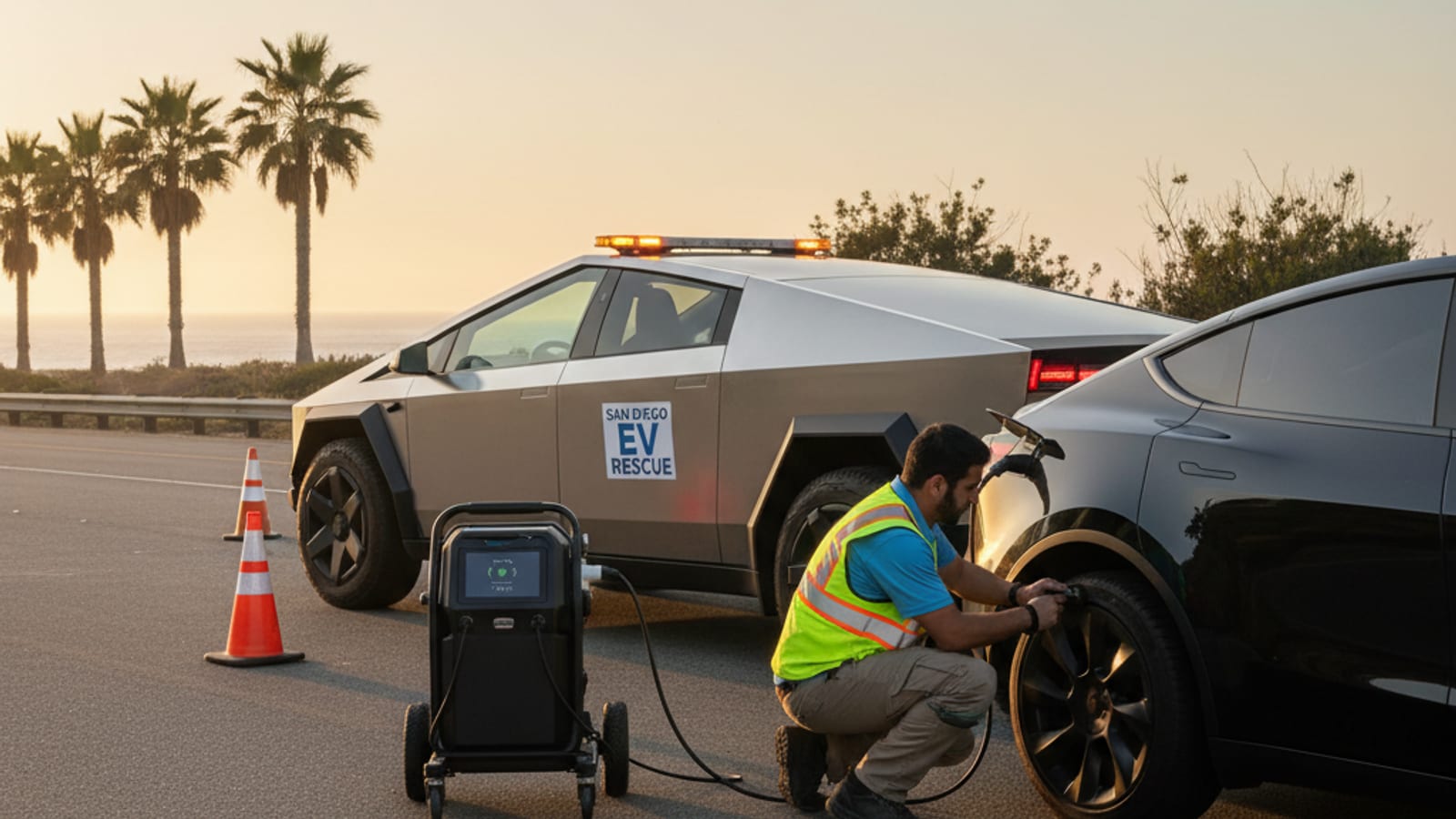
The search points at a truck, not a brick
Retail pages and rescue pages share a phrase. They don’t share a machine. A travel EVSE is a cord and a box. The plug still expects a receptacle. You can carry it in the frunk. You still have to find 120 or 240 volts in a building.
A roadside operator brings the volts with them. The source sits on the truck. The car stays where it already stopped. That’s the product people actually need after the low-battery warning.
Photos make the mix-up worse. One listing shows a compact brick on asphalt. Another shows a bed-mounted outlet and a cable in a charge port. Only the second setup works on the 91, I-405, or I-5. The first is a home or shop tool that left the house with you.
Keep a travel charger if you own one. Use it at a dryer outlet you have permission to use. Use it at a workplace pedestal that’s actually free. Don’t plan a freeway recovery around it. There’s no dryer circuit in the gore point. There’s no spare NEMA box in a theme-park garage stall. Not unless the building already wired one.
Charge Pro OC doesn’t sell those bricks. We’re a referral line. We match stranded drivers with independent local operators. The operator quotes before they start. They bill you directly. We don’t own the truck. We don’t set the price.
A portable charger still wants a wall
Level 1 wants a household receptacle. That’s the same outlet as a lamp. Overnight at a house, it can creep range in. On the SR-22 shoulder at the Crush, it has nothing to grab.
Level 2 wants 240 volts. That’s a dryer, a range, or a wall connector. That family is explained here. See this 240-volt charging guide. At home, that circuit is the daily plan. On Ortega Highway, that circuit isn’t standing in the dirt. On Santiago Canyon Road, it isn’t standing in the dirt either. In a Tustin office-park garage you might see a pedestal. You might also see it occupied, reserved, or dark.
So “portable” describes the box, not the power. Electricity still comes from a building, a pedestal, or a truck that carries a source. If the car already sat down, you need the source that travels.
A personal unit also leaves you in the lane with a cord. The operator’s truck can sit as a buffer. That’s a safety difference, not a dispatch claim. We don’t publish arrival times. We don’t promise a clock.
Some ads hint at DC fast in a van. That isn’t what these operators bring. The verified kit is a 240V Level 2 source. Treat anything else as unconfirmed unless the operator says it in the quote.
What actually rolls up
The truck is a 240V Level 2 source. Native NACS for Tesla. A CCS or J1772 adapter for other EVs. That’s the kit. Here’s the gear list. See what the truck actually brings.
Once the cable is in, charging time is typically 15 to 30 minutes. That session is meant to add about 10 to 20 miles of range. Read those minutes as charging time. They aren’t a claim about when the truck appears.
Ten to twenty miles is a recovery. It’s enough to roll to a public stall in a lot of the basin. Home works too if you’re that close. It isn’t a full pack. It isn’t Supercharger speed. AFDC lists Orange County Tesla sites at several maxima. You’ll see 75 kW, 125 kW, 150 kW, and 250 kW. Some sites report 325 kW. Garden Grove’s Valley View site reports 500 kW as the AFDC maximum. The truck isn’t in that family.
The operator is an independent pro. The pros we connect you with are licensed and insured. Charge Pro OC matches the call. We don’t perform the charge. We don’t hold a license for this work. We don’t stock parts. We don’t run a yard. The pros we send plug in.
They’ll ask the model. They’ll ask the state of charge if you can still see it. They’ll ask whether the port opens. They quote before they start. If the 12V died, the pack may still hold range. Then the job may be a jump. Say what the car did before it quit.
Orange County’s EV file, in plain numbers
This search shows up here because the fleet is large.
The California Energy Commission publishes the light-duty file. Orange County had 210,842 battery-electric vehicles as of December 31, 2025. Plug-in hybrids added 47,567. Fuel-cell vehicles added 2,424. That’s 260,833 ZEVs in the light-duty file. Gasoline still leads at 1,996,523, plus 180,219 gasoline hybrids.
ZEVs are 10.56% of Orange County’s light-duty fleet. BEVs alone are 8.54%. California’s ZEV share of its light-duty fleet is 7.54% in the same file. Orange County holds 12.02% of California’s battery-electric vehicles. The county is 8.33% of the state’s light-duty fleet.
Tesla accounts for 138,121 of those 210,842 BEVs. That’s 65.51% of the county’s battery-electric fleet. It’s 5.59% of all light-duty vehicles here. California’s Tesla share of BEVs is 61.34%. This county is 6.4 points more Tesla-concentrated than the state.
New sales stay ahead of California, with two caveats you should keep. Orange County’s ZEV share of new light-duty sales was 28.76% in 2025. California sat at 22.93%. In 2026 Q2 it was 24.77% here and 19.09% statewide. The county runs about five to six points above the state. Don’t read that as a climb that never breaks. California’s ZEV share of new sales peaked at 25.31% in 2024. 2026 Q1 was the weakest quarter in that series at 15.76%. CEC changed its new-sale method in 2023 and again in 2025. Year-over-year lines across those breaks aren’t clean.
Charging hardware is real. CEC’s December 31, 2025 charger file lists 7,095 public ports in Orange County. That’s 20 public Level 1 ports and 5,600 public Level 2 ports. Public DC fast adds 1,475. Shared private ports add 4,685. Public plus shared private totals 11,780. Orange County holds 7.75% of California’s public ports.
Divide 260,833 ZEVs by 7,095 public ports. That’s 36.8 ZEVs per public port. Statewide the same math is 24.4. More EVs share each public port here than in California as a whole. CEC builds those counts from surveys, grant data, AFDC, PlugShare, and other listings. Updates run twice a year.
Federal AFDC data shows 48 Supercharger sites inside the county boundary. That’s 861 Tesla DC fast ports, public and available in the extract. Countywide, public DC fast is 223 stations and 1,452 ports. Exclude Tesla and you have 175 stations and 591 DC fast ports. Tesla holds 59% of Orange County’s public DC fast ports. ChargePoint shows the most stations and about 1.1 ports per site. Many of those are single-plug dealership or office units. They aren’t a rescue-grade row.
The map has real stalls. Anaheim has seven Tesla Supercharger addresses in that extract. They include 2404 E Katella Ave and 680 N Euclid St. Irvine has six, including 1920 Main St with 40 stalls. Garden Grove has 32 stalls at 12891 Harbor Blvd. San Clemente’s 101 W Avenida Vista Hermosa site lists 49 stalls. You can still sit empty in a structure while those rows exist across town. The car’s pin is the problem the truck solves.
Start at EV charging in Orange County.
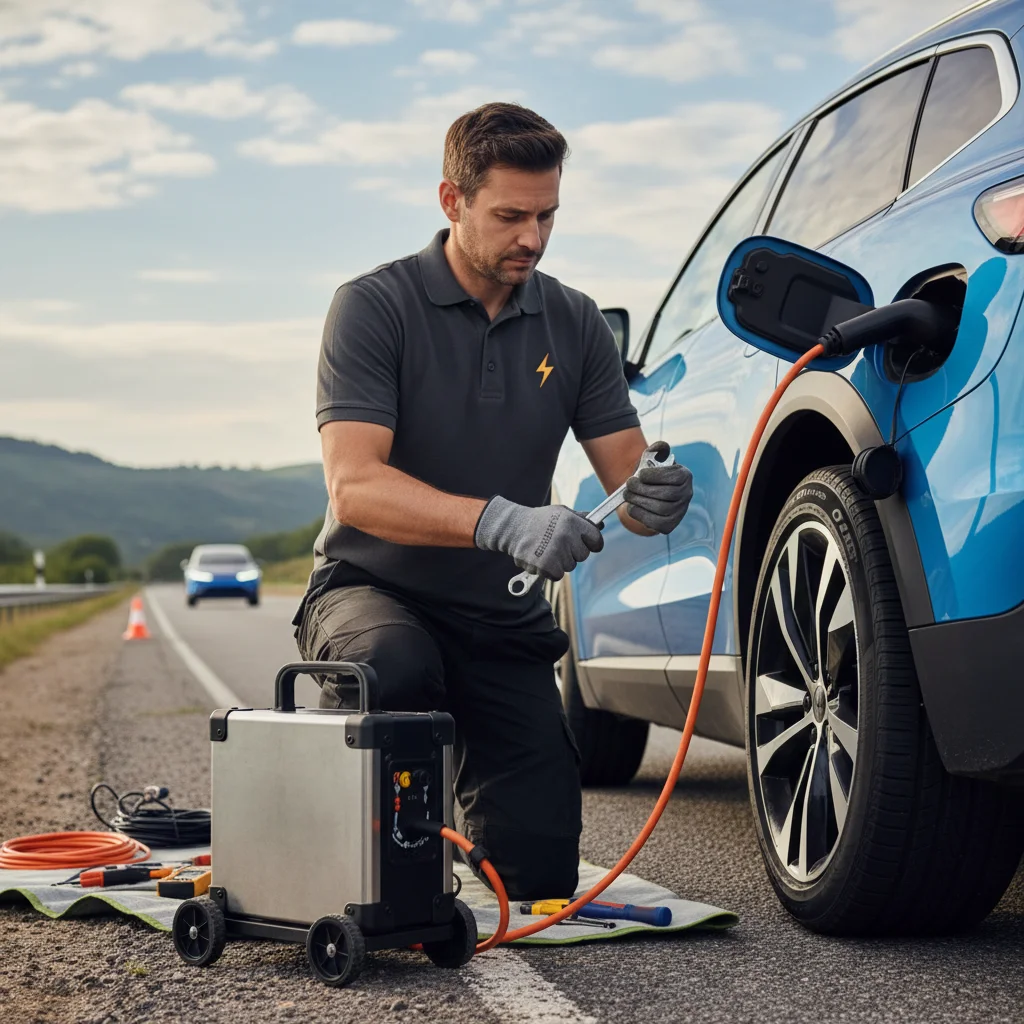
A Level 2 boost is a recovery charge
Charging levels from a wall outlet up to a truck are listed here. Read EV charging levels for stranded drivers. The roadside product in this network is Level 2.
The job is to move the car to a stall you can actually use. After 10 to 20 miles you might roll to 1475 S Harbor Blvd in Fullerton. Or 6940 Beach Blvd in Buena Park. Or 1065 Brea Mall. Or 950 Spectrum Center Dr in Irvine. Or 23701 Moulton Pkwy in Laguna Hills. Or 24301 Muirlands Blvd in Lake Forest. Or 6913 Warner Ave in Huntington Beach. Those Tesla Supercharger addresses come from the AFDC extract.
Non-Tesla DC fast is in the same federal file. Electrify America lists 10 DC fast ports at the Anaheim Walmart. The AFDC address is 440 N Euclid St. Fashion Island lists 8 at 401 Newport Center Dr in Newport Beach. The Dana Point Station at 25825 Las Vegas in Capistrano Beach lists 12. That’s the largest non-Tesla DC fast site in south county in that extract. EVgo lists 14 DC fast ports at Plaza Antonio in Rancho Santa Margarita. The AFDC address is 22351 Antonio Pkwy. Ocean View Plaza in San Clemente lists 10. Seal Beach has an EVgo listing at 801 Pacific Coast Hwy with 4 stalls.
Mission Viejo’s Shops site is a reminder to read power, not just pins. AFDC and Tesla disagree on kW there. Tesla’s own listing is the 72 kW figure to use for those 10 stalls. Westminster Mall’s 24 stalls are listed at 75 kW. A recovery cop charge can still get you onto a slower row. A suitcase charger can’t create that trip from a dead stop.
Tell the operator your next target if you have one. They still quote first. Use your car’s nav or the federal AFDC locator after you’re rolling. Don’t hunt while the pack is already at zero.
NACS, CCS, and the rest of the fleet
Most BEVs here are Teslas. 72,721 are not. That’s 210,842 minus 138,121. Hyundai, Kia, Ford, GM, and BMW still need a matching inlet. So do Mercedes, Rivian, Volkswagen, and the rest.
Operators bring native NACS. They also bring a CCS or J1772 adapter. Confirm the model on the call. A Model 3 and a Cybertruck share a family. A Mach-E and an Ioniq 5 don’t share Tesla’s inlet.
Lake Forest’s 24372 Rockfield Blvd Supercharger is listed as Magic Dock. AFDC shows CCS1 plus NACS, 16 stalls, and 325 kW. That’s a destination if you can drive. It doesn’t help a car that already sat down.
For Tesla-specific help, see Tesla roadside rescue. For the charge itself, see mobile EV charging.
North county, the basin, the coast, and the canyons
Orange County isn’t one commute. If you’re on a freeway shoulder, stay out of the lane. Keep passengers behind a barrier if there is one. Don’t walk the shoulder looking for a receptacle. There isn’t one to find on the white line.
Inland north county
Inland north county is theme-park garages, Harbor Boulevard, Katella, and the 91. Anaheim’s Supercharger list in AFDC runs Lincoln, Imperial, Katella, Euclid, and Santa Ana Canyon Road. Buena Park sits on Beach and Knott. The Knott Avenue Tesla site lists 28 stalls at 325 kW. Fullerton sits on Harbor and Orangethorpe. Harbor’s newer site lists 12 stalls at 325 kW. A car that dies in a stadium or park garage is boxed in. Other cars hem it in. A portable Level 2 brick doesn’t create a receptacle in that stall. An operator who can pull to the space does.
The central basin
The central basin is SR-22, I-5, I-405, and office parks. Santa Ana’s Tesla sites in the file sit at 1008 17th St. The other is 300 E 5th St. Seventeenth Street lists 28 stalls at 325 kW. Fifth Street lists 20 stalls at 75 kW. Tustin has Red Hill, Franklin, Kensington Park, and Flight Way. Franklin Avenue lists 36 stalls. Costa Mesa has Bristol, South Coast Drive, and Hyland. When a workplace pedestal is taken, the stranded car is often already indoors. A tow out of a structure is a long production. A Level 2 cable in the stall is a shorter story.
The coast
Coastal cities add beach lots and climbs. Huntington Beach and Newport Beach stack weekend parking. So do Costa Mesa, Laguna Beach, Dana Point, and San Clemente. Huntington Beach’s Tesla site at 6913 Warner Ave lists 24 stalls at 325 kW. Fashion Island’s Electrify America row is one named option after a Newport Center day. MacArthur’s Tesla site lists 12 stalls at 250 kW. A pack that looked fine at the sand can be a low number at dusk. That’s a planning miss, not a mystery about the county’s stall count.
Canyons and gated hills
East county and the canyon roads are grades and gates. Santiago Canyon Road, Silverado, Modjeska, Trabuco Canyon, and Ortega Highway chew range on the climb. SR-241 is a toll road with its own shoulder rules. A gated street in Coto de Caza or Ladera Ranch adds a code. Give the operator the gate plan. The referral doesn’t change. The work still happens at the car.
We serve every city in the county. The operator who shows up still has to reach the pin you drop.
Empty pack, or a 12V that went dark
A dark EV isn’t always at zero. The 12V runs computers, contactors, and door electronics. When it drops, the car can look fully dead. The traction pack may still hold range.
Tesla’s Model Y owner’s manual describes a depleted-range trap. Once the high-voltage pack is exhausted, the low-voltage battery can lose support. The car may need an external supply before the high-voltage battery can charge again. That’s a sequence from Tesla’s manual, not a local statistic.
If the dash was fine and then everything died after sitting, think 12V. If range warnings stacked up and then the car sat, think empty pack. If you can’t tell, say so on the call. A jump on a truly empty pack won’t create miles. A charge port that won’t open needs a 12V wake first. Only then can a Level 2 cable do anything.
Operators in this network jump or replace a dead 12V on site. They handle Tesla and every major EV brand. The quote still comes before the work.
Stay with the car, or move the car
Mobile EV charging or a tow is the choice when the pack is empty.
A tow relocates a silent car. You still need a live stall at the far end. You still need a flatbed crew that knows how to move an EV. You wait for the hook. You wait again for a plug. If the 12V is dead, the car may not unlock. It may not roll the way a gas car does.
On-site Level 2 keeps the car where it is. After 15 to 30 minutes of charging, you drive. Then you finish at a Supercharger or a home hookup. An Electrify America or EVgo row works too.
That comparison is about steps. It isn’t a claim that a rescue truck beats a tow truck on the clock. Charge Pro OC doesn’t publish response times. Don’t trust an ad that invents one.
Tesla’s roadside-assistance page couldn’t be opened directly during the September 5, 2026 research pass. Search snippets of Tesla’s own page say a depleted battery isn’t a financially covered service. They also say Tesla can arrange transportation. Read the live Tesla roadside policy before you assume coverage. Don’t treat a snippet as a contract. The honest read of those snippets is simple. Tesla’s published path for an empty pack is transport, not an on-site charge. Tesla’s Santa Ana service listing publishes 877-798-3752 as the roadside number.
How Charge Pro OC connects you
Charge Pro OC matches stranded EV drivers with independent local mobile rescue operators. We serve Orange County. We don’t employ the technicians. We don’t own equipment. We don’t promise an arrival window. We don’t publish business hours.
You give a location and a model. We connect you. The operator quotes. If you agree, they bring the 240V Level 2 source to the car.
If you’re already stopped, call (949) 444-0151. That’s the number to reach the referral line. It isn’t a promise that a truck is around the corner.
Frequently asked questions
Does a mobile EV charger for roadside use plug into a wall?
No. The roadside product is a truck that carries 240 volts. A portable brick in your trunk still needs a receptacle. If you’re on I-405, I-5, or the 91, you don’t have one. Ask for an operator with a source, not for a longer cord.
How much range does the truck add?
Typical charging time is 15 to 30 minutes. That session is meant to add about 10 to 20 miles. It’s a recovery charge so you can reach a stall or home. It isn’t DC fast. The operator quotes before they start. Every car and every stop is different.
Can they charge a car that isn’t a Tesla?
Yes. Operators bring native NACS for Tesla. They also bring CCS or J1772 adapters for other major EV brands. Confirm your model on the call. Most BEVs in this county are Teslas. 72,721 of the county’s 210,842 BEVs are not.