A Hyundai Kona Electric that won’t start is usually a dead 12-volt battery. The traction pack can still hold a real commute. The computers just never wake, so the car looks bricked. You’ll see this after an unplugged night in an older Orange County apartment lot. There’s no Level 2 on that stall, so nothing topped up the 12V while you slept.
Hyundai also sells a gas Kona and a hybrid. This page is only for the electric one. A fuel door and an engine bay full of engine means a different job. That’s a conventional no-start. A standard jump on the engine battery is the path there. On the EV, the 12V is a small auxiliary pack. It runs the modules that enable the high-voltage system. Kill that little battery and the big one can’t help you.
Older apartments, an unplugged night, and a quiet dash
If you park at an older apartment without Level 2 on the stall, the Kona sits on 12-volt standby until morning. If your stall was never wired for 240 volts, that’s the pattern in Santa Ana, Garden Grove, Anaheim, and Westminster lots. Cabin cameras and aftermarket alarms keep sipping current. A weak AGM can drop overnight. You come down to a dark cluster and a fob that does nothing.
Public DC fast still exists in those same cities. Garden Grove has a 32-stall Tesla Supercharger at 12891 Harbor Blvd. Anaheim has several Tesla sites, plus Electrify America at 440 N Euclid St with 10 DC fast ports. Those stalls don’t help a Kona that won’t wake. A dead 12V can keep the charge door shut. You can’t roll to a public plug until the low-voltage side comes back.
Orange County had 210,842 battery-electric vehicles on the road as of December 31, 2025. That figure comes from California Energy Commission vehicle population data. ZEVs were 10.56% of the county’s light-duty fleet. BEVs alone were 8.54%. The same agency’s charger file for that date counts 7,095 public ports in the county. That works out to 36.8 ZEVs per public port. Statewide the ratio is 24.4. Morning competition at public stalls is real. Restoring 12V at the apartment curb often beats trying to nurse a dark car across town.
The same overnight sit happens in Irvine when the cord never reached your space. The car sits. The 12V sags. The dash goes dark. Inland stalls in Anaheim, Fullerton, and Yorba Linda take more afternoon heat. Coastal lots in Huntington Beach and Costa Mesa stay milder. Heat is harder on an AGM over the years. We couldn’t confirm a Hyundai-published replacement year or mileage for this page. Ask the dealer, or read the maintenance schedule in your owner’s manual.
Dark cluster versus an empty drive pack
A jump won’t add range. A mobile charge won’t wake a brick-dead 12V. Sort the two jobs before you call anyone.
If the cluster is fully dark, think 12V. The fob doesn’t unlock. Interior lights ignore the switch. Start/Stop does nothing. You get no click and no chime. That’s a low-voltage failure, even if you charged yesterday.
If the dash still lights, think pack. You probably already saw low-range warnings. The car may have crawled a last few blocks. The charge door still opens. Ready won’t stay on because there’s no energy to drive.
| What you notice | Dead 12V | Empty traction pack |
|---|---|---|
| Cluster stays black | Yes | No, you’ll still see warnings |
| Key fob won’t unlock | Yes | No |
| Cabin lights stay off | Yes | No |
| Ready never comes up | Yes | Yes |
| Car drove, then quit | No | Yes |
| Low-range warnings first | No | Yes |
| Charge door still works | Often no | Usually yes |
The electrical picture behind that split is in when the 12-volt dies, and why the EV looks completely dead. The Ioniq 5 is a different Hyundai platform with the same two-battery trap. Our Ioniq 5 12V checks cover that car. The Kona’s bay layout is its own.
If the dash is alive and the range is gone, skip the jump. You want mobile EV charging at the stall, or a CCS session once the car will move. Check the inlet on your car before you queue at a Tesla stall. Operators bring a CCS or J1772 adapter for non-Tesla EVs. Tesla Superchargers are NACS unless the site is a Magic Dock. Federal station data lists Lake Forest at 24372 Rockfield Blvd as Magic Dock, with CCS1 and NACS. Electrify America and EVgo sites around the county take CCS without that extra check.
Where Hyundai put the Kona’s 12V
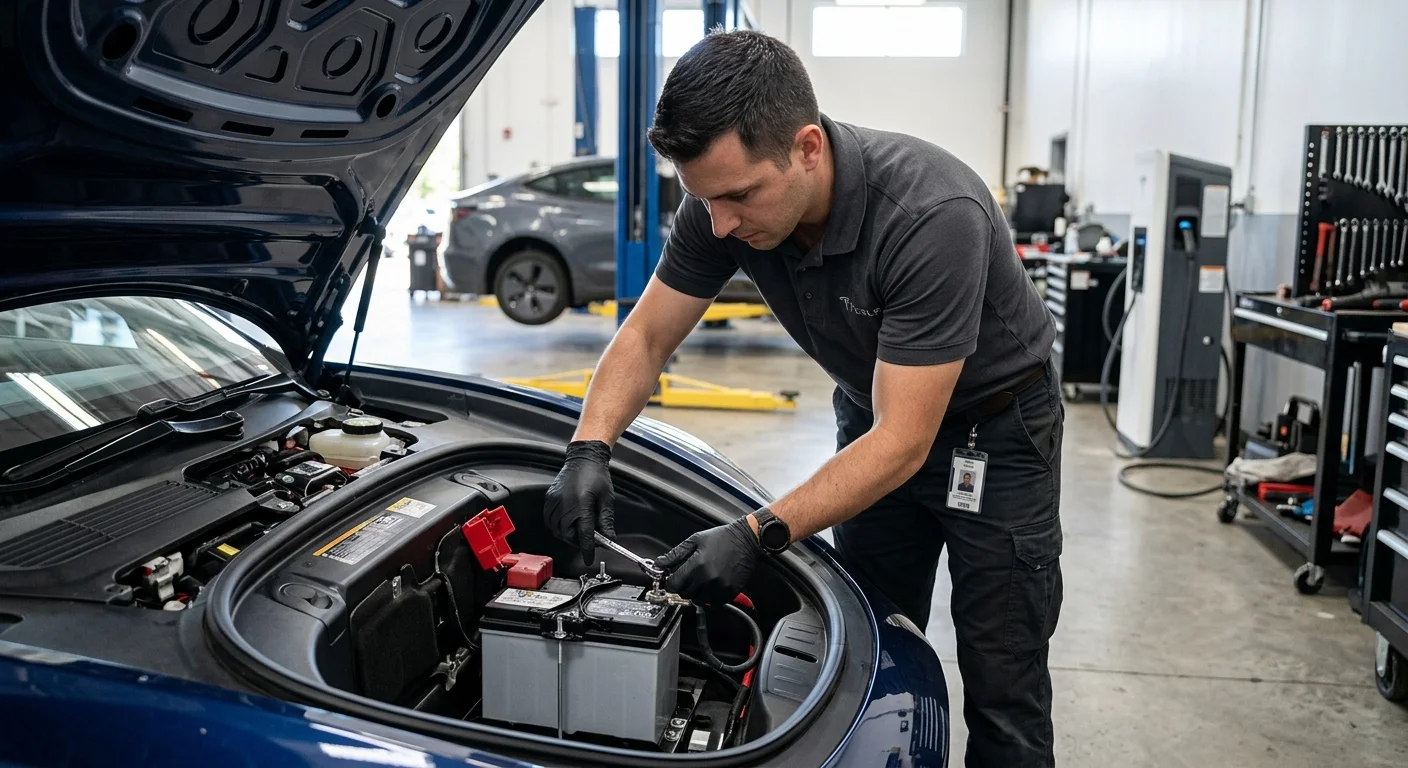
Hyundai placed this battery in the engine bay, driver’s side, toward the rear of the compartment. It’s a standard 12V AGM, about the size of a compact gas-car battery. That’s easier to reach than a pack under the cargo floor. The bay is still tight. Gloves and eye protection are worth putting on before you lean in.
Confirm the tray, the strap, and the caps in your owner’s manual. Year to year, covers move a little. The positive post usually wears a red cap. Negative is often bare or under a black cover.
If the 12V is fully dead, the interior hood release may not fire. Hyundai documents an emergency hood path in the manual. Use that page for your year. Don’t pry the latch from memory in a dark lot.
What to try before you call
Start with the fob, held close to the handle. Try the physical key if your fob hides one. Watch for any interior light. A totally dark cabin points at 12V. A lit dash with no drive points at the pack.
Don’t keep pressing Start/Stop. A flat 12V won’t wake because you asked again. You’ll only flatten it more.
If you own a portable 12-volt jump pack made for cars, you can try the jump yourself. If you don’t, stop. Apartment aisles are tight. Long cables across a neighbor’s bumper are a bad setup. A local operator can work in that stall with a compact pack.
Charge Pro OC is a referral line. We match stranded EV drivers with independent mobile rescue operators. We don’t own trucks, and we don’t do the work. The operator quotes you before anything starts and bills you directly. For a Kona, non-Tesla EV rescue is the service page to keep handy. The same operators can jump a 12V or bring a 240-volt Level 2 source with a CCS or J1772 adapter.
Jumping the Kona at the curb
The Kona uses dedicated jump points under the hood. Don’t clamp casually on the battery posts if the manual points you to the fuse box. That dedicated positive terminal is safer, and it’s easy to miss.
On many years the positive jump point sits on the fuse box cover, driver’s side, under a red cap. Negative belongs on a clean, unpainted chassis ground. A bolt on the shock tower is a common choice. Skip rusty paint. Skip the battery’s negative post if the manual wants a chassis ground instead.
Don’t use a second EV as the donor. These cars aren’t built to source jump current that way. You can throw faults in the other car. Use a pack, or a gas vehicle with ordinary cables. The full safety sequence lives in how to jump start an electric car without making it worse.
Connect positive to the Kona’s positive jump point first. Then complete the ground on the chassis. Let the pack feed the system for a short sit. Press Start/Stop with your foot on the brake. Ready should come up if the 12V was the only fault.
Once it wakes, don’t shut it down in the lot to test it. Get a Level 2 session as soon as you can. Charging the high-voltage pack lets the car support the 12V again. If the 12V dies the next morning, the battery is likely finished. A jump is a bridge, not a repair. Follow that with your EV 12V replacement guide.
We couldn’t confirm a Hyundai factory interval for this 12V. Don’t guess a year count off a forum. Ask the selling dealer, or read the schedule printed for your model year.
Battery Save, once the screen works
From the 2019 model year, many Kona Electrics include a 12V Battery Save setting. You won’t see it on a black cluster. The feature needs a living display.
Look under Settings, then Vehicle, then Charge Settings. Wording shifts by year and trim. When it’s on, the car can pull a little energy from the traction pack. That current keeps the 12V above a cutoff.
It’s a net, not a new battery. If you lean on it every week, the AGM is aging out. Replace the 12V. Don’t treat Save as a substitute. After a roadside jump, turn it on for the drive to a charger if the menu is available.
We couldn’t confirm a specific Hyundai software campaign that causes overnight drain. If your 12V failed right after an update, tell the dealer. Bring the date and the update name from the cluster. They can check Hyundai’s own bulletins. Owner-forum stories aren’t a source we’ll print as fact.
Short Orange County hops, then a dead morning
A lot of Kona miles here are surface streets. Harbor Boulevard, Katella Avenue, and the SR-22 corridor are short-hop driving, not a long charge-and-cruise. The DC-DC converter does support the 12V while you drive. A weak battery still sags overnight when you park unplugged at the apartment.
That pattern shows up in Santa Ana lots after work. It shows up in Garden Grove after a grocery run that never needed the freeway. It also shows up in Anaheim after a long theme-park day, when the car sat for hours with electronics awake. Restore 12V first. Charge the pack only if range is actually gone.
If you do get moving and the gauge is empty, stay with the car. Don’t nose onto a freeway shoulder to get closer to a stall. A Level 2 truck at the curb adds 10 to 20 miles of range in 15 to 30 minutes of charging. That’s charge time on the truck, never an arrival time. Countywide, federal station data shows 175 non-Tesla DC fast stations and 591 non-Tesla DC fast ports. Electrify America at Fashion Island, 401 Newport Center Dr, has 8 DC fast ports. Use that if you’re already on the coast and the car will move. EVgo at Plaza Antonio, 22351 Antonio Pkwy in Rancho Santa Margarita, has 14 DC fast ports. None of those help until the 12V wakes the car.
If Ready never comes back
Stop after a proper jump attempt fails. A 12V that won’t take current can look like a blown fuse. A module that won’t talk can look the same from the driver’s seat. None of those are a parking-aisle DIY.
The operator can jump or replace a dead 12V on site. They can also charge the pack if that was the real problem. If high voltage still won’t enable, the car needs a Hyundai shop, not another jump. Don’t let a random hook drag it without EV tow procedure. The Kona wants a flatbed or the right dollies. Charging or jumping on site is the first try when it’s safe to stay put.
Frequently asked questions
How can I tell the 12V died on my Kona Electric?
A black dash and a dead fob almost always mean the 12V. An empty pack still shows warnings. The charge door often still works when range is the issue. When the 12V is gone, that door can stay shut.
Can I jump a Kona Electric in an apartment lot?
Yes, if you can open the hood and reach the jump points. Use a 12-volt pack, not another EV. In a tight stall, an operator with a compact pack is the cleaner move. They work at the car, not from a neighboring space.
What does 12V Battery Save actually do?
It lets the traction pack support a sagging 12V. You need a working screen to turn it on. It won’t revive a battery that’s already fully dead. Replace the 12V if you keep needing that setting.
If the Kona is still dark in the lot, call Charge Pro OC at (949) 444-0151. We’ll connect you with a local operator who can jump the 12V or charge the pack on site. They quote before they start.