A search for EV charger installation in Orange County means a wall unit at home. That’s the right long-term setup when you own the stall. The panel still has to take a 240-volt circuit. In HOA garages and older Central OC apartments, that install often never clears. The board, the landlord, or the shared panel blocks it. When the plug you already have fails overnight, the car sits empty. The electrician isn’t the first call in that hour. We connect you with a mobile rescue operator. That operator charges the car where it sits. The electrician still owns the wall repair. Rescue just gets you out of the stall.
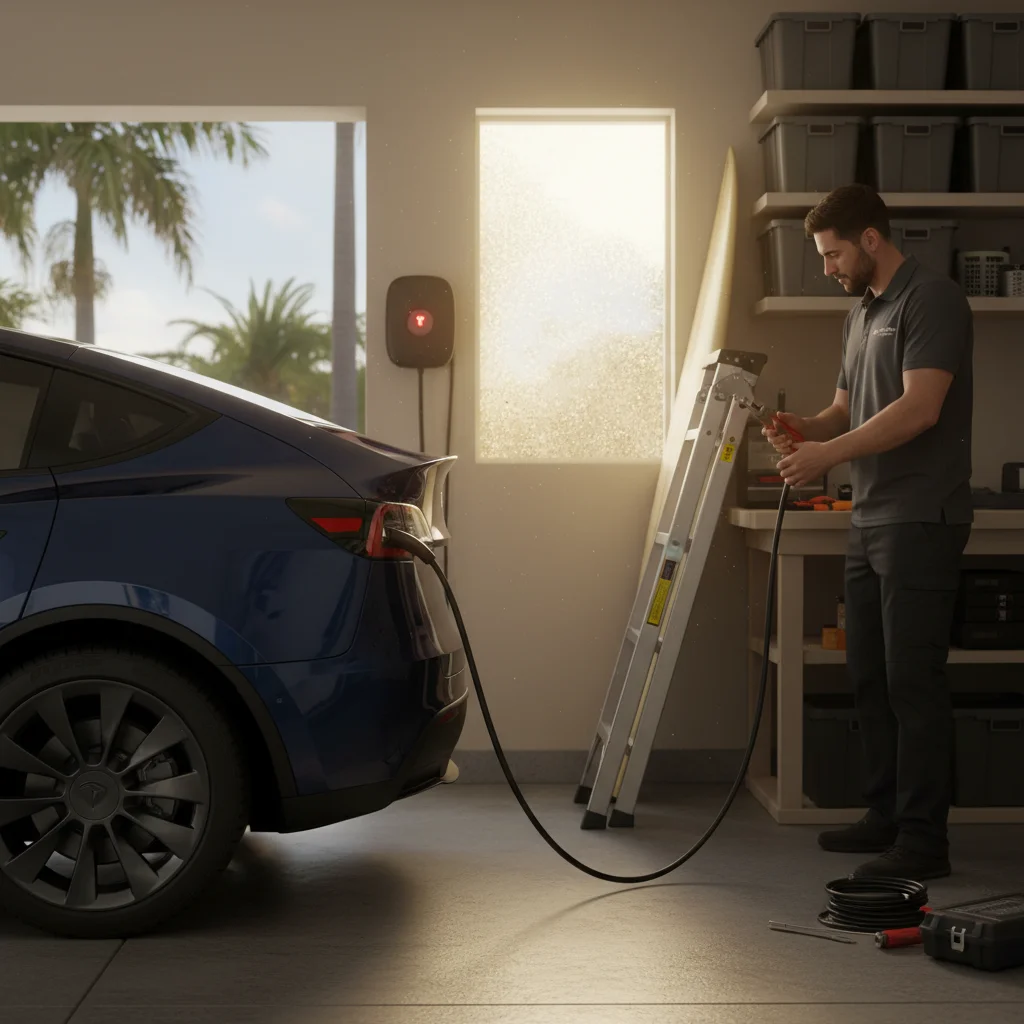
Why a paper-easy install stalls in Central OC
Santa Ana, Garden Grove, and Westminster still have a lot of shared garages. Older blocks of Orange do too. Those buildings weren’t laid out for a 240-volt circuit in every stall. Many apartments share one garage and one panel. The space you rent is a parking assignment. You don’t control that wall. Tustin, Fountain Valley, and Villa Park HOAs may treat a wall charger as an alteration. Charge Pro OC couldn’t confirm a countywide HOA rule. It also couldn’t confirm a city ordinance number or a standard apartment-panel spec. Your CC&Rs, your landlord, and that city’s building department are who set it. Get the written answer before you order a Wall Connector.
South County has the same HOA fight in newer buildings. Irvine home batteries, HOA garages, and when you still need a charge covers that version. Central OC’s version is the older garage. One panel, many cars, and no assigned 240-volt feed.
The California Energy Commission counted Orange County’s battery-electric fleet at 210,842. That figure is as of December 31, 2025. ZEVs totaled 260,833, or 10.56 percent of the county’s light-duty fleet. Battery-electrics alone were 8.54 percent. Orange County held 12.02 percent of California’s battery-electric cars. It made up 8.33 percent of the state’s light-duty fleet. Most of those cars are supposed to refill at home. When the stall can’t take a charger, that shows up at dawn. When the charger that’s there goes dark, it shows up the same way.
Who installs the wall, and who we are
Charge Pro OC is a referral line. We match stranded EV drivers with independent local operators. The operators we connect you with are licensed and insured. We don’t pull permits, run conduit, or hold an electrical license. We don’t own trucks, and we don’t employ technicians. The operators in the network bring a 240-volt Level 2 source to the car. They quote before they start and bill you directly. They don’t replace your wall unit.
A Level 2 install is building electrical work. Confirm the person you hire is allowed to do that work in your city. Check their license on the California Contractors State License Board site. We couldn’t confirm a required license class for every Orange County city. We also couldn’t confirm a permit fee or a standard labor-warranty term. Santa Ana runs its own building department. So do Garden Grove, Orange, Tustin, Westminster, and Fountain Valley. Ask the contractor which desk pulls the permit. Then verify it with that desk. Confirm which department covers your address. This page couldn’t confirm a single permit desk for every Orange County parcel.
Don’t treat a handyman quote as the same job. This page won’t invent a fire-code citation or an insurance clause. Ask your insurer what a permitted circuit means for coverage. Ask the city what inspection they want.
If the holdup is panel capacity, start here. Read panel upgrade for a home charger, or roadside help tonight. That’s the construction path, and rescue is the overnight problem.
What to get in writing before anyone opens the panel
Vet the installer the way you’d vet any contractor who touches the house.
License, permit, and the city that inspects
Ask for the license number and verify it on the CSLB site. Ask which building department inspects. Ask whose name is on the permit. If they can’t name the city, pause. Garden Grove’s desk isn’t Santa Ana’s. Orange’s desk isn’t Tustin’s.
The stall you don’t own
In a Central OC apartment, the garage wall may be common area. In an HOA, the board may want an application packet. We have no verified roster of associations that allow a wall connector. Your property manager and your CC&Rs are the documents that matter. A casual yes from a manager isn’t approval.
Your charger model and the circuit plan
Tesla Wall Connectors and ChargePoint Home Flex units aren’t identical. Other Level 2 brands differ in small ways that matter on install day. Ask whether they’ve hung your model. Ask the breaker size they plan to use. Ask whether the quote is fixed. Ask whether it changes if the panel is short. No verified install price turned up in the research for this page. Don’t guess from a forum. The contractor sets the number. You should see it itemized. That list should include labor, wire, breaker, permit, and any panel work.
Who warrants the labor
The factory warrants the charger. The electrician warrants the work only if that’s in the contract. We couldn’t confirm a standard labor-warranty length in Orange County. Ask for the term in writing.
What actually failed while you slept
You plugged in after dinner in a Garden Grove garage. Or you plugged in at a Santa Ana carport. The app should’ve shown a high state of charge. It shows a sliver instead.
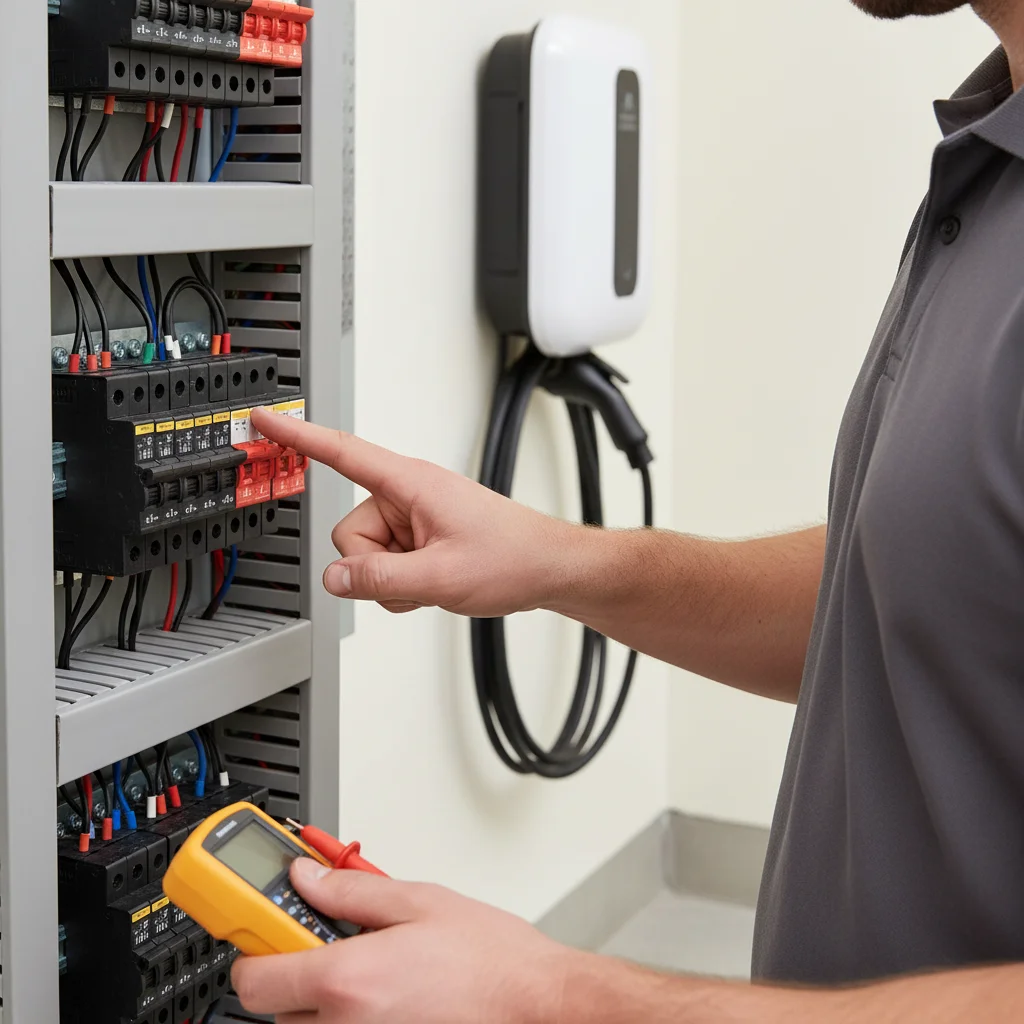
Work the simple checks first.
A tripped breaker is the usual culprit. A Level 2 session is a long, steady draw. Older apartment panels were sized for laundry and lights. One reset can restore the session. A breaker that trips again needs an electrician, not a third try. Why your home EV charger keeps tripping the breaker covers that loop.
GFCI protection in garages can nuisance-trip on EVSE electronics. That’s a safety device, so don’t bypass it. If it popped, stop and have the circuit checked.
The charger has indicator lights. Solid green usually means the session is healthy. Blinking red or amber means a fault. The manual maps the blink pattern. Overheating, a failed board, or a wiring problem all look the same before coffee.
Sometimes the wall unit is fine. The car refused the handshake. The onboard charger can cut off when it dislikes the power quality. That looks like a dead plug. Plugged in all night and still empty splits wall faults from car faults.
Cables and connectors take the wear. Bent pins, a tired latch, or a heat-cycled handle can kill a session. The box on the wall may still be fine.
None of those checks put miles in the pack. The electrician’s next open slot may not be this morning. School drop-off in Orange still happens on the original clock. So does an office run toward SR-22. A Tustin workplace stall doesn’t help if you woke up empty at home.
When the wall is dead and the car has to roll
Orange County had 7,095 public charging ports as of December 31, 2025, per the CEC. That’s 36.8 ZEVs per public port. Statewide the ratio is 24.4. Shared-private ports add another 4,685 in the county file. Public Level 2 accounted for 5,600 of those public ports. Public DC fast accounted for 1,475. Those ratios are why a dead home plug hits harder here. They still don’t put range in your car.
If you still have enough miles to drive, named Central OC Superchargers are real. Santa Ana has 28 stalls at 1008 17th St. That AFDC record lists 325 kW. Santa Ana also has 20 stalls at 300 E 5th St. That second site lists 75 kW, so it’s the slower of the two. Garden Grove has 32 stalls at 12891 Harbor Blvd. It also has 16 stalls at 12161 Valley View St. Tustin has several sites, including 36 stalls at 14661 Franklin Ave. Fountain Valley has 16 stalls at 17940 Newhope St. It has 12 more at 9430 Warner Ave. Westminster Mall has 24 stalls at 1025 Westminster Mall. The AFDC record on that mall site lists 75 kW. That’s a slower fill than the 250 kW and 325 kW sites nearby. Confirm live availability in the Tesla app. Don’t spend the last miles hunting a stall that’s taken.
If the pack is too low to reach those lots, don’t start with a tow. A hook to a Supercharger still leaves you waiting in someone else’s stall. Mobile EV charging refers an independent operator to you. They come to the garage or curb where you’re already parked. The operator brings a 240-volt Level 2 source. That’s a native NACS plug for Teslas. CCS or J1772 adapters cover non-Tesla EVs. Typical charging time is 15 to 30 minutes. That session usually adds about 10 to 20 miles of range. That’s session time, not a clock on arrival. The operator quotes before starting and bills you directly.
That’s the same idea as EV roadside assistance when you’re empty at home. You’re empty at home instead of on the freeway. Tesla’s published path for a depleted pack is transportation, not a driveway charge. Confirm the current wording on Tesla’s roadside-assistance page before you assume any coverage. Running out of charge isn’t the warrantable-breakdown transport Tesla describes as covered.
Teslas were 138,121 of Orange County’s 210,842 battery-electric vehicles as of December 31, 2025. That’s 65.51 percent of the county’s BEV fleet. Non-Tesla drivers in the same Santa Ana and Westminster buildings still need CCS or J1772. Operators in this network handle both.
The stretch between a dead plug and a working wall
An HOA vote doesn’t resolve before breakfast. Neither does a landlord’s vendor or a city inspection. This page won’t guess the wait. While the wall is down, you still need range. Public DC fast helps if you can reach it. If you can’t, some drivers use a mobile Level 2 top-up at the curb. Each visit is a fresh quote. We don’t sell a package and we don’t set the price. See the mobile EV charging quote guide for the pieces. It doesn’t invent a figure.
Keep the installer search if your stall and your panel can take the work. A permitted Level 2 at home is still the goal. We won’t run that job. If the plug has already failed, call (949) 444-0151. Use that number when the car won’t make the next trip. That line refers you to a local operator. It doesn’t install a charger. It doesn’t promise an arrival time.