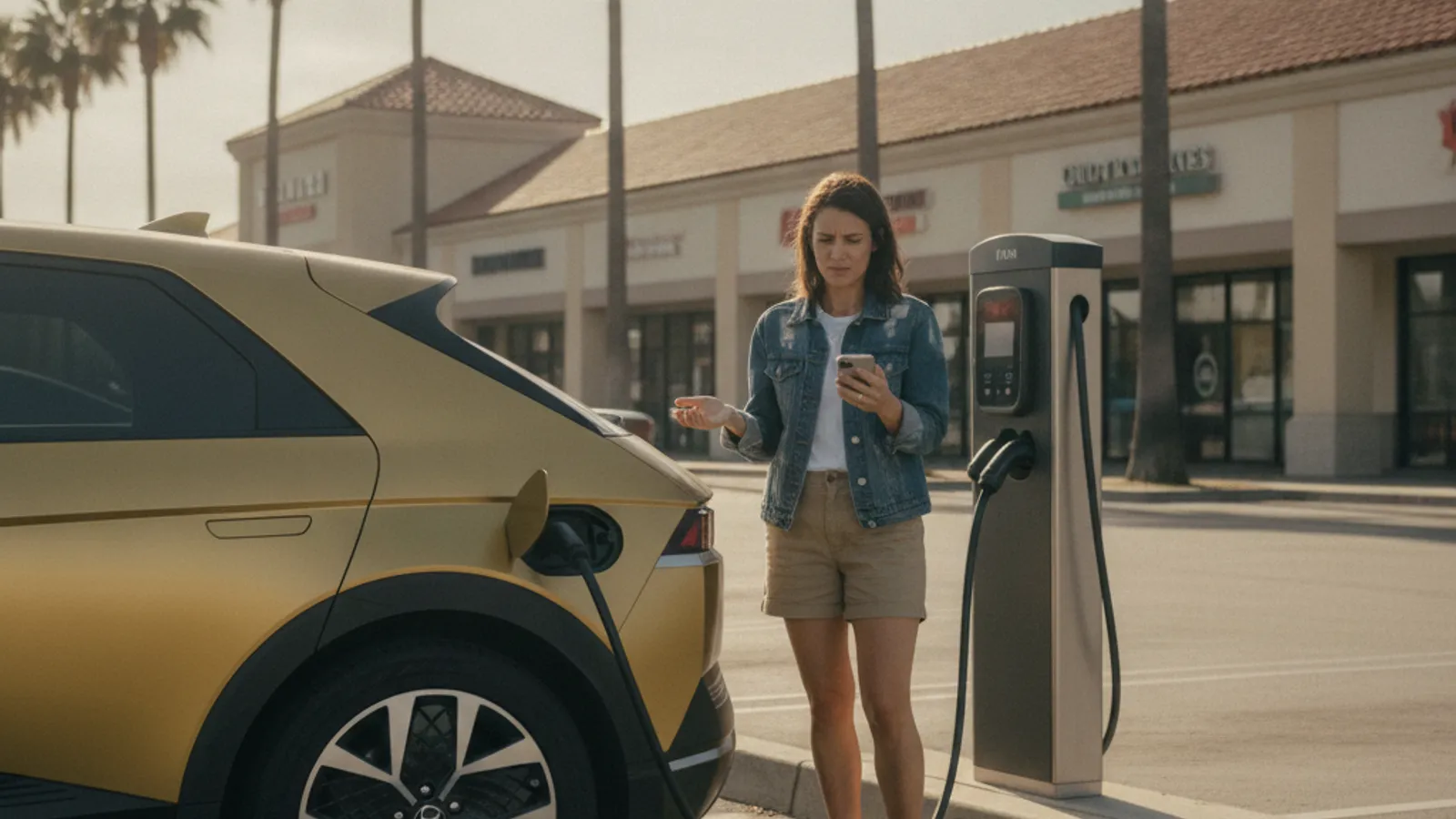
Your EV charger keeps tripping the breaker because the circuit can’t hold Level 2. In older Orange County apartments, that’s wiring, not a car that needs a tow. A trip every session is the circuit talking. It isn’t a glitch in the car.
Older apartments, shared circuits, and a load that never cycles
Orange County had 210,842 battery-electric vehicles on the road as of December 31, 2025. The California Energy Commission puts that at 8.54% of the light-duty fleet. ZEVs as a group are 10.56% here, against California’s 7.54%. This county holds 12.02% of the state’s battery-electric cars. That’s on 8.33% of the state’s light-duty fleet. Home charging is the nightly plan for a lot of those drivers.
Public ports don’t erase a dead apartment circuit. At year-end 2025, Orange County had 7,095 public ports. That’s 36.8 ZEVs per public port. The statewide ratio was 24.4. If the garage breaker opens, you’re not imagining a squeeze.
Tesla accounts for 65.51% of the county’s battery-electric fleet. A Wall Connector and a mobile cable both ask the same thing of the branch circuit. They want a long, steady draw. A dryer cycles off, and Level 2 doesn’t. Picture a carport in Santa Ana, Garden Grove, or Fullerton. The receptacle may share a run with a washer, a freezer, or a shop vac. Combined load trips a breaker that always worked for tools. An Irvine garage is a different building, with a different panel and a different set of rules. Don’t copy a neighbor’s setup. Have an electrician read yours. Orange County isn’t one housing stock. The charger didn’t change, but the circuit did.
The lasting fix is a dedicated circuit sized for the charger’s amperage. A licensed electrician does that work. Charge Pro OC doesn’t. We’re a referral line. We match stranded EV drivers with independent local operators. Those operators charge the car. They don’t rewire the building.
Read the trip before you call a tow
Write down when the handle flipped.
A trip at the moment you plug in points to a ground fault, moisture, or a bad EVSE. A trip after ten to thirty minutes of charging points to an undersized or overloaded circuit. A trip only when something else is running is a shared circuit. A trip after rain or sprinklers is moisture until proven otherwise.
One reset is a test. A second reset is a habit. Don’t keep flipping the same breaker. Don’t open the panel to inspect wiring. The breaker is doing its job.
Two ground-fault devices can fight each other
Most Level 2 EVSE units already watch for a ground fault. Some plug-in outlets add an external GFCI on the same circuit. The EVSE sends a small test current to confirm an earth path. That tiny current can look like a fault to the other device. Nothing has to be wet or broken. The two systems are arguing.
Electricians often hardwire the station instead of using a plug-in GFCI receptacle. That’s their call after they see the panel. Orange County and the cities in this metro didn’t publish a verified homeowner amperage rule. They also didn’t publish a GFCI rule in the sources behind this page. Don’t guess a number. Ask the electrician who’s standing at the panel.
Water in the outlet is a real trip, not a mood
Moisture inside a NEMA 14-50, or at the cable’s plug, can trip a GFCI as a genuine fault. Uncovered outdoor outlets collect rain and sprinkler spray. Dry the receptacle and the connector, then try once. If it trips again, stop. This isn’t a tow. It’s an outlet.
When the EVSE is the weak link
Less often, the charger itself is at fault. A portable cable or a wall unit can fail internally and dump the breaker under load. If a different EVSE holds on the same outlet, the equipment is the suspect. If the same cable holds on a different outlet, look back at the original circuit.
Get range while the circuit waits on an electrician
Electrical work follows the electrician, the landlord, and sometimes an HOA. That’s not a reason to hook the car. Operators we connect you with bring a 240-volt Level 2 source to the bumper. Typical charging time adds 10 to 20 miles in 15 to 30 minutes. That’s charging time, never an arrival time. They quote you before they start. They bill you directly.
They carry a native NACS plug, plus CCS or J1772 adapters for non-Tesla EVs. They handle Tesla and every major EV brand. They can also jump or replace a dead 12-volt battery on site. A tripping breaker is usually not the 12-volt. Don’t treat it like one.
If you need the car charged while the circuit is down, start with mobile EV charging. Apartment plugs fail in Irvine too. Use EV roadside assistance in Irvine when the apartment charger is taken. In the central city, use EV roadside assistance in Santa Ana. For the wider map, see the Orange County EV charging hub.
A bigger electrical project is a separate conversation. Panel upgrade for a home charger, or roadside help tonight walks that split. So does home charger install vs mobile rescue. If the car sat on a dead circuit all night, read plugged in all night and still empty. Charge Pro OC doesn’t install home chargers. We don’t repair them. Call (949) 444-0151 when you need a mobile charge at the car.
Frequently asked questions
Is it safe to keep resetting a breaker that trips on Level 2?
No. The breaker is opening to protect the circuit. One reset to confirm the pattern is enough. If it trips again, stop and call a licensed electrician. Repeated resets can hide a fault that gets worse.
Can a bad charging cable trip the breaker by itself?
Yes. An internal fault in the EVSE or the portable cable can dump the breaker every session. Try a different charger or a different outlet once. That split tells you whether it’s equipment or wiring.
Does Charge Pro OC install or repair home EV chargers?
No. Charge Pro OC is a referral line. We match stranded drivers with independent mobile operators. We don’t wire panels, pull permits, or install circuits. A licensed electrician owns the breaker problem. A mobile operator can add range at the curb while that work gets scheduled.