The screens came back after the first jump. Then they went dark in the driveway. In Orange County, a battery dying after jump start points past the 12-volt. Treat that second blackout as new evidence, not a cue to guess again.
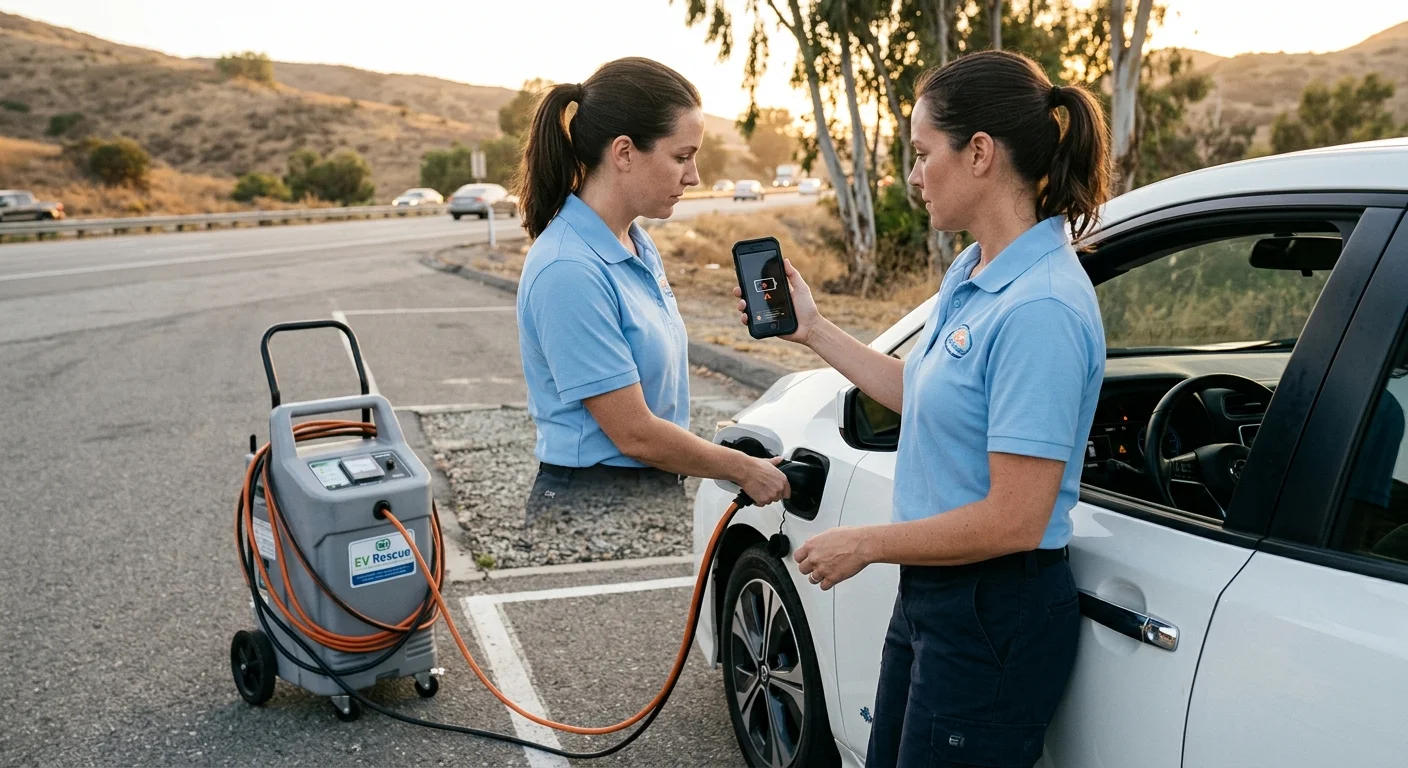
The second blackout changes the job
A jump that restores lights only proves the car can wake for a moment. It doesn’t prove the original fault is gone. When power drops again, the 12-volt wasn’t holding the system on its own.
Orange County is a dense EV county, not a novelty market. The California Energy Commission counted 210,842 battery-electric vehicles in the county. That’s the on-the-road figure as of December 31, 2025. Teslas were 138,121 of those BEVs, 65.51% of the county’s battery-electric fleet. About two in three electric cars in local driveways are Teslas. Repeat 12-volt failures show up often in that mix. They also show up in Hyundai, Ford, Rivian, and Chevy EVs nearby. Don’t call it a dead battery when you ask for help. That phrase hides which system actually quit.
Separate a 12-volt sag from an empty pack
Tesla’s Model Y owner’s manual covers this split. The Running Out of Range notes describe what follows an empty pack. Once range is exhausted, the low-voltage battery can lose support. The car then needs an external power supply before the high-voltage pack can charge. A jump that lights the cabin doesn’t prove the pack has energy. It also doesn’t prove the 12-volt can keep voltage on its own.
Hold both possibilities open after that fade. The 12-volt may be unable to hold a charge. The pack may actually be empty, and the low-voltage system followed it down. A converter or charging fault can starve the 12-volt after a brief recovery. None of that is confirmed from the curb. Don’t pick a diagnosis in the driveway. Your owner’s manual and a qualified tech can name the fault. The driveway is for notes, not a verdict.
How to tell a dead Tesla pack from a 12-volt failure walks through that split. Pair that with what happens when the 12-volt dies on the road. Neither page replaces your model’s owner documentation.
Copy the exact warning text from the car. Use the dashboard, the center screen, the app, or a key alert. Look for 12V, low voltage, propulsion, or charging language. Leave that wording alone when you call. Don’t turn that wording into a theory.
Keep a field log, not a story
Write while the details are still in front of you. An operator can use a short log. Start with make, model, and model year. Add the street, the city, and how someone reaches the bumper. Then add only what you actually saw.
- What the car was doing right before the first blackout
- The exact warning text, in order if several appeared
- Who did the first jump, and whether they followed the official procedure
- Which functions returned: locks, screens, shifting, app, charge door
- Whether the car moved, stayed parked, or tried to plug in
- What happened in the minutes before power failed again
Photograph the full display when it’s safe. Don’t crop the photo to one banner. If warnings cycle, capture each one in order. A screenshot from the official app helps when the dash is already dark. Don’t clear messages to make the screen look tidy. Keep the warnings that are already there.
If someone else did the first jump, ask what they used. Hold replacement talk until someone has assessed the car. Our EV 12V replacement guide is for that later conversation. Model year, warning history, and present behavior should lead that talk. A second blackout isn’t, by itself, a confirmed need for a new 12-volt.
A second jump isn’t the default next step
Check the official jump procedure for your exact model year first. Do that before anyone connects cables again. Connection points, access panels, and allowed equipment vary by car. This page doesn’t give repeat-jump steps for a reason. Those weren’t confirmed here for every EV in the county.
If the manual says to stop, stop. If you can’t confirm the procedure, don’t improvise. Trial and error around a high-voltage vehicle is the wrong move.
Tell the next professional that power already returned once and failed again. Hand them the timeline and the photos. Ask whether they support your model and this low-voltage pattern. Get that answer before any work starts.
Read how to jump start an electric car on site for first-attempt context. Use it as context, not as a script to run again in the driveway.
If you see smoke, heat, or damaged cables, step away. Call emergency services from a safe distance. Don’t ask a bystander to keep experimenting.
Where the car sits changes the handoff
Orange County isn’t a usable address by itself. An operator needs the street, the gate, the garage level, or the nearest cross street.
A private driveway in Yorba Linda often means a grade and a tight approach. North Tustin hillside streets are the same kind of pin. Say how a truck reaches the bumper.
A parking structure in Costa Mesa needs the entrance and the floor. Long stays on Lincoln or Katella in Anaheim hide the car in a full row. Name a landmark and the nearest cross street.
Fashion Island in Newport Beach is a named lot with public DC fast charging. If you parked there, give the structure and the level. Huntington Beach lots along Warner aren’t Fountain Valley lots on Warner. Name the nearest cross street so nobody circles the wrong Warner.
CEC counted 7,095 public charging ports in Orange County. That’s the snapshot as of December 31, 2025. The ratio is 36.8 ZEVs per public port, against 24.4 statewide. Large Tesla sites exist, including 1920 Main St. in Irvine. San Clemente has 49 stalls at 101 W. Avenida Vista Hermosa. If the car already died twice, those stalls aren’t the next move. Stay with the vehicle and describe the spot.
Coto de Caza and Ladera Ranch need a clear meeting point. Give the meeting point before anyone rolls out. After a second failure, don’t assume the car can drive to a Supercharger.
Roadside help or a service visit
Pick based on what you need right now, not on a guessed fault. Roadside help fits when the car can’t shift, unlock, or move. Ask whether the operator handles your exact model. Ask about a repeat 12-volt failure, and on-site charging if the pack is empty.
Charge Pro OC is a referral line, not a repair shop. We match stranded drivers with independent local operators. Those operators bring a 240V Level 2 source to the car. They use a native NACS plug, plus CCS or J1772 adapters for non-Tesla EVs. They typically add 10 to 20 miles of range. That takes 15 to 30 minutes of charging. That’s charging time, never an arrival time. They can also jump or replace a dead 12-volt on site. They quote you before they start, and they bill you directly.
For that path, start with EV roadside assistance. Tesla owners can review Tesla 12V battery jump help. Other brands can use non-Tesla EV rescue for that match.
A service center fits when you need diagnosis, testing, or a repair. Tesla service addresses in this county weren’t independently verified here. Confirm the nearest site on Tesla’s findus locator.
Tesla’s roadside number, as published on its Santa Ana service page, is 877-798-3752. That roadside policy page wasn’t fetched live on September 5, 2026. Open Tesla’s current policy in a browser before you assume coverage.
Sometimes you need both paths in one day. An operator may get the car movable. A service visit then handles the fault that killed it the second time. If transport comes up, follow the manufacturer’s tow instructions for your model.
The U.S. Department of Energy publishes a general electric vehicle overview. It won’t diagnose a post-jump failure on your driveway.
Before you approve work, ask who will do it and what they’re proposing. You contract with the independent operator, not with this referral line. You pay that person directly for the work.
When the driveway stays quiet
If the 12-volt dies again and the car stays dark, call for a match. Share the model, year, exact warnings, street, and what followed the first jump. Charge Pro OC will connect you with a local operator. Call (949) 444-0151 when you’re ready for that match.