Tesla vs Rivian roadside assistance in Orange County is not a tie. Tesla is 65.51% of the county’s battery-electric fleet. Rivian and Lucid owners still stall on a Tesla-shaped map. Tesla’s published empty-pack rules are the local baseline. The other two brands have to live with that.
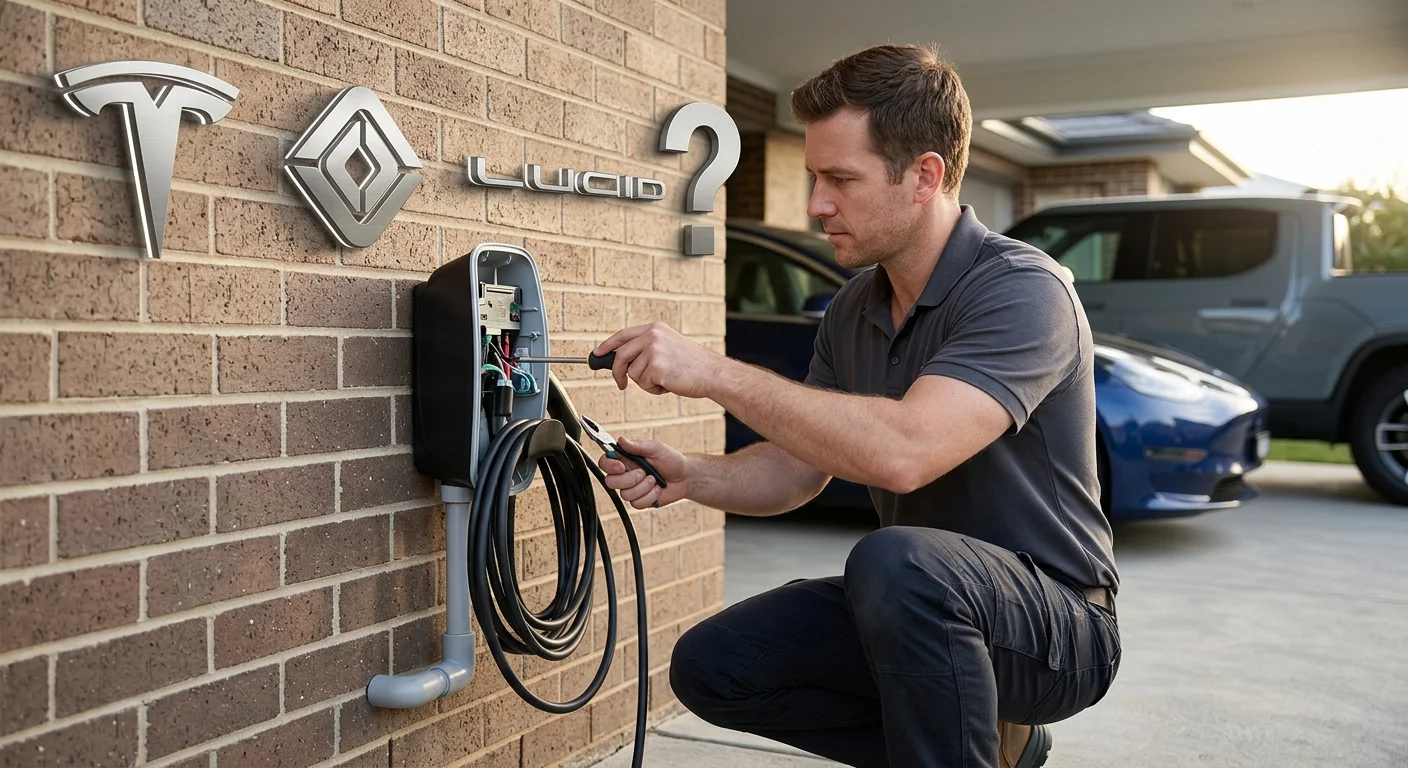
Tesla’s 65.51% share sets the local baseline
Orange County had 210,842 battery-electric vehicles on December 31, 2025. The California Energy Commission vehicle population file is the source. Tesla accounted for 138,121 of those BEVs. That’s 65.51% of the county’s battery-electric fleet. It’s 5.59% of all Orange County light-duty vehicles in that same CEC universe.
California’s Tesla share of BEVs is 61.34%. Orange County runs 6.4 points more Tesla-heavy than the state. The county holds 12.02% of California’s battery-electric vehicles. It’s only 8.33% of the state’s light-duty fleet. ZEVs are 10.56% of Orange County’s light-duty mix. BEVs alone are 8.54% of that mix. The state’s ZEV share of light-duty stock is 7.54%.
That mix is why a Tesla roadside rule becomes everyone’s weather. Dispatchers, tow contracts, and Supercharger queues all form around the majority car. A Rivian R1S on an Orange County freeway still sits in that weather. So does a Lucid Air in a Tustin lot.
New sales tell a milder Tesla story. Tesla took 56.9% of Orange County new ZEV sales in 2023. The share was 47.2% in 2024 and 44.7% in 2025. The first half of 2026 came back at 56.4%. Rivian and Lucid live in that leftover slice. They’re on the sale sheet. They’re not close to Tesla’s parked fleet.
Orange County still buys ZEVs at a higher clip than California. In 2026 Q2, ZEVs were 24.77% of new light-duty sales here. The state figure was 19.09%. The county has run about 5 to 6 points above California on that measure. The trend isn’t a straight climb. California’s ZEV share of new sales peaked at 25.31% in 2024. 2026 Q1 was the weakest quarter in that series at 15.76%. The CEC also changed its new-sale method in 2023 and again in 2025. Don’t treat those year jumps as a clean acceleration.
The registered pack is what roadside programs actually meet. 138,121 Teslas sit on local streets. Everything else, including Rivian and Lucid, shares the rest.
What Tesla publishes for an empty pack
Tesla’s roadside-assistance language, as search indexed it in 2026, splits two jobs. A depleted pack is one job. A warrantable breakdown is the other.
When the battery is empty and you can’t reach a stall, Tesla can assist. It also says that help isn’t a financially covered service. Confirm the live sentence on Tesla’s roadside-assistance page. The research fetch of tesla.com returned 403. Re-read the live page in a browser before you argue with a dispatcher.
Warrantable breakdowns get a different sentence. Tesla describes transportation of up to 500 miles to the nearest Service Center. That transport is for a warrantable breakdown that leaves the car undrivable. An empty pack is called out as outside that covered bucket. Tesla can still move the car. You should plan on paying for that move.
The clean comparison point is the method. Tesla’s own roadside policy answers a dead pack with transportation. It doesn’t answer it with charging at the bumper. Tesla’s roadside number, published on the Santa Ana service page, is 877-798-3752.
There’s a 12V hitch after the pack hits zero. Tesla’s Model Y owner’s manual describes the low-voltage battery losing support once range is exhausted. The car may need an external power supply before the high-voltage pack will charge. A Supercharger tow can leave you dark if the 12V is already down.
Tesla roadside rescue in this network is a different method. Independent operators bring 240V Level 2 to the car. Teslas take a native NACS plug. It typically adds 10 to 20 miles of range. That’s 15 to 30 minutes of charging. That’s session time, never an arrival claim. What Tesla roadside treats as free tracks the warranty side of the same split.
The DC fast map those three brands actually share
AFDC counts public DC fast ports inside the county. That file shows 223 stations and 1,452 ports. Tesla occupies 48 Supercharger sites and 861 of those ports. That’s 59% of public DC fast ports in Orange County.
Remove Tesla and 175 stations remain, with 591 DC fast ports. ChargePoint has 71 stations and only 76 DC fast ports. That’s about 1.1 ports per site. Most of those are dealership and office singles, not a rescue net. Electrify America has 30 stations and 138 ports. EVgo has 30 stations and 131 ports. EVCS has 14 stations and 87 ports. Rivian Adventure has 2 stations and 22 ports. Shell Recharge shows 1 station and 14 ports.
Tesla Superchargers cluster where the fleet already is. Anaheim has Lincoln Avenue sites, Imperial Highway, Katella, Euclid, and Santa Ana Canyon Road. Irvine has Culver Drive, Main Street, Michelson Drive, Walnut Avenue, and Spectrum Center Drive. Santa Ana has 17th Street and 5th Street. Tustin has Red Hill Avenue, Franklin Avenue, Kensington Park Drive, and Flight Way. San Clemente’s 101 W Avenida Vista Hermosa site lists 49 stalls. That’s the largest Tesla stall count in the county.
A few Tesla sites need a careful kW read. Mission Viejo’s Shops site lists 10 stalls. Tesla lists that site at 72 kW. That’s the figure to use. AFDC power ratings aren’t always right. Lake Forest has a 16-stall site at 24372 Rockfield Blvd. AFDC lists it as Magic Dock, CCS1 plus NACS. Confirm in the Tesla app whether your Rivian or Lucid can use it. Don’t navigate on a guess.
Named non-Tesla DC sites matter more for Rivian and Lucid. Electrify America lists Dana Point Station at 25825 Las Vegas in Capistrano Beach. That site has 12 DC fast ports. That’s the largest non-Tesla DC site in south Orange County. Electrify America lists 10 ports at Walmart 2242, 440 N Euclid St in Anaheim. Fashion Island at 401 Newport Center Dr in Newport Beach has 8 Electrify America ports. EVgo lists 14 DC fast ports at Plaza Antonio, 22351 Antonio Pkwy in Rancho Santa Margarita. Ocean View Plaza in San Clemente has 10 EVgo DC ports. Westar Mercantile East in Ladera Ranch has 8. Seal Beach has 4 EVgo stalls at 801 Pacific Coast Hwy.
The county’s public plug count is 7,095 ports. That’s 20 public Level 1, 5,600 public Level 2, and 1,475 public DC fast. Orange County holds 7.75% of California’s public ports. Against 260,833 ZEVs, that’s 36.8 ZEVs per public port. Statewide it’s 24.4 ZEVs per public port. The Orange County charging hub is the map view. The ratio is why an empty curb is a normal problem here.
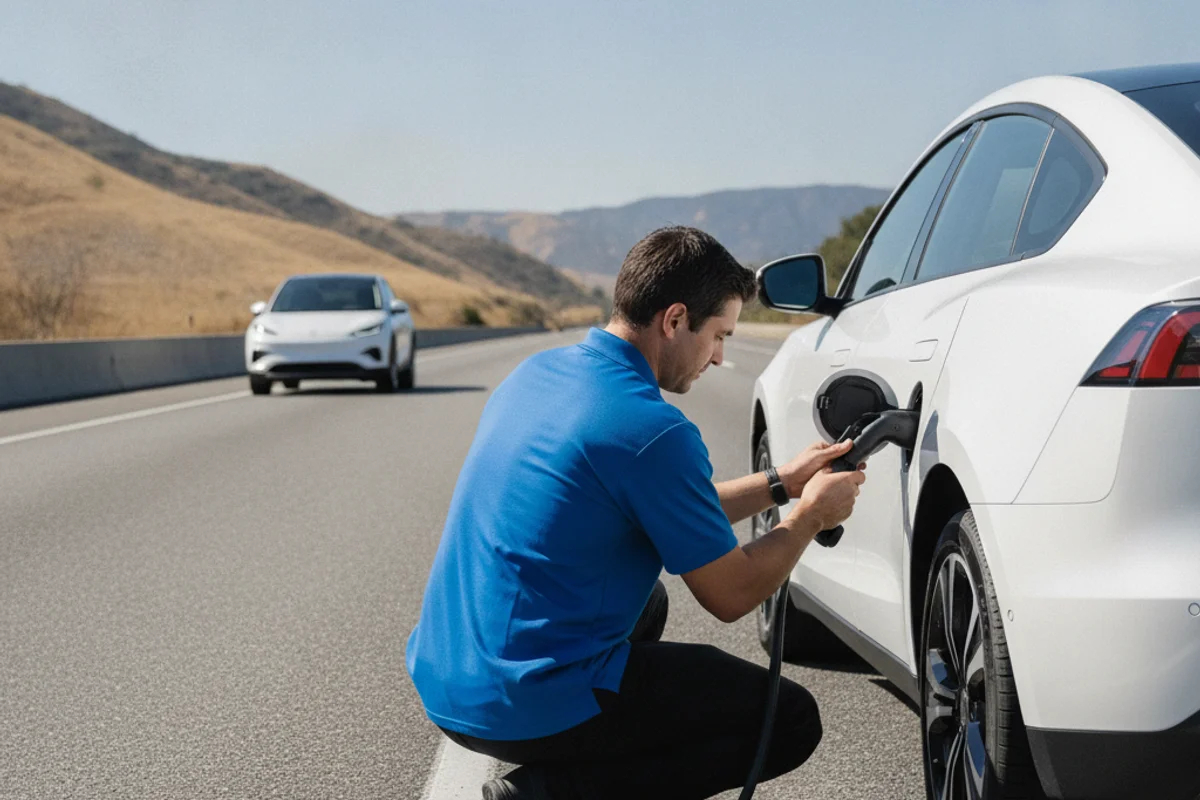
Rivian roadside in a Tesla county
Tesla vs Rivian roadside assistance looks even because both badges print a roadside promise. The local file doesn’t treat them as equals. Tesla’s empty-pack rule is the one we can cite from Tesla’s own language. Rivian’s covered list wasn’t confirmed from a page we could open. Mile caps and out-of-charge terms weren’t either. Rivian sets those terms. Read them in the Rivian app, the owner account, and Rivian’s current roadside materials.
Infrastructure is the part we can count. Rivian Adventure shows 2 public DC fast stations in Orange County and 22 ports. Tesla has 48 Supercharger sites. A Rivian that needs DC fast is mostly on EVgo, Electrify America, and EVCS. Tesla’s 861 Supercharger ports aren’t a Rivian net. They only count if the stall is open to that truck.
Tesla lists service centers in Costa Mesa, Buena Park, Santa Ana, Irvine, Anaheim, and Aliso Viejo. Confirm each address in Tesla’s finder. The street lines weren’t opened as live pages in this research. A Rivian service destination is Rivian’s to assign. We couldn’t verify a Rivian service-center address inside Orange County. Ask Rivian where a covered tow is allowed to stop.
If the R1T or R1S is empty, manufacturer help is often a tow to a charger. That pattern is common across EV brands. It isn’t the only pattern. Rivian Highway Assist versus a local operator is the longer fork. On-site, operators bring Level 2 with a CCS or J1772 adapter. That puts miles in where the truck already sits. Non-Tesla EV rescue is how Charge Pro OC refers that job. Charge Pro OC doesn’t own the truck. It matches you with an independent local operator. The operator quotes before starting. The operator bills you directly.
Lucid on the same Tesla-shaped roads
Lucid Air volume in Orange County is small next to Tesla’s 138,121 cars. A Lucid-specific registered count wasn’t in the CEC extract used here. Treat Lucid as part of the non-Tesla 34.49% of local BEVs. Don’t fill that blank with a made-up headcount.
Lucid’s warranty roadside terms weren’t confirmed from a primary page we could open. Coverage years, tow caps, and empty-pack rules have to come from Lucid. Check the owner portal, in-car help, or Lucid’s published roadside policy. If Lucid’s site doesn’t state it, we won’t either.
The map problem is the same one Rivian has. Superchargers hold 59% of public DC fast ports. A Lucid needs a CCS-capable stall or an adapter the car accepts. A mobile charge at the bumper is the other path. Fashion Island’s Electrify America is one named option. So is Dana Point Station. EVgo sites in Rancho Santa Margarita, San Clemente, Ladera Ranch, and Seal Beach are in the record too. Irvine’s Main Street Supercharger doesn’t automatically count as Lucid rescue. Neither does San Clemente’s 49-stall Tesla site. San Juan Capistrano has Tesla Superchargers on Verdugo St and Camino Capistrano. Those are Tesla ports unless your Lucid is allowed onto them.
A dead 12V on an Air looks like a total failure. Screens, locks, and ready all lean on that small battery. Whether Lucid jumps it on site wasn’t verified. What we can say is the field fix used here. Operators in this network jump or replace a dead 12V where the car sits. Lucid Air 12V checks cover the owner steps before anyone dispatches.
12V failures are a third comparison, not a footnote
A lot of Tesla, Rivian, and Lucid cars that won’t start aren’t empty packs. The 12V wakes the computers that close contactors. Newer Model 3 and Y cars use a lithium low-voltage pack for that job. If that battery is down, the traction pack can still hold range. The car just won’t go ready.
Tesla’s 12V-specific roadside wording couldn’t be confirmed. The support page blocked the research fetch. Open Tesla Roadside in a browser and ask whether they jump on site. Don’t treat a blocked page as a no.
Rivian R1T and R1S trucks use the same 12V logic. A weak 12V leaves a large EV looking like a brick. Lucid is the same physics in a sedan. You don’t need a brand myth for that. The computers need 12 volts. No 12 volts, no drive.
The operators we connect you with handle Tesla and every major EV brand on that job. They can jump the 12V at the curb. They can replace it when that’s the right call. They don’t need the car to roll to a service center first.
Warranty extras: tires, lockouts, and the PDF you should open
Manufacturer roadside is usually a bundle. Flat tires, lockouts, and mechanical tows often ride with the empty-pack clause. Tesla, Rivian, and Lucid each write that bundle differently. Tesla’s North American roadside policy PDF is the Tesla document to open. Rivian and Lucid publish their own lists.
We’re not printing warranty year counts or mile caps in this comparison. Those figures weren’t in the CEC or AFDC files. Tesla’s full policy PDF wasn’t fetched as a primary source for this post. If the car’s screen still shows a roadside window, trust the screen. Don’t trust a blog table.
The local destination is the part we can name for Tesla. A Tesla mechanical tow, when Tesla approves it, aims at a Service Center. Tesla lists Orange County service cities as Costa Mesa, Buena Park, Santa Ana, Irvine, Anaheim, and Aliso Viejo. Confirm the street address in Tesla’s finder before you follow a pin. A Rivian or Lucid mechanical tow aims at that brand’s approved shop. If that shop isn’t in the city you’re in, you’re on a flatbed. That’s not a curb fix.
Charge Pro OC isn’t a body shop. It’s not a service center. The referral is for range, 12V, and getting the car movable.
What a local operator brings that brand dispatch often skips
Charge Pro OC is a referral line. It matches stranded EV drivers with independent local mobile rescue operators. It performs no work. It owns no trucks. It employs no technicians. It sets no prices. It promises no arrival time. It publishes no business hours. It holds no licence. The operator quotes before starting and bills you directly.
Those operators bring a 240V Level 2 source to the car. Tesla gets native NACS. Rivian, Lucid, and other non-Tesla EVs get a CCS or J1772 adapter. The session is meant to add 10 to 20 miles of range. That’s 15 to 30 minutes of charging. Then you drive to a stall that actually fits the car.
That’s the live fork against Tesla’s transport answer. Tesla moves an empty car toward a charger. A mobile charge puts energy in where you already are. Mobile EV charging is that job. It’s not a Supercharger on a truck. It’s Level 2 at the bumper.
Irvine’s 1920 Main St Supercharger has 40 stalls. Anaheim’s 2404 E Katella Ave site has 16. Huntington Beach has 24 stalls at 6913 Warner Ave. Garden Grove has 32 stalls at 12891 Harbor Blvd. Those are real, named Tesla sites. They only help a car that can still roll. A zero pack stays in the space it’s already occupying. So does a 12V that won’t close.
How to pick Tesla, Rivian, Lucid, or a local operator
Call the manufacturer when the failure looks like a warrantable breakdown. Tesla’s 500-mile transport language is for that case. Rivian and Lucid will have their own mechanical rules. Get the claim number. Ask where the car is allowed to go. Ask whether an empty pack is included.
Call a local operator when the car needs range or a 12V wake where it sits. That’s the empty-pack case Tesla treats as paid transport. It’s also the case where a Rivian or Lucid can’t use most Tesla ports. Confirm the brand’s paper trail first if you want it. Then decide whether a tow to a stall is the outcome you want.
Charge Pro OC serves every city in Orange County. The match works the same in Santa Ana and San Clemente.
If you’re stranded now, call (949) 444-0151. We’ll connect you with a local operator who quotes before starting.