A Tesla low battery warning on an OC canyon grade is about remaining pack energy. It isn’t automatically a dead 12-volt battery. The climb ahead can use more range than the screen shows. If you can’t reach a named Supercharger from where you sit, stay put. The next move is on-site 240V at the car.
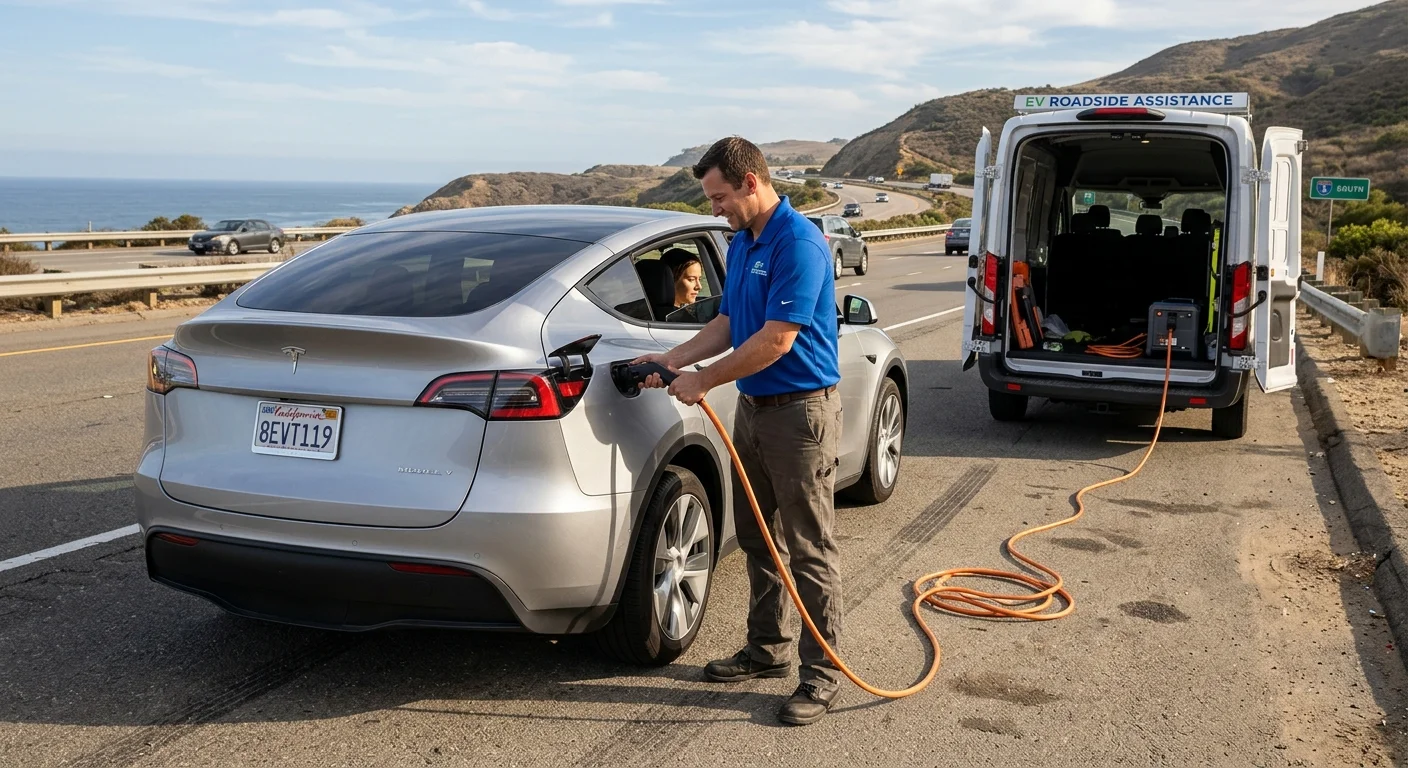
Read the message as pack energy, not a 12-volt fail
Drivers often mash several Tesla alerts into one phrase. They call all of them a Tesla low battery warning. That shorthand can send help toward the wrong problem.
A low traction-charge alert means the high-voltage pack is running thin. It isn’t proof that the 12-volt battery has failed. A message that names low voltage shouldn’t be read as “the pack is empty.” Treat those as separate until the car, or a qualified operator, confirms more.
Don’t infer the cause from the battery icon alone. Charge Pro OC couldn’t confirm a universal Tesla warning threshold for every current model. Follow the guidance on your screen. Check Tesla’s current owner materials for that vehicle.
If you’re parked in a safe spot, photograph the complete message. Include the heading, the extra text, and any symbols. Don’t crop a line that might change the operator’s read.
Share the model, model year, shown charge, and exact location. Say whether the Tesla can move, shift, or still use the display. Report what you observe. Don’t label it a failed pack unless it’s been diagnosed. Our guide to a dead pack versus a 12V failure helps you keep those two stories apart.
Canyon grades change what those remaining miles can do
Orange County isn’t one energy picture. A Tesla climbing Trabuco Canyon isn’t in the same energy spot as one in a Santa Ana lot. Silverado, Modjeska, and Williams Canyon add grade after grade. Hills toward Laguna Beach, Coto de Caza, and Rancho Santa Margarita work the pack too.
The display can still show miles. An uphill stretch can spend them faster than a flat Irvine street would. That’s why this warning isn’t a casual mall run. You can still need a 240V source at the bumper while the car can roll.
Tesla ownership is dense here. As of December 31, 2025, the California Energy Commission counted 210,842 battery-electric vehicles in Orange County. Teslas were 138,121 of them. That’s 65.51 percent of the county’s BEV fleet.
If the screen says to stop, stop. Don’t keep climbing to test the last miles. If it points you toward charging, compare that with a site you can reach from this direction. A map pin isn’t permission to ignore a stricter warning.
Named Superchargers are real. Reachable is a different test.
Nearby and reachable aren’t the same word. Don’t lean on a fixed mileage cushion. Charge Pro OC couldn’t confirm a universal Tesla reserve that covers every canyon grade. Use the in-car guidance for your car.
Check the whole route before you move. Confirm the site is accessible from your travel direction. Check the provider’s current status. Confirm the equipment fits your Tesla.
You can plan against named sites. Lake Forest has Superchargers at 24301 Muirlands Blvd. Irvine lists a site at 5396 Walnut Ave. Laguna Hills has 16 stalls at 23701 Moulton Pkwy and 16 at 25248 Cabot Rd. Mission Viejo has 24 stalls at 27741 Crown Valley Pkwy. Those counts come from U.S. DOE AFDC records, accessed September 5, 2026.
Non-Tesla DC fast is on the same federal list. EVgo reports 14 DC fast ports at Plaza Antonio, 22351 Antonio Pkwy, in Rancho Santa Margarita. Countywide, AFDC counted 223 DC fast stations and 1,452 DC fast ports. Tesla held 861 of those ports, 59 percent.
CEC charging counts as of December 31, 2025 put Orange County at 36.8 ZEVs per public port. The statewide figure was 24.4. That ratio doesn’t describe any one street. It does explain why a low pack on a grade can outrun the hunt for a stall.
If the route to a named site isn’t safe, drop that pin. Stay with the car. Describe the grade, the shoulder, and the last turn you made. For Trabuco Canyon charging and rescue context, start with where the Tesla actually sits.
Tesla’s published next step is transport, not a bumper charge
Tesla’s own roadside policy answers a depleted pack with transportation, not with on-site charging. Tesla’s roadside-assistance page describes help when charge is depleted and you can’t reach a station. That help isn’t a financially covered service. Tesla can still arrange transport. The 500-mile transport Tesla describes as covered is for a warrantable breakdown that leaves the car undrivable. An empty pack sits outside that.
Tesla’s published roadside number, listed on the Santa Ana service page, is 877-798-3752. That line is Tesla’s process, not Charge Pro OC’s. Don’t quote Tesla as saying it doesn’t offer mobile charging. That exact sentence wasn’t confirmed.
Tesla’s Model Y owner’s manual is more useful on the electrical side. Once range is exhausted, the low-voltage battery can lose support. The car may then need an external power supply before the high-voltage pack can accept a charge. Waiting until zero on a grade can add a 12-volt problem. Our low-voltage warning steps cover that second alert if it appears.
On-site 240V is for the car that shouldn’t keep climbing
Roadside charging can fit when the Tesla is in a safe spot and an operator confirms compatible service there. It isn’t the answer for every Tesla low battery warning. Vehicle state, site access, equipment, and the operator’s own assessment all matter.
Tell the operator where the car sits. Include model, model year, displayed charge, the full warning text, and whether it can move. For a garage or HOA lot, share the level, gate instructions, and clearance. For a canyon or arterial, give the road, direction, nearest cross street, and a visible landmark.
The operators we connect you with bring a 240V Level 2 source to the car. Tesla owners get a native NACS plug. Other EVs use a CCS or J1772 adapter. Typical charging time, not travel time, adds 10 to 20 miles of range in 15 to 30 minutes. That’s often enough to reach a Supercharger you couldn’t risk from a dead stop. The operator quotes you before work starts and bills you directly.
Ask what outcome the operator proposes. That may be on-site charging, a short move toward a stall, or transport. Confirm the connector they plan to use. Confirm price, payment, and any warranty with that operator. Charge Pro OC doesn’t perform the work, set prices, or issue warranties. We connect you with licensed, independent local EV rescue operators. Our Tesla roadside rescue page and out-of-charge recovery page explain that referral.
Don’t treat emergency charging as a promise of a set energy amount. Charge Pro OC couldn’t confirm an approved figure for that. Ask the operator what they can do for the car and the grade you described.
Don’t roll the Tesla into traffic to make the truck’s job easier. If the present spot is unsafe, emergency direction comes first.
Transport when the screen, the grade, or the site says so
Transport can be better when the screen restricts driving. It also fits when no safe work area exists, or charging isn’t possible there. Transport also fits when the Tesla won’t accept a charge, or can’t be moved safely.
That choice doesn’t diagnose the main battery. A car that won’t continue can have more than one issue. If you see both a low-charge alert and a separate low-voltage message, share both. Don’t drop one because the other sounds familiar.
Charge Pro OC couldn’t confirm one tow procedure that fits every current Tesla. Follow the active on-screen guidance, Tesla’s current owner materials, and the operator’s instructions. Our empty-pack playbook for OC roads is the stay-put version of this choice.
Location details matter more on a grade. Tell the operator if you’re on a narrow shoulder, behind a gate, or near traffic. Describe its orientation and what blocks access. Don’t try an unverified release or tow method to make access easier.
Tesla’s depleted-pack transport is a paid path, not a covered roadside charge. Our comparison of an empty pack versus a warrantable breakdown keeps those two Tesla categories apart.
A matched operator reviews the vehicle state and the site. That operator, not Charge Pro OC, does the charging or the transport.
When to call
Call when the on-screen guidance leaves no safely reachable charging option. Call when you need an operator to weigh on-site 240V against transport. Call (949) 444-0151 and we’ll connect you with a local EV rescue operator.