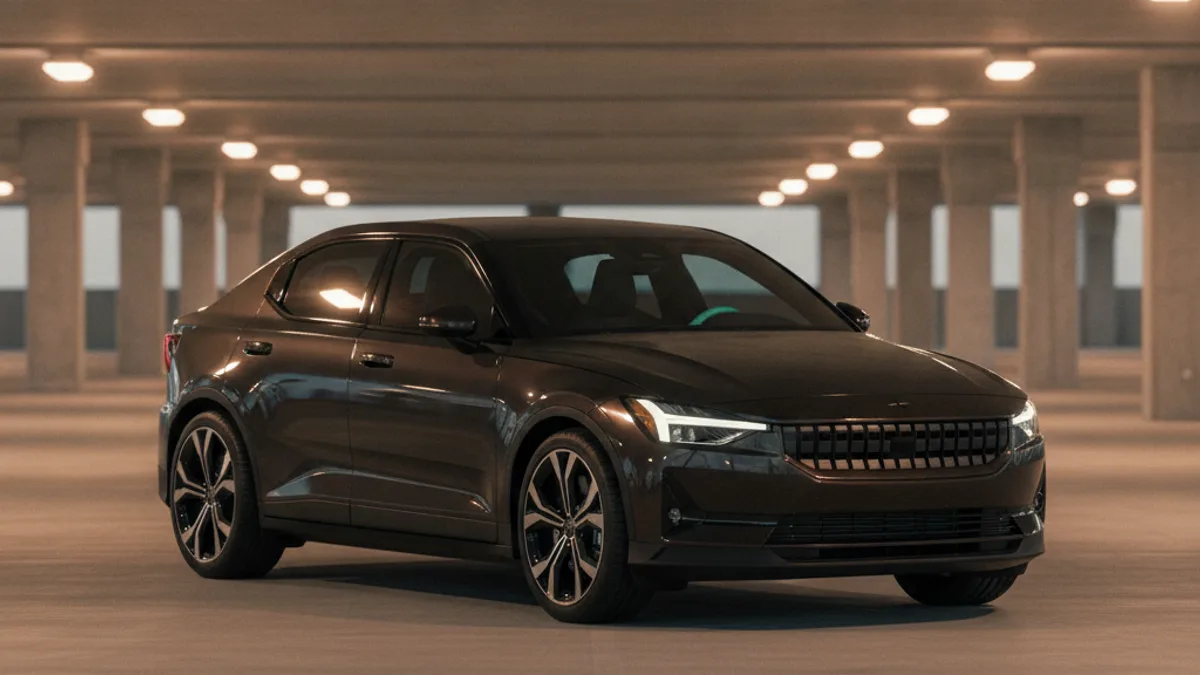
When a Polestar 2 won’t start, begin with the 12V battery. The drive pack can still show a healthy range number. That figure doesn’t wake the computers or unlock the doors. It also doesn’t close the contactors to the pack. A hotel lot in Orange County is a typical setting. The car sits overnight while you’re inside. Background features keep sipping power the whole time. By morning the dash is dark and the frunk stays shut. You still need an operator with a jump pack. They also need a CCS or J1772 adapter. This isn’t a Tesla. A NACS-only lead won’t finish the job if the pack needs a curb charge too.
Orange County had 210,842 battery-electric vehicles as of December 31, 2025. That count comes from the California Energy Commission. Teslas were 138,121 of them, or 65.51% of the county’s BEV fleet. Most mobile kits around here default to a native NACS plug. A Polestar 2 sits in the other share of that fleet. The operator we send still needs the right adapter. That’s true even when the failure is a small 12V in the frunk.
The 12V has to boot the car before the pack can help
A Polestar 2 has no alternator, unlike a gas car. While you drive, a DC-DC converter tops the 12V off from the high-voltage pack. Park long enough and that top-off never runs. The 12V powers the computers and the locks. It also powers the contactors that connect the drive battery. If it sags, the car looks fully dead. The last range figure you remember doesn’t change that.
Two parked-car features make a hotel stay harder on a weak 12V. Always-on connectivity keeps the app reachable even while you sleep. Remote climate and diagnostics stay on that same feed. That background draw doesn’t fully sleep overnight. The digital phone key uses Bluetooth to notice when you’re nearby. In a busy hotel driveway, people walk past all evening. Each pass can wake the car instead of letting it rest. A healthy 12V handles that load, and an aging one doesn’t.
A black screen is often the 12V, not the software
The center display runs Android Automotive on the same low-voltage feed as everything else. It’s often the first thing to glitch. The screen goes black, reboots on its own, or shows an energy-saving note. Then the car stops answering from the key and the app.
A one-time freeze can be a glitch. Hold the bar at the bottom of the screen for about 20 seconds. That soft reset clears a single software hitch. If the screen keeps dying, stop treating it as an infotainment bug. A low-voltage message with those symptoms is the 12V struggling under load. Keep driving on it and you’ll strand in a lot instead of your driveway.
Use the front jump panel, not the battery itself
The 12V lives in the front trunk, under the main storage tub. You lift the liner to see the battery. That only works when the frunk still pops. A fully dead 12V usually won’t open it for you. Starting at the battery wastes time you don’t have.
Polestar put the jump points somewhere else. They sit at the front of the car, low on the left. A plastic cover hides them, held by five push-pin plugs. Those posts are where the cables go. You don’t clamp the terminals under the tub.
Cable order for a Polestar 2 jump
Press the locking pin in the center of each plug. A screwdriver or a pen will do it. Lift the cover away after the pins release. You’ll see two charging points side by side. The positive post is the one closer to the center of the car.
Connect in this order.
- Red lead to the jump pack’s positive terminal first.
- Red lead to the Polestar positive point, the inner one.
- Black lead to the jump pack’s negative terminal.
- Black lead to a bare metal ground bolt on the chassis, not the panel.
Wait about a minute, then try to start. Pull the cables off in reverse, black first, then red. Polestar is clear that these posts are only for jumping this car. They aren’t rated to send power into another vehicle. Doing that can blow a fuse in the jump circuit. Our guide to jumping an EV on site covers the safety steps that apply across EV brands.
When the frunk and hood both stay shut
Sometimes the 12V is so flat that even that cover won’t cooperate. Polestar added a small access port under the car, near the front left wheel. It lets you feed the 12V circuit from outside. You don’t open the frunk or the hood to use it.
Never clip a second 12V battery straight onto that port. The terminal is fused at a low amperage, documented around 30 amps. Too much current blows that fuse for good. That repair is worse than a dead battery. Use a proper jump pack, not a donor car battery. Follow the positive and negative marks exactly. Use the hood panel whenever you can reach it. Save the under-car port for a car that won’t open at all.
What each no-start pattern usually means
| Symptom | Likely cause |
|---|---|
| Dash fully dark, key and app ignored | 12V fully discharged |
| Center screen blacks out or reboots | 12V sagging under load |
| Doors and frunk dead, range still high | 12V too weak for low-voltage systems |
| Car wakes, then goes dark again | 12V can’t hold the load once awake |
| More than one jump in a few weeks | 12V has failed and needs replacement |
If this Polestar 2 has already needed a second jump, stop repeating the same patch. A 12V that won’t hold a charge needs a test. In most cases it needs a replacement. See our guide to an EV 12V that dies on the road. It covers why one small battery can take down the car.
Hotel lots in Anaheim, Irvine, and along the coast
This failure shows up after the car sits. Anaheim hotel lots sit along Katella and Lincoln, near the parks and stadium. A Polestar 2 can spend the night there while you’re inside. Tesla Superchargers on that corridor include 2404 E Katella Ave. Lincoln Avenue sites sit at 1128 W Lincoln Ave and 1734 W Lincoln Ave. Another sits at 2270 E Lincoln Ave. There’s also 156 N Imperial Hwy and 680 N Euclid St. A dead 12V can’t drive to any of those stalls. The car has to wake first. For the city layout, see EV charging in Anaheim.
Irvine is the business-travel version of the same night. Hotels near Spectrum Center and Main Street hold cars between meetings. The Supercharger at 1920 Main St has 40 stalls. Other Irvine Tesla sites include 14346 Culver Dr and 950 Spectrum Center Dr. Walnut Avenue has 5396 and 5406 Walnut Ave, plus 3021 Michelson Dr. Those help after the 12V is up. They don’t replace a jump in the garage. Irvine’s charging page maps the city. The operator still comes to the stall you parked in.
Costa Mesa lots near 1475 S Coast Dr see the same sit-and-drain pattern. Superchargers there include 1475 S Coast Dr and 1400 Bristol St. There’s also a smaller site at 3303 Hyland Ave. Santa Ana has a 28-stall site at 1008 17th St. It also has a 20-stall site at 300 E 5th St. Huntington Beach has 24 stalls at 6913 Warner Ave. Newport Beach has 12 stalls at 4241 MacArthur Blvd. Electrify America lists 8 DC fast ports at Fashion Island, 401 Newport Center Dr. EVgo lists 4 stalls at 801 Pacific Coast Hwy in Seal Beach. Those are AFDC records from a 2026-09-05 pull. They help once the car can roll. They don’t jump a dark Polestar 2 in a hotel garage.
A work trip is the other classic setup. Leave the car in a structure for several days with connectivity left on. The DC-DC converter never runs. The digital key keeps waking the car as people walk by. You come back to a brick. Treat that as a 12V problem until you prove it isn’t.
Adapters still matter after the jump
Charge Pro OC is a referral line. We match stranded EV drivers with independent local operators. We don’t own trucks, and we don’t do the work. The pros we send jump or replace a dead 12V on site. They also bring a 240V Level 2 source with a native NACS plug. A CCS or J1772 adapter rides along for non-Tesla EVs. That second kit is why a hotel-lot Polestar 2 isn’t a Tesla-only dispatch.
Sometimes the 12V was the only failure. The dash comes back and range looks fine, so you drive out. Sometimes the pack is low too, because the car sat. Or you were already hunting a stall. Then the operator needs the CCS or J1772 adapter at the curb. Typical on-site charging adds about 10 to 20 miles. That takes 15 to 30 minutes of charge time. That’s charging time, not a window for when anyone arrives.
If the jump brings the car back and the pack is empty, stay at the car. Mobile EV charging is the service for that case. For the broader Polestar coverage picture, read what Polestar roadside assistance covers in Orange County. Other non-Tesla brands in the same lots use the same non-Tesla EV rescue path.
Tesla still dominates Orange County’s public DC fast map. AFDC data shows 48 Tesla Supercharger sites in the county. Those sites hold 861 Tesla DC fast ports. Every other network combined has 175 stations and 591 DC fast ports. Tesla holds 59% of public DC fast ports here. A Polestar 2 is built around CCS. Lake Forest has a Tesla Magic Dock site at 24372 Rockfield Blvd, CCS1 plus NACS. Electrify America, EVgo, EVCS, and ChargePoint fill in the rest. ChargePoint has the most sites and roughly 1.1 ports per site. Those are mostly single-plug dealership and office units. The sites help once you can drive. A dark Polestar 2 in a hotel stall can’t get there on its own.
The county’s public charging file isn’t the rescue either. Orange County had 7,095 public ports as of December 31, 2025. The same file counts 260,833 ZEVs. That’s 36.8 ZEVs per public port, against 24.4 statewide. More cars share each plug than the California average. A hotel garage with a tired 12V doesn’t care about that ratio. You need power at the bumper.
ZEVs were 10.56% of Orange County’s light-duty fleet on that same CEC file. The state figure was 7.54%. Orange County holds 12.02% of California’s battery-electric vehicles. It’s 8.33% of the state’s light-duty fleet. Non-Tesla owners are a real share of that mix. They still get skipped when a truck shows up with Tesla-only leads.
After the car wakes, don’t keep patching it
Take a drive so the DC-DC converter can top the 12V up. Then get the 12V tested at a shop. Repeated no-starts in a week mean the 12V is done. Jumping it again in the same hotel lot only resets the clock. Replacement is a shop job after you’re moving again. Rescue is what gets you off the property.
If you can’t tell 12V from a dead pack, describe what you see. Dark dash, no handles, app ignored: that’s 12V language. Car awake with range at zero is a pack problem. The operator quotes you before any work starts, and bills you directly. Charge Pro OC doesn’t set that price.
Call (949) 444-0151 when the Polestar 2 is still dark at the car. We serve every city in Orange County. The person who shows up is the independent pro we connected you with. That’s not a Charge Pro OC crew.
Frequently asked questions
Why won’t my Polestar 2 start when the range still looks fine?
Range comes from the high-voltage pack. The 12V is a separate battery. It boots the computers and closes the contactors. If that small battery is dead, the car stays dark. A jump on the documented front posts usually brings it back. Then confirm the 12V can hold a charge. Otherwise you’ll repeat this in the next hotel garage.
Where do you jump a Polestar 2, and what if nothing opens?
Don’t start at the battery under the frunk tub. Use the left-side front panel behind five push-pin plugs. Positive is the post nearer the center. Ground on a chassis bolt, not the panel. If nothing opens, use the under-car port near the front left wheel. Never attach a second 12V battery to that port. It’s fused at a low amperage, around 30 amps. Excess current kills that fuse for good. Use a jump pack and match the polarity marks.
Do the operators handle a Polestar 2, or only Teslas?
They handle Tesla and every major EV brand, Polestar included. Orange County’s BEV fleet is 65.51% Tesla. A lot of roadside gear is NACS-first. A Polestar 2 still needs the CCS or J1772 adapter for a curb charge. The 12V jump is the first move. The adapter lets the same operator finish the job in the hotel lot.