Your pack just hit empty on I-5 in San Clemente. Stay on the shoulder. Don’t limp through beach traffic toward a stall. You can’t reach that stall from the travel lanes. Get a charge brought to the car. Then drive off under your own power.
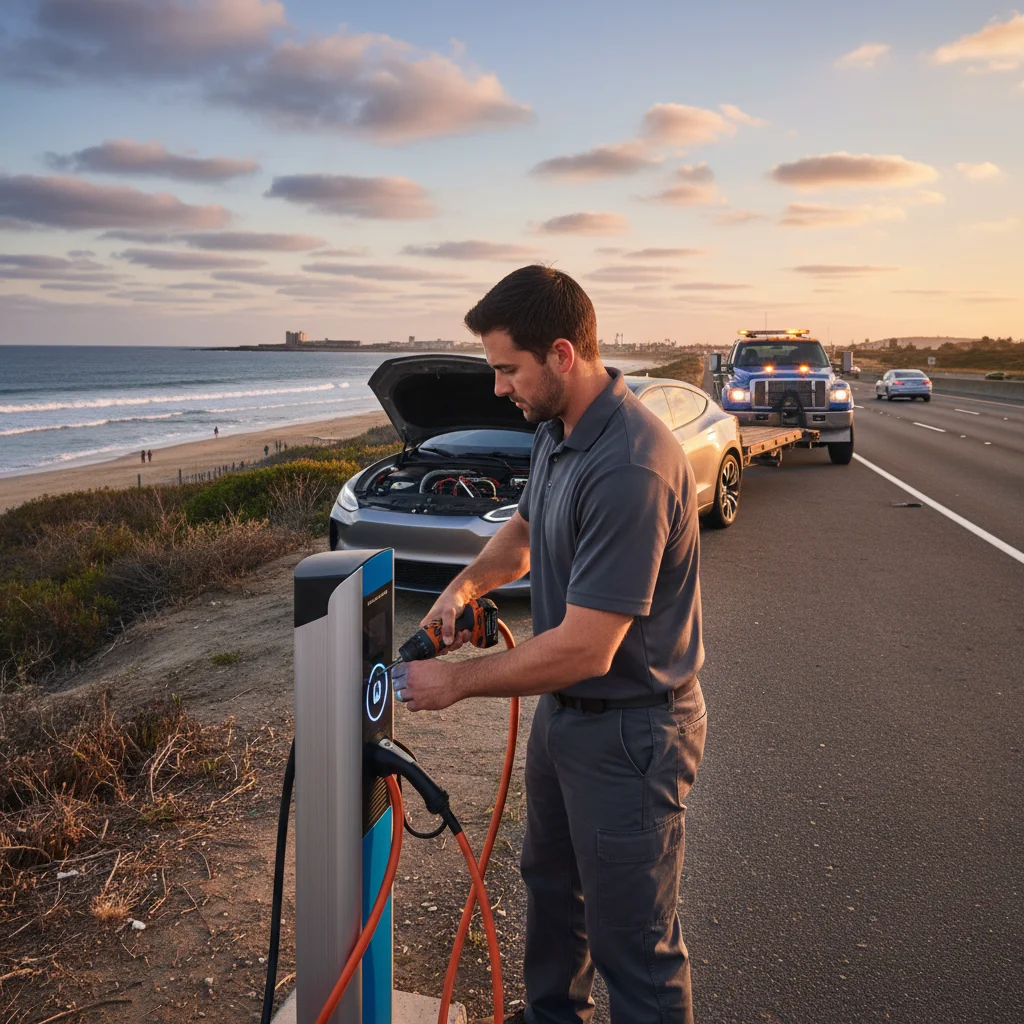
This stretch is beach traffic on a county-line shoulder
San Clemente is where Orange County runs out on I-5. The freeway still carries coast traffic, inland traffic, and people headed to the beach. Shoulders get tight. Speeds swing from a crawl to full highway pace. An empty EV in that mix is a hazard, not a navigation puzzle.
The chargers in town are real, and they’re large. Tesla lists 49 DC fast stalls at 101 W Avenida Vista Hermosa. The federal Alternative Fuels Data Center carries that record. The site opened in 2017, with a listed max of 250 kW. A second Tesla site sits at 990 Avenida Vista Hermosa. It lists 16 stalls at the same listed power. EVgo lists 10 DC fast ports at Ocean View Plaza, 638 Camino de los Mares. Those lots matter once the car can move. They don’t matter while you’re still in the number four lane.
The San Clemente EV roadside piece covers those city blocks.
Range you had inland is not range you have here
A number on the dash is a guess built on the last few miles. Coast grades and a headwind off the water change that guess. A backup at the beach exits does too. Climate control adds load in summer heat. Cool marine-layer air can pull efficiency down too. Treat the last miles as real consumption, not brochure miles.
People leave Mission Viejo, Laguna Hills, or Irvine with a buffer that looked fine. Then I-5 slows. The beach exits jam. The estimate falls faster than the car. That’s a common Orange County pattern.
The California Energy Commission counted 210,842 battery-electric vehicles in Orange County. That count is as of December 31, 2025. ZEVs were 10.56% of the county light-duty fleet. Tesla accounted for 138,121 of those BEVs, which is 65.51%. Many cars that die here are Teslas. They were pointed at Vista Hermosa and came up short.
Orange County also holds 7,095 public charging ports against 260,833 ZEVs. That’s 36.8 ZEVs per public port. Statewide the same math is 24.4. The county is busier per plug than California as a whole. A beach weekend makes that ratio feel personal.
AFDC lists 48 Tesla Supercharger sites in Orange County, with 861 DC fast ports. Those ports sit in parking lots, not in the travel lanes. A car already stopped still needs power brought to it.
North of here, the same freeway has a different rhythm. Empty on I-5 south of Irvine is the companion piece. Use it if you stalled closer to the central county.
If you still have a few miles, stop anyway
A dash that shows a handful of miles isn’t a plan to thread beach off-ramps. Those ramps dump into surface streets that crawl. You can burn the rest of the pack in a turn pocket. Pull onto the right shoulder while the car still moves. Then call.
If you’re northbound leaving the beach, the same rule holds. The pack already paid for the day. Don’t spend the last miles hunting a stall on the map. You can’t reach it in this traffic.
Decide what actually died
Not every silent EV is out of traction energy. Most still need a 12-volt battery to wake the computers and close the high-voltage contactors. If the screens are black, the handles are dead, and nothing responds, say that first. A 12V jump or a 12V replacement on site may be the whole job.
Tesla’s Model Y owner’s manual describes a related failure. Once driving range is gone, the low-voltage battery can lose support. The high-voltage pack may then need an external supply before it’ll accept a charge. A tow to a Supercharger doesn’t always wake that car.
If the car is awake and the display shows zero, you need pack energy. That’s out-of-charge recovery. Don’t stand in a live lane to open a frunk. Stay on the shoulder side of the car.
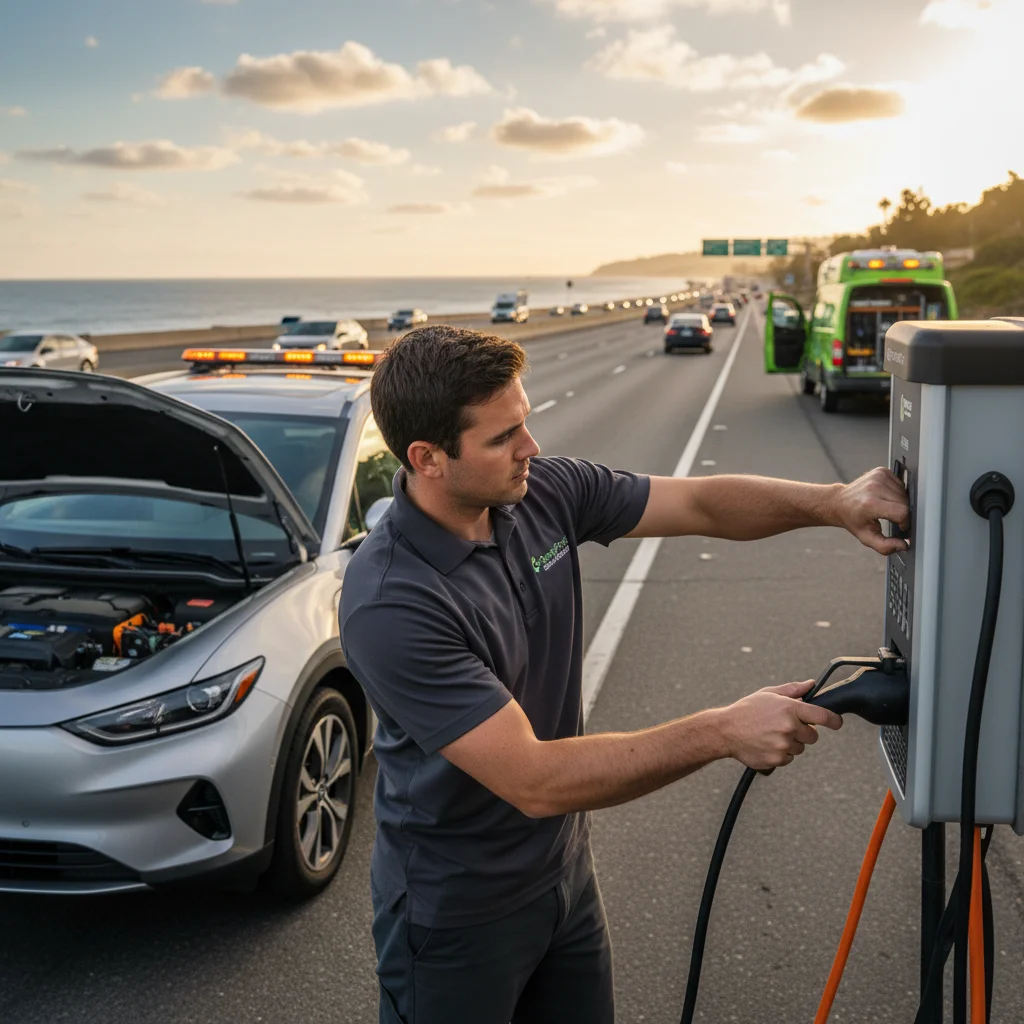
First minutes on the shoulder
Put the hazards on. If you can still roll a few feet, get fully onto the shoulder. Then stop. Don’t hunt for a better turnout through a beach backup. A dying pack in moving traffic is how this becomes a collision.
Stay in the car if the shoulder is narrow or the trucks are close. Keep the seatbelt on until you’re sure you’re clear. If you must get out, exit on the right. Get behind the barrier if there’s one.
Phone battery matters now. Make the call while you can still see a mile marker. Drop a pin in Maps and keep that pin. “I-5 San Clemente” is a long piece of road.
Freeway Service Patrol is the yellow-truck program many Orange County drivers know from other freeways. Published FSP hours for this I-5 segment weren’t confirmed here. Confirm current hours with OCTA or Caltrans. Don’t sit waiting on a truck you can’t verify is still running. Evening is when that wait most often fails.
Tesla roadside is transport, not a plug at the bumper
If you start with Tesla, know what that path is. Tesla treats a depleted battery as paid assistance. It isn’t a covered service on Tesla’s roadside policy. The 500-mile transport Tesla describes is for a warrantable breakdown that leaves the car undrivable. Running to empty sits outside that window. Tesla’s own language points to transportation for a depleted pack. It doesn’t point to a mobile charge at the car. The number on the Santa Ana service page is 877-798-3752.
That can still get the car off the freeway. It usually means a tow. A tow from a live I-5 shoulder is slow and messy. It’s hard on an EV if the rig is wrong. Charging first, then driving off, skips that. Mobile EV charging or a tow is the longer version of that choice.
Charge Pro OC is a referral line, not a fleet. We match stranded drivers with independent local mobile rescue operators. We own no trucks. We set no prices, and we promise no arrival time. The operator quotes you before a cable goes in. They bill you directly.
What the operator actually plugs in
The source on the truck is 240-volt Level 2. Tesla owners get a native NACS connector. CCS or J1777 adapters cover the other major brands. Typical added range is about 10 to 20 miles. Typical time on the plug is 15 to 30 minutes. That’s charging time. It isn’t a clock on when someone shows up.
Ten to twenty miles is usually enough to leave the shoulder. That’s enough to reach a DC fast stall you can park in. Once you’re rolling in San Clemente, two named lots are the local options. Those are Vista Hermosa and Camino de los Mares. San Juan Capistrano has Tesla sites at 26701 Verdugo St. AFDC also lists 31971 Camino Capistrano. Electrify America lists 12 DC fast ports at 25825 Las Vegas in Capistrano Beach. Confirm live availability in your app. A federal station record isn’t a guarantee that a stall is free tonight.
Mobile EV charging is that on-site stop. Towing stays the last move. Use it only if the car is in a lane and can’t be shifted.
Tell dispatch three things, then stop talking
First, direction. Northbound and southbound shoulders aren’t the same road. Say it in the first sentence.
Second, a marker. A green milepost, an overcrossing name you can actually see, or a Maps pin. “By the ocean” doesn’t route anyone.
Third, the car and the symptom. Make, model, and whether the dash is alive. A Tesla Model 3 at 1% is a pack charge. A dark Kia EV6 with a 12V warning is a different kit.
If you’re not sure which failure you have, say so. Tell them the screens are dark if you don’t know. A guess that sends the wrong tools wastes the stop.
The same sequence applies on other OC freeways. Out of charge on an Orange County freeway is the county-wide version.
Once the car will move, finish in a lot
Don’t stop on the on-ramp for a little more range. Drive to a real stall and park. Charge enough that you aren’t repeating this in Dana Point.
Tesla still holds 59% of Orange County’s public DC fast ports. That’s from the AFDC station file filtered to the county. ChargePoint has more sites and far fewer ports per site. You want a multi-stall DC fast row for a fill that gets you home. Skip a single office-park plug for this job.
If the 12V was the failure, get it load-tested after you’re safe. A jump that dies again in a beach lot is a 12V failure. The pack isn’t the problem in that case. That’s a shop visit. It isn’t another freeway stop.
Call when the car is already the problem
Call when you’re already on the I-5 shoulder in San Clemente. Call when you won’t make a charger from there. Call when the pack is at zero, the 12V is dead, or you can’t tell. Don’t wait for the car to quit in a travel lane.
We connect you with operators across Orange County, including this south-county stretch. If you’re still planning the drive, start with the San Clemente charging page. If you’re already stopped, you need a 240-volt source at the bumper.
Call (949) 444-0151. The operator quotes you before they start.