A Tesla Model S with no power still needs a careful handoff. That holds on an Orange County freeway, and in a garage. Share the model year, what still responds, and the exact spot. Then name where the car should go. The matched operator should confirm Tesla’s current transport notes. They should do that for your Model S before anyone hooks it.
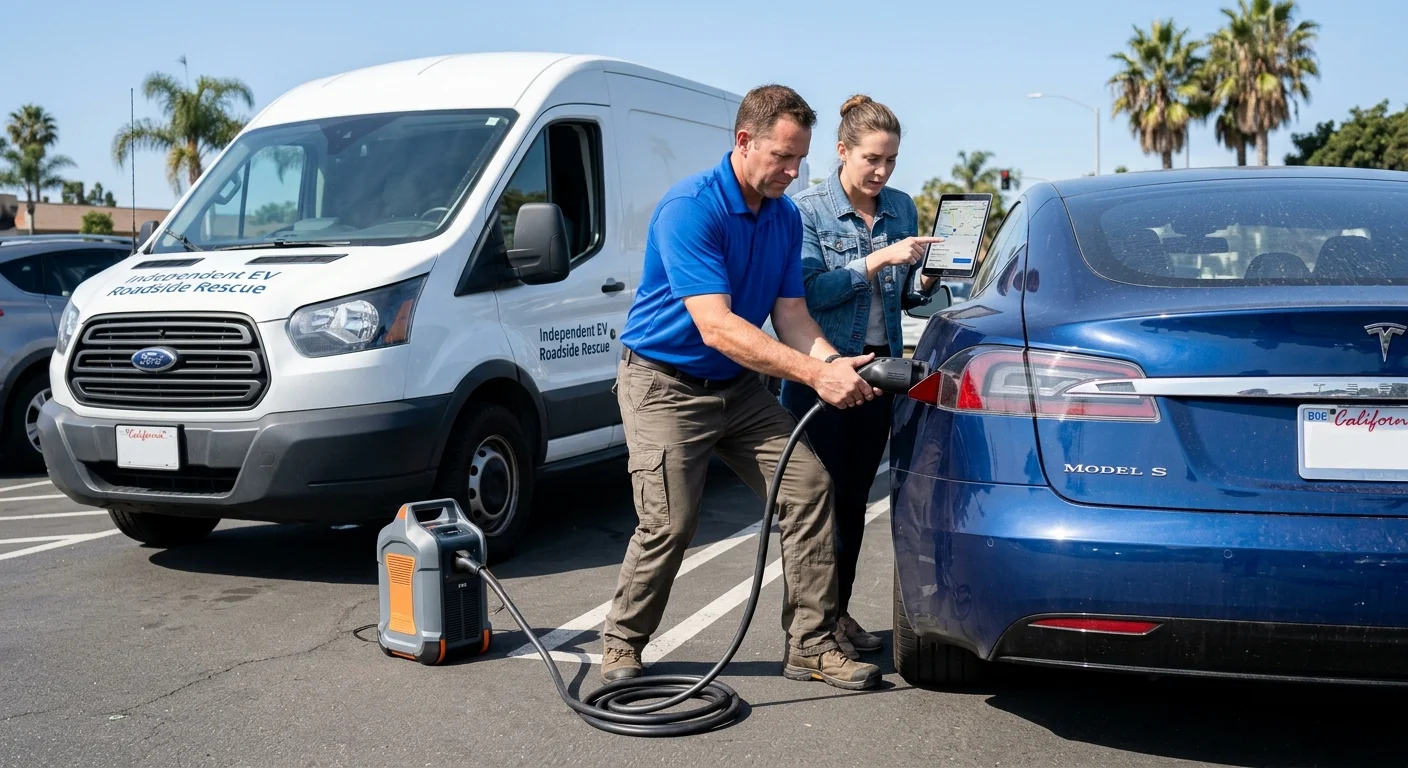
Confirm it’s a Model S, and the year
Start with the nameplate you can prove. The car is a Tesla Model S. Then pull the model year from paperwork you trust. Don’t guess from paint, wheels, or the screen.
Orange County is a Tesla-heavy market. The California Energy Commission counted 210,842 battery-electric vehicles in the county. That figure is as of December 31, 2025. Teslas were 138,121 of that BEV fleet, or 65.51%. A Model S still isn’t a Model 3 or a Model Y. The operator should use instructions for your year, not another Tesla.
Give the full description from your records. Include trim wording you can confirm. If you can reach the vehicle identification number, have it ready. Don’t post it in a public comment.
A low stance, unusual wheels, or a kit can change access. You’re not telling the operator how to load. Also say why you think the car needs help. An empty range reading before shutdown is one story. Collision damage, a tire problem, or a stall with no warning are different handoffs. State only what you observed.
If the car just won’t wake, read our Model S 12V checks. That guide organizes symptoms. It doesn’t replace Tesla’s current vehicle instructions.
Say what still responds
Next, describe power in ordinary words. Don’t open panels. Don’t pull trim. Don’t improvise a jumper for this checklist. Use the controls you’d use on a normal day.
Tesla’s Running Out of Range owner’s-manual entry is useful context. Once range is exhausted, the low-voltage battery can lose support. The car may then need external power before the high-voltage pack can charge. That’s a published technical note. It isn’t a reason to start electrical work on the shoulder.
Tell the operator whether doors respond. Say whether the center display lights. Mention whether exterior lights react to their usual controls. If nothing responds, say that plainly.
Use lines like these:
- The center screen is on and shows a message.
- The doors respond, but the car won’t move.
- The app connects, but the car doesn’t.
- There’s no visible response from the car.
- I can’t get into the cabin.
Copy a displayed message exactly. A photo helps if you can take it from a safe place. Don’t turn the wording into your own diagnosis. “No visible power” is cleaner than naming a failed battery you haven’t proven.
Report the charge port the same way. Don’t force the door. Say if a cable is attached, and who owns it. If you’re on a public stall, name the site you can actually see.
These notes help the operator weigh a charge, access help, or a tow. They don’t prove which part failed.
Give the Orange County pin, then the obstacles
A map pin is step one. Include the street, travel direction, and a nearby named road. Add the parking level or a clear entrance.
North county doesn’t look like the coast. An Anaheim stop on E Katella Ave is its own scene. A Santa Ana curb near 17th St isn’t a Mission Viejo lot. Crown Valley Pkwy is a different handoff. Fullerton’s Harbor Blvd stalls are not Buena Park’s Beach Blvd site. Newport Beach on MacArthur Blvd is a different pin. So is San Clemente on Avenida Vista Hermosa. Camino Capistrano in San Juan Capistrano needs its own line.
If you’re on a freeway shoulder anywhere in the county, say the direction you’re facing. Don’t walk into traffic to read a sign. In a garage, name the building, the level, and the entrance street. Add any posted clearance you can read from a safe spot.
Name what’s between the operator and the Model S:
- A gate, locked entrance, or parking attendant
- A narrow driveway or a sharp turn
- A steep ramp or a low ceiling
- A reserved space or a shared charging stall
- A wheel sitting against a curb
- Visible collision or tire damage
- A cable still in the port
Describe those conditions. Don’t prescribe equipment. Charge Pro OC is a referral line. It matches you with independent local operators. It owns no trucks and employs no technicians. The operator decides whether the site and the car fit their rig.
Choose the destination before transport starts. Give the exact address and the name on the building. Then confirm access, intake, and hours with that destination. We don’t publish unverified facility hours. We don’t promise a shop will accept the car.
Tesla lists service operations in Costa Mesa, Buena Park, and Santa Ana. There are also listings in Irvine, Anaheim, and Aliso Viejo. Confirm the current street address in Tesla’s own finder before you send a truck. Those addresses were not verified from a directly opened Tesla page.
A short charge may let the car roll again. A Supercharger can then be a better end point than a hook. The U.S. DOE Alternative Fuels Data Center tracks Tesla Superchargers. Orange County has 48 sites in that inventory. Those sites hold 861 DC fast ports. Irvine’s 1920 Main St site lists 40 stalls. San Clemente’s 101 W Avenida Vista Hermosa site lists 49. Check the live map. Don’t assume a stall is open.
For a shoulder stop with no safe way to roll, start here. Read our out-of-charge freeway notes. Stay with the car if you can do that safely.
Have the operator open Tesla’s current transport page
Before towing a Tesla Model S, the operator should open Tesla’s current instructions. They should match those notes to your year. This site’s approved claims file doesn’t hold verified Model S transport-mode steps. It also doesn’t hold loading points, jump points, or manual-access procedures. We won’t invent those from memory.
Use the owner information tied to your car. Search by the confirmed model and year. If the screen or app still works, look there. Ask the operator which official page they’re using.
Don’t treat an old screenshot or forum reply as the last word. It may describe another Tesla, or another year. Send the operator the official page you found. Include the model year and any message still on the car.
Our guide to towing a Tesla with a dead pack is a planning overview. It doesn’t replace current Model S instructions. Treat it as prep for the call, not as a loading sequence.
Don’t say the car is already in a transport setting unless the vehicle confirms it. If the screen is up and no setting is selected, say that. If you can’t find instructions for the right year, say that too. Ask the operator to name the source they’ll follow before loading starts.
Ask whether a charge fits before the hook
A dark Model S doesn’t automatically mean you need a tow. Give the operator the facts. Then ask whether charging or transport fits those facts. Don’t pick a method by guessing the failed part.
Charging deserves a look when the last display showed a depleted driving battery. Add whether the port still responds. Add whether the car sits where a truck can work. The operator decides if charging is appropriate at that spot.
Matched operators can bring a 240V Level 2 source to a Tesla. That typically adds 10 to 20 miles in 15 to 30 minutes of charging. That’s charging time. It isn’t an arrival time. The operator quotes you before starting. The operator bills you directly.
Tesla’s indexed roadside wording treats a depleted pack as transportation. It isn’t described as a financially covered service. Covered transport of up to 500 miles is tied to a warrantable breakdown. That breakdown has to leave the car undrivable. Running out of charge sits outside that covered list. Confirm the current policy on Tesla’s own roadside page before you rely on it. Tesla’s roadside number, as published on the Santa Ana service page, is 877-798-3752.
Transport deserves a look when the car won’t take a charge. It’s also in play when you can’t access the cabin. Visible damage or a shop destination can require a move too. Those are observations. They aren’t a diagnosis.
If you’re weighing both paths, read why charging often beats towing a dead EV. For an empty pack, start with out-of-charge recovery.
Ask the matched operator these questions:
- Are you evaluating mobile charging, transport, or both?
- Have you confirmed my Model S year?
- Which current Tesla instructions will guide the transport?
- Does this location create an access concern?
- What else do you need about available power?
- Should I confirm anything with the destination first?
Ask that operator about price, payment, scope, and any warranty before you agree. Those terms belong to the independent operator. Charge Pro OC doesn’t set prices and doesn’t warrant the work. Current Model S-specific towing prices couldn’t be confirmed through our approved claims file. This page doesn’t publish a number.
When the notes are ready, make the call
Call when your Model S has no power. You may need help choosing a charge or a tow. Have the year, power status, exact location, access notes, and destination ready.
Use the Tesla roadside rescue referral to reach a licensed, insured operator. Charge Pro OC performs no towing and no charging. Call (949) 444-0151 when you want that match.