Searching “mobile EV charging near me” in Orange County gets a referral. Charge Pro OC matches you with an independent local operator. That operator brings 240V Level 2 power to the car. They quote before they start, and they bill you directly. The county has a large public map. People still end up sitting with a dead pack. CEC data as of December 31, 2025 counts 7,095 public ports here. The same files count 260,833 ZEVs. That’s 36.8 ZEVs on each public port. Statewide the ratio is 24.4. The search is local because the math is local.
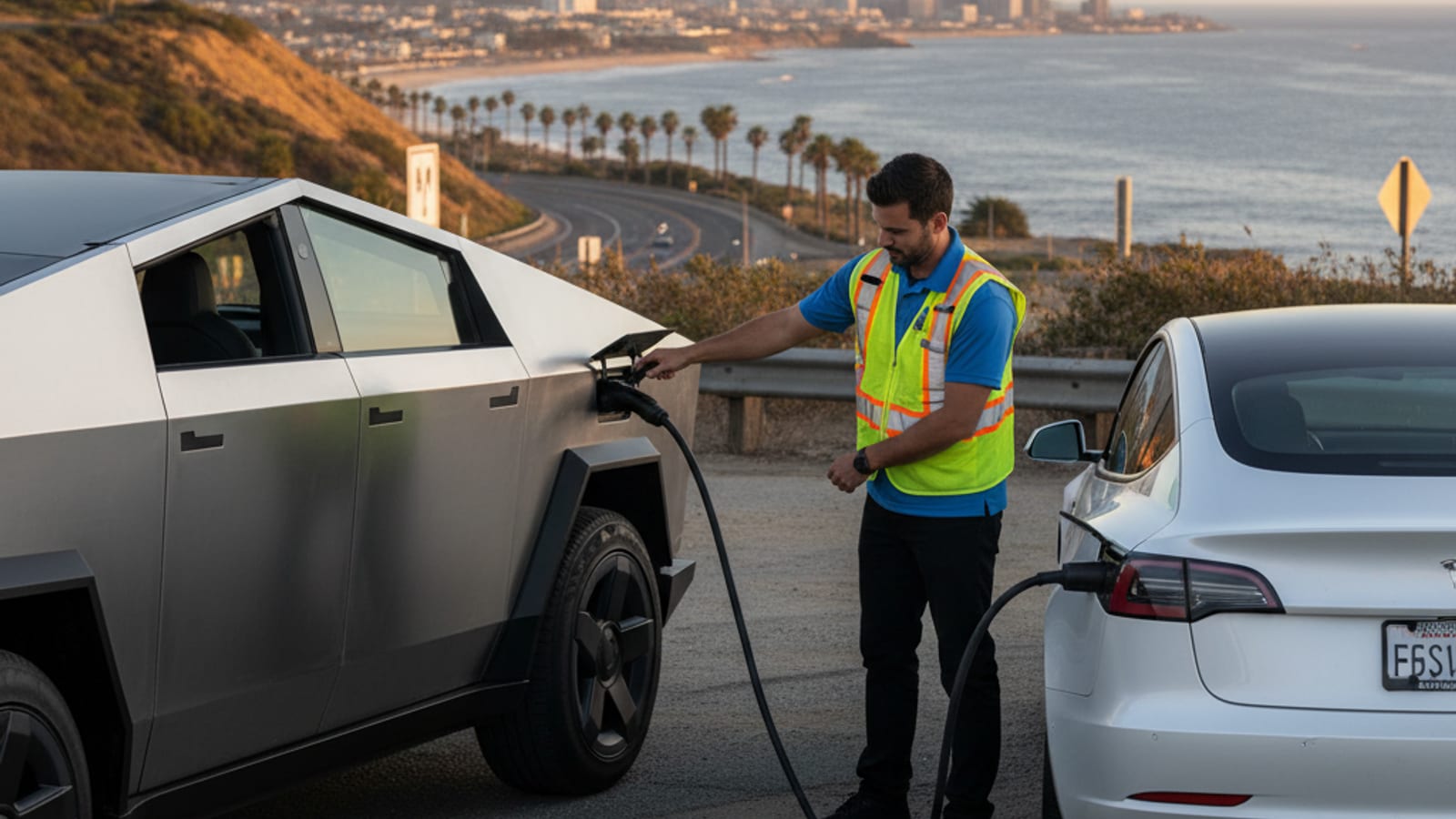
Why Orange County’s charger count still leaves you calling
Orange County isn’t short on plugs on paper. Public Level 2 ports sit at 5,600. Public DC fast ports sit at 1,475. Add 20 public Level 1 outlets and you get 7,095. The California Energy Commission published those counts. They mix surveys, grant lists, AFDC records, and PlugShare. The file updates twice a year.
The pressure is the fleet, not the stall total. Battery-electric vehicles here number 210,842. Plug-in hybrids add 47,567. ZEVs are 10.56% of the county’s light-duty fleet. California’s share is 7.54%. Orange County holds 12.02% of the state’s battery-electric cars. It’s only 8.33% of the state’s light-duty fleet. Teslas are 138,121 of those BEVs, or 65.51%. That’s 6.4 points above the state’s Tesla share.
New sales stay ahead of California without any boom talk. In 2026 Q2, ZEVs were 24.77% of new light-duty sales here. California sat at 19.09%. Orange County has run about five to six points above the state. California’s ZEV share peaked at 25.31% in 2024. 2026 Q1 was the weakest quarter in that series. CEC changed its sales method in 2023 and 2025. The range anxiety numbers for Orange County walk through the file.
You need range at the curb. Public ports exist. They also sit under 36.8 ZEVs each. A lot fills. A session fails. A workplace plug is taken. That’s when mobile EV charging is the move.
What the referral is, and what it isn’t
Charge Pro OC is a referral line. It holds no licence for this work. It doesn’t employ technicians. It doesn’t own operator vehicles, yards, or parts. It doesn’t set the price. It doesn’t promise an arrival window. It doesn’t publish hours. The operator who accepts the job quotes you first. That operator bills you directly.
You call and describe the car and the spot. Charge Pro OC matches you with a local mobile rescue operator. The operator confirms whether they can reach you. They tell you what they’ll do on site. You decide before they plug in. For the quote itself, see what goes into a mobile EV charging quote.
Orange County isn’t one place with a name swap. Coastal north county is beach lots and harbor parking. Inland north county is Fullerton, Brea, Yorba Linda, and the 91. The central cities are Santa Ana, Garden Grove, Orange, Tustin, and the Crush. East County is canyon roads and hillside driveways. South County is Irvine office parks, gated streets, and the I-5 toward San Clemente. An Irvine garage isn’t a Huntington Beach lot. A Santa Ana curb isn’t a Yorba Linda driveway.
What shows up at the car
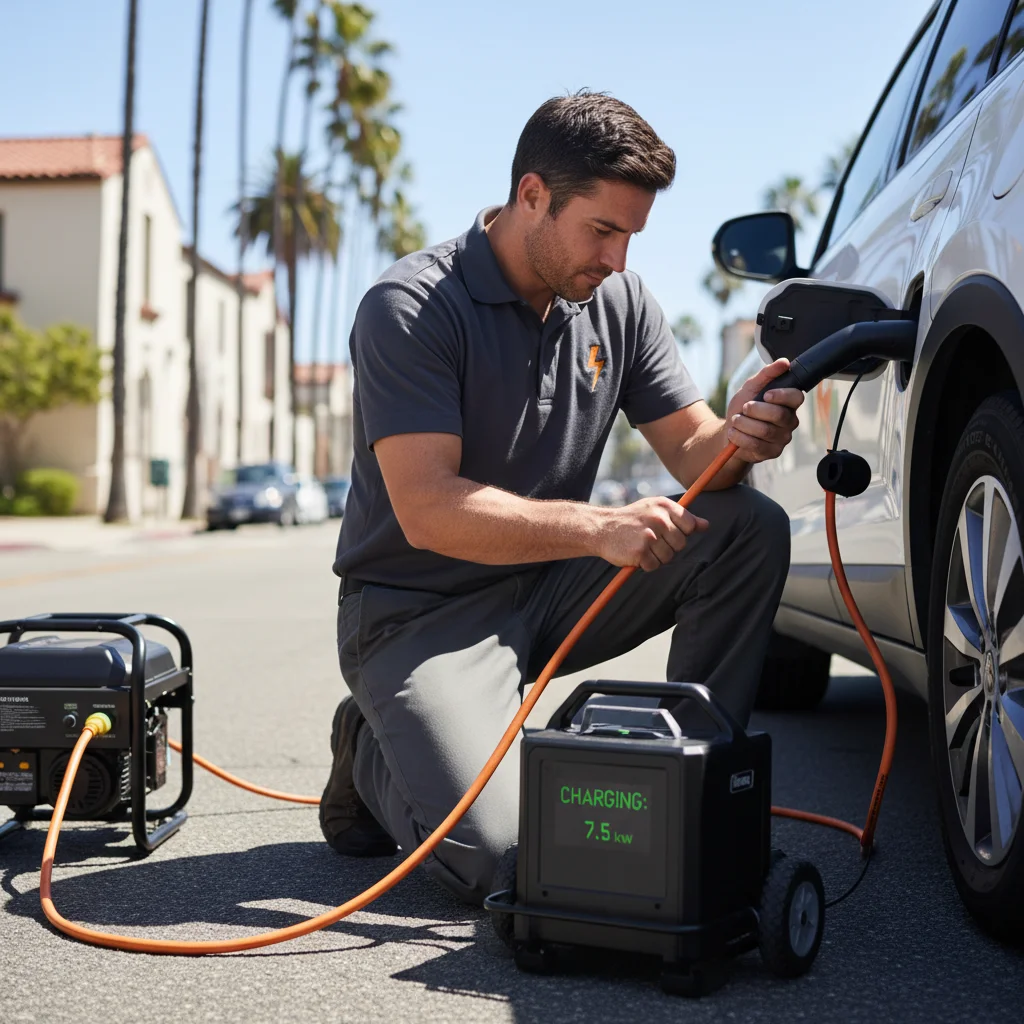
The operator brings a 240V Level 2 source. That isn’t a household outlet on a long cord. It isn’t a DC fast stall on wheels. Level 2 adds usable miles without a tow. Native NACS covers Tesla. CCS or J1772 adapters cover non-Tesla EVs. The EV charging truck walkthrough explains the hardware.
Typical charging time is 15 to 30 minutes. That’s charging time, not a promise of when someone arrives. In that window the operator is usually adding about 10 to 20 miles of range. That’s enough to reach a public stall, a home plug, or a safer lot. It isn’t a full pack.
Operators also jump or replace a dead 12V battery on site. That’s a different failure than an empty high-voltage pack. Tesla and every major EV brand sit in the same playbook. The connector changes. The 12V problem doesn’t.
Where people actually sit empty in this county
Freeway shoulders are the stressful version. I-5 south of Irvine is a long, fast run. I-405 through west county is stop-and-go. SR-22 at the Orange Crush stacks traffic. The 91 through north county fills around park days. SR-241 is a toll road. If you’re already on the shoulder, stay there. Don’t hunt a stall on fumes.
Coastal lots are a different failure. Huntington Beach and Newport Beach parking after a long day is a classic 12V scene. You leave the car in heat with screens on. The traction pack can still show range. The 12V can still be dead. Seal Beach and Dana Point harbor lots look the same from the seat. Costa Mesa structures near the airport add another layer. You’re in a garage, not on a curb.
Grades eat range on the inland and south side. Laguna Canyon Road climbs. The Newport Coast climb takes miles on the way up. Ortega Highway and Santiago Canyon Road get long and dark if you guessed wrong. Yorba Linda and North Tustin driveways sit on hills. Rancho Santa Margarita and Coto de Caza sit behind gates. Aliso Viejo, Laguna Niguel, and Mission Viejo HOA garages close. The operator still comes to the car.
Anaheim is its own pattern. Theme-park and stadium lots hold cars all day. Buena Park auto row and park lots do the same. Tustin office parks look fine at 9 a.m. They’re a miss at 7 p.m. if the workplace charger is taken. Garden Grove and Westminster mall stalls can be slow or packed. The car is already where it is. The charge should come there.
Named stalls you can actually plug into
You can name real sites. Tesla Superchargers in Orange County number 48 sites and 861 DC fast ports, from AFDC station data. Countywide public DC fast charging, Tesla included, is 223 stations and 1,452 ports. Take Tesla out and you still have 175 stations and 591 DC fast ports. Tesla holds 59% of the county’s public DC fast ports.
Large Tesla sites you can aim at, if you can still roll:
- San Clemente, 101 W Avenida Vista Hermosa, 49 stalls
- Irvine, 1920 Main St, 40 stalls
- Tustin, 14661 Franklin Ave, 36 stalls
- Garden Grove, 12891 Harbor Blvd, 32 stalls
- Santa Ana, 1008 17th St, 28 stalls
- Buena Park, 8888 Knott Ave, 28 stalls
Garden Grove at 12161 Valley View St is listed at 500 kW in that AFDC file. Anaheim has multiple Lincoln and Katella sites. Lake Forest added a Magic Dock site at 24372 Rockfield Blvd with CCS1 and NACS. Mission Viejo’s Shops site is the power exception. Tesla lists it at 72 kW. Trust Tesla’s figure there over AFDC.
Non-Tesla DC fast sites matter when Tesla stalls are a queue. Electrify America at Fashion Island, 401 Newport Center Dr in Newport Beach, has 8 DC fast ports. Electrify America at Walmart 2242, 440 N Euclid St in Anaheim, has 10. Electrify America in Dana Point, 25825 Las Vegas in Capistrano Beach, has 12. That’s the largest non-Tesla site in south county. EVgo at Plaza Antonio, 22351 Antonio Pkwy in Rancho Santa Margarita, has 14.
ChargePoint shows up as 71 stations with only 76 DC fast ports. That’s about 1.1 ports per site. Many are dealership or office singles. Electrify America has 30 stations and 138 ports. EVgo has 30 stations and 131 ports.
A long Supercharger list doesn’t help if every stall is taken. Anaheim Tesla Superchargers when they’re packed is that local problem. The county charging hub is the map-level view.
Empty pack versus a 12V that won’t wake the car
People search “mobile EV charging near me” for two failures that look identical. One is a high-voltage pack at zero. The other is a 12V battery that’s dropped out. Tesla’s Model Y owner’s manual describes the low-voltage battery losing support once range is exhausted. It then needs external power before the high-voltage pack can charge. That’s why a “dead Tesla” isn’t always an empty pack.
If screens are dark and you had range this morning, start with 12V. Operators jump or replace that battery on site. Tesla 12V battery jump is the path for that failure. If the range meter hit zero, you need energy into the pack. That’s the 240V job.
Don’t guess on a freeway shoulder. Tell the operator both symptoms.
What to do in the first minutes
Get out of the travel lane if you can still roll a few feet. Put the hazard lights on. Stay in the car if the shoulder is narrow and traffic is fast. If you exit, go out the side away from traffic. NHTSA publishes roadside safety guidance for that moment, and you should follow it.
Then call. Have a pin ready, or a cross street, or a mile marker. Have the make, model, and year. Say whether this is an empty pack or a car that won’t wake. Charge Pro OC matches you from that. The operator who takes the job is the one who talks timing. The referral line doesn’t invent a window.
While you wait, don’t keep cycling the car. Don’t try to limp to a stall you can’t reach. Don’t accept a random tow that isn’t set up for an EV. A flatbed is the usual safe method if you do need a tow later.
Charge here, or tow it somewhere else
A tow moves the problem. It doesn’t add miles. You still need a stall at the other end. You need a driver who knows EVs. You need a flatbed, not a wheel-lift that fights the motors. Mobile Level 2 charging leaves the car where it sits. You get 10 to 20 miles in a 15 to 30 minute charge. Then you drive to a Supercharger, an Electrify America site, or a home plug.
Towing still has a place. If the car has a mechanical fault, charging won’t fix it. If an operator can’t reach the spot, you may need a short tow to a legal curb. That’s a later decision. The first question is whether the pack is empty and the car is otherwise fine. If yes, charge on site.
Tesla owners hit another fork. Search-index copies of Tesla’s roadside page, captured for this research on 2026-09-05, treat a depleted battery as assistance Tesla can arrange. They don’t treat it as a financially covered service. Tesla can still help with transport. Covered transport of up to 500 miles, in that same language, is tied to a warrantable breakdown. Running out of charge sits outside that. Tesla’s policy answers a dead pack with transport, not with on-site charging. Open Tesla’s roadside page in a browser before you rely on that wording.
Tesla roadside’s published number, from the Santa Ana service page, is 877-798-3752. You can call them and still call a local operator if you want charging at the car.
How to need this less often
Route in the car before you leave, not after the low-battery chime. Tesla navigation and ChargePoint show live status. The DOE Alternative Fuels Data Center locator is the federal second check. Orange County’s CEC port file is a county total, not a live occupancy feed.
Home charging still does the most work. Overnight Level 2 is how most of these 210,842 BEVs start the day. Apartment buildings and HOAs don’t always give you that. Irvine, Lake Forest, Ladera Ranch, and Laguna Woods owners already know the garage politics. A roadside charge doesn’t replace a panel upgrade. It covers the night the assigned plug is broken or blocked.
Watch the 12V the way you’d watch a 12V in a gas car. Warnings, slow windows, and random app dropouts are early. Heat in inland lots cooks 12Vs. Long beach days with the car sitting do it too.
Don’t treat a DC fast stop as a full fill if you only need 20 minutes. Get to a known site with a buffer. Irvine Main Street, Tustin Franklin, Garden Grove Harbor, and San Clemente Vista Hermosa are the high-stall Tesla records. Fashion Island and the Anaheim Euclid Walmart are the Electrify America backups. Plaza Antonio is the fast site in Rancho Santa Margarita. None of that replaces a truck if you’re already at zero.
Frequently asked questions
What do I actually get when I search mobile EV charging near me?
You get matched with an independent operator in Orange County. Charge Pro OC doesn’t send its own truck. The operator brings 240V Level 2 charging to the car. They quote before work starts. They bill you directly. Expect about 10 to 20 miles in 15 to 30 minutes of charging. That’s charging time on site, not a drive-time promise.
Does this work if I’m not in a Tesla?
Non-Tesla EVs are in the same match. Operators carry a native NACS plug for Tesla. They carry CCS or J1772 adapters for other EVs. Rivian, Ford, Hyundai, Chevy, BMW, and the rest of the major brands are in that set. Tesla is 65.51% of Orange County’s battery-electric fleet.
How does the operator set the price?
Charge Pro OC doesn’t set it. No page here should invent a number. The operator quotes you before they start. Location, vehicle, and whether you need a 12V jump or a pack charge all change the quote. If the number isn’t right, you can decline.
When the pack is empty in Orange County, stay put. Search mobile EV charging near me, then call Charge Pro OC at (949) 444-0151. You’ll get matched with a local operator who charges at the car.