A Level 1 EV charger is the 120-volt cord that shipped with your car. In Orange County, it won’t save you once you’re already stranded. The California Energy Commission counted 20 public Level 1 ports here as of December 31, 2025. The same file lists 210,842 battery-electric vehicles on county roads. Those outlets add about 3 to 5 miles of range per hour. That’s overnight top-off speed, not a roadside recovery.
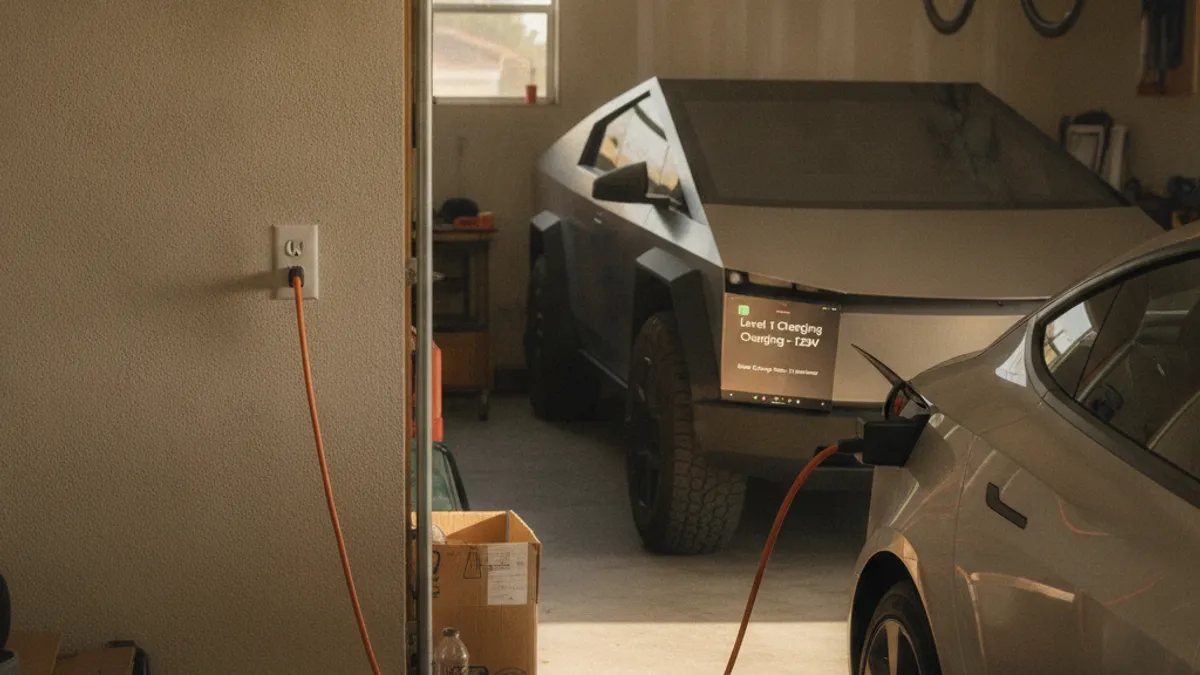
What a Level 1 EV charger actually is
It isn’t a wall box you order and mount. It’s the portable cable that lives in the trunk. One end fits a standard household outlet. The other end fits your charge port. You plug in, and the car sips power from a normal 120-volt circuit.
That circuit can only push so much current. That’s why the rate stays around 3 to 5 miles an hour. A near-empty pack on Level 1 can take two to three days. Orange County also has 47,567 plug-in hybrids in that CEC file. Their smaller packs can live on this cord. A full battery-electric car usually can’t, not as its only plan.
Some kits include a second adapter for a 240-volt dryer-style outlet. That isn’t true Level 1 anymore. Check your owner’s manual for what actually shipped with your car.
Twenty public ports, and why they don’t rescue you
Orange County’s public map isn’t built on wall outlets. CEC counted 5,600 public Level 2 ports as of December 31, 2025. It also counted 1,475 public DC fast ports. Public ports of every kind totaled 7,095. Level 1 is 20 of those. The file doesn’t list those 20 by street. Treat a public 120-volt receptacle as a lucky find, not a plan.
Even if you found one, you’d sit for hours for a handful of miles. A stranded car on I-5, I-405, the 91, or SR-22 needs range in minutes, not overnight. A workplace 120-volt receptacle is the same math. You’d still be there when the lot empties.
The county also carries more EVs per public port than California as a whole. CEC’s figures work out to 36.8 ZEVs per public port here, against 24.4 statewide. Slow outlets don’t fix that ratio. They just make a long wait longer.
Tesla makes up 65.51% of the county’s battery-electric fleet. Most of those cars can take a NACS Level 1 cord at home. That still doesn’t make 120 volts a rescue on Katella, the 22, or a Costa Mesa structure.
For how the three charging levels compare when you’re already stuck, see EV charging levels for stranded drivers.
When a wall outlet is enough, and when it isn’t
Level 1 can work at home if your day is short and you park all night. A few local errands, then a full sleep on the cord, can hold a modest routine. Miss a night and you’re already behind. A long Anaheim park day, or a Huntington Beach lot until evening, can outrun an overnight wall outlet.
You can’t make up that deficit on 120 volts before work. The cord’s still useful as a garage backup. It isn’t a recovery tool on the shoulder, in a structure, or at the curb.
Tesla’s Model Y owner’s manual is blunt about a fully empty pack. Once range is exhausted, the low-voltage battery can lose support. The car may need external power before the high-voltage pack will accept a charge. A random wall outlet doesn’t help if the car won’t wake.
A 240-volt home circuit changes the overnight math. A Level 2 circuit is the kind a dryer uses. It adds 20 to 44 miles an hour, depending on the car and breaker. Overnight then means a real recharge, not a trickle. We walk through that home-versus-shoulder choice in 240-volt charging at home, or on the shoulder.
Plug habits that keep a Level 1 night from failing
Skip the extension cord and the power strip. Plug the EV cable straight into a wall outlet. A long thin cord running for hours can heat up. If that outlet shares a circuit with a fridge, the breaker can trip. A trip at 2 a.m. is a dead car at 7 a.m.
What actually recovers a stranded OC EV
Public recovery here is Level 2 and DC fast, not Level 1. Tesla has 48 Supercharger sites and 861 DC fast ports in Orange County, per AFDC station data. Irvine’s 1920 Main St site lists 40 stalls. Electrify America has DC fast stalls at Fashion Island, 401 Newport Center Dr in Newport Beach. There’s another site at 440 N Euclid St in Anaheim. Those stalls refill in a short session, and a wall outlet doesn’t. If you can’t reach one, sitting on 120 volts is the wrong wait.
The pros we connect you with bring a 240-volt Level 2 source to the car. They use native NACS for Tesla, plus CCS or J1772 adapters for other brands. Charging time is typically 10 to 20 miles of range in 15 to 30 minutes. That’s time on the plug, not a promise of when someone arrives.
Charge Pro OC is a referral line. We don’t perform the work, and we don’t own the trucks. We match stranded drivers with independent local mobile rescue operators. The operator quotes you before starting and bills you directly. Read what’s an EV charging truck, and how mobile rescue works here. The mobile EV charging page covers the on-site path. For the home-versus-rescue fork, see home charger install vs mobile rescue. For the county map, start at EV charging in Orange County.
If a 120-volt cord left you short of the next stall, call (949) 444-0151. An operator can quote a mobile charge at the car.
Frequently asked questions
Can a Level 1 EV charger get a stranded Orange County car moving?
Not in any useful window. The CEC count is 20 public Level 1 ports, each adding 3 to 5 miles an hour. A stranded driver needs Level 2, DC fast, or a 240-volt source at the car.
How many miles per hour does a Level 1 EV charger add?
About 3 to 5 miles of range per hour, depending on the vehicle. From near empty, a full charge can take two to three days. That’s why it’s a garage trickle, not a rescue.
What’s the difference between Level 1 and a roadside charge?
Level 1 is 120 volts from a household outlet. A roadside operator brings 240-volt Level 2 to wherever the car sits. The truck session adds enough miles to reach a faster stall or get you home.