EV roadside assistance in Rancho Santa Margarita is a charge at the car. There’s no Tesla Supercharger inside the city. The nearest listed site sits in Laguna Hills at 25248 Cabot Rd. That’s 5.1 straight-line miles. Road miles over the foothills run longer. In town, EVgo at Plaza Antonio, 22351 Antonio Pkwy, is the real DC fast island. It has 14 ports. That’s the backup when the Tesla map goes thin.
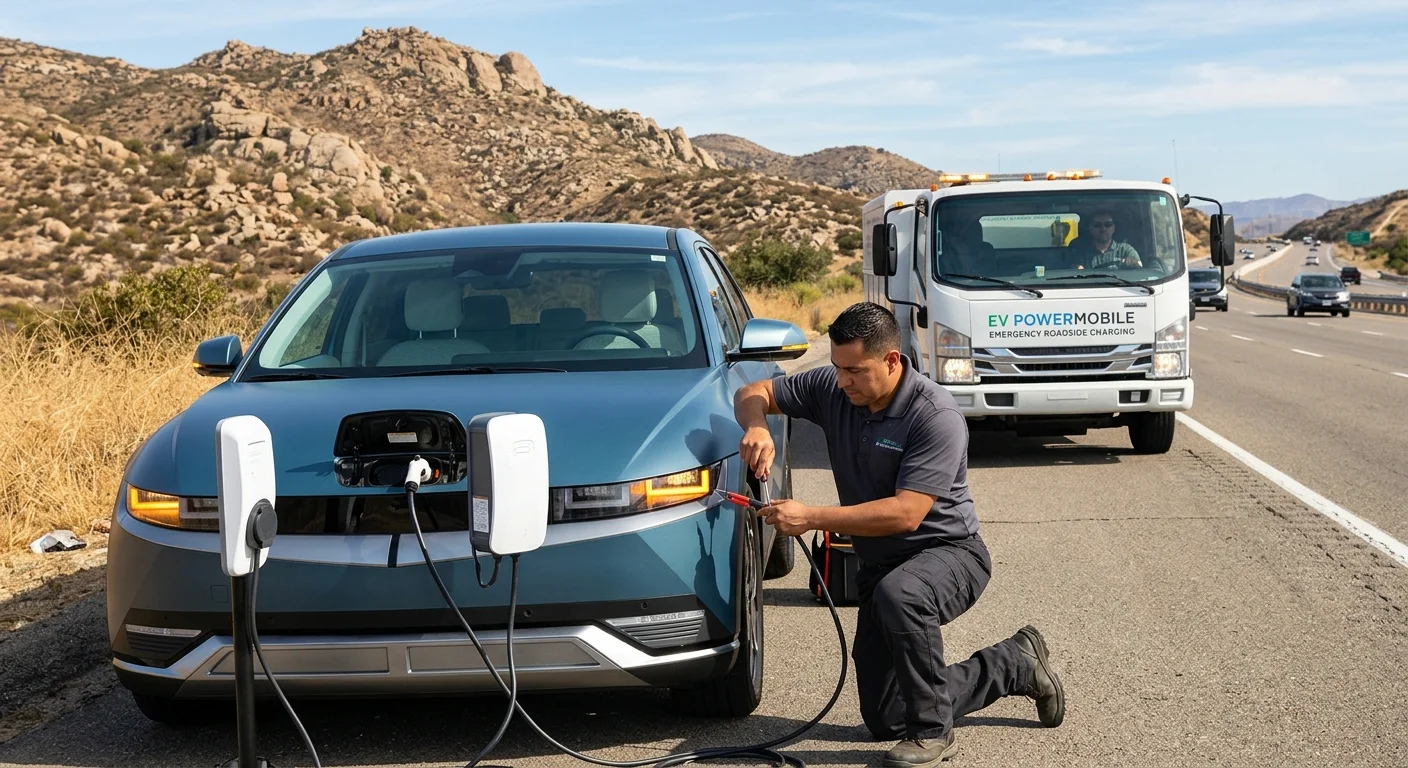
This city sits on a plateau, not on I-5
People still call Rancho Santa Margarita unincorporated. It isn’t. The city’s been incorporated since January 1, 2000. It’s the 33rd city in Orange County. The line takes in the planned core. It also takes in Robinson Ranch, Dove Canyon, Rancho Cielo, Trabuco Highlands, and Walden. About 47,257 people live here. The ZIPs are 92688, 92679, and 92678.
You’re on the Plano Trabuco plateau, against the Santa Ana Mountains. Arroyo Trabuco drops away to the west. SR-241 is the freeway in: the Foothill toll road. You reach it from Santa Margarita Parkway or Antonio Parkway. There’s no I-5 frontage at all.
The surface roads you’ll actually stall on are local. Santa Margarita Parkway. Antonio Parkway. Alicia Parkway. Avenida de las Banderas. Avenida Empresa. Plano Trabuco Road. Los Alisos Boulevard. Lago Santa Margarita and the SAMLARC Beach Club sit in the middle. RSM Central Park and Upper Oso Reservoir do too. City Hall and the library share 22112 El Paseo. O’Neill Regional Park is next door. Tijeras Creek Golf Club is in the same fold. Plano Trabuco is the gateway toward Trabuco Canyon and the Cleveland National Forest.
For the in-city charger list, use the Rancho Santa Margarita charging page.
Heat here isn’t a coastal problem
This is the hottest, driest corner of South Orange County. There’s no marine layer on this plateau. Cabin cooling is a real range tax in summer. AAA publishes an 8.5% range loss at 95 F with the air conditioning on. That figure fits Rancho Santa Margarita. It doesn’t fit a beach city with afternoon breeze.
You’re also in a wildfire-interface community. CAL FIRE puts this area in a Very High Fire Hazard Severity Zone. Hot, dry, and stacked against the mountains is the climate you drive in.
A pack that looked fine in Mission Viejo can sag on the 241 climb. Add air conditioning. Add a stop at the lake. The range number on the screen was built on easier miles.
After a few hours at the SAMLARC Beach Club, the cabin is oven-hot. RSM Central Park is the same. So is City Hall at El Paseo. So is a round at Tijeras Creek. You start the AC before you’ve left the lot. That draw stacks on a thin ride home. None of those lots is a Supercharger. Plaza Antonio is the DC island you drive to, if you can still move.
Melinda Heights, Tijeras Creek, Altisima, and Canyon Crest sit on that same hot shelf. Las Flores is on the edge. Robinson Ranch is too. Dove Canyon and Rancho Cielo sit behind gates. An operator still needs a code or a meet. Say that up front.
What the fast-charge map actually shows
If you drive a Tesla, this city is a Supercharger desert. That’s a map term with a method. There’s no Tesla-listed Supercharger inside the municipal line. The closest is Cabot Road in Laguna Hills. That’s 5.1 straight-line miles. Laguna Hills also has 16 stalls at 23701 Moulton Parkway. Both still sit off the plateau.
Non-Tesla drivers have a stronger in-town option. EVgo at Plaza Antonio, 22351 Antonio Pkwy, lists 14 DC fast ports. Per the DOE station locator, it’s inland South Orange County’s largest non-Tesla fast site. Target RSM adds 3 DC fast ports and 1 Level 2 stall. Avila RSM Apartments lists 7 Level 2 ports. Those apartment plugs are for residents. They’re not a public rescue plan.
Orange County had 210,842 battery-electric vehicles on the road as of December 31, 2025. Tesla made up 65.51% of those BEVs. Public ports lag that fleet. The CEC math is 36.8 ZEVs per public port in the county. Statewide it’s 24.4. On this plateau, Tesla owners feel it first. The Superchargers sit over the hills.
If Plaza Antonio is queued or a cabinet is down, waiting it out isn’t a plan. A truck at the bumper is.
SR-241 is where empty actually happens
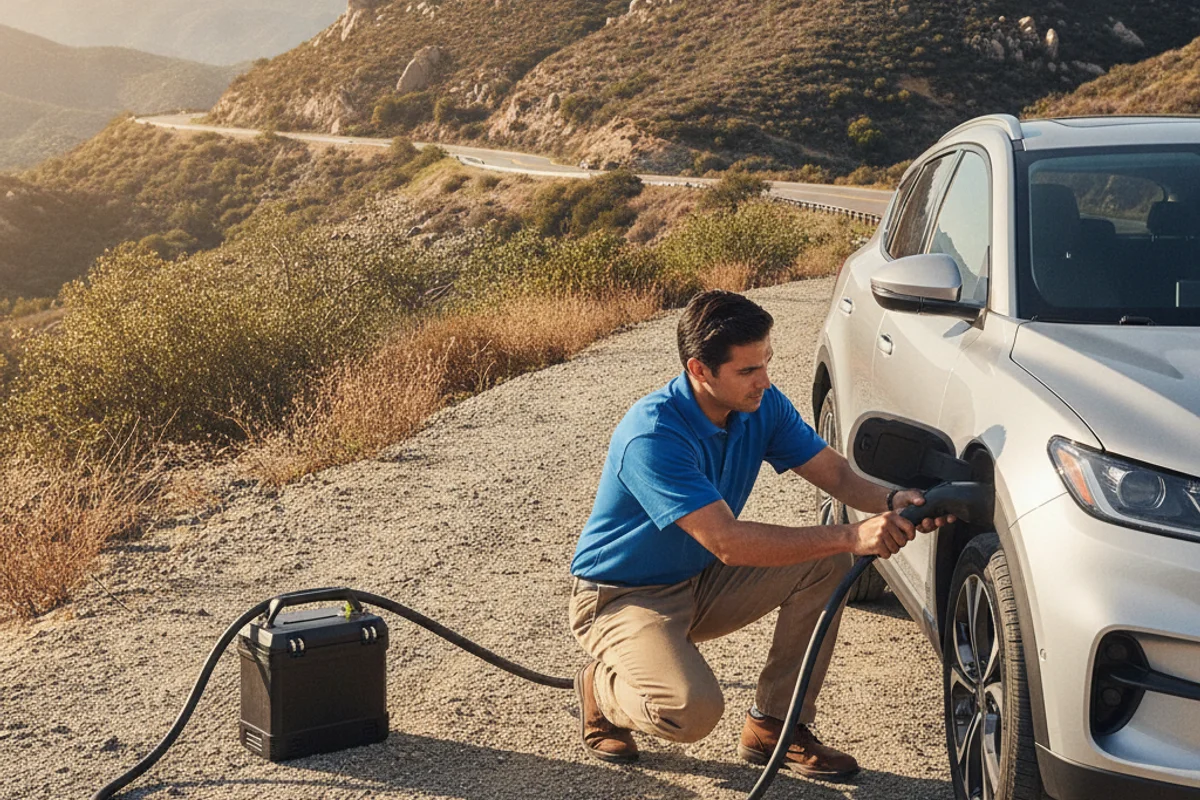
Most of this city goes to work on SR-241. It’s a toll road with real grade and long stretches. It isn’t a surface street with a grocery charger on the corner. Published Freeway Service Patrol coverage skips the toll roads. Run out north of Santa Margarita Parkway and the picture gets awkward. You’re on a shoulder that list doesn’t treat as a regular beat. The SR-241 empty-pack guide is the playbook for that shoulder.
Stay in the vehicle if that’s the only safe place. Put the hazards on if the 12-volt still feeds them. Don’t walk the toll lanes. Don’t spend the last miles guessing you can make Cabot Road. Straight-line distance isn’t the road you still have to climb.
Antonio Parkway and Santa Margarita Parkway are the ramps back into town. They’re also where a lot of low-range drives finish. The climb already spent the buffer. Alicia Parkway and Plano Trabuco Road add more hill if you’re pointed at the canyon.
Empty pack, or a 12-volt that quit
Both failures look like a dead car. They aren’t the same fix. Dark screens and odd door behavior are clues. A car that won’t wake often points at the 12-volt. Tesla’s owner’s manual says that once range is gone, the low-voltage battery can lose support. The high-voltage pack then needs external power before it’ll take a charge.
Operators in this network jump or replace a dead 12-volt on site. They also roll up a 240-volt Level 2 source. Teslas take a native NACS plug. Other EVs use a CCS or J1772 adapter. Typical charging time puts about 10 to 20 miles back in 15 to 30 minutes. That’s time on the cable. It isn’t a promise of when the truck arrives.
Tesla’s own roadside policy answers a depleted battery with transportation. Running empty isn’t a financially covered service on Tesla’s wording. The 500-mile transport Tesla describes is for a warrantable breakdown that leaves the car undrivable. An empty pack isn’t that breakdown. If you want charge at the bumper, that’s out-of-charge recovery.
For the truck itself, read what a mobile EV rescue truck brings.
Charge on the plateau, don’t assume a tow
A tow over the hills sounds clean until the car has no power. Many EVs need a flatbed and a set roll direction. A dead 12-volt can block doors and park release. Charging first keeps the car in Drive. That’s how it was built to move.
Plaza Antonio can be the right second stop once you have a buffer. Cabot Road can be the right second stop in a Tesla, if you can actually reach it. Neither helps if you’re already stopped on SR-241. Neither helps inside Dove Canyon. Neither helps in a driveway off Avenida Empresa. That’s when the operator comes to you.
Charge Pro OC doesn’t own the truck. It’s a referral line. It matches stranded EV drivers in Orange County with independent local operators. The operator quotes before starting and bills you directly. We don’t set the price. We don’t promise an arrival window. We don’t hold a contractor license. We don’t do the work. The pros we connect you with handle Tesla and every major EV brand.
Dove Canyon and Rancho Cielo add a gate. Robinson Ranch and Trabuco Highlands are simpler on access. They’re still on the same hot plateau.
Nearby towns don’t pull you if you’re already stopped
Coto de Caza sits next door. It’s also 5.1 straight-line miles from that Cabot Road Supercharger. Its streets are gated. Las Flores and Trabuco Canyon sit toward the canyon. Mission Viejo has Superchargers at 27741 Crown Valley Parkway. There’s another at 555 The Shops at Mission Viejo. Lake Forest has stalls at 24301 Muirlands Boulevard. There’s a Magic Dock site at 24372 Rockfield Boulevard. Those sites help if you can still drive. They don’t help if you’re already sitting in RSM.
Heading up Plano Trabuco on a thin buffer is a choice. You’re moving away from Plaza Antonio and the Target DC ports. Keep enough range to turn around, or plan on a truck.
If the car is empty on a city street, EV roadside assistance is the call. Same if you’re in an HOA garage or on the 241 shoulder. Tell the operator your plug type. Say about how many miles you need. Say whether you’re behind a gate.
Call (949) 444-0151 and we’ll connect you with a local operator. That operator quotes you before any work starts.