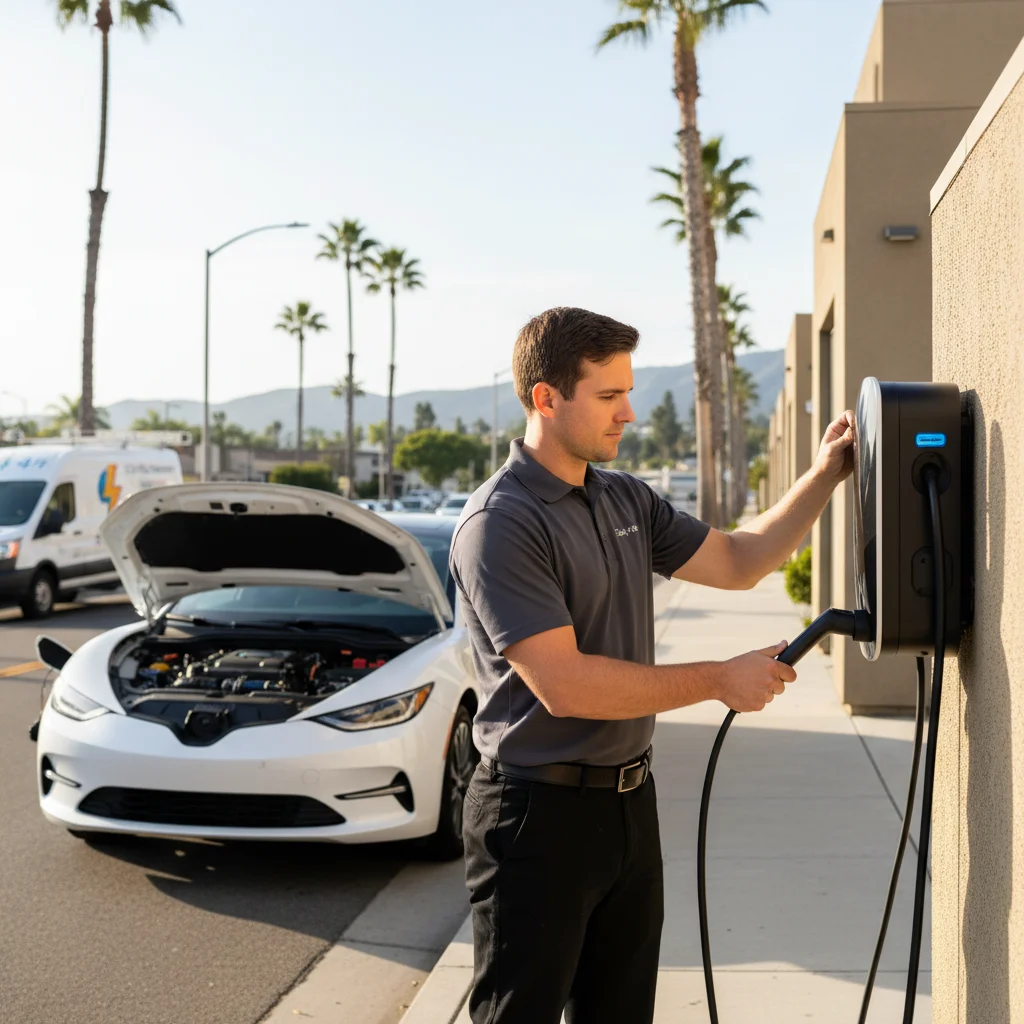
An empty EV in Garden Grove usually dies in a parking stall. Harbor hotel lots, 1950s carports, and the SR-22 shoulder are typical. You don’t have to hunt a Supercharger first. EV roadside assistance means a local operator brings 240V to the car.
Garden Grove has fast stalls. Your car often isn’t there
Garden Grove isn’t missing public charging on the map. Tesla lists two Supercharger sites inside the city. Harbor Town and Country at 12891 Harbor Boulevard has 32 stalls. Those stalls are rated up to 250 kW. The newer site sits at 12161 Valley View Street, beside a Starbucks. It has 16 stalls, rated up to 500 kW. AFDC flags Valley View as one of the fastest sites in Orange County. Federal station data lists its open date as June 26, 2026. Electrify America also runs a DC fast stop at 12075 Euclid Street.
Those pins help when you can still roll. They don’t help once you’re already parked. Harbor hotel lots, Little Saigon apartments, and SR-22 are where cars stop. Harbor or Valley View can still be queued or offline. We covered that in when the Garden Grove Tesla stalls are packed or offline.
Orange County had 210,842 battery-electric cars as of December 31, 2025. That’s California Energy Commission data, not a brochure. The county holds 12.02% of California’s BEVs. It holds only 8.33% of the state’s light-duty fleet. Public ports haven’t matched that weight. CEC counts 7,095 public ports in Orange County. That’s 36.8 ZEVs per public port, versus 24.4 statewide. Garden Grove sits in the dense middle of that squeeze.
For stall locations and nearby cities, use our Garden Grove EV charging page.
Harbor Boulevard, park guests, and a lot that won’t charge you
The Harbor Boulevard hotel strip is Garden Grove’s defining empty-pack pattern. Thousands of Disneyland visitors sleep in Garden Grove instead of Anaheim. They’ve driven in from Arizona, Nevada, or Northern California. The pack’s already low, and they assume the hotel has a working destination charger. Often it has two plugs, both taken, or one that’s offline.
You’ve got a park day tomorrow. Sitting at Harbor Town and Country all evening isn’t always realistic. A mobile charge in the hotel lot still works. Great Wolf Lodge sits on that same resort edge. The Chapman and Harbor district works the same way. Cars sit in hotel stalls, not in a Supercharger queue.
Christ Cathedral, once the Crystal Cathedral, pulls weekend traffic onto Chapman. Village Green Park and the Garden Grove Amphitheater fill nearby lots. The Atlantis Play Center does it on family afternoons. Garden Grove Hospital Medical Center at 12601 Garden Grove Boulevard is the weekday version. You park, you stay, and the dash goes quiet.
Operators we send don’t need that public stall. They park beside you, quote the job, and bill you directly. Charge Pro OC doesn’t own the truck. We match you with the independent pro who does.
1950s tracts, carports, and Little Saigon blocks
Garden Grove is a postwar tract city, not a hillside suburb. Census data shows 77.8% of homes were built before 1980. A striking 36.8% went up in the 1950s. Those houses often have small electrical panels. Parking is a detached garage or a narrow carport. Overnight Level 2 at home was never in the original plan.
West Garden Grove, Garden Park, and Woodbury still live in that stock. So do Buena Clinton and Stanford Village. Historic Main Street and the Civic Center add street parking and older lots. Little Saigon along Bolsa Avenue is denser still. The Asian Garden Mall sits on the Westminster line. Apartment blocks there often have no assigned charger.
About 170,603 people live in Garden Grove. Vietnamese residents are 32.4% of the city. That’s the largest Vietnamese population in the county. Hispanic or Latino residents are 37.6%. Spanish is spoken at home by 29.0% of residents. West along Bolsa, Vietnamese comes first. East and southeast, Spanish is more common. Help still has to reach the curb in every ZIP. Those ZIPs are 92840, 92841, 92843, 92845, and 92844.
The ground won’t save you or strand you. Elevation is about 83 feet, and the city’s uniformly flat. Historic drainage runs southwest toward the Westminster and Bolsa Chica lowland. Range here drains on congested arterials, not grades. Harbor, Brookhurst, Euclid, and Magnolia crawl at peak hours. So do Garden Grove Boulevard, Chapman, Katella, and Westminster Avenue. Trask, Lampson, and Valley View join that crawl. Mid-county air is partially marine-moderated. Terrain doesn’t cut range here. Congestion on SR-22 does.
SR-22, Beach Boulevard, and the I-405 clip
SR-22, the Garden Grove Freeway, runs the full length of the city. That’s the shoulder-call corridor. If the pack hits zero there, stay in the car when it’s safe. Put the hazards on, and don’t walk the lanes hunting a charger pin. The playbook for that stretch is in stranded on SR-22 at the Crush.
I-405 clips the southwest corner, and SR-39 Beach Boulevard holds the west line. Stay put on those shoulders, then charge at the bumper. Then you leave under your own power.
If you’re in a Tesla, Tesla Roadside Assistance still answers at 877-798-3752. Tesla’s published policy treats a depleted pack as paid transport. It isn’t a covered on-site charge. Free transport up to 500 miles is for a warrantable breakdown. That breakdown has to leave the car undrivable. Running out of charge sits outside that. The operators we connect you with bring a charge to the bumper instead.
Tesla still makes up 65.51% of Orange County’s battery-electric fleet. Harbor’s 32 stalls are built for that majority. Non-Tesla drivers still stall on the same streets. Euclid’s Electrify America site is one answer for CCS cars. A curb charge is the other when you can’t roll that far.
Empty pack versus a 12V that killed the car
Two failures look identical from the sidewalk. The traction pack can be at zero, or the small 12V battery is dead. That 12V runs computers, lights, and door latches. Teslas, Hyundais, Fords, Rivians, and GM EVs all carry one. When it dies, the car won’t wake and the charge port may not open. The big pack is still there, just unreachable.
Tesla’s Model Y owner’s manual notes a further wrinkle. The low-voltage battery can lose support once range is exhausted. You may need external power before the high-voltage pack will charge. That’s why a jump isn’t a gimmick on an empty Tesla. Operators jump or replace a dead 12V on site. They also handle a pack that’s simply empty. Out-of-charge recovery is the name for both jobs.
Don’t keep jumping a 12V that dies again an hour later. That’s a replacement conversation, not another bump from a portable pack.
What shows up: 240 volts, not a tow first
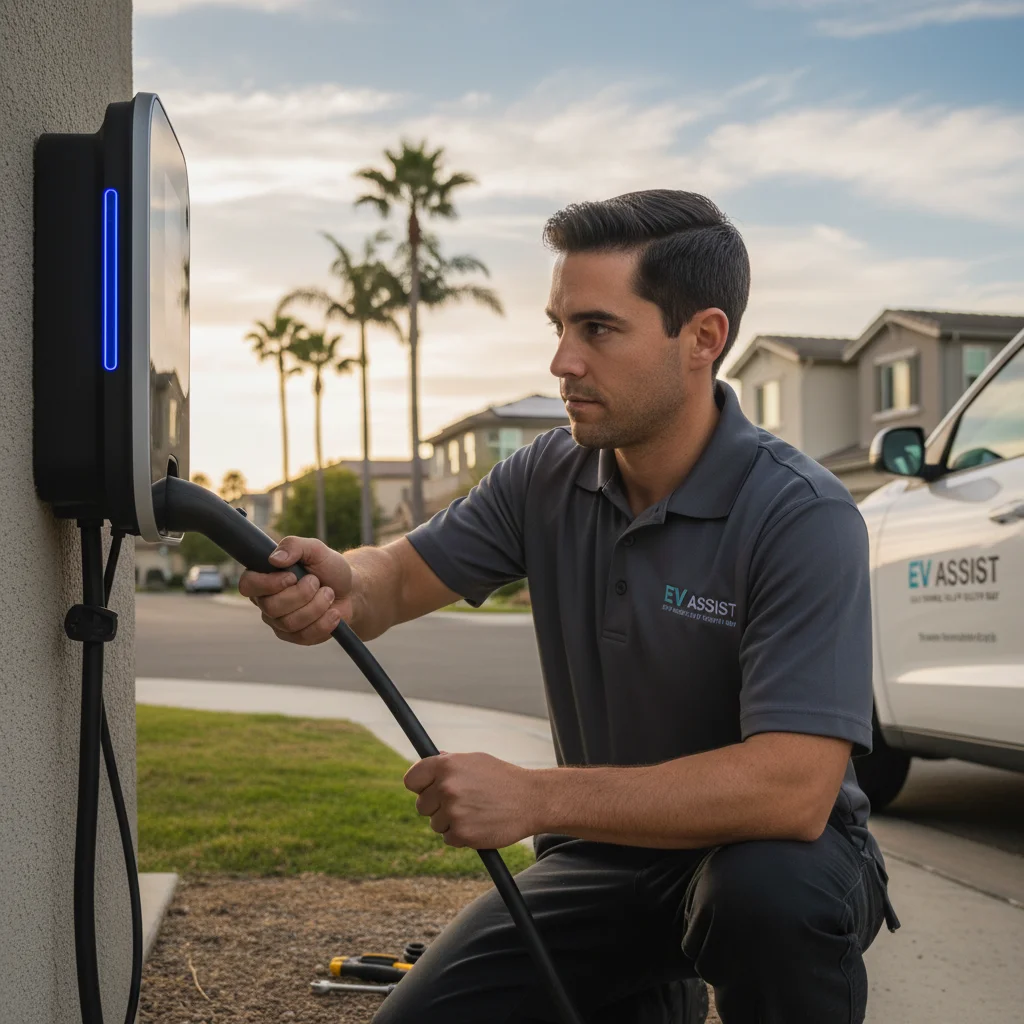
The truck that arrives is a mobile 240V Level 2 source. Teslas take a native NACS plug. Other EVs use a CCS or J1772 adapter. Typical charging time is 15 to 30 minutes. That window is plug time, not a promise of when the truck appears. Most cars pick up about 10 to 20 miles of range. That’s enough to reach Harbor, Valley View, or Euclid under your own power.
The operator quotes you before any cable goes in, and you pay that operator. Charge Pro OC sets no prices and publishes no arrival clock. The pros we connect you with are licensed and insured. We serve every city in Orange County, including Garden Grove’s neighbors. Westminster, Santa Ana, Anaheim, Stanton, and Fountain Valley sit on the same arterial grid.
Mobile EV charging is the right call when the car still accepts a charge. A tow is the right call when it won’t take current. A smashed port or a pack that refuses current needs a flatbed and a shop. An honest operator will say so. For that fork in the road, read mobile EV charging or a tow.
After 10 to 20 miles back in the pack, you’re driving. Harbor Town and Country is the Tesla path from the hotel strip. Valley View is the high-power option on the west side. Euclid covers many CCS cars. In a 92840 carport, you may only need enough range to get home. Plug into whatever outlet you already have once you’re off the street. A household Level 1 trickle won’t rescue you on SR-22. It can finish the night in the driveway.
If the car won’t move, call for a curb charge
You’re not waiting on a miracle stall. You’re asking for range at the bumper. Tell the operator your street and the nearest arterial. Say whether the dash is fully dead or just at zero. Mention a hotel lot, a carport, or a freeway shoulder. That changes how they set up the truck.
Stay with the car, and keep hazards on if you’re on SR-22 or Beach Boulevard. Don’t stand in traffic. Don’t take a ride and leave an empty EV in a fire lane. The operator needs the car, the port, and you for the quote.
Call (949) 444-0151 when you’re ready. We’ll connect you with a local independent operator. They quote first, then charge the car in front of you.