When an EV sits empty at Dana Point Harbor, stay with the car. EV roadside assistance here is a Level 2 charge at that stall. It’s not a hunt for a Supercharger down the coast. Charge Pro OC connects you with independent local operators. Those operators bring 240V to the space you’re in. The operator quotes you before any cable goes in. You pay that operator directly.
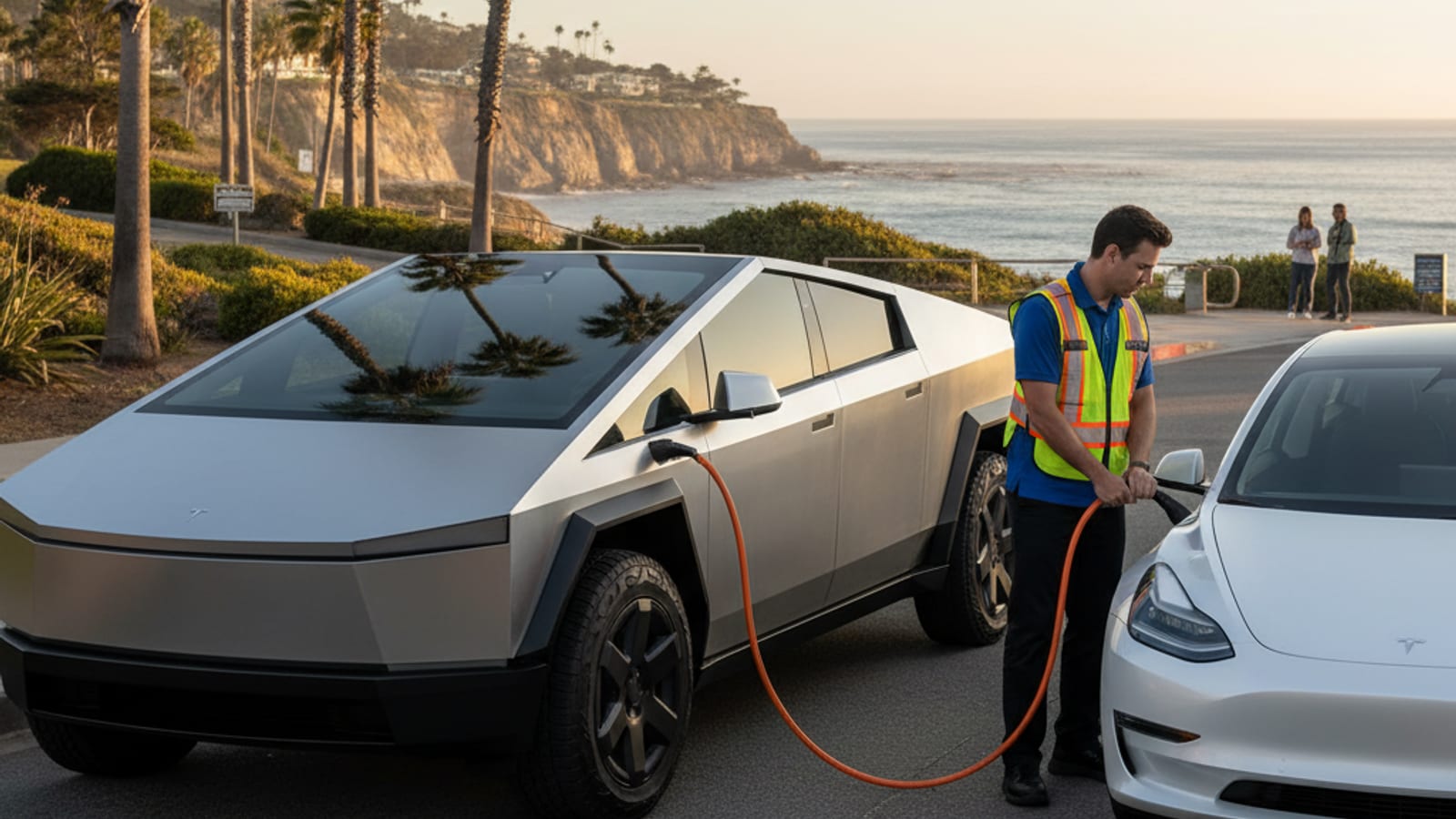
Dana Point is a harbor town on a bluff. The slips sit near sea level. The rest of town sits roughly 144 feet up. Golden Lantern, Blue Lantern, and Selva Road all drop hard to the water. They climb just as hard on the way out. Pacific Coast Highway runs the length of the city. Summer PCH traffic adds its own drain. I-5 sits inland. You reach it on PCH, Camino Las Ramblas, or Crown Valley. SR-73 ends at I-5 just north of town. That mix is why a normal harbor day can empty a pack.
Harbor parking is a long sit, not a quick errand
Dana Point Harbor is the working center of this city. It holds thousands of slips. Visitor parking fills around the Ocean Institute, the charter docks, and the harbor shops. Boat owners leave cars for days. Whale-watching and fishing charters park people for six to eight hours. That dwell is 12V territory as much as range territory.
A Tesla can look fine at 9 a.m. Sentry mode, cabin overheat protection, and the 12-volt system keep sipping. By late afternoon the dash can be dark. The pack may still have miles. The little battery that wakes the car may not. If nothing lights up, treat it as a 12V problem first. A Tesla 12V battery jump at the stall beats dragging the car through harbor traffic.
If the high-voltage pack is actually at zero, don’t roll down Golden Lantern on hope. The descent is easy. The climb back to Del Obispo, Stonehill, or PCH is not. You’d spend the last miles on a grade. Stay in the lot. Call for mobile EV charging at the car.
Harbor Point, Doheny Village, and the Lantern District all feed the same funnel. Dana Point Harbor Drive, Del Obispo Street, and Golden Lantern are how most visitors arrive. Those streets are parking, boat ramps, and a steep exit. They’re not a Supercharger plaza. Camino Del Avion and Stonehill Drive tie the harbor to Capistrano Beach. They also reach the inland arterials. If you’re empty on any of them, pick a legal curb and stop.
Capistrano Beach uses ZIP 92624. The rest of Dana Point uses 92629. Say which one you’re in. It changes which lot the operator is hunting.
No Supercharger in town, and the Capistrano Beach flagship
There’s no Tesla Supercharger inside Dana Point. You won’t find one on Golden Lantern. You won’t find one on PCH through town, or on Dana Point Harbor Drive. Orange County has 48 Tesla Supercharger sites and 861 DC fast ports. None of those sites sit inside this city. Tesla drivers who planned on a Supercharger stall have to look in the next city. That only works if the car can still move.
San Juan Capistrano has two Tesla Supercharger sites. One is at 31971 Camino Capistrano. It’s the older seven-stall, 125 kW location that opened in 2014. The other is at 26701 Verdugo Street, with 12 stalls at up to 250 kW. San Clemente has a much larger pair on Avenida Vista Hermosa. The site at 101 W Avenida Vista Hermosa has 49 stalls. The site at 990 Avenida Vista Hermosa has 16. Those stalls help a car that can still drive. They don’t help a car that already died in harbor parking.
For non-Tesla drivers, the south-county flagship is Electrify America’s Dana Point Station. It sits at 25825 Las Vegas in Capistrano Beach. That’s inside Dana Point’s 92624 ZIP. The site has 12 DC fast ports. It’s the largest non-Tesla DC fast site in south Orange County. If your CCS car still has a few miles, that’s the stall to aim for. If you’re already at zero in the harbor, a truck at the car is the move.
Open the Electrify America app, PlugShare, or your in-car map before you roll. Confirm the ports are up. A public stall can be occupied, offline, or queued. That’s not a reason to guess a backup in your head. It’s a reason to keep a roadside option when the pack is already empty.
AFDC station data for Orange County shows how Tesla-heavy the fast map is. The county has 223 DC fast stations and 1,452 DC fast ports. Take Tesla out of that file and you have 175 stations and 591 ports. Tesla holds 59% of the county’s public DC fast ports. Electrify America has 30 stations and 138 ports countywide. The Capistrano Beach site sits in this city. It’s the local piece of that network.
Resorts on the bluff, and a long afternoon at Doheny
The second Dana Point pattern is the resort driveway. The Waldorf Astoria Monarch Beach sits on this bluff. So does the Ritz-Carlton Laguna Niguel. The Ritz-Carlton carries a Laguna Niguel name. The building is physically in Dana Point. Guests arrive from out of state with a thin pack. They find the hotel chargers taken. Monarch Beach Golf Links and the Waldorf sit on that same headland strip. Crown Valley Parkway is the inland approach at the Monarch Beach end. PCH is the coastal one.
Those resorts sit in Monarch Beach. The Strands at Headlands, Niguel Shores, Ritz Cove, and Sea Terrace wrap around them. Some of those streets are gated. An operator still needs a gate code and a stall number. Give a clear description of the car. The Strands funicular is a landmark, not a plug. People park, walk the bluff, and come back to a silent dash.
Doheny State Beach is the third pattern. It’s a long beach day in a hot lot. Afternoon sun sits on a dark pack. Climate control on the way in already spent range. Doheny is a state-park stall with a walk to the water. When the car won’t wake, stay with the vehicle. Don’t limp up Doheny Park Road on a warning light. Don’t try Camino Del Avion that way either.
Salt Creek Beach and the Headlands Conservation Area add the same coastal dwell. Lantern Village sits above the harbor. Locals also call it the Lantern District. The streets are a steep grid. Street parking there is older coastal housing, not a charging plaza. About 50.7% of Dana Point homes were built before 1980. Carports, shared drives, and curb parking are common. Overnight Level 2 isn’t a given for a guest.
What the operator brings to the curb
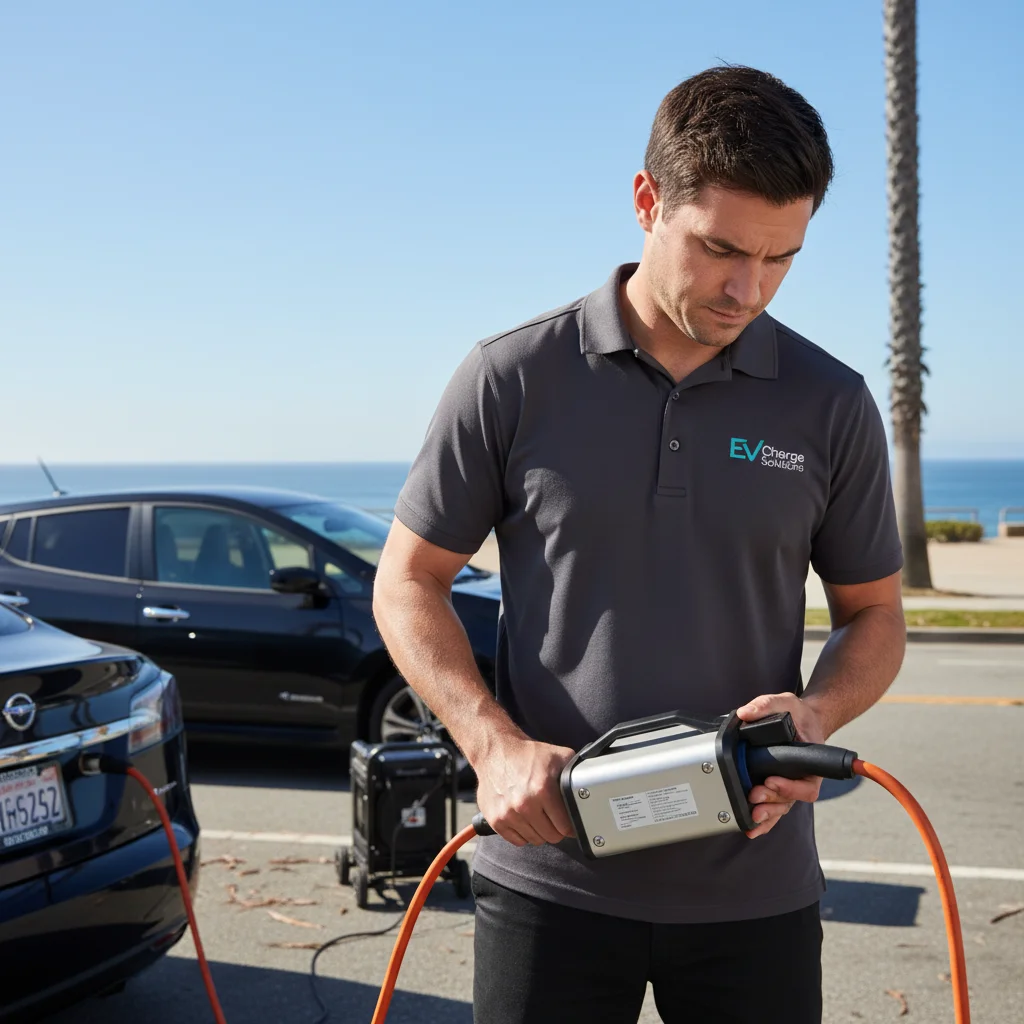
Charge Pro OC doesn’t own trucks and doesn’t employ technicians. It’s a referral line. We match you with independent local operators. The pros we connect you with are licensed and insured. They bring a 240V Level 2 source to the car. Tesla owners get a native NACS plug. Other EVs get CCS or J1772 through an adapter. The session is a short top-up, not a full pack. Operators handle Tesla and every major EV brand.
Typical charging time is 15 to 30 minutes. That’s time on the cable. It’s not an arrival window. In that charging window, operators typically add 10 to 20 miles of range. How far that actually takes you depends on the climb. Ten miles on PCH through town isn’t ten miles up Golden Lantern from the harbor. Ask for enough range to reach a stall you can actually use. For a Tesla, that may be a San Juan Capistrano Supercharger. That’s only if you can still drive. For a CCS car, that may be Electrify America on Las Vegas Avenue. That’s the Capistrano Beach site.
If you want a plain look at the truck itself, read what’s an EV charging truck, and how mobile rescue works here.
The operator will want the make, model, and charge-port type. They’ll want a pin on the map, not “near the harbor.” Harbor parking is large. Name the lot, the aisle, and the car’s color. “By the boats” isn’t enough. Give Harbor Point or the Ocean Institute if that’s where you are. In Capistrano Beach, name Las Vegas Avenue, Doheny Park Road, or the lot you’re in.
Once the cable is in, stay with the car. Lots here move. A gate or a lot rule can ask you to shift. The operator bills you directly. Charge Pro OC doesn’t set the price and doesn’t collect it.
When the pack is fine and the car still won’t wake
Harbor dwell makes 12V failures look like empty packs. Tesla’s Model Y owner’s manual describes what happens when range is gone. The low-voltage battery can lose support. Then the high-voltage pack can’t charge until something feeds the 12-volt system. That’s a technical fact, not a scare line. It’s why a jump at the stall can still matter. You may have called for a charge.
Signs skew toward 12V when the screens are black. Handles may not present. The app may not wake the car. Signs skew toward an empty pack when the car still talks to you. The range will read zero. If you’re unsure, say so on the call. The operators we connect you with can jump or replace a dead 12V on site. Then they can charge if the pack is also low.
A car that sat through a charter is a classic 12V candidate. So is one that sat through a resort check-in or a Doheny picnic. So is a car that sat in The Strands or Niguel Shores while you walked the bluff. Heat on a closed cabin adds load. So does Sentry in a public lot.
Don’t keep jumping the 12V and driving off as a plan. If it dies twice, the battery wants replacement, not another boost. The roadside visit gets you home or to a stall. A shop visit finishes the job.
What actually moves the quote
Operators quote before they start. There’s no published rate card on this site, and we won’t invent one. What changes the quote is ordinary fieldwork.
Distance to you is the first lever. A harbor stall, a Monarch Beach gate, and a Capistrano Beach side street are different drives. Time of day is the second. PCH in summer changes the job. So does a packed Doheny lot, or a late charter return. Those all change how long the operator is on site. How much range you need is the third. A bump to the Electrify America site is a shorter session than a bump toward San Clemente. A 12V jump with no charge is a different job than a 240V session.
Tell the operator which of those you need. Get the quote. Then decide. The quote exists so you’re not surprised after the cable is in.
Charge Pro OC doesn’t promise a clock. Traffic on I-5, Crown Valley, and PCH is real. The operator gives you their own window when they take the job.
Charge where it sits, or put it on a flatbed
A dead EV in harbor parking is a poor first candidate for a tow. Many EVs shouldn’t be flat-towed. A flatbed needs room to line up in a crowded visitor lot. Boat trailers, foot traffic, and tight aisles make that worse. A charge at the stall skips the hook.
Towing still has a place. A mechanical fault can require a flatbed. So can a bent wheel, or a pack that won’t accept charge. In those cases, a shop is the honest path. Tesla’s own roadside policy answers a depleted battery with transportation, not with on-site charging. Running out of charge isn’t treated as a warrantable breakdown on Tesla’s roadside page. You can still call Tesla for transport. That’s transport on Tesla’s terms, not warrantable breakdown coverage.
For a local comparison of charge, jump, or tow, see electric car died: should you charge, jump, or tow it.
If you already made it onto I-5, different rules apply. That’s if the car died on the shoulder. Stay in the vehicle if it’s safe. Put the hazards on. Don’t walk the lane. South of town, the San Clemente stretch is its own problem. We wrote that up as empty on I-5 near San Clemente: shoulder first, then a charge.
Neighboring cities when you still have a few miles
If the car can still move, pick a stall you can actually finish. Capistrano Beach’s Electrify America site is the non-Tesla flagship here. San Juan Capistrano’s two Supercharger sites are the Tesla options in the next city. San Clemente’s Vista Hermosa sites are the large Tesla plazas down the coast.
Laguna Niguel sits above you on the inland side. Gated streets there have the same access problem as The Strands. San Juan Capistrano is the mission-and-rail next door. Laguna Beach is the next coastal city northwest on PCH. Charge Pro OC serves every city in Orange County. Dana Point is the harbor-and-bluff version of the same referral. The operators we send still quote before they start. They still bill you. They still bring 240V rather than a promise.
For a city-level snapshot, start at the Dana Point EV charging page.
Orange County’s EV file, and why a harbor town still calls a truck
This isn’t a small-market problem. The California Energy Commission vehicle file, data as of December 31, 2025, counts 210,842 battery-electric cars on Orange County roads. Plug-in hybrids add 47,567. Fuel cells add 2,424. The ZEV total is 260,833. That’s 10.56% of the county’s light-duty fleet. BEVs alone are 8.54%. California’s ZEV share in the same file is 7.54%. Orange County holds 12.02% of California’s battery-electric vehicles while being 8.33% of the state’s light-duty fleet.
Tesla is 138,121 of those 210,842 Orange County BEVs, or 65.51% of the county’s battery-electric fleet. That’s 6.4 points more Tesla-heavy than the state. A harbor lot full of Model Ys matches the registration file.
Public charging hasn’t kept a matching pace. CEC’s December 2025 charger file counts 7,095 public ports in Orange County. That’s 20 Level 1, 5,600 Level 2, and 1,475 DC fast. Statewide, the ratio is 24.4 ZEVs per public port. In Orange County it’s 36.8. The county is worse served per EV than the state average. That’s a government-sourced fact, not a slogan.
New ZEV sales in Orange County still run ahead of the state. In 2025, 28.76% of new light-duty sales here were ZEVs, against 22.93% statewide. In 2026 Q2 the county was at 24.77% against 19.09% for California. The trend isn’t a straight climb. California’s ZEV share of new sales peaked at 25.31% in 2024. Don’t read this as a boom that will fill every lot with a stall. Read it as a lot of EVs, and a harbor town with no Supercharger.
The Census puts Dana Point’s population at 32,883. About 22.6% of residents are 65 and over. The searcher for this page is often a visitor, a boat owner, or a commuter on PCH. It isn’t only a year-round local.
Stay put, then call
If you’re on the Golden Lantern descent with a range warning, don’t try to finish the climb on fumes. Pull into a legal space. Hazards on if you’re blocking anyone. Then call. Give the operator the neighborhood. Harbor, Capistrano Beach, Monarch Beach, The Strands, Niguel Shores, Lantern District, or Doheny all mean different pins. Give the car’s make. Say whether the screens are on.
Charge Pro OC’s number is (949) 444-0151. That line matches you with an operator. It doesn’t dispatch a branded fleet. The operator confirms the work and the quote. Then they bring 240V, a 12V jump, or they tell you the car needs a flatbed instead.
Keep people out of the travel lane on PCH. Stay off Golden Lantern’s downhill traffic while you wait. If someone is hurt, that’s 911, not a charging call.
Frequently asked questions
Can an operator charge a Tesla in harbor parking?
Yes. The operators we connect you with bring a native NACS plug. They also carry CCS and J1772 adapters for other brands. Harbor parking is a normal work site for them. You still need a legal stall and a way for the truck to stand nearby. If a gate is involved, have a code or a contact ready.
What if the dash is dark but I charged last night?
Treat that as a 12V failure until proven otherwise. A full pack won’t wake a car whose low-voltage battery is dead. Ask for a jump at the car. Then see whether the high-voltage system comes up. If the pack is also empty, the operator can follow the jump with a 240V session.
How much range does a mobile charge add?
The usual session adds about 10 to 20 miles. That’s in 15 to 30 minutes of charging. That’s cable time, not travel time. On a bluff town, ask for enough range to reach a stall you already checked in an app. For many CCS drivers that’s Electrify America at 25825 Las Vegas in Capistrano Beach. For many Tesla drivers that’s a Supercharger in San Juan Capistrano. That’s only if the car can still make that drive.
Empty at the harbor doesn’t have to mean a tow
Dana Point will keep filling harbor lots, resort drives, and Doheny stalls with EVs. There’s still no Supercharger in this city. The Capistrano Beach Electrify America site is the local DC fast flagship for everyone who isn’t on Tesla’s network. When the car is already silent, neither map helps until you can move. A Level 2 truck at the space is the practical next step. Call, get a quote, and let the operator work at the car.