You left Brea Mall with range still on the dash. Now the car sits in an apartment stall off Birch Street, and it won’t roll. The Tesla Supercharger at 1065 Brea Mall has 20 stalls. The site at 175 N Madrona Ave has 24. Electrify America sits in the same Simon Brea Mall lot. None of those plugs reach a car that’s already stopped. EV roadside assistance in Brea is a truck at the bumper.
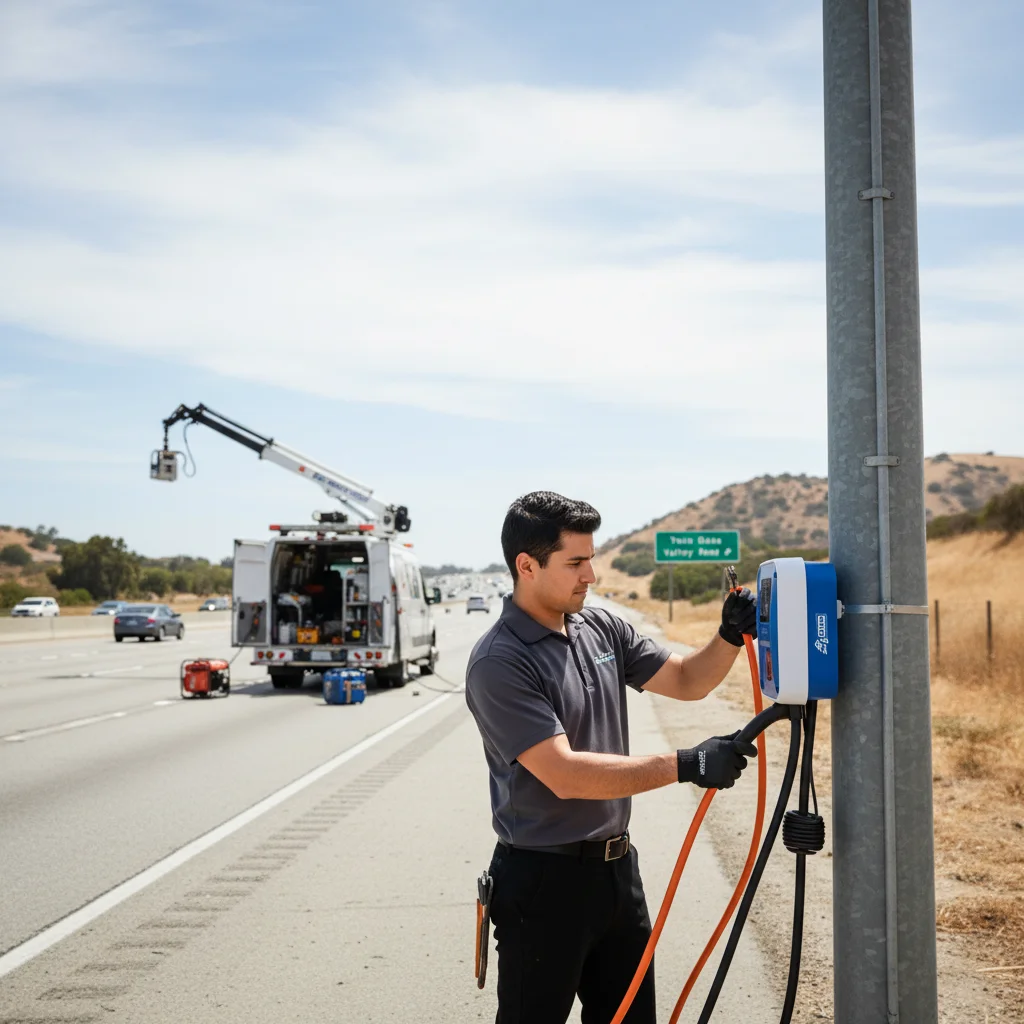
Superchargers at the mall don’t move a sitting car
Those stall counts come from the US Department of Energy AFDC station locator. AFDC lists the mall Tesla site as opening June 28, 2021. Madrona’s open date is October 11, 2022. Both list 250 kW as the max connector power. That’s the federal record, not a Tesla generation label. Electrify America is the non-Tesla DC option at 1065 Brea Mall Dr.
If the car can still creep into that garage, use the stall. If it died in a Brea Ranch carport, the mall is the wrong tool. The same is true in a structure you can’t exit. Circling the garage burns the last bar you had. The point is a car that won’t drive to the plug.
Those 44 Brea Tesla stalls sit inside a larger county inventory. AFDC’s Orange County filter counts 48 Tesla Supercharger sites and 861 Tesla DC fast ports. Tesla holds 59% of the county’s public DC fast ports. ChargePoint has 71 sites and 76 DC fast ports. Most of those are single-plug dealership and office units, not a rescue-grade network.
Orange County had 210,842 battery-electric cars on the road as of December 31, 2025. The source is the California Energy Commission’s vehicle population file. ZEVs are 10.56% of the county’s light-duty fleet. The county holds 12.02% of California’s BEVs. It’s only 8.33% of the state’s light-duty fleet. Public charging ports haven’t matched that vehicle density. CEC counts 7,095 public ports in Orange County against 260,833 ZEVs. That’s 36.8 ZEVs per public port, versus 24.4 statewide. Brea’s two Supercharger banks are on that map. They still leave a dead apartment car where it sits.
Tesla is 65.51% of Orange County’s battery-electric fleet on that same date. The other third still shows up in these lots. Hyundai, Ford, Chevy, Rivian: the operator brings CCS or J1772 adapters for those.
Carbon Canyon, the 57, and inland heat
SR-57 is the Orange Freeway through town, and SR-90 is Imperial Highway. SR-142 is Carbon Canyon Road, listed by Caltrans on the state highway network. Daily miles also sit on Brea Blvd and Lambert Road. State College Blvd, Birch Street, Kraemer Blvd, and Valencia Ave carry the rest.
Carbon Canyon is the grade that surprises people. It’s a two-lane mountain road with sharp curves and a real climb. It runs Brea into Chino Hills and San Bernardino County. North and east Brea already rise into the Puente and Chino Hills. The Olinda oil-field hills sit north of Lambert. The city’s internal point is 547 feet, and the canyon keeps going up from there. Santa Ana winds use that corridor in autumn.
Leave the mall with 40 miles on the estimate. Then take the canyon toward the 71. The top can arrive with a lot less than the dash promised. The reverse commute does the same work. Drivers coming into Brea from San Bernardino County show up already low. They aim at Madrona or the mall. If the pack died in the lot, they need mobile EV charging at the bumper.
Brea tracks Fullerton and Anaheim heat, not the coast. Fullerton Municipal Airport normals are 84.4 F in July. August is 86.7 F at station USW00003166. Cabin cooling on Imperial Highway burns range. A crawl in the mall structure burns more. A climb toward Olinda finishes the buffer.
Apartment lots, hillside streets, and a 12V that quits
Brea’s population is 47,337, in zips 92821 and 92823. Census ACS 2023 puts 56.5% of housing as built before 1980. Newer pockets exist, and La Floresta is one of them. The stranding pattern is still the apartment stall and the hillside driveway.
Olinda Village and Carbon Canyon mean steep approaches. A car that got home last night may not climb out in the morning. Olinda Ranch, Country Hills, Blackstone, and Brea Ranch sit on that same rise. Downtown Brea is flatter, near the Civic and Cultural Center and Curtis Theatre. Street parking there still means a long sit. Birch Hills Golf Course is a longer dwell. Carbon Canyon Regional Park is the same idea.
The mall structures are the other local pattern. A shopping-and-movie dwell of five or six hours finds a weak 12V. The car looks fully dead from the curb. Screens stay dark, and doors may not wake. Tesla’s Model Y owner’s manual covers running out of range. The low-voltage battery loses support once range is exhausted. It needs an external power supply before the high-voltage pack can charge. A 12V jump in the stall is often the first fix. Kaiser Permanente Brea medical offices produce the long-visit version of the same stall.
Nearby La Habra sits on Imperial Highway. Fullerton and Placentia share the 57 edge, and Yorba Linda is the next climb east. You still have to roll before you can use another city’s stalls.
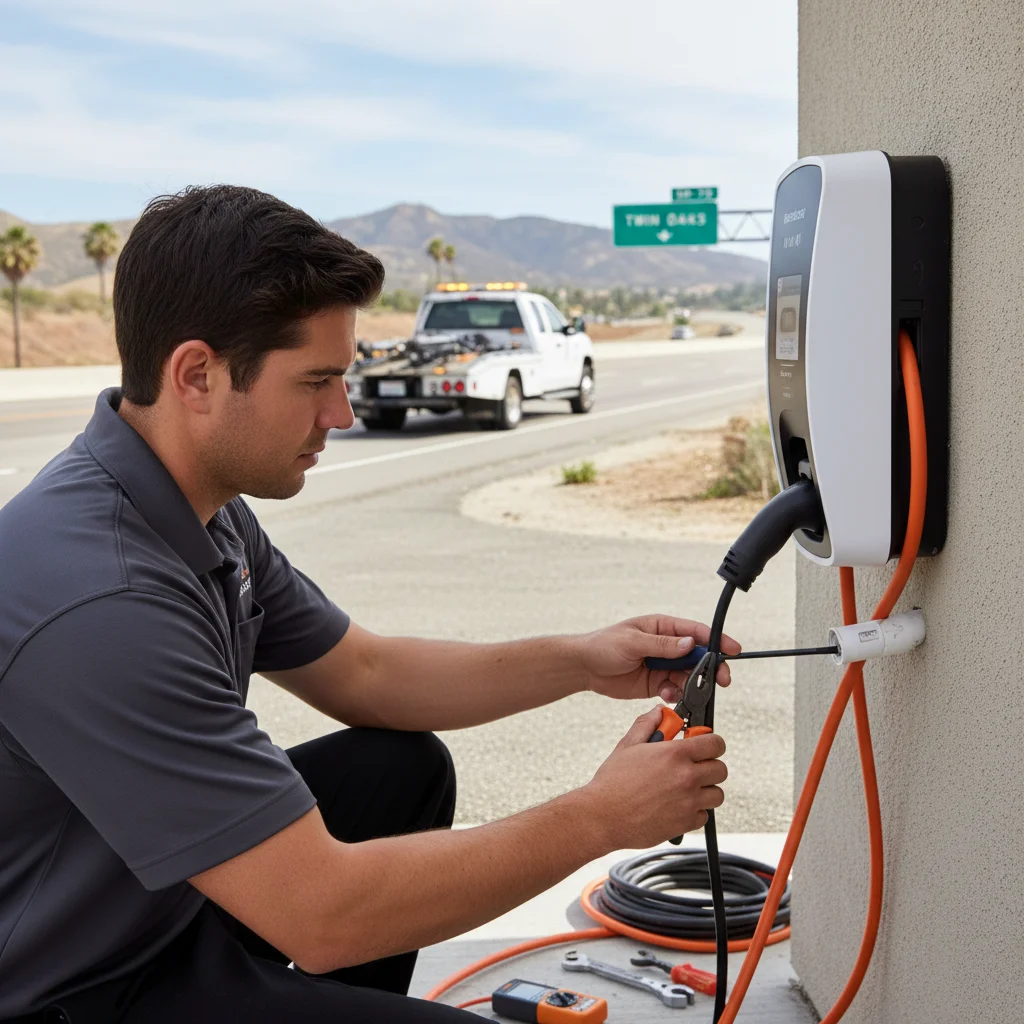
What the operator brings, and what this brand does not
Charge Pro OC is a referral line, not a shop. It matches stranded EV drivers with independent local operators. Charge Pro OC serves Brea and the rest of Orange County. It performs no work, owns no trucks, and employs no technicians. It sets no prices, promises no arrival time, and publishes no business hours. The operator quotes you before starting and bills you directly.
What the operator brings is a 240V Level 2 source to the car. Teslas use a native NACS plug, and other EVs use a CCS or J1772 adapter. Typical charging time adds 10 to 20 miles of range. That takes 15 to 30 minutes of charging. That’s charging time, never a promise of when someone arrives. They can also jump or replace a dead 12V on site. Tesla and every major EV brand are in scope.
If the pack is empty and the car still rolls, use a public stall. If it won’t move, EV roadside assistance keeps the car in place. The stall-versus-truck choice has its own writeup. Read rapid charger near you, or a truck at the car.
Tesla’s published roadside path for a depleted pack is transportation. It’s not described as on-site charging. Tesla’s roadside page treats a depleted charge as help that isn’t a financially covered service. That wording came from search-index snippets in 2026, not a live page pull. Confirm it on Tesla’s site before you rely on it. The 500-mile transport Tesla describes is for a warrantable breakdown. That breakdown has to leave the car undrivable. Running out of charge sits outside that. Tesla Roadside Assistance is 877-798-3752.
Charge where you sit, then decide on a tow
Towing an EV isn’t like towing a gas car. Many EVs need a flatbed so the drivetrain isn’t damaged. You still have to land somewhere with a working plug. If the only failure is an empty pack, skip the yard. A dead 12V is the same idea. A wreck, a ruined tire, or a damaged charge port needs a tow instead. Charge, jump, or tow is the decision tree, and empty is usually charge.
Call when the car is sitting and it won’t reach a stall. Call when a 12V died after a movie at Brea Mall. Call when you made it home to Olinda Village and can’t climb out. Stay with the car on SR-57, Imperial Highway, or Carbon Canyon.
Tell the operator the street, the lot, and whether the car still wakes. Mention make and connector if you know them. They quote before they start. Charge Pro OC connects you with that operator. Call (949) 444-0151.