A confirmed ev rapid charger near me helps only if you can still reach it. If remaining range won’t cover the real drive, stay put. Bring a 240-volt charge to the car instead. Tesla holds 59 percent of Orange County’s public DC fast ports. A close pin can still be the wrong plug.
Tesla owns most of the county’s DC fast ports
Federal station data counted 1,452 public DC fast ports at 223 Orange County stations. Tesla Superchargers account for 48 sites and 861 ports. That’s 59 percent of the county’s public DC fast inventory. The other 175 stations hold 591 ports across Electrify America, EVgo, EVCS, ChargePoint, and smaller networks.
That split turns a near-me search into a plug check. Tesla also holds 65.51 percent of Orange County’s battery-electric fleet. That’s 138,121 of 210,842 BEVs as of December 31, 2025. Most local battery-electric cars can use Superchargers. The rest of the BEV fleet needs a confirmed CCS or adapter path.
ChargePoint has the most DC sites, with 71 locations. It also has the fewest ports per site. Seventy-six ChargePoint DC ports sit across those 71 sites, about 1.1 each. Many are single plugs at a dealer or an office lot.
Tesla’s larger banks are in the same federal file. Irvine lists 40 stalls at 1920 Main Street. San Clemente lists 49 at 101 West Avenida Vista Hermosa. Tustin lists 36 at 14661 Franklin Avenue. Garden Grove lists 32 at 12891 Harbor Boulevard.
If you aren’t in a Tesla, name the non-Tesla banks. Electrify America lists eight DC fast ports at Fashion Island, 401 Newport Center Drive in Newport Beach. A 10-port Electrify America sits at the Anaheim Walmart, 440 North Euclid Street. South county has 12 Electrify America ports at 25825 Las Vegas in Capistrano Beach. EVgo lists 14 DC fast ports at Plaza Antonio, 22351 Antonio Parkway in Rancho Santa Margarita. Lake Forest’s Tesla site at 24372 Rockfield Boulevard is logged as Magic Dock, with CCS1 and NACS.
The US Department of Energy publishes a DC fast connector guide. It names CCS, CHAdeMO, and J3400. Your car may not accept every connector. An adapter doesn’t make every stall work for your model. Follow the maker’s adapter rules. For network mix, read Shell Recharge or a Tesla stall in Orange County.
A map pin isn’t a drive you can finish
Orange County had 7,095 public charging ports as of December 31, 2025. That includes 5,600 public Level 2 ports and 1,475 public DC fast ports. Countywide that’s 36.8 ZEVs per public port. Statewide the same ratio is 24.4. More local EVs share each public stall than the state average. A green icon can still mean a wait when you arrive.
Coast lots, inland office parks, and theme-park edges don’t share one entrance maze. A Warner Avenue stall in Huntington Beach can look near. So can a Main Street stall in Irvine. They’re not the same last mile at a few percent.
On I-5, I-405, SR-22, or the 91, read the actual exit. Then read the return onto your heading. Include garage ramps, one-way loops, and the property gate. Don’t spend remaining range on a stall you can’t enter.
See our Fashion Island charging note. If you’re still rolling, open the operator’s own app, then save a second compatible backup. Use the charging apps to check before you’re stranded.
Confirm the stall before you spend the last miles
Start with the network that owns the hardware. Cross-check the address in the car’s nav. An aggregator can surface options. It can’t promise the cable works tonight.
Work through this list before you commit:
- The connector matches the car, including any maker-approved adapter
- The operator still lists the stall as available
- You can enter the lot, garage, or driveway on arrival
- The stall isn’t limited to customers, residents, or staff
- Predicted energy covers the full approach, not a straight line
- You’ve read the current session price in the operator’s app
We don’t publish charger rates. Confirm the figure in that app before you start. Live status is a hint, not a hold. Another driver can take the last cable on the off-ramp. A stall can show green while the screen or latch fails. If you arrive and nothing happens, note the on-screen message. Try another compatible stall only if you can do it safely. Our public charger not working checklist separates a station fault from a car fault.
Mission Viejo’s Tesla site at 555 The Shops is a reminder to trust the operator. AFDC and Tesla have disagreed on that site’s power. Tesla’s published figure is 72 kW, and stall count matches at 10. Check Tesla’s own listing before you plan a high-power session there.
Stay put when remaining range won’t cover a verified stall
Treat the dashboard number as an estimate. Add the freeway exit, local turns, and the station entrance. If that path eats your buffer, stop hunting pins.
Check whether the car is still acting like a car. A reduced-power warning can mean a public stall won’t help. So can a locked charge port or a fault code. Read the exact dash message, then check the manual.
A dark cabin can be a dead 12-volt, not an empty pack. A car that won’t shift can be the same 12-volt failure. Independent operators we connect you with can jump or replace a 12V on site. Don’t guess which failure you have from the sidewalk.
When no verified compatible stall sits inside remaining range, stop driving toward a hopeful pin. Roll to a safe, legal spot if the car can still move. If it can’t, don’t push it.
What a truck at the car actually does
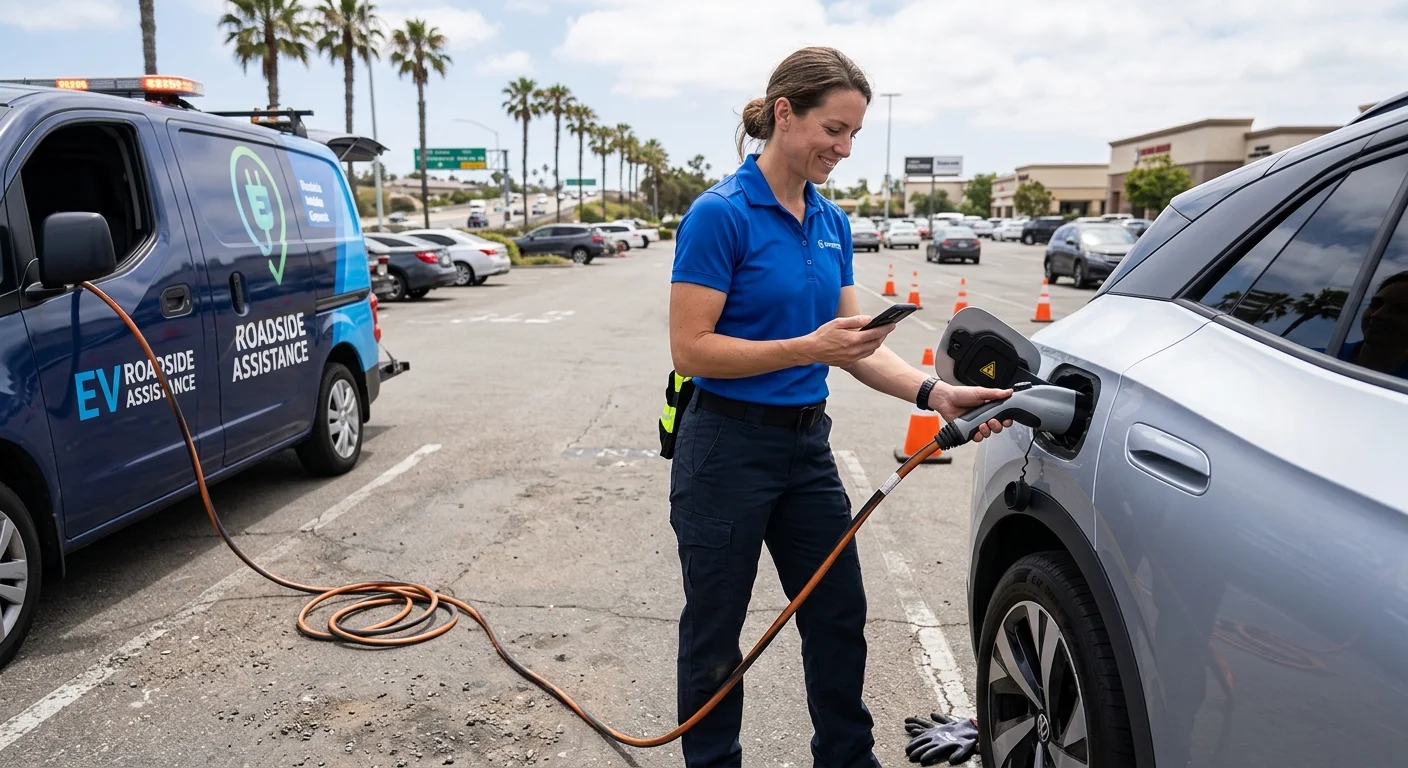
A mobile charge is usually a range top-up. It isn’t a stand-in for a long Supercharger session. Independent operators we refer bring a 240-volt Level 2 source to the vehicle. Tesla cars typically take a native NACS plug. Other EVs typically need a CCS or J1772 adapter. The usual result is 10 to 20 miles of added range. That takes 15 to 30 minutes of charging at the car. That’s time on the cable, not a promise of when anyone arrives.
Charge Pro OC is a referral line. We don’t own trucks or employ technicians. We don’t set prices or publish arrival times. The operator quotes you before work starts and bills you directly. Confirm connector support, access, and the quoted work before you agree.
Before you request mobile EV charging, have this ready:
- Year, make, and model
- The exact dash message
- Displayed percent, if the screen still shows one
- The plug type you can see on the car
- A precise pin, plus any gate, garage, or height limit
- Whether the car can unlock, shift, and steer
On a freeway, add the route, direction, and nearest exit when it’s safe. “Near the parks” or “somewhere in Irvine” wastes the first call. For what actually rolls up, see how a mobile EV rescue truck works here.
Mobile charging may not fit if the car won’t accept power. It also may not fit if the port is damaged or the car sits in an unsafe place. Describe the symptoms without guessing the cause. The operator confirms whether the job matches.
When transport fits instead
A tow or flatbed fits when charging won’t fix the immediate problem. That includes a car that can’t accept power, a port that won’t open, or a serious dash fault. It’s the safer path when the car is in a live lane and can’t roll.
Tesla’s published roadside policy answers a depleted pack with transport, not an on-site charge. Running out of charge isn’t a financially covered Tesla roadside service. Free transport of up to 500 miles is for a warrantable breakdown that leaves the car undrivable. Confirm the current wording on Tesla’s own site before you rely on it. Tesla Roadside Assistance publishes 877-798-3752.
If a tow is the plan, follow the maker’s loading rules. Tell the operator whether the car can enter transport mode, go to neutral, and unlock the port.
For an empty pack on the street, out-of-charge recovery is the referral path. Charge Pro OC doesn’t tow or set operator prices. Confirm the proposed service, current price, equipment, and destination before you agree.
If you can’t reach a confirmed rapid charger
Call when remaining range won’t get you to a verified, compatible stall. We’ll connect you with an independent local operator.
Call (949) 444-0151. We’ll connect you with a local EV rescue operator.